# Understanding the Tree of Life Narrative Therapy Worksheet
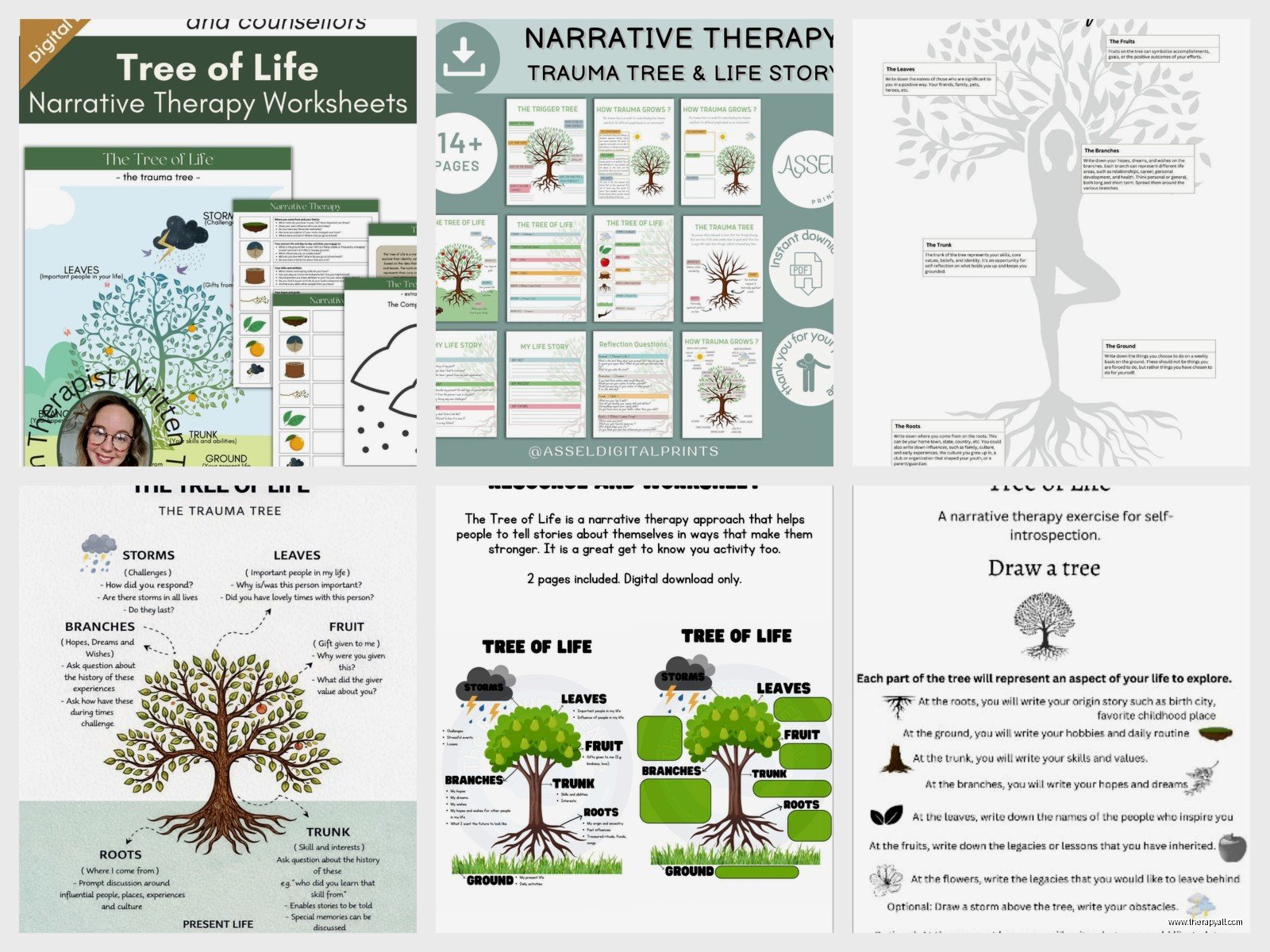
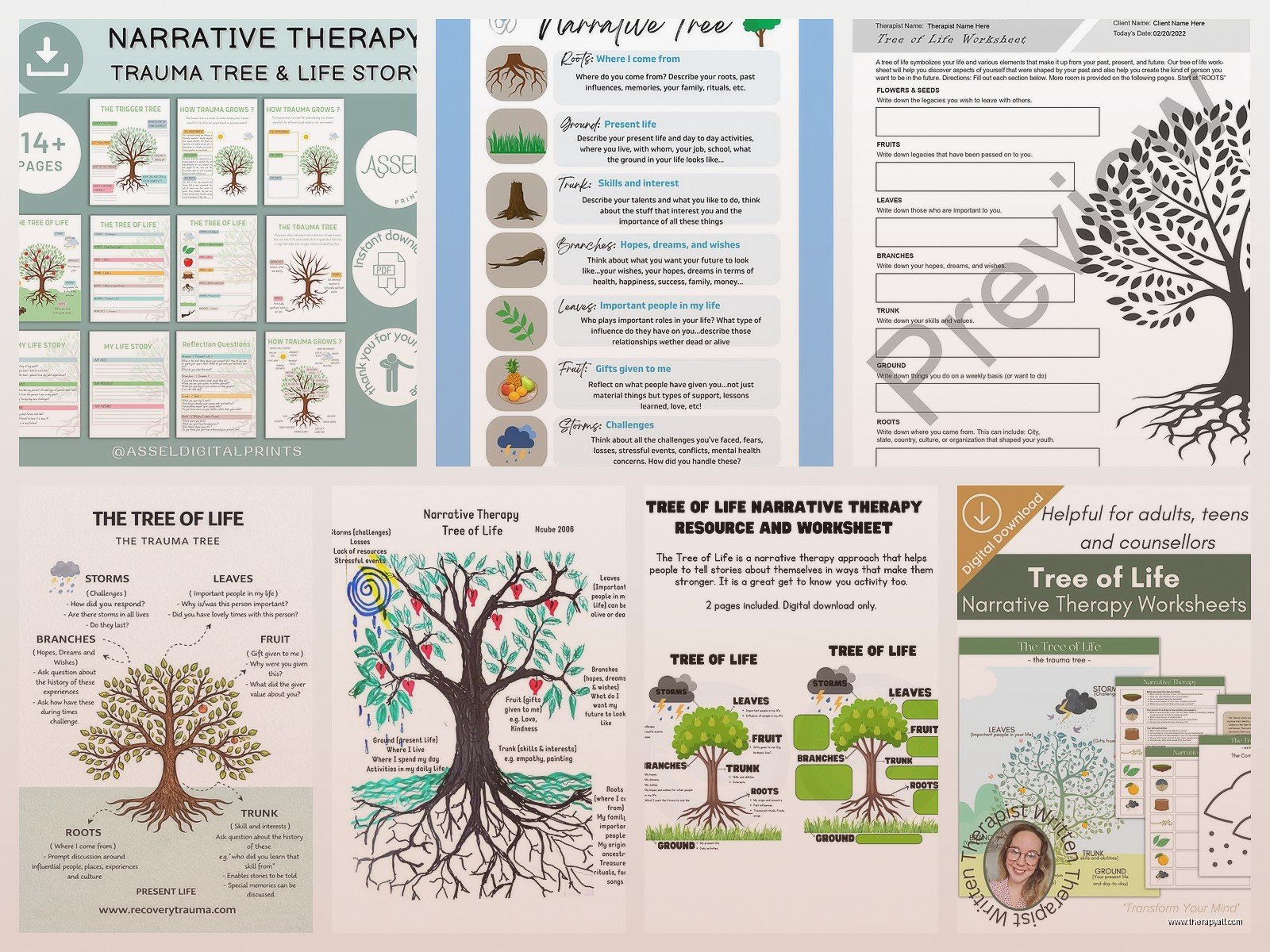
The Tree of Life is a visual narrative therapy technique developed by Ncazelo Ncube and David Denborough, originally designed to work with vulnerable children and communities affected by trauma, particularly in African contexts. The metaphor maps a person’s life story onto different parts of a tree—roots represent origins and values, the ground symbolizes daily life, the trunk shows skills and abilities, branches hold hopes and dreams, leaves are significant people, fruits represent gifts given to you, and seeds are what you pass forward to others.
You draw a tree. Then you fill in the sections. That’s the basic structure, but the psychological work happens in how people organize their experiences into these categories and what patterns emerge.
I remember around 2019 working with a teenager who refused to do traditional talk therapy but would draw for hours, and when I introduced a tree-based worksheet she spent nearly forty minutes on it without me saying a word. The externalization aspect—putting your life outside yourself as an object you can examine—shifts the therapeutic dynamic entirely. You’re not “broken” or “damaged,” you’re someone with a complex story that has different elements, some nourishing, some in need of attention.
## Core Components of a Tree of Life Worksheet
**Roots** ask you to identify where you come from. This includes literal geographic origins, cultural background, family traditions, ancestral knowledge, or formative experiences from childhood. The roots aren’t just facts—they’re the value systems and beliefs that ground you. Someone might write “Sunday dinners with extended family” or “my grandmother’s stories about migrating north” or “growing up bilingual.” The depth here matters because it connects present identity to historical context.
**Ground** represents your current daily life. What does your week actually look like? This section often reveals discrepancies between stated values and lived reality. You might discover your roots emphasize community and connection but your ground is 60-hour work weeks alone. Or vice versa—maybe you think you’re isolated but your ground shows regular meaningful contact. This is where people write things like “morning coffee routine,” “Tuesday game nights,” “walking the dog,” “checking on my neighbor.”
**Trunk** catalogs skills, knowledge, and competencies. Not just professional skills—emotional regulation strategies, languages spoken, ability to make people laugh, knowing how to fix a leaky faucet, understanding when someone needs space. I’ve seen people struggle here more than any other section because we’re trained to minimize our capabilities or only count “impressive” ones. The trunk should be thick with specific abilities.
**Branches** extend toward hopes, wishes, and dreams. Future-oriented but not in a goal-setting productivity way—more about what you’re reaching toward. “I hope to feel less anxious in crowds,” “I want to reconnect with my sister,” “I dream about living near water,” “I wish I could be more patient with myself.” The branches don’t have to be realistic or achievable; they show direction.
**Leaves** represent important people. Some versions ask you to write names on individual leaves, others want you to cluster relationship categories. You can include people who’ve passed away, estranged family, mentors you met once, online friends, pets. My cat absolutely would be a leaf on mine, not even gonna pretend otherwise. The leaves show your relational ecosystem.
**Fruits** are gifts you’ve received from others—tangible or intangible. Advice that stuck with you, an opportunity someone created, a book recommendation that changed your perspective, financial support during hard times, someone believing in you when you didn’t believe in yourself. This section counters the individualistic narrative that you built everything alone.
**Seeds or Flowers** represent what you offer others or want to pass forward. Your legacy in the smallest sense—what you contribute to your immediate world. Teaching someone a skill, offering a listening ear, creating art, raising children with certain values, volunteering, or just being the person who remembers birthdays.
## Why Narrative Therapy Uses This Metaphor
Narrative therapy operates on the principle that people aren’t their problems—problems are separate entities that interact with people. The Tree of Life externalizes your entire life story, making it an object you can examine, edit, and reauthor. You’re not a depressed person; you’re a person with roots, ground, a trunk full of skills, branches reaching toward hopes, and also there’s this thing called depression that affects some parts of the tree.
The metaphor also builds in resilience automatically. Trees weather storms, lose leaves seasonally, grow new branches, develop deeper roots over time. When you map trauma or difficulty onto a tree, it becomes one element in a larger living system rather than the defining characteristic of your existence.
What genuinely annoys me is when people slap a tree outline on a worksheet, label the parts, and call it narrative therapy without understanding the theoretical foundation. Narrative therapy isn’t just creative journaling—it has specific techniques around externalizing problems, identifying unique outcomes, and re-membering conversations. A Tree of Life worksheet without the narrative framework is just… a diagram.
## How to Actually Use the Worksheet
You can work through this alone or with a therapist, but the process differs. Solo work tends to be more meditative and self-reflective. You sit with the blank tree, maybe over several sessions, filling in sections as things occur to you. There’s no rush. Some people do the roots first because chronology makes sense; others start with leaves because relationships feel most accessible.
Therapeutic facilitation adds questions and externalization. A therapist might ask: “When that storm of anxiety comes through, which parts of your tree does it affect most? Which parts stay strong?” or “Looking at your fruits section, what does it mean about you that you were able to receive those gifts?” or “I notice your branches are all about other people’s wellbeing—what would a branch just for you look like?”
The worksheet becomes a reference document. You return to it during difficult periods to remember your roots when you feel unmoored, to notice your trunk when you feel incompetent, to look at your leaves when you feel alone. It’s also a living document—you can add to it, cross things out, redraw sections as your life changes.
## Finding and Using Free Printable Versions
Multiple organizations offer free PDF versions of Tree of Life worksheets. The Dulwich Centre, which developed the approach, provides resources though some require registration. Various therapist websites and mental health platforms host downloadable versions with different artistic styles—some highly detailed botanical illustrations, others simple outlines, some with extensive prompting questions built in, others just the basic structure.
When selecting a worksheet, consider how much guidance you want. Heavily prompted versions (“In the roots section, write about: your birthplace, your family’s cultural traditions, childhood homes…”) work well if you feel stuck or overwhelmed. Minimal versions (just a tree outline with labeled sections) offer more creative freedom but require you to generate your own content without scaffolding.
Print quality matters more than you’d think. A tree you can barely see because it printed too light, or one where the sections aren’t clearly defined, creates frustration. Test print one copy before committing if you’re planning to use it with multiple people or in a group setting.
Some worksheets include a “storms” section—external challenges like illness, loss, discrimination, trauma—that affect the tree but aren’t part of its essential structure. This is actually a really important addition because it acknowledges difficulty while maintaining that difficulties happen TO you, they’re not you.
## Adaptations for Different Populations
The original Tree of Life was designed for children in Zimbabwe affected by HIV/AIDS and political violence, which means the metaphor carries specific cultural resonance in contexts where trees symbolize community, ancestry, and continuity. When using it in other contexts, some adaptation might be necessary—or might not, because tree symbolism is pretty universal, or… actually I’ve seen it work across wildly different cultural contexts without modification.
For young children, the worksheet needs to be more concrete. Instead of abstract “values,” roots might be “people in my family” or “places I’ve lived.” The drawing itself becomes more important than written content. Some kids will spend the entire session coloring leaves different colors to represent different feelings about different people.
For adolescents, the future-oriented branches often become the most engaging section. Teens are already constantly thinking about who they’re becoming, so having a structure to articulate that feels validating. The fruits and seeds sections can surface surprising awareness about interdependence during a developmental phase focused on independence.
Adult versions can go deeper into complexity and contradiction. Your roots might include cultural traditions you’ve rejected. Your ground might show patterns you want to change. Your branches might conflict with each other. That nuance is developmentally appropriate and therapeutically rich.
Couples or families can create collective trees—shared roots, individual branches, overlapping leaves. This makes relationship dynamics visible in new ways. Group therapy settings sometimes create a forest, with each person’s tree contributing to a larger ecosystem.
## Common Pitfalls and Misconceptions
People often treat this like a one-time activity when it’s actually designed to be revisited and revised. Your tree at 25 will differ from your tree at 40 or 60. Returning to it periodically shows growth, changing priorities, and evolving identity.
Another issue is perfectionism. There’s no correct way to fill out a Tree of Life worksheet. Your roots don’t need to be profound, your trunk doesn’t need to list impressive skills, your branches don’t need to be ambitious. I’ve worked with people who wrote “I can make really good grilled cheese” in their trunk section and that’s valid—it’s a skill that brings comfort and nourishment.
Some people skip sections they find difficult rather than sitting with the discomfort of “I don’t know what to write here” or “this section feels empty.” Those gaps are valuable information. A sparse leaves section might indicate isolation worth addressing. Branches that feel vague might suggest difficulty connecting with future possibilities. Don’t just skip past the hard parts.
The worksheet also isn’t a fix. It’s an assessment tool and a narrative organizing structure. Completing it doesn’t resolve trauma, cure depression, or solve relationship problems. It creates a framework for understanding your story and identifying areas for therapeutic work.
## Integration with Other Therapeutic Approaches
Tree of Life fits naturally with other narrative techniques like externalizing conversations, re-authoring, and definitional ceremony. But it also combines well with non-narrative approaches. CBT therapists might use it to identify core beliefs in the roots section or cognitive distortions affecting how someone views their trunk. DBT practitioners might map emotional regulation skills onto the trunk and interpersonal effectiveness goals onto the branches.
Trauma-focused therapists sometimes use it as a resource-mapping tool before processing traumatic material. Looking at your tree reminds you that trauma is one part of a larger story—you also have roots, skills, connections, and hopes. The tree provides grounding when trauma work feels destabilizing.
Grief therapists use it to maintain connection with people who’ve died. A deceased person might appear in your leaves, your roots (if they shaped your values), your fruits (gifts they gave you), and your seeds (what you carry forward from them). This spreads their influence across the tree rather than locating them only in loss.
## Practical Tips for Therapists
If you’re incorporating this into practice, introduce the metaphor before handing over the worksheet. Explain the theoretical basis briefly—this isn’t just arts and crafts, it’s a structured narrative intervention. Set appropriate time expectations; some clients will finish in 20 minutes, others will want to take it home and work on it over weeks.
Consider whether you want clients to draw their own trees or use a template. Free-drawing allows more personalization but can trigger anxiety in people who feel they can’t draw. Templates provide structure but might feel constraining. Having both options available works well.
Process the completed worksheet together. Don’t just have someone fill it out and move on. Ask about choices they made, patterns they notice, sections that surprised them, and areas they want to develop further. The conversation about the tree is often more therapeutic than creating it.
Keep copies in the file and suggest clients photograph their trees. Returning to it in future sessions—”Let’s look at your tree from six months ago and see what’s changed”—provides concrete evidence of progress and shifting narratives that can be really powerful when someone feels stuck.