# Rational Emotive Therapy PDF – Everything You Need to Know
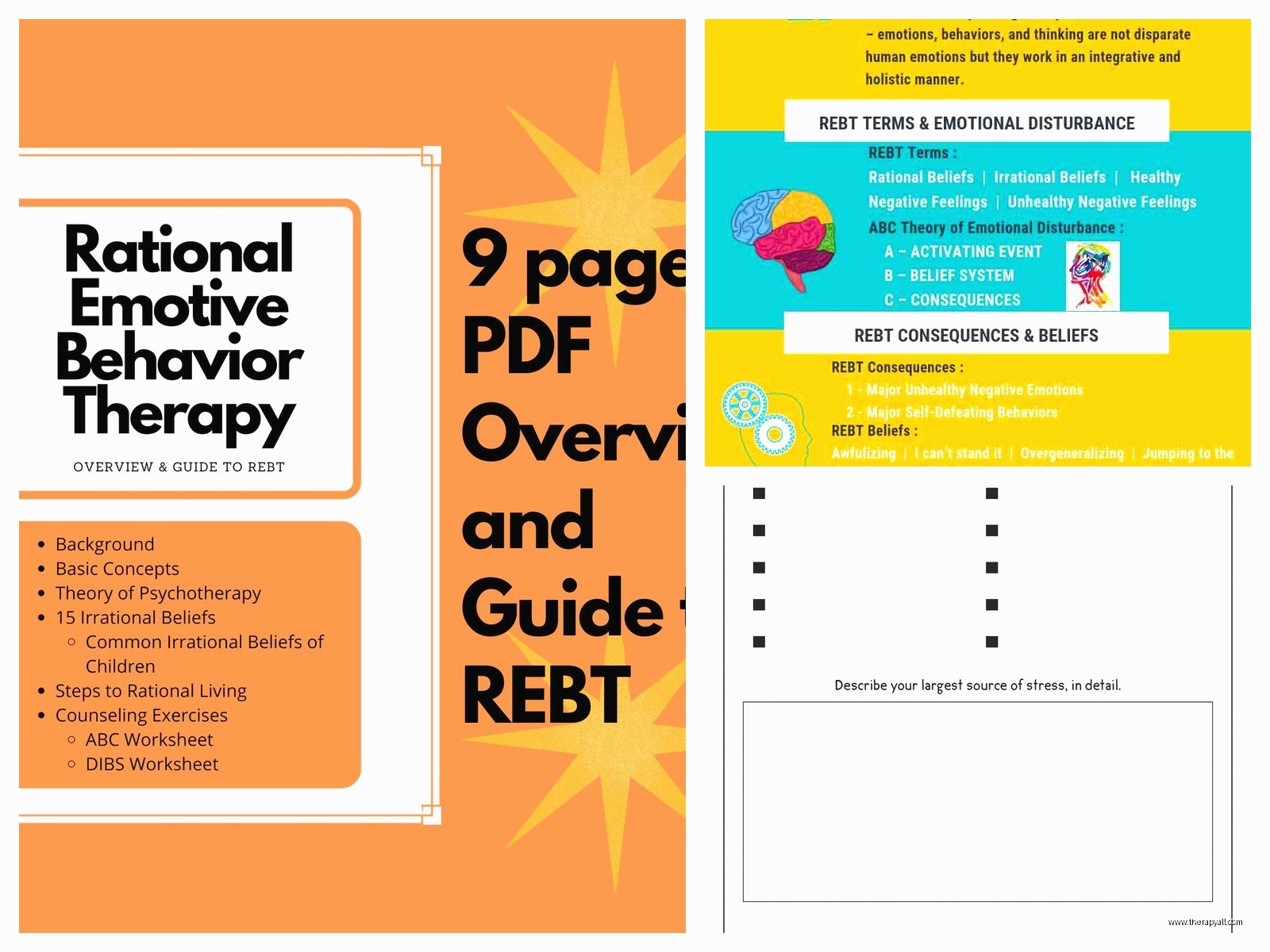
Rational Emotive Behavior Therapy, or REBT, is Albert Ellis’s answer to what he saw as overly passive forms of therapy back in the 1950s. The PDFs floating around about this modality usually cover the ABC model, which is honestly one of the more straightforward frameworks in cognitive therapy. A is the Activating Event, B is your Belief about that event, and C is the emotional or behavioral Consequence. The whole point is that A doesn’t directly cause C—your belief system at B is what’s actually running the show.
I remember around 2019 I was writing a roundup of different therapy worksheets and stumbled on maybe fifteen different REBT PDFs, and half of them were just… badly formatted scans from the 80s with that weird photocopy smell you can almost detect through the screen. It made me realize how much good material is locked behind terrible presentation.
You’re gonna find REBT PDFs in a few categories: clinical manuals, self-help workbooks, therapist training guides, and client handouts. The clinical manuals are dense—think 200+ pages of theory, case studies, research citations. Self-help workbooks are more accessible but sometimes oversimplify the disputation process. Client handouts are usually 2-10 pages and focus on one concept, like identifying irrational beliefs or practicing rational coping statements.
The ABC Model Breakdown in Most PDFs
Every REBT PDF worth downloading will walk you through the ABC model, but the quality of explanation varies wildly. The Activating Event is whatever happened in external reality—you got rejected for a job, your partner criticized you, you failed an exam. It’s objective, factual, the thing that happened.
Then you’ve got the Belief system, which is where people get tripped up. Ellis divided beliefs into rational and irrational. Rational beliefs are flexible, logical, and help you cope. Irrational beliefs are rigid, illogical, and create emotional disturbance. The big categories of irrational beliefs are demandingness (musts, shoulds, have-tos), awfulizing (this is the worst thing ever), low frustration tolerance (I can’t stand this), and global evaluations of worth (I’m completely worthless because of this one thing).
The Consequence is your emotional and behavioral response. If your belief at B is irrational, your consequence at C will be unhealthy—like severe depression instead of sadness, rage instead of annoyance, or complete avoidance instead of cautious approach.
Most PDFs will then introduce D and E. D is Disputation, where you actively challenge the irrational belief. E is the new Effect or philosophy you develop after successful disputation.
Common Irrational Beliefs You’ll See Listed
Ellis identified a bunch of core irrational beliefs that show up repeatedly. PDFs usually list them out, sometimes with checkboxes so you can identify which ones you hold. There’s “I must be thoroughly competent and achieving in everything I do or I’m worthless.” There’s “Other people must treat me kindly and fairly, and if they don’t, they’re terrible people who deserve punishment.” And “Life conditions must be comfortable and easy, and if they’re not, it’s catastrophic.”
The thing that genuinely annoys me about how these beliefs are presented in a lot of PDFs is that they’re framed as obviously ridiculous, like no reasonable person would think this way. But when you’re actually in the grip of one of these beliefs, it doesn’t feel irrational at all—it feels like objective truth. A good REBT PDF will acknowledge that and help you spot the belief even when it’s dressed up in reasonable-sounding language.
You might not consciously think “I must be perfect,” but you might think “Well, if I don’t get this promotion, it means I’ve failed at my career and wasted years of my life,” which is the same belief with extra steps.
Disputation Techniques Explained in PDFs
The disputation section is where REBT PDFs either shine or completely fall flat. Ellis was big on three types of disputation: logical, empirical, and functional.
Logical disputation asks: Does this belief make sense? Just because I want something doesn’t mean I must have it. The logic doesn’t follow. Empirical disputation asks: Where’s the evidence? Show me the data that proves you’re worthless because you made one mistake. Functional disputation asks: Is this belief helping you? Even if it were true that you should never fail, does believing that actually help you function better?
I’ve seen PDFs that just list these three types without examples, which is kinda useless. The better ones walk through actual scenarios. Like, if your irrational belief is “My partner must never criticize me,” the PDF might show: Logically, why must they never criticize you? Because you want them not to? That’s not how logic works. Empirically, is there evidence that people in healthy relationships never offer criticism? Nope. Functionally, does believing your partner must never criticize you help your relationship? No, it probably makes you defensive and damages communication.
Self-Help REBT PDFs vs Clinical Resources
Self-help REBT PDFs are designed for people to work through on their own. They usually include worksheets, thought records, and exercises. You’ll see ABC logs where you write out situations and track your beliefs and consequences. You’ll find rational coping statement generators. Some include homework assignments like “Identify three musts you held this week and dispute them.”
Clinical PDFs are written for therapists and include case conceptualization frameworks, treatment planning guides, and intervention protocols. These get into the weeds of how to use REBT with specific disorders—depression, anxiety, anger issues, addiction. They’ll discuss how many sessions to spend on psychoeducation, when to introduce disputation, how to handle client resistance.
The Albert Ellis Institute publishes a lot of the official REBT materials, and their PDFs tend to be the most theoretically sound. But they’re also sometimes written in this very 1960s assertive style that can feel — I don’t know, my cat just knocked over my coffee mug and I lost my train of thought — aggressive? Ellis himself was known for being confrontational with clients, directly challenging their beliefs in a way that would probably get flagged in modern supervision.
The REBT Worksheet Landscape
Summer 2021 I was writing like four therapy resource roundups a week for a mental health platform and I started actually using some of the REBT worksheets myself, which was kinda meta. The most common worksheet is the ABCDE log or thought record. You’ve got columns for each component and you fill it out whenever you notice a strong emotional reaction.
There are also worksheets specifically for identifying cognitive distortions, though technically Ellis didn’t use that exact term—he talked about irrational beliefs instead. But there’s overlap with Aaron Beck’s cognitive distortions, so a lot of modern REBT PDFs blend the two frameworks.
You’ll find rational belief inventories where you rate how strongly you agree with various irrational beliefs. These are useful for assessment at the beginning of therapy. Some PDFs include behavioral experiment worksheets, where you test out whether your irrational belief is actually true by trying a new behavior and seeing what happens.
Common Mistakes in REBT PDF Content
One thing you’ll see in lower-quality PDFs is conflating REBT with generic cognitive-behavioral therapy. They’re related—REBT is actually considered the first form of CBT—but they’re not identical. REBT is more philosophical and focuses specifically on demanding beliefs and disputation. Standard CBT includes behavioral experiments, exposure, activity scheduling, and a broader range of cognitive techniques.
Another mistake is presenting REBT as positive thinking. It’s not. Ellis was actually critical of positive thinking approaches because they often just replace one irrational belief with another. Instead of “I must succeed” you get “I will succeed if I just think positively,” which is still rigid and disconnected from reality. REBT aims for rational thinking, not positive thinking. It’s okay to acknowledge that bad things happen and feel appropriately sad or frustrated—you just don’t catastrophize or awfulize about it.
Some PDFs also oversimplify the emotional component. They’ll say the goal is to replace unhealthy negative emotions with healthy negative emotions, but they don’t clearly explain the difference. Healthy negative emotions—like sadness, concern, annoyance, regret—are proportionate responses to negative events that motivate constructive action. Unhealthy negative emotions—like depression, anxiety, rage, guilt—are disproportionate and often lead to avoidance or destructive behavior.
Where to Find Quality REBT PDFs
The Albert Ellis Institute website has a resources section with some free downloadable PDFs. These are gonna be the most accurate to Ellis’s original formulation. The Association for Behavioral and Cognitive Therapies also has fact sheets and self-help resources that include REBT materials.
Academic databases like PsycINFO or Google Scholar will turn up research PDFs about REBT’s effectiveness for various conditions. These are useful if you want the evidence base, but they’re not practical guides for actually doing the therapy.
TherapistAid and Therapist Worksheets websites have free REBT handouts and worksheets, though you gotta check carefully because some of them are mislabeled as REBT when they’re actually just generic CBT. I’ve seen “REBT worksheets” that don’t mention beliefs at all, which is like… the entire point of REBT.
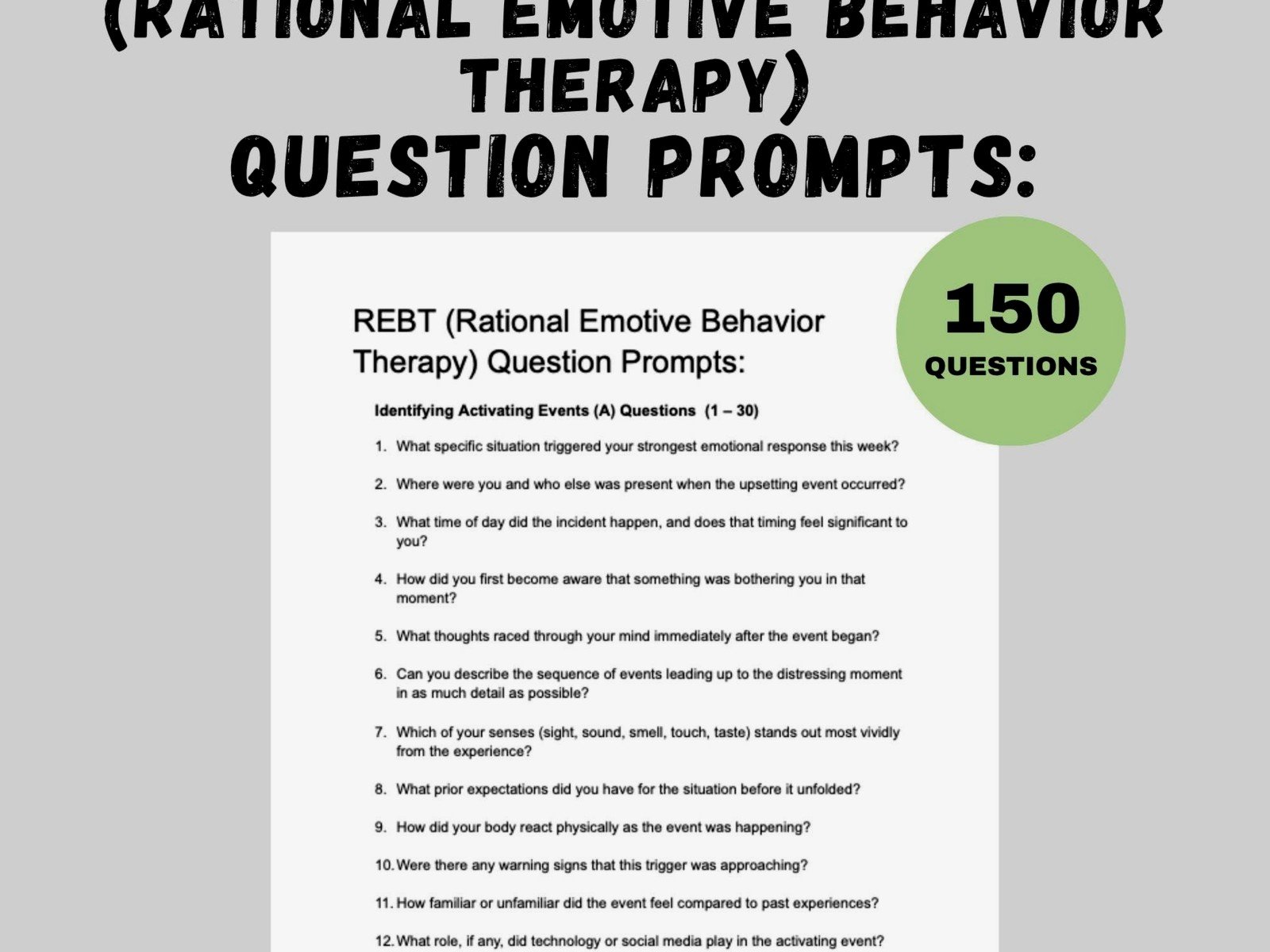
Some therapists and coaches sell REBT workbook PDFs on platforms like Etsy or Gumroad. Quality varies enormously. I’ve bought a few out of curiosity and some are excellent—well-designed, clear examples, good exercises—while others are just reformatted public domain content from Ellis’s old books.
How Therapists Actually Use REBT PDFs in Practice
In my experience talking with therapists who use REBT, the PDFs serve a few functions. First, psychoeducation handouts to give clients after the first session or two explaining the ABC model. This gives clients something concrete to reference between sessions.
Second, homework worksheets. Clients fill out ABC logs during the week and bring them to the next session. The therapist reviews them, helps identify irrational beliefs the client might have missed, and models disputation. Over time, clients get better at catching and challenging their own irrational beliefs in real-time.
Third, training and supervision materials for the therapist themselves. Even experienced REBT practitioners use PDFs as refreshers on specific techniques or to review how to handle particular presentations.
Some therapists create their own custom REBT PDFs tailored to their client population. A therapist working with adolescents might create simplified worksheets with examples relevant to teen concerns. Someone working with couples might develop relationship-focused REBT materials.
Digital vs Print REBT PDFs
Most REBT PDFs are designed to be printed out and written on by hand, which some clients prefer because it feels more personal and there’s something about the physical act of writing that helps process the content. But you can also fill them out digitally if you’ve got a tablet with a stylus or just type into form fields.
I’ve noticed some newer REBT resources are moving toward interactive PDFs with fillable fields, which is more convenient but sometimes the formatting breaks depending on what PDF reader you’re using. There are also apps now that incorporate REBT principles, but that’s outside the scope of PDF resources specifically.
REBT PDFs for Specific Issues
You’ll find specialized REBT PDFs targeting particular problems. There are PDFs focused on using REBT for social anxiety, where the irrational beliefs often center around needing approval and fearing negative evaluation. PDFs for anger management emphasize challenging demanding beliefs about how others should behave.
For depression, REBT PDFs focus on global self-rating (“I’m worthless”) and awfulizing about life circumstances. For perfectionism, they target demanding beliefs about performance and achievement. Some PDFs address low frustration tolerance specifically, which shows up in procrastination and addiction.
The effectiveness varies—some of these specialized PDFs are evidence-based adaptations of REBT protocols tested in research, while others are just someone’s opinion about how REBT might apply to a particular issue.
One format I’ve seen that actually works well is the case study PDF, where a fictional client’s journey through REBT is documented session by session. You see the initial assessment, the ABC logs they completed, the disputation dialogue with the therapist, and the progress over time. These are more engaging than straight didactic content and give you a sense of how REBT unfolds in practice.