# Everything You Need to Know About Therapy Sheets
Therapy sheets are structured worksheets designed to help clients work through psychological concepts, track behaviors, identify patterns, or practice skills between sessions. They’re tools that therapists hand out or email to extend the work beyond the 50-minute hour. Some are fill-in-the-blank forms, others are rating scales, and some ask you to draw or diagram your thoughts.
I remember back in 2019, I was sitting in a supervision group and one of the newer therapists was complaining that her clients never completed homework. She’d print out these beautifully formatted CBT thought records from some premium template site, and they’d come back blank every single week. What annoyed me then—and honestly still does now—is that so many therapists treat these sheets like magic documents. They hand them over assuming the client will automatically understand why they matter or how to use them. A worksheet is just paper unless you actually explain the purpose and walk through at least one example together in the room.
## What Makes a Therapy Sheet Different from a Regular Worksheet
You could argue that any worksheet involving feelings or thoughts is a therapy sheet, but that’s kinda reductive. The distinction is intent and structure. Therapy sheets are grounded in specific therapeutic modalities or evidence-based frameworks. A CBT thought record follows a particular sequence: situation, automatic thought, emotion, evidence for and against, alternative thought. A DBT diary card tracks specific target behaviors, urges, skills used, and emotions on a 0-5 scale.
Random printables that say “What are you grateful for today?” aren’t therapy sheets. They’re journaling prompts, which is fine, but they don’t serve a clinical function tied to treatment goals. I’ve written enough content roundups to know the difference, and it drives me up the wall when lifestyle blogs slap “therapy worksheet” on anything with a feelings wheel.
## Common Types of Therapy Sheets
**Thought Records** are probably the most recognizable. They help you identify cognitive distortions and challenge unhelpful thinking patterns. The classic version has columns: What happened? What did I think? What did I feel? What’s the evidence? What’s a more balanced thought? Some versions add a re-rating section where you score your belief in the original thought after challenging it.
**Behavioral Activation Sheets** track activities and mood. You write down what you did each hour or each day, then rate your mood and energy. The goal is to spot patterns—maybe you feel worse on days when you don’t leave the house, or your energy tanks after scrolling social media for two hours. I actually started using one of these myself during summer 2022 when I was writing like three worksheet roundups a week and realized I felt like garbage every day. Turned out I wasn’t taking any real breaks and my mood tanked every afternoon around 3pm when I’d hit a wall.
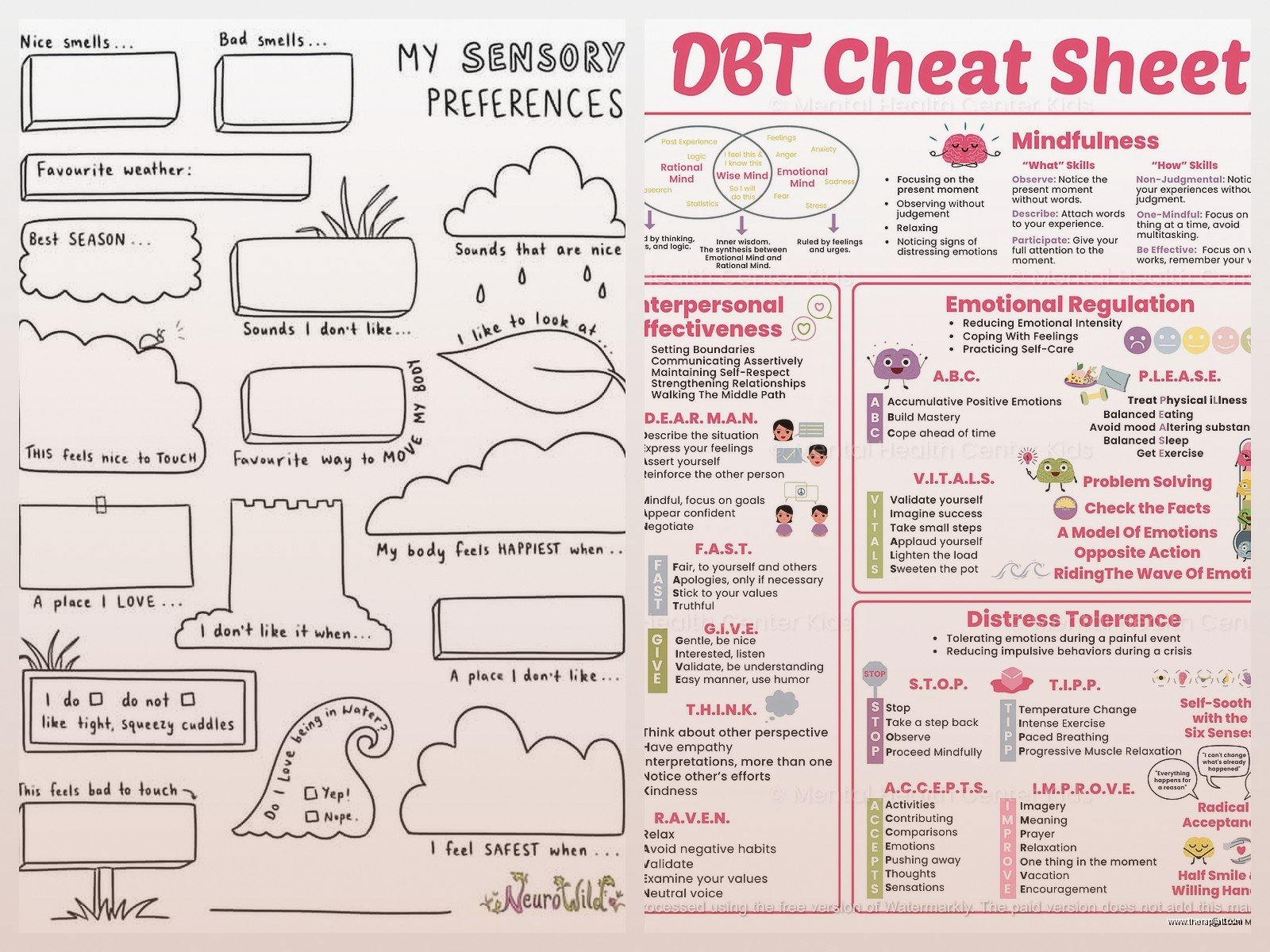
**Emotion Regulation Worksheets** help you name what you’re feeling, identify triggers, and choose coping strategies. A lot of these come from DBT. There’s the chain analysis, which walks backward from a problem behavior to figure out every link in the sequence that led there. There’s the PLEASE skill sheet (Physical illness, balanced Eating, Avoid mood-altering substances, Sleep, Exercise) which is just a checklist but it’s structured around vulnerability factors.
**Exposure Hierarchy Forms** are used in anxiety treatment. You list feared situations from least to most distressing, rate each one, then work your way up. Exposure therapy doesn’t work if you just dive into your biggest fear, so the sheet keeps you organized and gradual.
**Safety Planning Templates** are critical for clients dealing with suicidal ideation or self-harm urges. They list warning signs, coping strategies, people to contact, places to go, and ways to make the environment safer. These aren’t optional feel-good worksheets—they’re literal safety tools.
**Values Clarification Exercises** show up a lot in ACT (Acceptance and Commitment Therapy). You rate different life domains, identify what matters to you, notice gaps between your values and your actions. They’re less about problem-solving and more about direction-setting.
## How Therapists Actually Use These
In session, a good therapist will introduce the sheet, explain why it’s relevant to your specific goals, and complete part of it with you. Let’s say you’re working on social anxiety and your therapist hands you a thought record. They’ll pick a recent situation—maybe you avoided a work meeting—and walk through each column together. What did you think would happen? What did you feel? What’s the evidence that people would judge you? What’s the evidence against?
Then you take it home. The idea is that you practice the skill on your own when similar situations come up. You bring the completed sheet back next session and review it together. That’s where the real work happens—you start noticing your patterns, your therapist points out themes you might’ve missed, and the skill becomes more automatic over time.
But here’s the thing—most clients don’t complete them, and that’s not always a motivation issue. Sometimes the sheet is too complicated. Sometimes life got in the way. Sometimes the client didn’t see the point because the therapist didn’t explain it well enough. I’ve seen therapists get weirdly passive-aggressive about uncompleted homework, which… nah, that’s not helpful. If a tool isn’t working, you adjust the tool or the expectation, you don’t shame someone for not doing their feelings homework.
## Digital vs. Paper Therapy Sheets
There’s been a huge shift toward apps and digital worksheets. Some therapy platforms have built-in homework modules where you can fill out a thought record on your phone and it syncs with your therapist’s notes. That’s convenient if you’re gonna actually use your phone for it, but a lot of people still prefer paper. There’s something about physically writing that helps with processing, and you don’t get distracted by notifications.
I’m not anti-digital, but I do think there’s a tendency to over-engineer these tools. I tested out one app last year that required like six taps just to log a single emotion. By the time I navigated through the interface, I’d forgotten what I was even feeling. Sometimes a PDF you can print and scribble on is just better.
My cat just knocked over my water bottle and now there’s a puddle under my desk, which is perfect timing because I was losing focus anyway.
## What Makes a Therapy Sheet Actually Useful
**Clarity.** If you need a PhD to understand the instructions, it’s not a good worksheet. The language should be straightforward. Avoid jargon unless you’re defining it right there on the page.
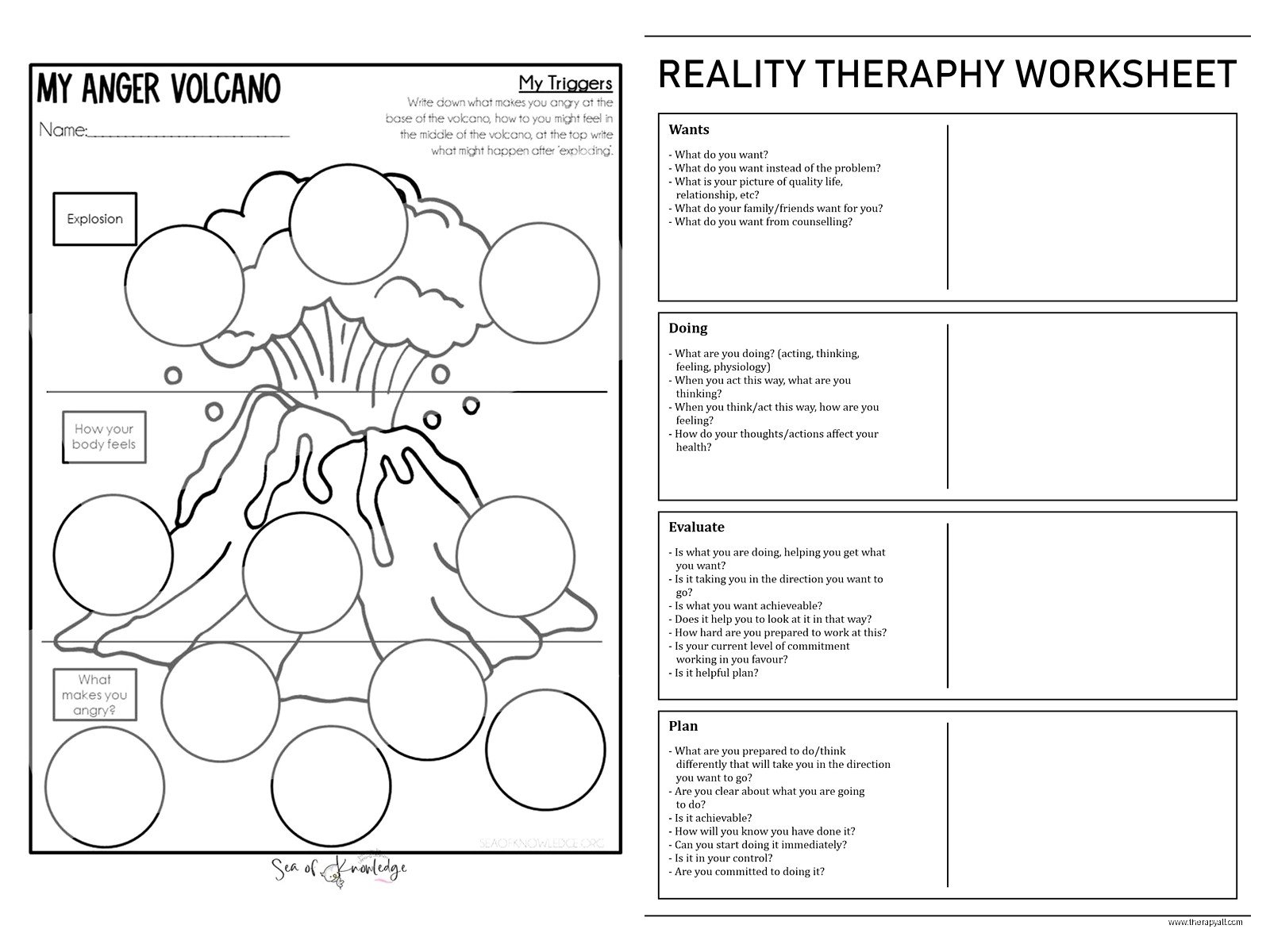
**Relevance.** The sheet should connect directly to a treatment goal. If you’re working on anger management, a gratitude journal isn’t gonna cut it. You need something that tracks triggers, physical sensations, thoughts, and coping responses specific to anger.
**Space to write.** I’ve seen so many worksheets with tiny boxes that fit maybe three words. If you’re asking someone to explore a complex thought or describe a situation, give them room. White space is your friend.
**Not too long.** A worksheet that takes 45 minutes to complete won’t get completed. Unless it’s a one-time deep dive exercise, keep it manageable. Five to fifteen minutes is the sweet spot for regular homework.
**Flexibility.** Rigid formats don’t work for everyone. Some people think in bullet points, others need to free-write. Some people want structure, others find it constricting. The best sheets have a framework but leave room for individual style.
## Common Misconceptions That Drive Me Nuts
One misconception is that therapy sheets are only for CBT. You see them across modalities—DBT, ACT, psychodynamic therapy (yes, really, there are psychodynamic journaling prompts), EMDR has worksheets for resourcing and processing, narrative therapy uses externalization maps. The format changes but the concept of structured between-session work is pretty universal.
Another misconception is that if a worksheet didn’t help, therapy isn’t working. Sometimes a specific tool just doesn’t land. That doesn’t mean the whole approach is wrong. I’ve had clients tell me they hated thought records but loved behavioral experiments, or they couldn’t get into mood tracking but the values worksheet changed everything. It’s not one-size-fits-all.
Also—and this is important—therapy sheets are not a replacement for actual therapy. You can’t just download a bunch of CBT worksheets from the internet, fill them out alone in your apartment, and call it treatment. The therapeutic relationship, the feedback, the tailored application, the safety of the space—all of that matters. The sheet is a supplement, not the whole deal.
## Where to Find Quality Therapy Sheets
Therapist Aid is probably the most well-known free resource. They have hundreds of worksheets organized by topic and modality, available in multiple languages. The quality is solid and they’re actually designed by clinicians.
Psychology Tools offers some free sheets but their best stuff is behind a subscription. If you’re a therapist, it’s worth it. If you’re a client, ask your therapist to provide what you need rather than paying for a subscription yourself.
PESI and other continuing education companies sell worksheet bundles. These tend to be more specialized—like a whole packet on eating disorders or trauma processing.
Some individual therapists share their own creations on blogs or social media. Quality varies wildly. I’ve seen brilliant one-page tools and I’ve seen stuff that’s just… a feelings word list with clip art.
If your therapist isn’t offering worksheets and you think they’d help, just ask. Most therapists have a library of go-to sheets and are happy to pull something relevant, or they might even create something custom for your specific situation.
## How to Actually Use a Therapy Sheet (If You’re the Client)
First, understand why you’re using it. If your therapist just handed it to you without explanation, ask. “What’s the goal here? What am I supposed to get out of this?” That’s not a rude question, it’s a necessary one.
Complete it as soon as possible after the relevant situation. If you’re tracking anxious thoughts and you wait three days, you’ll forget the details. Keep the sheet somewhere accessible—in your bag, on your desk, saved on your phone.
Don’t aim for perfection. You don’t need to fill out every single box or write profound insights. Messy, honest responses are more useful than polished, performance-y ones. Your therapist isn’t grading you.
If you’re stuck, write that down. “I don’t know what I was thinking, I just felt bad” is valid data. If a question doesn’t make sense, skip it or write a question mark and bring it up next session.
And if you truly can’t complete the sheet—because it’s too hard, too time-consuming, too triggering, or just not clicking—tell your therapist. A good therapist will troubleshoot with you, not guilt you. Maybe you need a simpler version, maybe you need to try a different tool, or maybe homework just isn’t part of your treatment plan and that’s okay too.
## Therapy Sheets for Specific Issues
**Depression:** Behavioral activation sheets, activity scheduling, thought records focused on negative automatic thoughts, self-compassion exercises. The goal is usually to increase activity and challenge hopelessness.
**Anxiety:** Exposure hierarchies, worry time logs (you schedule when you’re allowed to worry and postpone it otherwise), thought records focused on overestimation of threat and underestimation of coping, body scan worksheets to notice physical symptoms without catastrophizing.
**Trauma:** Grounding technique checklists, trauma narrative worksheets (used carefully and only when appropriate), self-care planning, trigger identification logs. These need to be used with a lot of caution and therapist support.
**Relationship Issues:** Communication pattern tracking, conflict resolution frameworks, needs and boundaries worksheets, attachment style reflections. Some couples therapists use shared worksheets that both partners complete separately then discuss together.
**Anger Management:** Anger logs that track triggers, intensity, physical sensations, thoughts, and responses. Coping skills menus. Cost-benefit analysis of angry reactions.
**Eating Disorders:** Meal logs, urge tracking, challenging food rules worksheets, body image exercises. These are highly specialized and should only be used under professional guidance because eating disorder treatment is complex and requires medical oversight, or at least it should, though I know some people try to navigate it alone which worries me honestly.
## When Therapy Sheets Don’t Work
Some people are just not worksheet people. That’s fine. Therapy can happen through conversation, art, movement, role-play, metaphor—there are a million ways to do the work. If paperwork stresses you out or feels like a chore, tell your therapist.
Cultural factors matter too. Some worksheet formats assume a level of literacy, comfort with introspection, or individualistic framing that doesn’t fit everyone. A good therapist adapts tools to fit the client’s background and preferences, not the other way around.
Timing matters. If you’re in crisis, a thought record isn’t the priority. If you’re dissociating heavily, a complex worksheet might not be accessible. If you’re just starting therapy and building trust, homework might feel premature.
And sometimes the worksheet itself is just badly designed, which happens more often than it should.