# Psych Worksheets – Free PDF & Printable Resources
Psych worksheets are structured documents designed to help people track thoughts, behaviors, emotions, or symptoms in a format that’s easier to analyze than random notes or journal entries. They’re used in therapy sessions, assigned as homework between sessions, or downloaded by people working on mental health skills independently.
Most worksheets follow evidence-based frameworks from cognitive behavioral therapy, dialectical behavior therapy, acceptance and commitment therapy, or other modalities. They typically include prompts, fill-in-the-blank sections, rating scales, or exercises that guide someone through a specific skill or reflection process.
You can find them on therapist websites, mental health organizations, educational platforms, and honestly just scattered all over Google if you search the right terms. The quality varies wildly, which I’ll get to in a second because that’s been a recurring frustration for me since I started curating these resources back in 2018.
## What Makes a Worksheet Actually Useful
A good psych worksheet has clear instructions. I cannot overstate how many times I’ve seen beautifully designed PDFs that look professional but the person filling it out has no idea what they’re supposed to do with the boxes or circles or whatever decorative element the designer thought looked nice.
The layout matters more than people think. If you’re asking someone to track emotions throughout the day, the structure needs to make that easy. Tiny boxes, confusing arrows, or questions that bleed into each other—these things create friction that defeats the whole purpose.
It should target one specific skill or concept. The worksheets that try to do everything at once—tracking mood AND challenging thoughts AND practicing gratitude AND setting goals—those usually end up in the recycling bin or forgotten in someone’s downloads folder.
Summer 2019 I was putting together a resource library for a mental health nonprofit and I must’ve reviewed like 400 different worksheets in the span of two months. I started noticing patterns in which ones actually worked versus which ones were just… there. The ones people actually completed and brought back to sessions had a few things in common: simple language, enough space to write real answers (not just one line), and a clear “why” stated somewhere on the page.
## Common Types You’ll Encounter
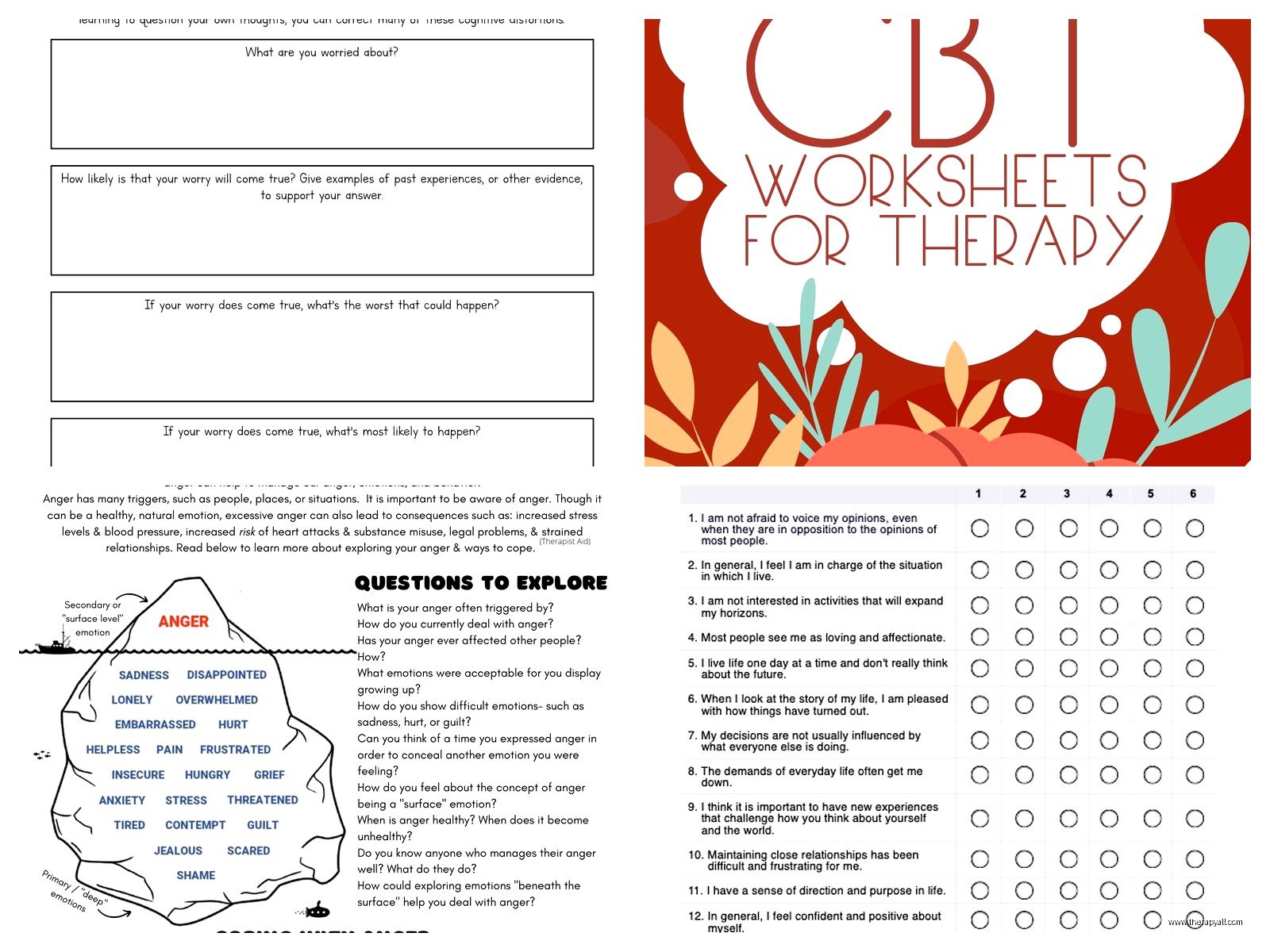
**Thought records** are probably the most common CBT worksheet. They walk you through identifying an activating event, the automatic thoughts that came up, the emotions and physical sensations, examining evidence for and against those thoughts, and coming up with a more balanced perspective. The classic format has columns, though some newer versions use a flowchart style.
**Mood trackers** let you log your emotional states over time, usually rating intensity on a scale. Some include space to note triggers, coping strategies used, or other variables like sleep or medication. These are helpful for spotting patterns—like noticing your anxiety spikes every Sunday evening or your mood consistently dips mid-cycle.
**Behavioral activation** worksheets help you schedule activities when you’re depressed and everything feels pointless. They usually have you rate how much pleasure and accomplishment you got from different activities, which sounds kinda silly until you realize you’ve been avoiding everything that used to make you feel even slightly better.
**DBT skills worksheets** cover the four main modules: mindfulness, distress tolerance, emotion regulation, and interpersonal effectiveness. These tend to be more structured than CBT worksheets because DBT is so protocol-driven. You’ll see acronyms everywhere—STOP, TIPP, DEAR MAN, GIVE, FAST. My cat just knocked over my water bottle, hold on… okay, anyway, those acronyms are memory aids for multi-step skills.
**Safety planning** templates help people identify warning signs, coping strategies, reasons for living, and emergency contacts. These are crucial documents and they need to be accessible, which means simple formatting and clear sections that someone in crisis can actually navigate.
**Exposure hierarchy** worksheets are used in treating anxiety disorders. You list feared situations and rate them by difficulty level, then work through them systematically. The worksheet itself is straightforward but filling it out requires really thinking through what scares you and why.
**Values clarification** exercises from ACT help you identify what matters to you across different life domains. They often include card sorts, rating scales, or reflective questions about how you want to be remembered or what you’d do if nothing could fail.
## Where to Find Quality Free Resources
Therapist Aid is probably the single best source for professionally designed, evidence-based worksheets. They have hundreds organized by topic and therapeutic approach. The free versions are totally usable, though they have a paid membership that gives you access to editable versions and additional materials.
Psychology Tools offers a mix of free and paid resources. Their free section is smaller but the quality is consistently high. They’re particularly good for CBT and schema therapy materials.
The Centre for Clinical Interventions in Australia has comprehensive workbooks available as free PDFs. These aren’t single worksheets but rather full self-help programs with multiple worksheets embedded throughout. Their social anxiety, depression, and perfectionism modules are excellent.
DBT-specific worksheets are best found through resources affiliated with Marsha Linehan’s work or DBT training programs. Some therapists share their adapted versions but you gotta be careful about copyright issues there.
University counseling centers often have worksheets available on their websites. UCLA, University of Michigan, and several others maintain public-facing resource pages. The worksheets tend to be simpler and more introductory, which is actually perfect if you’re new to these concepts.
I’m gonna be honest, one thing that genuinely irritates me is when websites gate-keep basic psychoeducation worksheets behind email capture forms. Like, I understand the marketing strategy, but if someone’s searching for a panic attack grounding worksheet at 2am, making them sign up for your newsletter first is… yeah, that bothers me. Mental health resources should be as accessible as possible.
## How Therapists Actually Use These
In session, worksheets serve as structured conversation guides. Instead of just talking abstractly about cognitive distortions, you’re both looking at the same document, filling it out together, seeing the thought pattern become visible on paper.
Between sessions, they’re homework assignments. The therapist might say “this week I want you to complete a thought record whenever you notice yourself catastrophizing” or “track your sleep and mood daily using this chart.” The worksheet creates accountability and gives you both something concrete to review next time.
Some therapists customize existing worksheets or create their own. I’ve modified probably hundreds of templates over the years to better fit specific clients’ needs or literacy levels or cultural contexts. A worksheet designed for college students might not work for someone who’s 65 and dealing with late-life depression, you know?
The physical act of writing things down does something different than just thinking about them. It slows down the process, engages different parts of your brain, creates a record you can reference later. I remember this client in 2020 who kept insisting she “didn’t have any negative thoughts” and then we spent one session just writing down every critical thing her inner voice said during our conversation and she was like… oh. That’s what you mean.
## DIY Mental Health Work vs Therapy
You can absolutely use these worksheets on your own without a therapist. Lots of people do, especially for maintenance between therapy episodes or when they can’t access professional help for whatever reason—cost, availability, stigma, scheduling, all the usual barriers.
But there are limitations to self-directed work. You might misunderstand the instructions, apply a technique incorrectly, or not recognize when you’re getting stuck in a pattern. Some worksheets assume baseline knowledge of therapeutic concepts that you might not have yet.
Certain issues really shouldn’t be tackled alone with worksheets. Active suicidal ideation, severe trauma processing, psychotic symptoms, eating disorders—these need professional support. A worksheet isn’t gonna replace that expertise and safety net.
That said, worksheets can be a great starting point or supplement. They can help you understand what therapy might look like, practice skills you’ve learned in session, or maintain progress after therapy ends.
## The Design Problem Nobody Talks About
Here’s something that’s bugged me for years: most psych worksheets are designed by people who understand psychology but not design principles or accessibility. You get walls of text in 10-point font, insufficient contrast for people with vision issues, overly complex layouts that confuse rather than clarify.
I’ve seen worksheets that were clearly just… someone’s Word document with clip art added. The content might be solid but the format makes it hard to actually use. Therapists aren’t graphic designers, which is fine, but then these poorly formatted documents get photocopied and shared and end up representing the profession.
Fillable PDFs are theoretically great but so many of them are buggy or don’t work properly on mobile devices. And increasingly people want to complete these things on their phones, not print them out, but most worksheets weren’t designed with that use case in mind.
There’s also the question of cultural relevance. A lot of free worksheets use examples or language that assumes a pretty specific cultural context—usually white, Western, middle-class. The underlying psychological principles might be universal but the way they’re presented often isn’t.
## Specific Worksheets Worth Knowing About
The **ABC model worksheet** (Activating event, Beliefs, Consequences) is foundational CBT. Simple three-column format that helps you see how thoughts mediate between situations and emotional responses. Every variation on this theme—thought records, cognitive restructuring worksheets—builds from this basic structure.
**SMART goals** templates help you set Specific, Measurable, Achievable, Relevant, Time-bound objectives. These show up in therapy a lot but also in like every self-help and productivity context, which has kinda diluted their effectiveness honestly, but they’re still useful when applied properly.
**Grounding techniques** worksheets, particularly the 5-4-3-2-1 sensory exercise, are go-to resources for anxiety and dissociation. You identify five things you can see, four you can hear, three you can touch, two you can smell, one you can taste. It’s almost embarrassingly simple but it works.
**Communication styles** worksheets that break down passive, aggressive, and assertive responses help people practice interpersonal effectiveness. Usually they present a scenario and ask you to write out how each style would respond, then identify which you typically use.
**Worry time** scheduling worksheets designate a specific 15-30 minute period for worrying, with the goal of containing anxious thoughts to that window instead of letting them intrude all day. Sounds weird, works surprisingly well for some people.
The **cope ahead** worksheet from DBT has you identify an upcoming stressful situation, imagine it in detail, plan specific coping skills you’ll use, and mentally rehearse implementing them. It’s like a fire drill for your emotions, or—sorry, I just got distracted because I was trying to remember if I’d ever actually used this one myself or just assigned it, and yeah, I did use it before a difficult family gathering in 2021 and it helped.
## File Management and Actually Using Them
Download folders become worksheet graveyards real fast. If you’re going to use these resources, you need some kind of organization system. Create a dedicated folder, use clear file names, maybe organize by category or date.
Print what you’ll actually use. Having 47 downloaded worksheets you never look at doesn’t help anyone. Better to print one thought record and complete it five times than to hoard a collection of every anxiety worksheet ever created.
Some people prefer digital, some prefer paper. There’s no right answer. Paper can feel more permanent and tangible, less easy to ignore. Digital is searchable, doesn’t require a printer, easier to back up. I personally—well, I’ve gone back and forth honestly, and right now I’m mostly digital for reference materials but I still print certain worksheets because the physical act of writing matters.
## What Worksheets Can’t Do
They can’t provide the relationship component of therapy. The therapeutic alliance, the feeling of being heard and understood, the dynamic feedback—a PDF can’t replicate that no matter how well designed.
They can’t adapt to your specific situation in real time. A therapist notices when you’re stuck, asks clarifying questions, adjusts the approach. A worksheet just sits there with its predetermined prompts.
They can’t contain crisis situations. If you’re completing a worksheet and realize you’re in danger, you need immediate human support, not another fill-in-the-blank exercise.
They’re tools, not solutions. A hammer doesn’t build a house by itself. These worksheets work best as part of a broader approach that includes self-awareness, support systems, professional help when needed, and consistent practice over time.