# Therapy Forms – Everything You Need to Know
Therapy forms are the administrative backbone of any mental health practice, whether you’re running a private office, working in a clinic, or even doing telehealth sessions from your living room. They serve legal, clinical, and practical purposes—documenting consent, gathering patient history, tracking progress, and protecting both therapist and client if something goes sideways.
I remember back in 2019, I was visiting a friend’s new therapy practice and she had literally printed out 47 different forms for intake alone. We sat there with coffee going cold, trying to figure out which ones were actually legally required versus which ones she’d just downloaded because they looked “official.” That’s when I realized most therapists—and definitely most clients—have no idea what half these forms actually do or why they exist.
## The Essential Forms Every Practice Needs
Let’s start with the non-negotiables. These are the forms that you’re gonna see in basically every legitimate therapy setting, and they’re required for good reason.
**Informed Consent** is the big one. This document explains what therapy is, what it isn’t, the therapist’s qualifications, fees, cancellation policies, confidentiality limits, and what happens to your information. It’s not just a formality—it’s a legal contract that protects both parties. Clients sign this acknowledging they understand the therapeutic relationship and its boundaries. Without informed consent, a therapist can face serious ethical and legal consequences.
**HIPAA Authorization and Notice of Privacy Practices** are separate but related. The Notice of Privacy Practices explains how your health information can be used and disclosed. The authorization form is what you sign when you want your therapist to share information with someone specific—your psychiatrist, your primary care doctor, your previous therapist, whatever. One thing that genuinely irritates me is when practices bundle these together into one confusing mega-document that clients just sign without reading because it’s eight pages of legal jargon. Nobody actually reads that stuff, which defeats the whole purpose of informed consent.
**Intake Forms or Client Information Forms** collect basic demographic data, emergency contacts, insurance information, and the reason you’re seeking therapy. Some practices have a separate **Health History Questionnaire** that digs into medical conditions, medications, substance use, previous mental health treatment, and family psychiatric history. This information helps therapists understand the whole picture before that first session.
**Financial Agreement or Fee Agreement** outlines payment expectations, insurance billing procedures, what happens if you don’t pay, and policies around sliding scale fees if offered. Money is awkward to talk about in therapy, but this form makes it clear from the start.
## Assessment and Screening Tools
Beyond the administrative stuff, there are clinical forms that actually help with diagnosis and treatment planning. These aren’t just busywork—they provide baseline data and track changes over time.
The **PHQ-9** (Patient Health Questionnaire-9) is probably the most common depression screening tool. It’s nine questions, each scored 0-3, based on DSM criteria for major depressive disorder. You’ll see this at intake and then periodically throughout treatment. Same deal with the **GAD-7** for anxiety. These are brief, validated, and give therapists a numerical score to reference.
I spent basically all of summer 2021 writing about screening tools for a mental health platform, and I started actually using some of them on myself out of curiosity—turns out my baseline anxiety score is higher than I thought, which was… not surprising but still kinda jarring to see quantified.
**Suicide Risk Assessments** are critical in many settings, especially crisis situations or when working with high-risk populations. These forms help clinicians evaluate immediate danger, access to means, protective factors, and whether hospitalization might be necessary. They’re structured to ensure therapists ask the hard questions consistently.
For specific populations, you might encounter the **AUDIT** (Alcohol Use Disorders Identification Test), the **ACE Questionnaire** (Adverse Childhood Experiences), or trauma-specific assessments like the **PCL-5** for PTSD symptoms. Each of these serves a clinical purpose—they’re not random paperwork.
## Progress Notes and Documentation Forms
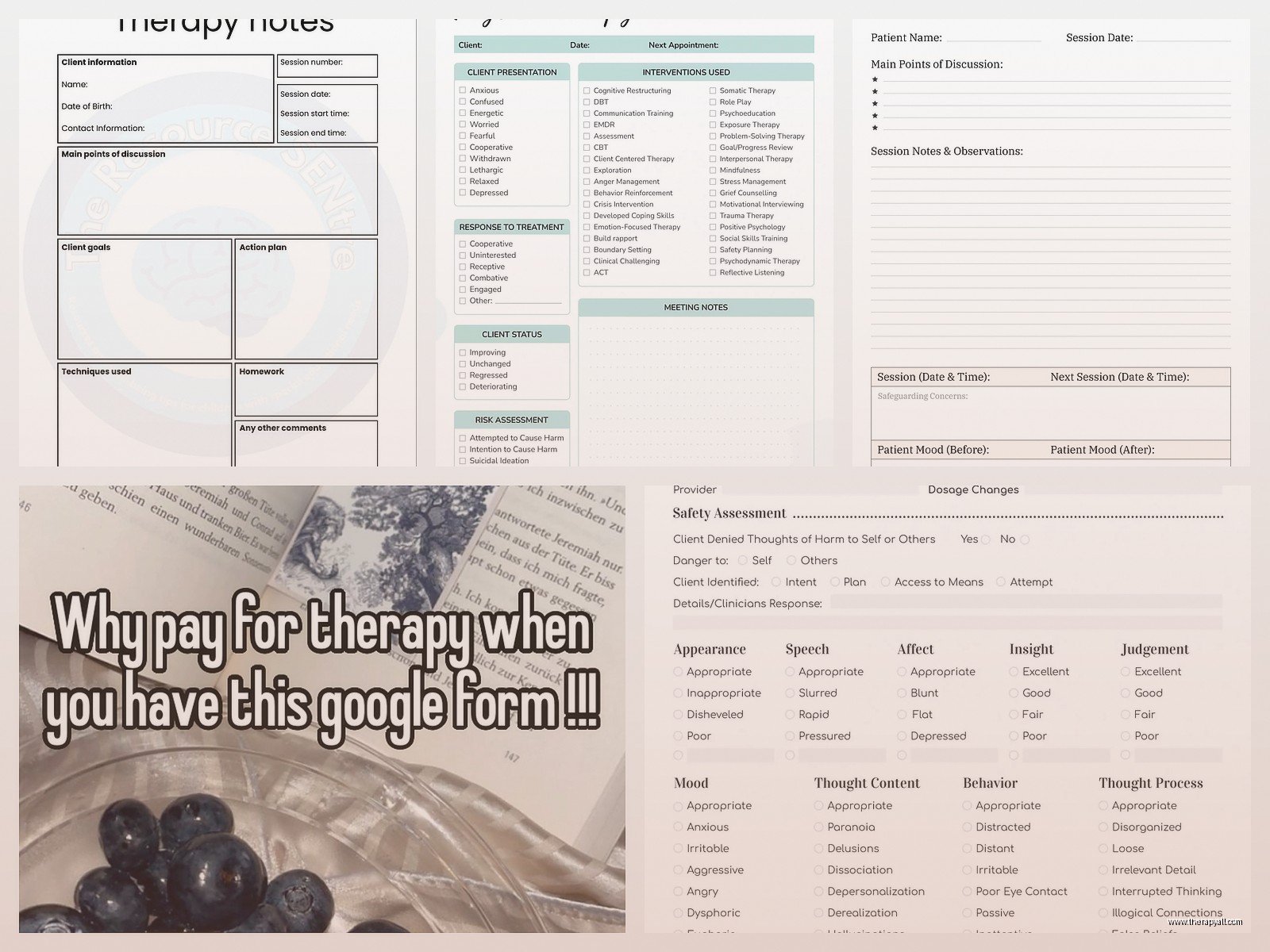
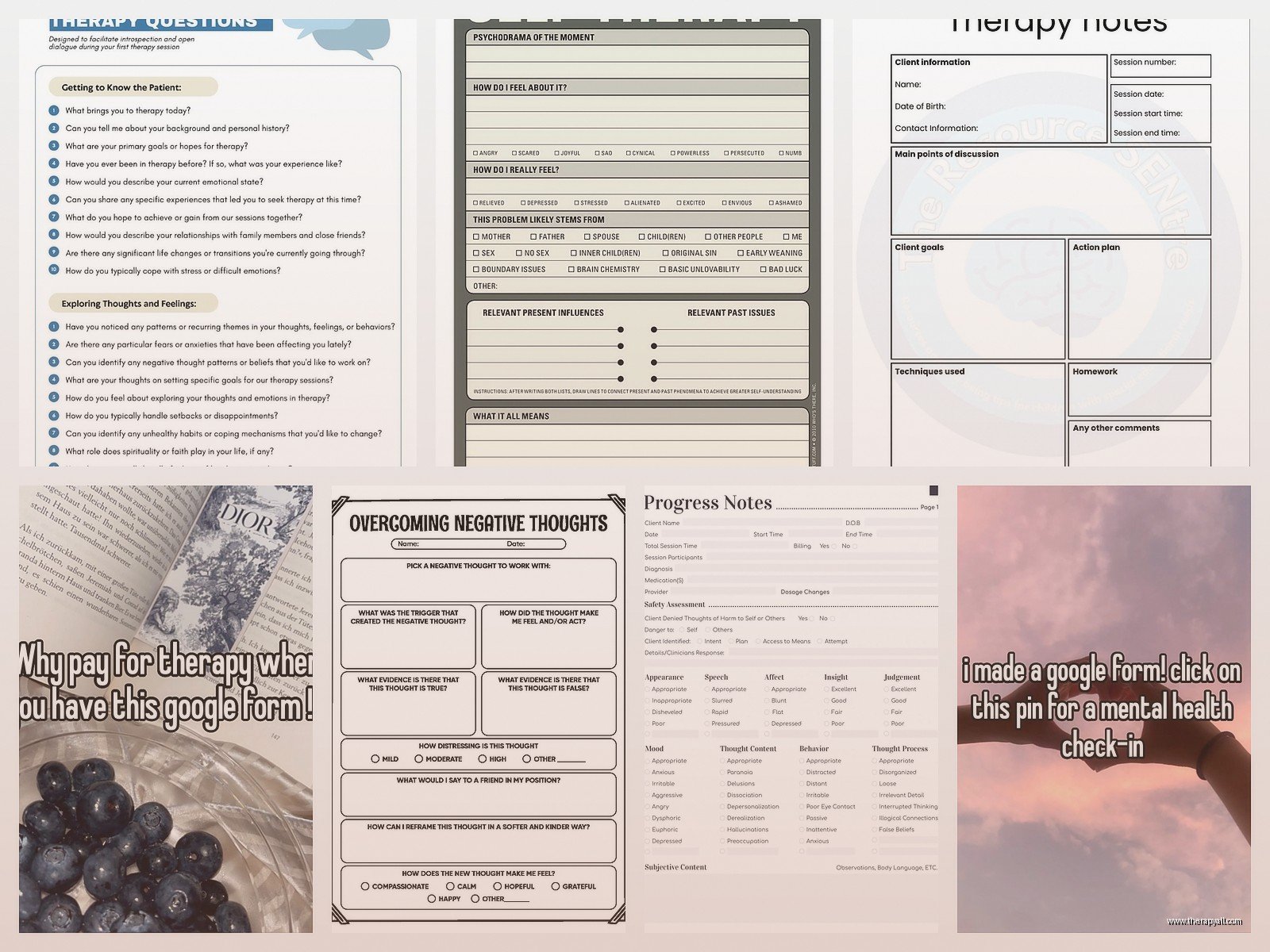
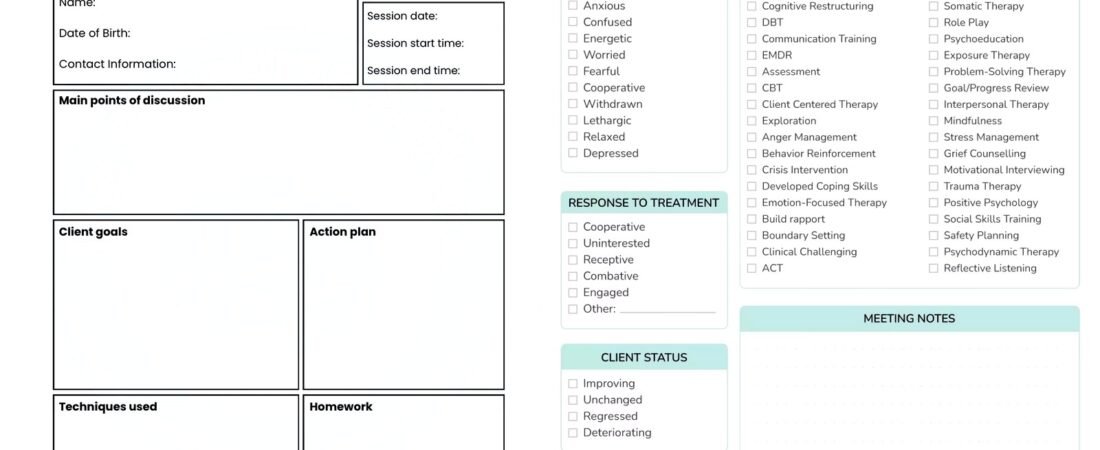
**Progress notes** aren’t typically something clients fill out, but they’re worth understanding because they document every session. Most therapists use some variation of SOAP notes (Subjective, Objective, Assessment, Plan) or DAP notes (Data, Assessment, Plan). These notes are legal documents that can be subpoenaed in court, which is why therapists are careful about what they write.
**Treatment Plans** outline specific goals, interventions, and measurable objectives. Insurance companies often require these, and they need to be updated regularly. A good treatment plan isn’t vague (“client will feel better”)—it’s specific (“client will identify and implement three coping strategies for managing panic attacks within 6 weeks”).
Some practices use **Session Rating Scales** or **Outcome Rating Scales** where clients quickly rate the session or their overall wellbeing. This gives real-time feedback and helps therapists adjust their approach if something isn’t working.
## Specialized Forms for Different Situations
**Release of Information (ROI) forms** come up a lot. Maybe you need your therapist to talk to your psychiatrist, or you’re switching therapists and want your records transferred, or you’re applying for disability and need documentation. Each situation requires a separate, specific ROI that states exactly what information can be shared, with whom, and for how long.
**No-Harm Contracts or Safety Plans** are used when there’s concern about self-harm or suicide but the client isn’t at imminent risk requiring hospitalization. I’ve gotta say, the term “no-harm contract” bugs me because research shows they’re not actually effective as contracts—what works is the collaborative safety planning process, not the signature on a piece of paper. But many therapists still use them.
For **couples or family therapy**, there are additional forms addressing confidentiality in multi-person sessions. What happens if one partner calls the therapist privately? What if a teenager wants something kept from their parents? These forms establish ground rules.
**Termination or Discharge forms** document the end of treatment, whether planned or not. They typically include a summary of progress, recommendations for ongoing care, and contact information for crisis resources.
## The Telehealth Era
Since COVID, telehealth consent forms have become standard. These address technology risks (session interruptions, security concerns), platform specifications, what happens if the video cuts out, and protocols for emergencies when therapist and client aren’t in the same location. Some states require separate informed consent for telehealth versus in-person therapy.
My cat just knocked over my water bottle while I was writing this section, which feels appropriate given how many telehealth sessions I’ve heard about being interrupted by pets.
## What Happens to All These Forms
Forms are stored in your clinical record, which therapists are legally required to maintain for a specific period—usually 7-10 years depending on state law, longer for minors. They must be kept secure, whether that’s a locked file cabinet or an encrypted electronic health record system.
You have the right to access most of your records, though therapists can withhold psychotherapy notes (their personal observations) and may limit access if they believe seeing the records would cause harm. The process for requesting records varies by practice.
## Common Problems and Misconceptions
A huge misconception is that everything you tell your therapist is 100% confidential. Nah. There are specific situations where therapists are legally required to break confidentiality: if you’re an imminent danger to yourself or others, if there’s suspected child or elder abuse, or if records are subpoenaed by a court. The informed consent form should spell this out clearly, but a lot of people don’t actually read it or… wait, I already mentioned people not reading forms. See, this is what happens when forms are too long and dense.
Another issue: forms that use outdated language or make assumptions about family structure, gender, or living situations. I’ve seen intake forms that only have “mother” and “father” fields, or that assume everyone has insurance, or that don’t include options for non-binary gender identity. Good practices update their forms regularly to be more inclusive.
**Electronic signatures** have become standard, but some older therapists still insist on wet signatures for everything, which creates unnecessary barriers for clients who have transportation issues or live far away.
## Forms Clients Often Don’t Realize They Can Request
You can request a **Good Faith Estimate** under the No Surprises Act if you’re paying out-of-pocket. This gives you an estimate of costs before treatment begins.
You can also request information about your therapist’s **grievance procedures** if you have a complaint, though this should be included in the informed consent.
If you’re using insurance, you have the right to ask what diagnosis is being billed and what information is being shared with the insurance company. Some therapists will show you the actual billing codes and documentation.
## The Reality of Form Overload
Here’s the thing—practices vary wildly in how many forms they require. Some minimalist therapists use maybe five forms total. Others have clients signing documents for 30 minutes before the first session even starts. There’s no perfect number, but there’s definitely a point where it becomes excessive and actually interferes with building rapport.
I’ve talked to clients who said the intake paperwork was so overwhelming they almost didn’t show up for their first appointment. That’s a problem. The forms exist to facilitate therapy, not create barriers to it.
Increasingly, practices use patient portals where you can complete forms online before your first session. This is generally better than showing up 20 minutes early with a clipboard, but it also means you’re filling out sensitive information on your phone while sitting in your car or whatever, which isn’t ideal for thoughtful responses.
## Special Populations and Additional Forms
**Minors** require parental consent for treatment in most cases (exceptions exist for specific situations like substance abuse treatment or reproductive health in some states). This creates additional forms around who has legal custody, who can access records, and how much confidentiality the minor has versus the parents’ right to information.
**Court-Ordered Therapy** involves forms specifying what must be reported back to the court, how often, and what happens if the client doesn’t comply with treatment requirements.
**Group Therapy** requires additional confidentiality agreements since you can’t guarantee what other group members might share outside the room.
## Actually Reading the Forms
Look, I know nobody wants to read legal documents, but you should at least skim the informed consent and notice of privacy practices. Pay attention to:
– Cancellation and no-show fees
– How long sessions last and what’s included in that time
– What happens in an emergency
– How to contact the therapist between sessions
– Whether the therapist takes insurance or is out-of-network
– What records are kept and for how long
The clinical questionnaires are sorta different—those you really should fill out accurately because they directly affect your treatment. If you minimize your symptoms on the intake forms, your therapist might not understand the severity of what you’re dealing with.
## Digital Forms and Security
Most modern practices use electronic health record (EHR) systems that are HIPAA-compliant and encrypted. Forms are filled out through secure portals, not regular email. If a therapist emails you intake forms as regular Word documents, that’s a red flag about their understanding of privacy requirements.
**E-signatures** are legally valid for healthcare documents under ESIGN and UETA laws, despite what some therapists might think. The technology has been around long enough that there’s really no excuse for requiring in-person signatures for routine paperwork.