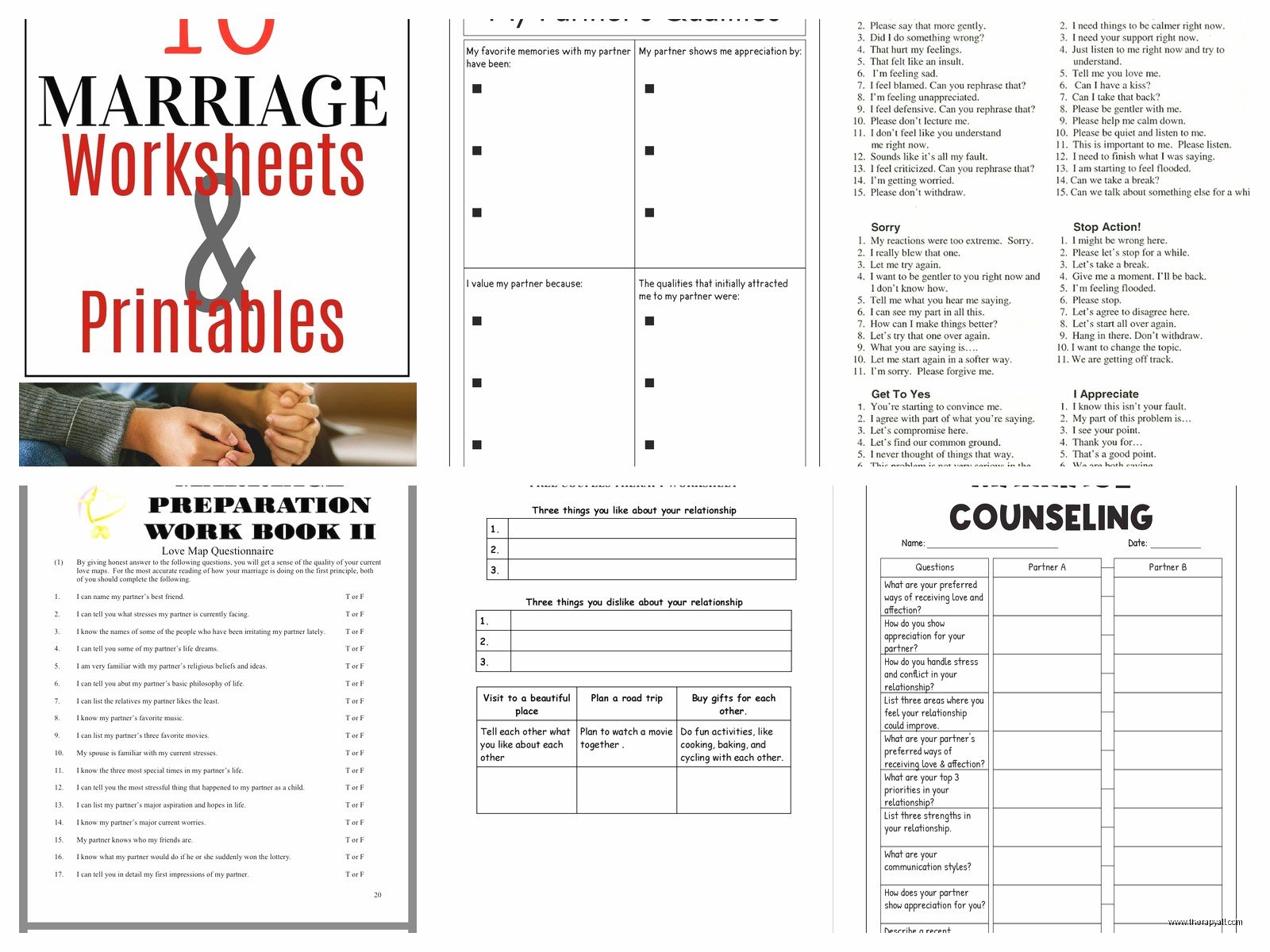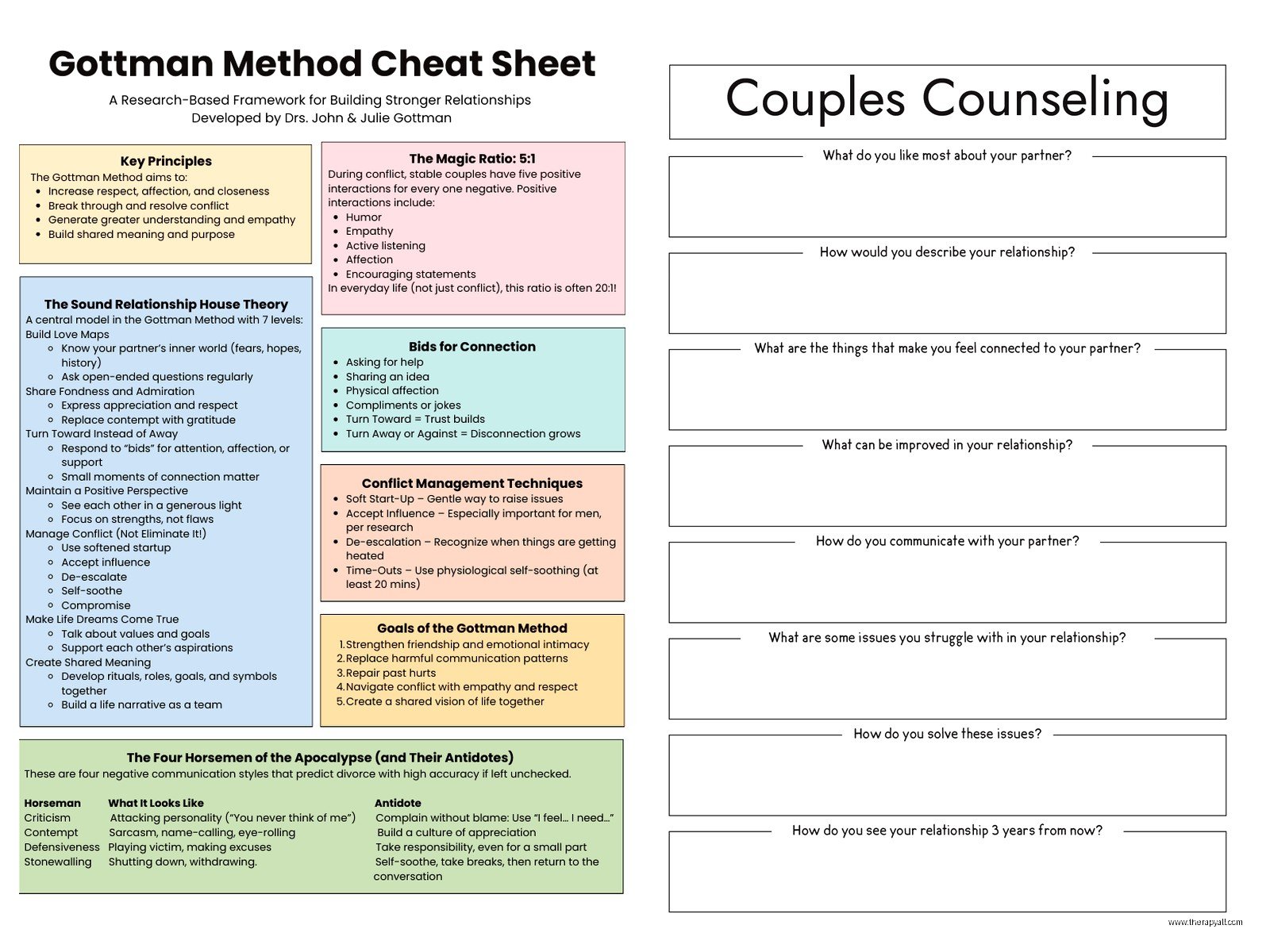
Marriage therapy worksheets get used in about 70% of couples counseling sessions, and for good reason—they create structure when emotions are running high and neither person can actually hear what the other is saying.
I remember back in 2019 sitting with a couple who’d been married 14 years and they literally could not name three things they appreciated about each other without one of them bringing up the dishwasher loading issue. That’s when I pulled out a basic gratitude worksheet and just… the relief on their faces when they had something concrete to look at instead of just staring at each other across the couch.
Why Worksheets Actually Work in Marriage Therapy
The therapeutic alliance between couples and their counselor matters, but worksheets do something different. They externalize the problem. Instead of “you never listen to me” it becomes “let’s both fill out this communication patterns chart and see what shows up.”
You’re essentially creating a third point of focus in the room. Not you, not your partner, but this piece of paper that’s asking both of you the same questions. It levels the playing field in a way that free-form conversation often can’t when one partner is more verbally skilled or the other shuts down under pressure.
Worksheets also create homework, which sounds tedious but actually extends the therapy beyond the 50-minute session. Most couples see their therapist weekly or biweekly—that’s not enough contact time to rewire years of communication patterns. The worksheets you take home and actually complete (key word: actually) keep the therapeutic process active between sessions.
Communication Pattern Worksheets
These track how you and your partner talk to each other, or more accurately, how you don’t talk to each other. The basic format asks you to identify your communication style—are you aggressive, passive, passive-aggressive, or assertive? Then you map out what happens during conflicts.
The Gottman Institute has a bunch of these, and honestly some of them are kinda dense with all the graphs and scales, but the core idea is solid. You’re looking for patterns like: who initiates difficult conversations, who withdraws, who escalates, who tries to problem-solve before emotions get acknowledged.
I’ve seen couples have complete revelations just from filling out a simple “during our last argument, I felt ___ and I responded by ___” worksheet. One partner writes “I felt dismissed and I responded by leaving the room” while the other writes “I felt attacked and I responded by explaining my logic more forcefully.” Neither person realized they were in completely different emotional experiences of the same fight.
The pursuer-distancer dynamic shows up constantly in these worksheets. One person wants to talk everything through immediately, the other needs space to process. Without a worksheet making this visible, couples just think their partner is being difficult—they don’t see it as a legitimate difference in processing style.
Speaker-Listener Technique Worksheets
These structure conversations so rigidly that couples usually hate them at first. One person talks, the other person has to paraphrase back what they heard before they get to respond. It feels artificial because it is artificial.
But when you’re stuck in a pattern where both people are just waiting for their turn to talk instead of actually listening, you need something artificial to break the cycle. The worksheet version usually includes prompts like “What I heard you say was…” and “Is that accurate?” with checkboxes and space for corrections.
My cat just knocked over my water bottle and I’m gonna ignore it and keep writing, but that’s basically what these worksheets prevent in conversations—ignoring the mess and pushing forward with your own agenda.
Emotional Needs Worksheets
Here’s what genuinely annoys me about most emotional needs worksheets: they list like 47 different needs and ask you to rank them all. Nobody has time for that, and by need number 23 (“playfulness”? “intellectual stimulation”?) you’re just randomly checking boxes.
The better versions ask you to identify your top 5 needs and then rate how well those needs are currently being met in your relationship. Common needs include: affection, quality time, words of affirmation, feeling heard, sexual intimacy, financial security, shared goals, independence, support during stress.
You fill it out separately from your partner, then compare. The gaps that show up are usually not surprising—most people kinda know their needs aren’t being met—but seeing it on paper next to your partner’s worksheet creates accountability.
What surprises couples is often what their partner’s top needs are. You might be working overtime to provide financial security because that’s your top need, but your partner’s top need is quality time and they’d rather have less money and more of your presence.
Love Languages Applied
Yeah, I know, the love languages thing is everywhere and sort of oversimplified, but the worksheets based on Gary Chapman’s framework do help couples get specific. Instead of just “I need more affection” you’re identifying whether you need physical touch, words of affirmation, acts of service, quality time, or gifts.
The worksheet version asks for concrete examples: “An act of service that would make me feel loved is ___” and you write something like “if you packed my lunch in the morning” or “if you handled the bedtime routine without me asking.” That specificity is what makes it useful, not just the category itself.
Conflict Resolution Worksheets
These walk you through the anatomy of a fight. Before the fight, during the fight, after the fight—what happened, what was said, what was felt, what was needed, what actually got resolved (usually nothing).
The fair fighting rules worksheets make me think of summer 2021 when I was putting together a resource guide and I must’ve reviewed like 30 different versions of “rules for fighting fair” and they all said basically the same thing: no name-calling, no bringing up the past, use I-statements, take breaks if needed, no stonewalling.
But having those rules on a physical worksheet that both partners agree to actually changes behavior. You can point to rule #4 mid-argument and say “we agreed not to bring up stuff from more than six months ago” and it’s less accusatory than just saying “stop bringing up old stuff.”
Time-Out Procedure Worksheets
When fights escalate past the point of productivity, you need a pre-agreed method for pausing. The worksheet establishes: what’s the signal for time-out, how long is the break (usually 20-30 minutes minimum), what do you each do during the break (not just stew in resentment), and how do you reconvene.
Without this structure, one partner walking away feels like abandonment to the other partner. With the worksheet, it’s following a protocol you both agreed to when you weren’t actively fighting.
Intimacy and Connection Worksheets
Sexual intimacy worksheets ask uncomfortable questions, which is kinda the point. Frequency, satisfaction, desires, boundaries, what’s working, what’s not working. I’ve had couples tell me they’d been married 20 years and never actually discussed what they each wanted sexually because it felt awkward.
The worksheet removes some of the awkwardness by making it clinical. You’re answering questions on a form, not trying to spontaneously bring up that you’d like to try something different or that you’re not enjoying a particular routine that’s been happening for years.
Non-sexual intimacy worksheets are just as important—when’s the last time you held hands, had a conversation longer than 10 minutes about something other than logistics, made eye contact during dinner, or… wait, I need to check if couples actually do make eye contact during dinner or if that’s just something therapists think should happen.
Date Night Planning Worksheets
These sound cheesy but they solve a real problem: couples who say they want more quality time together but then can’t agree on what to do, or one person always plans everything and feels resentful about it.
The worksheet lists potential activities, both partners rate their interest level, you identify overlapping interests, then you actually schedule them with specific dates and times. The specificity matters—”we should go hiking more” never happens, but “Saturday May 12th, 9am, we’re hiking the Ridge Trail” has a much better chance.
Trust and Repair Worksheets
After infidelity or major betrayals, trust doesn’t just magically rebuild. The worksheets for this are more structured than other types—they often include accountability logs, transparency agreements, and specific repair actions.
The hurt partner identifies what they need to feel safe again. The partner who broke trust identifies what they’re willing to do to rebuild it. Then you compare and negotiate because sometimes what the hurt partner needs isn’t realistic or sustainable long-term.
I’ve seen these worksheets save marriages that probably should’ve ended, and I’ve seen them clarify that a marriage needs to end because the gap between what’s needed and what’s possible is too wide. Both outcomes are valid.
Individual Reflection Worksheets
Before you can work on the relationship, you gotta understand your own patterns. These worksheets ask about your family of origin, your attachment style, your triggers, your conflict history, your expectations about marriage.
The “What I Bring to This Relationship” worksheet is harder than it sounds. You’re listing both your strengths and your baggage. Maybe you bring loyalty and humor but also a tendency to withdraw when criticized and some unresolved stuff about your parents’ divorce.
Your partner does the same, then you share them. It’s vulnerable in a way that regular conversation often isn’t because you’ve had to sit alone and actually think through these patterns before discussing them.
Goal-Setting and Vision Worksheets
Where do you see this relationship in 5 years? What are your shared goals? Your individual goals? How do those align or conflict?
Most couples have never actually discussed this explicitly. They assume they’re on the same page about kids, career priorities, where to live, retirement plans, how to spend money—and then they’re shocked when it turns out they had completely different visions.
The worksheet forces the conversation before resentment builds. You each fill out your vision separately, compare, identify gaps, and problem-solve. Sometimes the gaps are dealbreakers, but usually they’re negotiable if you know they exist.