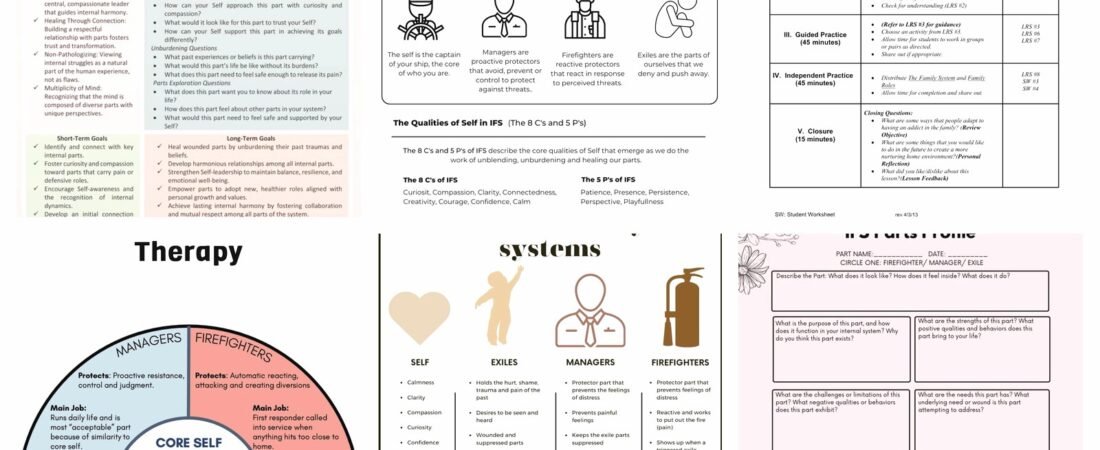
Internal Family Systems therapy worksheets focus on identifying and dialoguing with different parts of your personality. These parts work exercises help you map your internal landscape, differentiate between protective and vulnerable parts, and eventually unblend from parts that might be controlling your behavior in unhelpful ways.
What IFS Parts Work Actually Involves
The core premise is that your psyche isn’t a single unified entity. You contain multiples—parts that developed at different times, for different reasons, often in response to pain or threat. A part might be the inner critic who shows up every time you try something new. Another part might be the people-pleaser who can’t say no even when you’re exhausted. There’s usually a part that just wants to binge-watch TV and eat cereal for dinner, and honestly, I respect that one.
I remember sitting in a training back in 2019 where the facilitator had us do a parts mapping exercise, and I realized I had like seven different parts all screaming about the same deadline. One part was panicking, another was shutting down, a third was getting angry at the panicking part for being dramatic. It was kinda like watching a committee meeting inside my own head where nobody could agree on anything.
The worksheets help you externalize this process. Instead of just feeling overwhelmed by conflicting impulses, you write them down. You give them names. You ask them questions. It sounds weird until you try it, and then it sounds weird but also weirdly helpful.
Basic Parts Identification Worksheet
Start with a simple three-column format. Column one: What’s the part? Column two: What does it do? Column three: What’s it trying to protect?
Let’s say you have a part that procrastinates on important projects. You might notice it shows up specifically when the stakes feel high. This part isn’t just lazy—it’s usually trying to protect you from the possibility of failure or judgment. If you never finish the thing, you never have to face potential criticism.
The worksheet prompts you to get curious rather than critical. Instead of “Why am I such a procrastinator?” you ask “What is this procrastinating part afraid will happen if I actually complete this project on time?”
You can identify parts by tracking patterns in your behavior, emotional reactions, or even physical sensations. Some people notice a tightness in their chest when a particular part activates. Others hear a specific tone of voice in their internal dialogue.
The Self-to-Part Dialogue Exercise
This is where IFS gets interesting and also where a lot of worksheets fall apart because they try to make it too prescriptive. You can’t script genuine curiosity.
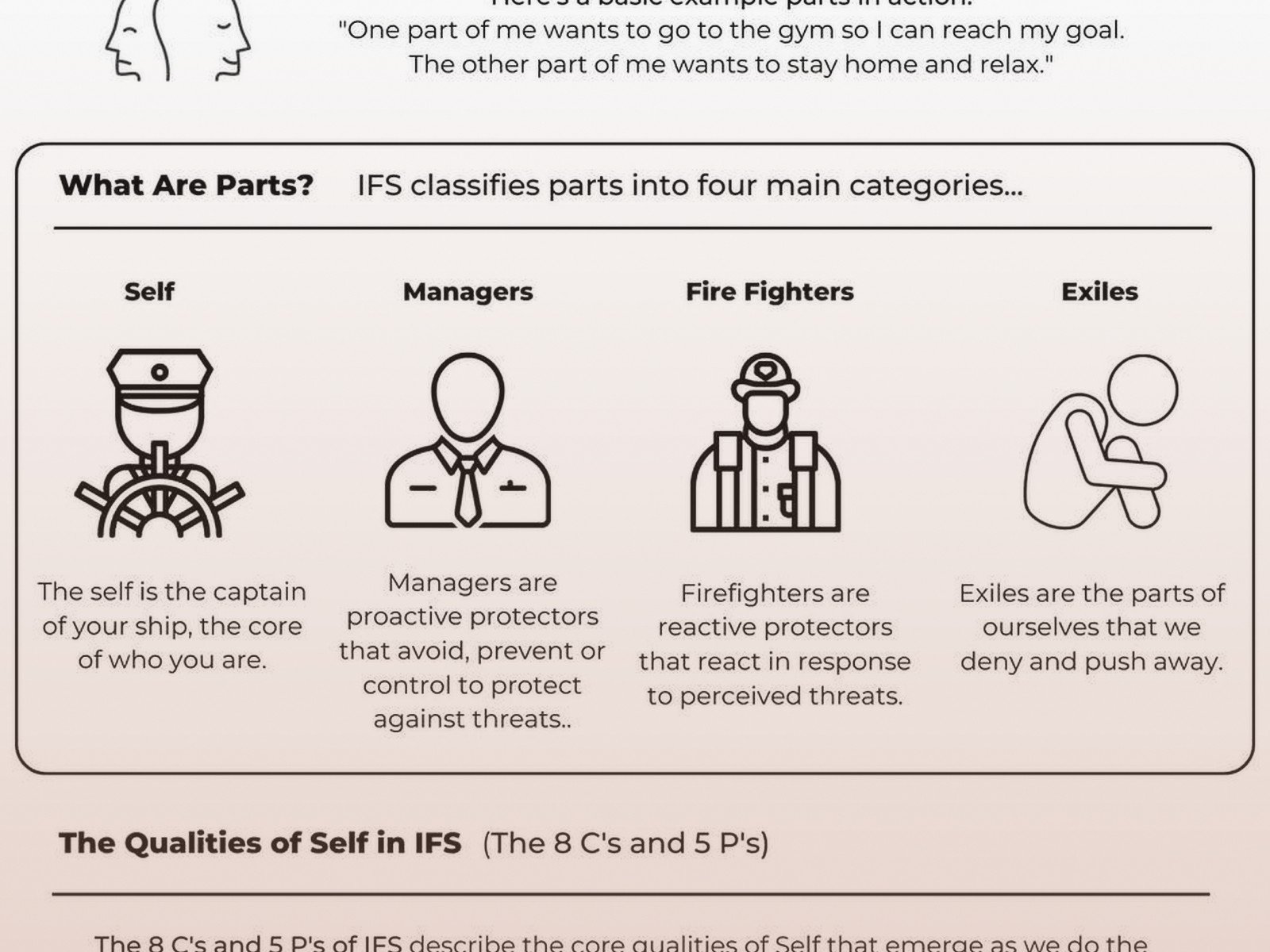
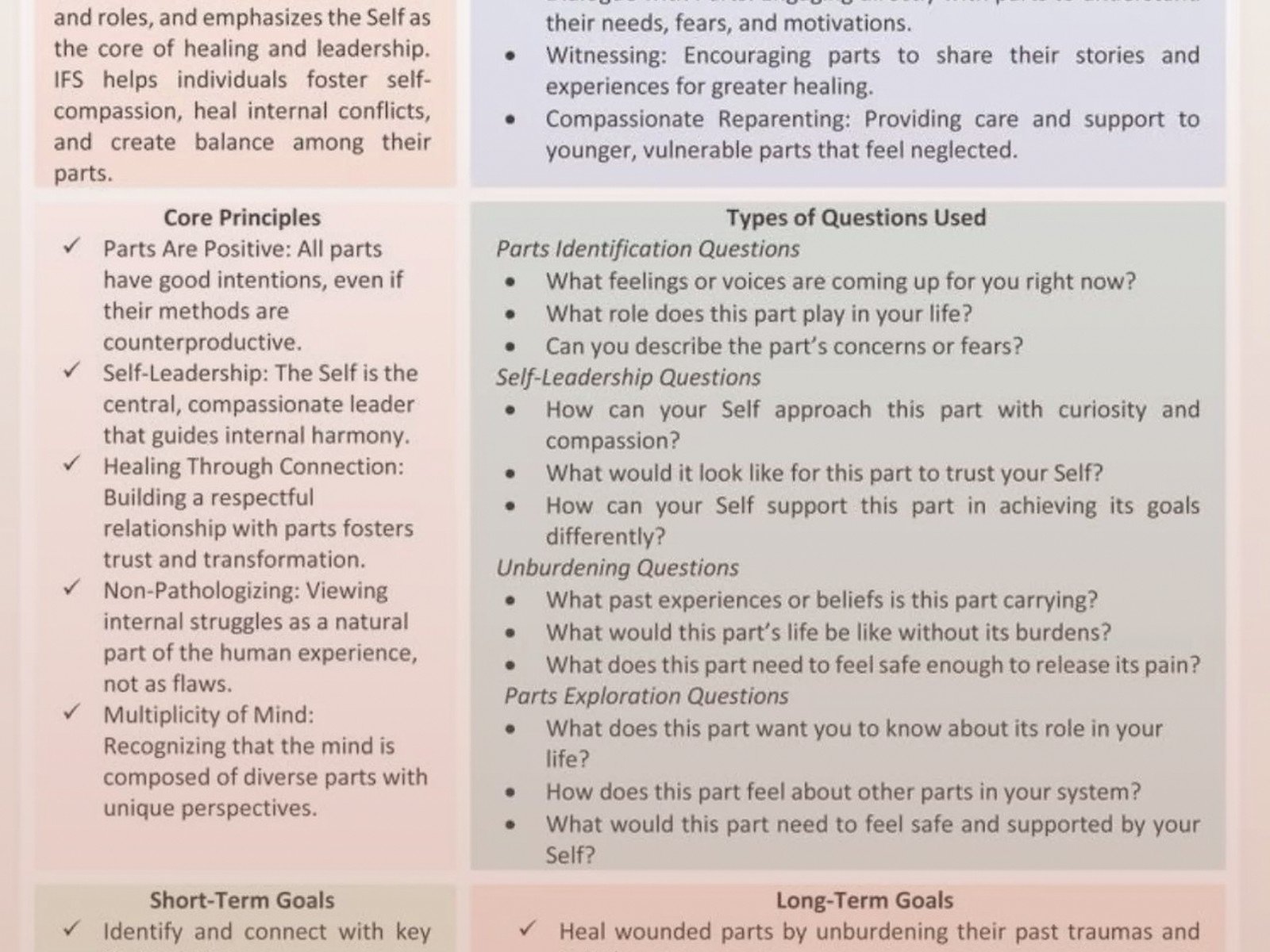
The goal is to access what IFS calls “Self”—the core you that isn’t a part, the calm center that can witness and communicate with parts without judgment. When you’re in Self, you feel the 8 C’s: curiosity, clarity, compassion, calm, confidence, courage, creativity, connectedness. When you’re blended with a part, you feel whatever that part feels—anxiety, rage, shame, numbness.
The worksheet typically asks you to choose one part to focus on. Then you write out a dialogue. You ask the part questions from a place of genuine interest:
- How old do you think you are?
- When did you first show up in my life?
- What are you trying to protect me from?
- What would happen if you stopped doing your job?
- What do you need from me?
And then you write the part’s response. This feels absolutely ridiculous the first time you do it. You’re gonna feel like you’re making it up. You are making it up, sort of, except the answers that come often surprise you.
I tried this exercise with a client who had a part that kept sabotaging her relationships right when they got serious. When she asked the part what it was protecting her from, it said “I’m protecting you from what happened with your dad.” She hadn’t made that connection consciously, but the part had been on guard since she was eleven years old.
Protector vs. Exile Mapping
IFS distinguishes between protectors and exiles. Exiles are the young, vulnerable parts that carry old pain, shame, or trauma. Protectors are the parts that developed to make sure those exiles never get triggered again.
The mapping worksheet usually has you draw or list your protectors first. These are easier to identify because they’re the parts you experience in daily life—the perfectionist, the cynic, the workaholic, the part that dissociates during conflict.
Then you work backward to identify which exiles each protector is protecting. This requires more careful work because exiles are usually hidden. Your protectors don’t want you accessing exile energy because it feels dangerous.
A good worksheet will have you ask your protectors for permission before approaching exiles. “Is it okay if I get to know the part you’re protecting?” If you feel resistance, that’s a protector saying no, and you respect that. You don’t bulldoze your way to the wounded inner child or whatever—that just activates more protection.
What annoys me is when IFS worksheets treat this like a linear process. Like, just identify your parts, dialogue with them, unburden them, done. Nah. Parts work is messy. You’ll think you’ve identified a part and then realize it’s actually three parts wearing a trench coat. You’ll start a dialogue and a completely different part will hijack the conversation.
Unblending Exercise Worksheet
Blending is when you become fused with a part to the point where you can’t distinguish between Self and part. When you’re blended with anxiety, you ARE anxious. When you’re unblended, you can observe “I notice a part of me feels anxious.”
The unblending worksheet walks you through steps to create separation:
- Notice the part (what thoughts, feelings, sensations?)
- Acknowledge it without judgment
- Ask it to step back just a little
- Notice what shifts in your body or awareness
Sometimes you ask a part to step back and it just… won’t. That’s information too. It means the part doesn’t trust that you can handle whatever it’s protecting you from. You might need to build relationship with that part over multiple sessions before it feels safe enough to unblend.
I’ve noticed people get frustrated here because they want immediate relief, but unblending isn’t about making uncomfortable feelings go away. It’s about creating enough space that you’re not completely overtaken by them.
Parts Check-In Journal Prompts
These are ongoing worksheets you return to regularly, not one-time exercises. The prompts might include:
- Which parts showed up today?
- What activated them?
- Did any parts conflict with each other?
- Were you able to stay in Self with any of them?
- What do your parts need right now?
You start noticing patterns. The critic always shows up Sunday evenings before the work week. The shutdown part appears after social events. The helper part activates whenever someone seems even slightly upset.
My cat knocked over my coffee while I was filling out one of these journals last month and I noticed how many parts immediately activated—one part annoyed at the mess, another part worried about the laptop, a third part going “see, you can’t even drink coffee without something going wrong,” and then finally Self showing up like “okay everyone relax, it’s just coffee.”
The Firefighter, Manager, and Exile Framework
IFS categorizes protectors into managers and firefighters. Managers are proactive—they try to control your environment and behavior to prevent exile activation. Firefighters are reactive—they show up after an exile has been triggered and do whatever it takes to numb or distract from that pain.
A worksheet might have you list:
My Manager Parts:
- The planner who tries to anticipate every problem
- The perfectionist who won’t let me submit anything less than flawless
- The people-pleaser who monitors everyone’s mood
My Firefighter Parts:
- The one who scrolls social media for three hours when stressed
- The one who picks fights to create distance
- The one who drinks or uses substances to numb
My Exile Parts (if known):
- The part that felt abandoned at age seven
- The part that carries shame about my body
- The part that believes I’m fundamentally unlovable
Understanding this framework helps you see that even your most destructive behaviors are parts trying to help. The firefighter who uses alcohol isn’t trying to ruin your life—it’s trying to put out the fire of exile pain the only way it knows how.
Creating a Parts Map Visual Worksheet
Some people are visual processors. A parts map lets you draw your internal system rather than just writing about it.
You might draw yourself in the center, then draw or label parts around you. Some people use different colors for different types of parts. Others draw proximity—parts that are very blended might be drawn right on top of Self, while parts you have more distance from might be farther away.
There’s no right way to do this. I’ve seen parts maps that look like organizational charts, solar systems, family trees, or just abstract shapes and colors. The point is externalizing your internal experience in whatever form makes sense to you.
You can update your map over time. Parts that used to be very activated might move farther away as you work with them, or wait, sometimes they move closer because you’re actually building relationship rather than just being controlled by them.
Specific Dialogue Prompts for Stuck Parts
When you’re working with a particularly resistant or stuck part, you need different questions:
- What’s the worst thing that could happen if you stopped protecting me this way?
- How old were you when you took on this job?
- What would you rather be doing if you didn’t have to protect me?
- Do you know that I’m not [age] anymore?
- Would you be willing to update your information about my current life?
That last one is key. A lot of protector parts are operating on outdated information. They think you’re still in the dangerous situation where they first formed. They don’t know you’re 40 years old and no longer living with the person who hurt you.
The worksheet guides you through gently offering this updated information and asking if the part might be willing to try a different role. Not forcing, not demanding—just offering.
Integration and Unburdening Preparation
Unburdening is the IFS term for releasing the burdens (extreme beliefs and emotions) that parts carry. Before you get there, you need preparation worksheets that assess readiness.
Questions might include:
- Do my protectors give permission to work with this exile?
- Am I in Self or blended with a part right now?
- Do I have enough time and space to do this work safely?
- What resources do I have if I become overwhelmed?
You don’t unburden parts in the middle of your work day or right before bed. You need containment and support. Many people do this work with a therapist rather than on their own with worksheets.
The worksheets are tools for ongoing parts work, for building relationship with your system, for tracking patterns and progress. They’re not a replacement for therapy when you’re dealing with significant trauma or when parts are in extreme roles that impact your safety or functioning.