
Mental Health, Therapy resources
Emotion Worksheets: Identify, Understand, and Regulate Your Feelings
Jun
What Emotion Worksheets Actually Do
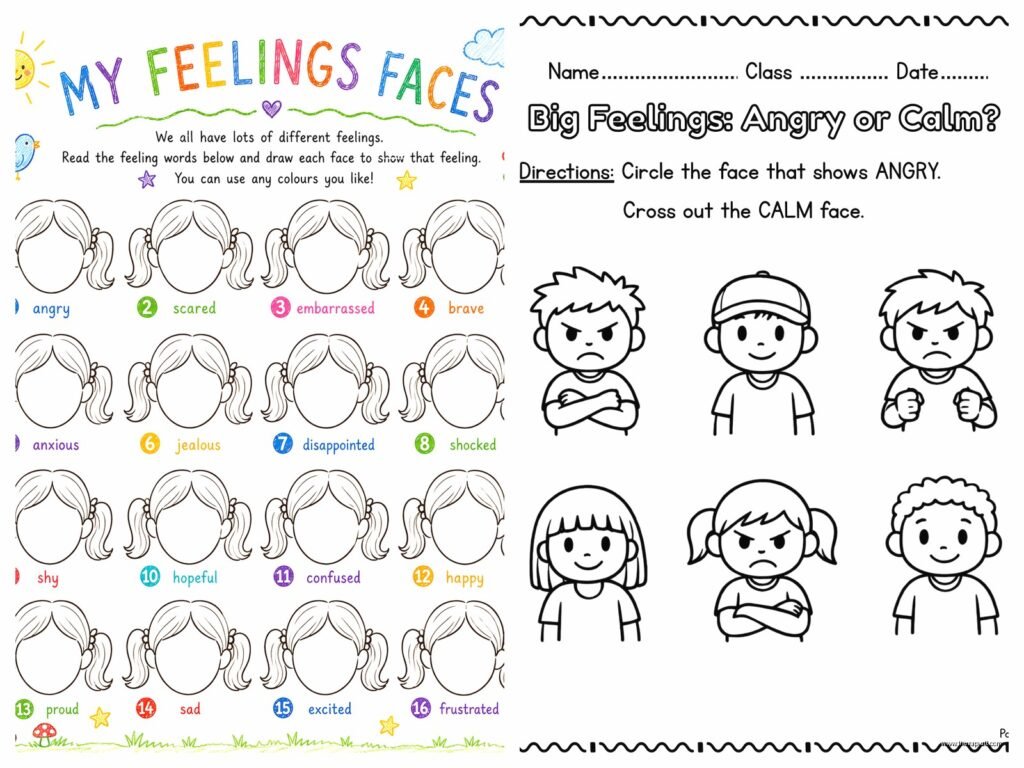
Emotion worksheets are structured tools that help you name what you’re feeling, figure out why you’re feeling it, and decide what to do about it. They’re not journaling prompts or affirmations. They’re frameworks—usually one or two pages—that walk you through a specific emotional process using questions, charts, or fill-in-the-blank formats.
I remember back in 2019, a client brought in this crumpled worksheet from another therapist and said it made her feel worse because she couldn’t identify her emotions from the list provided. The worksheet only had like eight feelings on it—happy, sad, angry, scared, disgusted, surprised, confused, excited—and she was experiencing something way more layered than that. That’s when I realized most emotion worksheets fail because they oversimplify, and people end up feeling broken when they can’t fit their experience into a tiny box.
The good ones don’t do that. They give you language, structure, and space to actually explore what’s happening inside without forcing you into categories that don’t fit.
Why You’d Use One Instead of Just Thinking About It
You might think you can just sit and reflect on your feelings without a worksheet. Sometimes that works. But a lot of the time, emotions are tangled up with physical sensations, automatic thoughts, past experiences, and about twelve other things, and trying to sort through that mentally is like trying to organize a junk drawer while blindfolded.
Worksheets externalize the process. You write things down, which slows your brain down. You can see patterns. You can notice that every time you feel anxious, you also feel a tightness in your chest and start thinking about your mom’s voice. That stuff is harder to catch when it’s just swirling around in your head.
I started using emotion worksheets myself in the summer of 2022 when I was writing content for like four different mental health platforms at once and kept hitting this wall where I’d feel irritable but couldn’t figure out why. Turns out I was angry about boundary stuff in my work life but kept mislabeling it as stress or tiredness. The worksheet I used had a section that asked “what happened right before you noticed this feeling” and that question alone cracked it open.
The Three Main Functions
Most emotion worksheets are designed to do one of three things: help you identify what you’re feeling, help you understand where it’s coming from, or help you regulate it so it doesn’t control your day. Some worksheets try to do all three, which can be useful or overwhelming depending on how you’re wired.

Identification Worksheets
These are the simplest ones and usually the best place to start if you’re someone who says “I don’t know” when people ask how you’re feeling. They typically include an emotion wheel or a list of feeling words organized by intensity or category.
The emotion wheel is probably the most common tool. It starts with basic emotions in the center—stuff like anger, fear, sadness, joy, disgust—and then branches out into more specific feelings. So anger might branch into frustration, irritation, rage, resentment, bitterness. The idea is that you start broad and narrow it down until you find the word that actually fits.
I’ve seen people get really stuck on this part because they think they’re supposed to feel only one thing, and when they circle three or four emotions they assume they’re doing it wrong. Nah. You can feel multiple things at once. You can feel relieved and guilty at the same time. You can feel excited and terrified. Emotions aren’t clean.
Some identification worksheets also ask you to note where you feel the emotion in your body, which sounds kinda woo-woo but is actually grounded in how emotions work physiologically. Fear might show up as a pit in your stomach. Anger might be heat in your face or tension in your jaw. Sadness might be heaviness in your chest or limbs. Tracking that helps you catch emotions earlier, before they build into something unmanageable.
Body Scan Sections
A lot of worksheets include a little body outline where you shade in or mark where you’re feeling sensations. I used to think this was unnecessary until I worked with clients who were completely disconnected from their bodies and genuinely had no idea that the knot in their stomach was related to the anxiety they were reporting. The visual makes it concrete.
Understanding Worksheets
These dig into the why. They’re more analytical and usually involve breaking down a specific emotional experience into parts: the trigger, the thought, the feeling, the physical sensation, the behavior. CBT uses this format a lot—thought records, ABC charts, that kind of thing.
The structure usually goes something like: What happened? What did you think? What did you feel? What did you do? What was the result? It’s formulaic, which some people hate and some people find incredibly clarifying.
What genuinely annoys me is when these worksheets present emotions as if they’re always logical responses to thoughts, like if you just change your thinking the emotion will vanish. That’s not how it works for everyone. Sometimes you feel something first and your brain scrambles to make sense of it afterward. Sometimes emotions are biochemical and don’t have a neat cognitive explanation. The worksheets that acknowledge that—by including sections for “I don’t know why I feel this way” or “this might not make logical sense”—are way better.
Trigger Mapping
Some understanding worksheets focus specifically on identifying patterns over time. You log emotions daily or weekly and look for recurring triggers. Maybe you notice you feel shame every time you talk to your sister, or anxiety spikes every Sunday night, or you feel flat and numb after scrolling social media for more than twenty minutes.
I had a client who tracked her emotions for a month and realized she felt angry every single time she got a text from her boss, even before reading it. Just seeing his name on her screen triggered a whole cascade. That awareness alone changed how she approached her job situation—she didn’t just think she hated her work, she realized she hated how her boss communicated and that was something she could actually address.

Regulation Worksheets
These are action-oriented. They assume you already know what you’re feeling and why, and now you need to do something about it so you don’t spiral or make things worse. Regulation worksheets often include coping skills lists, grounding exercises, or decision trees that help you figure out what intervention makes sense for the intensity of what you’re experiencing.
DBT has a ton of these—crisis survival skills, distress tolerance techniques, opposite action worksheets. The idea is that different emotions call for different strategies, and different intensities call for different levels of intervention.
If you’re mildly anxious, maybe you just need to take a few deep breaths or go for a walk. If you’re in a full panic attack, you might need more intense grounding—ice on your wrists, the 5-4-3-2-1 sensory exercise, that sort of thing. If you’re angry but not enraged, you might be able to talk it out. If you’re rage-filled, you probably need to physically move or discharge the energy before you can have a rational conversation.
Regulation worksheets help you match the tool to the situation instead of just trying the same thing over and over and wondering why it doesn’t work. My cat does this thing where she gets overstimulated and starts biting, and I’ve learned she needs completely different interventions depending on how worked up she is—sometimes distraction works, sometimes she just needs to be left alone. Emotions kinda work the same way.
Opposite Action
This is a DBT concept that shows up in a lot of regulation worksheets. The idea is that sometimes your emotion is valid but acting on it would make things worse, so you intentionally do the opposite of what the emotion is urging you to do.
If you’re feeling shame and the urge is to hide, opposite action might be to reach out to someone safe. If you’re feeling anxious about something that’s not actually dangerous and the urge is to avoid it, opposite action might be to approach it gradually. If you’re angry and the urge is to lash out, opposite action might be to be gentle or take space.
The worksheets walk you through identifying the emotion, the urge, whether acting on the urge would be effective, and what the opposite action would look like. It’s not about suppressing feelings—it’s about unhooking behavior from emotion when the behavior isn’t serving you.
What to Look for in a Worksheet
Not all emotion worksheets are created equal. The bad ones are patronizing, oversimplified, or so cluttered with graphics and fonts that they’re hard to focus on. The good ones are clean, specific, and flexible enough to fit different experiences.
You want worksheets that use a wide range of emotion vocabulary, not just the basic six or eight feelings. You want ones that don’t assume all emotions are problems to be fixed—sometimes you just need to understand what you’re feeling, not change it. You want ones that leave space for complexity, for “I don’t know,” for multiple emotions at once.
If a worksheet makes you feel stupid or broken for not being able to complete it, throw it out. Seriously. I’ve seen so many badly designed tools that demand you identify a “core belief” or a “primary emotion” when you’re still just trying to figure out if you’re anxious or sad or some weird combination of both and… honestly the ones that give you permission to not have it all figured out are the ones that actually help.
Digital vs. Paper
There are apps now that do this stuff digitally, and some people love that because it’s always on your phone and you can track trends over time with graphs and charts. I’m gonna be honest though—I still think paper works better for most people. Writing by hand slows you down in a way typing doesn’t, and there’s something about the physical act of filling out a worksheet that makes it feel more real.
That said, if you’re someone who never has a pen handy or you lose paper constantly, digital is better than nothing.
When Worksheets Don’t Help
Sometimes they just don’t. If you’re in the middle of a crisis, a worksheet isn’t gonna do much—you need immediate coping skills or support, not a form to fill out. If you’re someone whose trauma response is dissociation, trying to identify and name feelings might actually make things worse by pulling you into something you’re not ready to process.
Worksheets are tools, not therapy. They work best when you’re in a relatively stable place and you’re trying to build skills or understand patterns. They don’t replace professional support if you need it, and they’re not a measure of how well you’re doing. You can be terrible at worksheets and still be managing your emotions just fine in your actual life.
I’ve also noticed that some people use worksheets as a way to avoid actually feeling their feelings—they intellectualize everything, fill out the form perfectly, and never actually sit with the discomfort. If that’s you, you might need less structure and more space to just be with what’s coming up, which is uncomfortable but sometimes necessary.
How to Actually Use Them
Start with identification if you’re not sure what you’re feeling. Move to understanding if you keep feeling the same thing and don’t know why. Use regulation worksheets when you know what you’re feeling but it’s overwhelming or leading you toward behavior you’ll regret.
You don’t have to use them every day. Some people use them only when something big happens. Some people use them as a weekly check-in. Some people use them once, get what they need, and never look at them again.
Keep them somewhere accessible. If they’re buried in a drawer or saved in a folder you never open, you won’t use them. Print a few out and stick them in a notebook, or save them to your phone’s home screen if you’re going digital.
Don’t expect them to feel good. Emotional work isn’t supposed to be pleasant. It’s supposed to be clarifying. If a worksheet helps you see something you weren’t seeing before, it’s doing its job, even if what you see is uncomfortable.
ADHD & Neurodiversity
Life Planner Bundle – Life Organizer
Self-Care & Personal Growth
Acceptance And Commitment
Anxiety & Stress
Stress Processing Journal & Reflection Worksheets For Daily Self – Care
Self-Care & Personal Growth
Self – Reflection Guided Journal With Guided Prompts 30
Emotional Wellness
Decision Processing – Thought Processing Journal For Daily Self – Care
Therapist Resources
Physiotherapist Journal PDF Planner Tracker Or Log Book
Self-Care & Personal Growth
Customizable Self – Confidence & Self – Esteem Guided Journal
ADHD & Neurodiversity
ADHD Behavior Tracker PDF Planner Tracker Or Log Book