
Mental Health, Therapy resources
Thought Restructuring Worksheet: Reframe Negative Thought Patterns

Jun
# Thought Restructuring Worksheet: Reframe Negative Thought Patterns
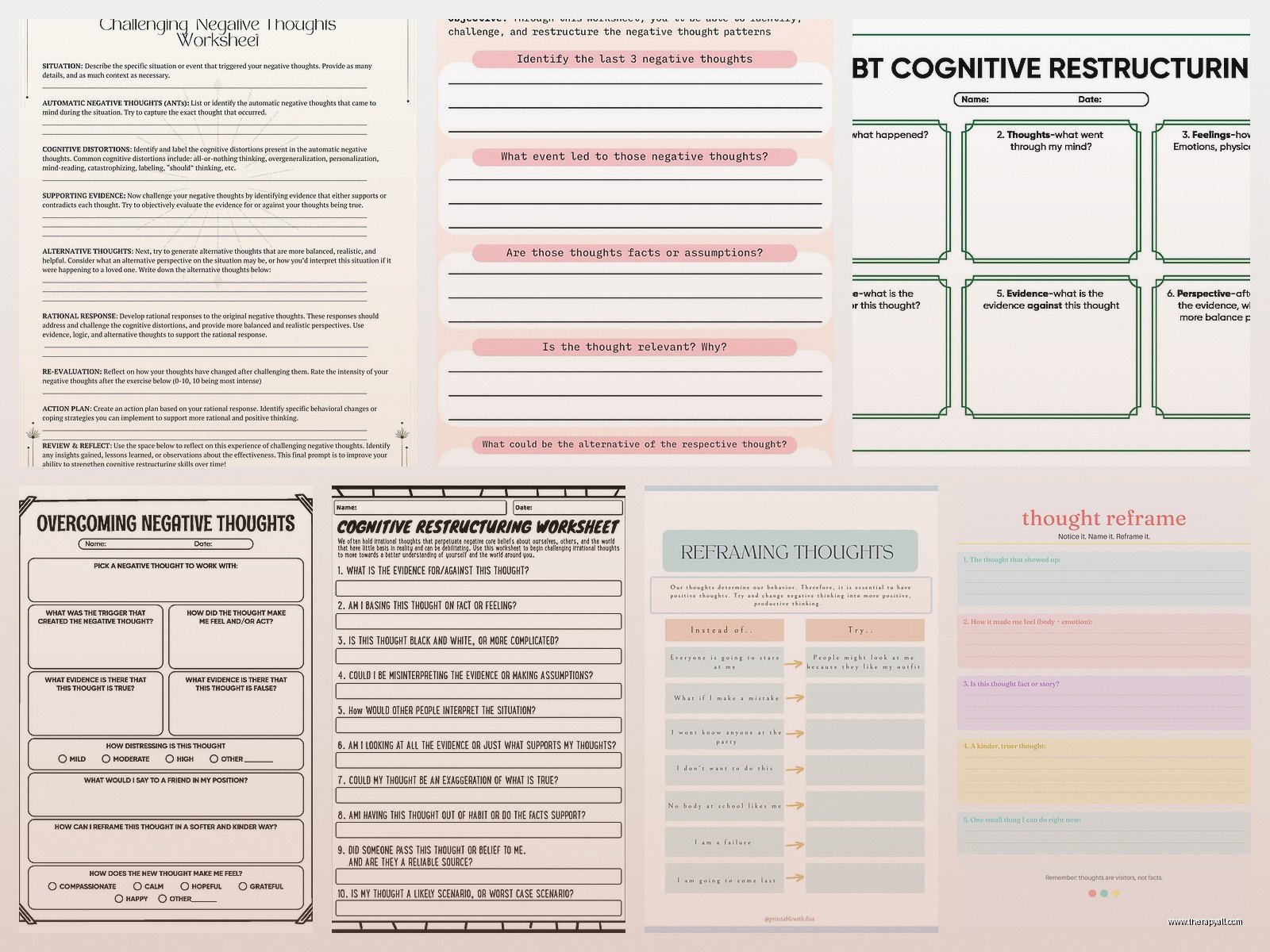
Thought restructuring worksheets are paper or digital tools designed to help you identify, evaluate, and replace distorted thinking patterns with more balanced interpretations. The core technique comes from cognitive behavioral therapy, specifically Aaron Beck’s work in the 1960s, and the worksheet format became standard practice because therapists needed a way for clients to practice the skill outside sessions.
The typical worksheet includes columns for: the triggering situation, the automatic thought that pops up, the emotions you feel, evidence supporting the thought, evidence against it, and a more balanced alternative thought. Some versions add intensity ratings or behavioral responses. I remember during my first year writing mental health content, I reviewed maybe fifteen different thought restructuring templates and got genuinely annoyed at how many of them were just… badly organized. Like, they’d ask you to rate your emotional intensity before you’d even identified what emotion you were feeling, or they’d use therapy jargon that nobody outside a graduate program would understand.
You start by writing down the situation as objectively as possible. Not “my boss hates me and ruined my day” but “my boss didn’t respond to my email for three hours, then sent a two-sentence reply.” The situation section should read almost like a police report or something, just facts without interpretation. This is harder than it sounds because our brains automatically blend fact and interpretation.
The automatic thought column is where you record the immediate thought that showed up. These thoughts happen fast, they feel true, and they usually contain cognitive distortions. Common examples: “I’m going to get fired,” “Nobody likes me,” “I always mess everything up,” “This proves I’m incompetible”—wait, incompetent, though honestly incompetible should be a word. Automatic thoughts often include words like always, never, everyone, nobody, should, or must.
Then you identify the emotions. Not thoughts disguised as feelings, but actual emotions. “I feel like he’s mad at me” is a thought. “I feel anxious” is an emotion. This distinction trips people up constantly. You might feel multiple emotions at once: anxious, embarrassed, and angry could all show up together. Rating the intensity from 0-100 helps track whether the restructuring actually changes anything.
The evidence-for column asks you to list facts that support your automatic thought. And here’s what annoys me about how this gets taught sometimes: people think you’re supposed to talk yourself out of your feelings or prove your thoughts wrong. Nah. You’re supposed to actually look for real evidence. If your thought is “my boss is angry with me,” real evidence might be “she used a period instead of an exclamation point” or “she didn’t include a greeting.” Write down what you’ve got, even if it seems thin.
The evidence-against column is where you list facts that contradict or don’t support the automatic thought. “She responded to my question,” “she approved my time-off request yesterday,” “she’s been short with everyone today,” “I’ve never been written up or warned about my performance.” You’re building a case here. I always tell people—well, I write for people who are reading, but you know what I mean—that this isn’t about positive thinking, it’s about accurate thinking.
My cat just knocked over my water bottle, hang on—okay, anyway, the alternative thought section is where you write a more balanced interpretation based on the evidence you’ve collected. Not “everything is fine and my boss loves me,” but something like “my boss gave a brief response, which might mean she’s busy, not that she’s angry with me. I don’t have evidence that my job is at risk.” The alternative thought should acknowledge reality while removing the distortion.
Some worksheets include a re-rating of emotional intensity after you’ve completed the thought restructuring. If your anxiety was 85/100 and it’s now 40/100, that’s useful data. If it didn’t change at all, that’s also useful data—maybe the thought wasn’t the main driver, or maybe you need more practice with the technique, or maybe there’s a genuine problem that needs addressing through action rather than cognitive work.
## How Cognitive Distortions Show Up
The worksheet works because it targets specific distortion patterns. All-or-nothing thinking turns everything into extremes: perfect or failure, loved or hated, success or disaster. You see this in thoughts like “I made one mistake so the entire project is ruined.” The evidence columns help you spot the middle ground that actually exists.
Overgeneralization takes one event and makes it a forever pattern. “I got rejected once” becomes “I’ll never find a relationship.” The words always and never are red flags here. When you list evidence, you’re forced to acknowledge that one data point doesn’t establish a pattern.
Mental filtering is when you focus exclusively on negatives and ignore or discount positives. Someone gives you feedback with nine compliments and one suggestion for improvement, and you obsess over the criticism. The evidence-against column makes you write down those nine compliments, which your brain was gonna skip right over otherwise.
Disqualifying the positive is filtering’s cousin—you acknowledge positive experiences but explain them away. “They only said that to be nice,” “That success doesn’t count because it was easy,” “Anyone could have done that.” This one’s tricky because you’ll fight to maintain your negative belief even when presented with contradictory evidence.
Jumping to conclusions includes mind reading (assuming you know what others think) and fortune telling (predicting the future negatively). “She thinks I’m stupid” is mind reading. “This presentation will be a disaster” is fortune telling. Both involve treating assumptions as facts. The evidence section forces you to separate assumption from observation, which is—look, it’s uncomfortable because you realize how much you’ve been treating your guesses as certainties.
Magnification and minimization mean blowing negatives out of proportion while shrinking positives. “I stumbled over one word in my speech” becomes “I humiliated myself in front of everyone” while “I spoke clearly for 25 minutes and answered questions well” becomes “That’s just basic, not impressive.” The intensity ratings help track this distortion.
Emotional reasoning is treating feelings as facts: “I feel stupid, therefore I am stupid,” “I feel like a burden, therefore I am one.” Worksheets interrupt this by asking for actual evidence. Your emotions are real and valid, but they’re not always accurate reporters of external reality.
Should statements create rigid rules about how you or others must behave. “I should be over this by now,” “They should have known better,” “I shouldn’t need help.” These thoughts generate guilt, frustration, and resentment. The alternative thought section helps rephrase these into preferences rather than demands.
Labeling is an extreme form of overgeneralization where you attach a fixed identity to yourself or others based on one event or characteristic. “I’m a loser,” “She’s a narcissist,” “He’s lazy.” Worksheets help you describe behaviors rather than assigning permanent labels. Instead of “I’m a failure,” you might write “I failed this test,” which is specific and changeable.
Personalization means taking responsibility for things outside your control or assuming everything relates to you. “My friend seems upset—I must have done something wrong” when maybe your friend just got bad news. The evidence columns help you identify other possible explanations.
## Actually Using The Worksheet
I’m gonna be honest, when I first started writing about these tools back in like 2018 or 2019, I thought they seemed kinda mechanical and I wasn’t sure people would actually use them. Then I started using them myself during a particularly rough stretch and realized they work specifically because they’re mechanical. The structure keeps you from spiraling.
You need to fill these out when you’re moderately distressed, not in crisis. If you’re at a 95/100 anxiety, you probably can’t engage with the worksheet effectively. Wait until you’re at 50-70, where you’re bothered enough to be motivated but calm enough to think. Some people fill them out after the emotional intensity has already decreased, which is fine for practice but less useful for actually shifting the emotion in the moment.
Handwriting versus typing is a personal preference thing. Some research suggests handwriting engages different cognitive processes, but I’ve seen people benefit from both. Digital worksheets have the advantage of being searchable—you can look back and notice patterns across multiple entries. Paper worksheets can be thrown away or burned if you find that cathartic, which you can’t really do with a Google doc.
Common mistakes include: being too vague in the situation column, writing multiple thoughts instead of identifying the hottest one, confusing thoughts and feelings, only filling out the parts that confirm what you already believe, and writing what you think you should write rather than what you actually think. The worksheet only works if you’re honest about what’s actually going through your head, even if it sounds irrational or embarrassing.
Some people need prompts for the evidence columns. Questions like “What would I tell a friend in this situation?” or “What would someone who cares about me say?” or “What’s another way to interpret this?” or “What do I know about this person/situation from past experience?” can help generate alternatives when you’re stuck.
## When Worksheets Don’t Work
Thought restructuring assumes your thoughts are distorted. Sometimes they’re not. If you think “I’m going to lose my job” and you’ve actually been told you’re on a performance improvement plan, that’s not a cognitive distortion, that’s an accurate assessment of risk. The worksheet might help you separate “I’m at risk of losing my job” from “I’m a worthless person,” but it won’t make the job situation less real.
Similarly, if you’re in an actually harmful situation—an abusive relationship, a discriminatory workplace, a genuinely unsupportive environment—thought restructuring can’t fix that. “My partner isn’t really that bad” is not a helpful alternative thought if your partner is actually mistreating you. I get frustrated when CBT techniques get marketed as a cure-all when sometimes the problem isn’t your thinking, it’s your circumstances, and you need to change the situation, not your interpretation of it.
Trauma responses don’t always respond to thought restructuring. If you have PTSD and you’re having intrusive thoughts, a worksheet probably isn’t the right tool in that moment. You might need grounding techniques, somatic work, or trauma-focused therapy approaches. Thought restructuring can be part of trauma treatment, but it’s not sufficient on its own.
Depression can make worksheets feel impossible. When you’re really depressed, finding evidence against your negative thoughts feels like lying. Everything confirms that life is pointless and you’re worthless. You might need medication, behavioral activation, or other interventions before thought restructuring becomes accessible. That said, some people find that mechanically filling out the worksheet, even when they don’t believe it, eventually creates small shifts. It’s individual.
Some thoughts are so automatic and so deeply believed that one worksheet won’t touch them. Core beliefs like “I’m unlovable” or “I’m incompetent” developed over years, maybe decades. They need repeated challenging across multiple situations, possibly with a therapist helping you trace the belief back to its origins and examine whether childhood conclusions still apply to your adult life.
## Variations and Additions
Some worksheets add a behavior column: what did you do in response to this thought, or what would be a helpful action based on the alternative thought? This connects cognitive work to behavioral change. If your alternative thought is “my friend is probably just busy,” a helpful behavior might be “send a casual follow-up text” rather than “avoid her forever because I’ve decided she hates me.”
Thought records sometimes include a section for identifying which cognitive distortion is present. This can be helpful for learning to spot your patterns, though it can also turn into an intellectual exercise that doesn’t actually shift the emotion. Some people get caught up in categorizing the distortion perfectly instead of actually challenging it.
Worry worksheets add probability estimates: what’s the likelihood this feared outcome will actually happen? What’s the likelihood you could cope even if it did happen? This works well for anxiety but less well for depression or shame-based thoughts.
Some versions include a positive data log where you record experiences that contradict your negative core beliefs. If you believe “I’m unlikable,” you log every interaction where someone chose to spend time with you, laughed at your joke, asked for your opinion, whatever. Over time, you build a database of counterevidence. I actually started doing this in summer 2021 when I was writing a piece about cognitive distortions and realized I was doing literally all of them, and it… it helped more than I expected, honestly.
Gratitude additions irritate me though. Not every thought restructuring worksheet needs to end with “three things I’m grateful for.” That’s a different intervention with a different purpose, and smooshing them together dilutes both. You can restructure a distorted thought without performing gratitude.
## Making It Stick
One worksheet won’t rewire your brain. You need repetition. Most therapists suggest doing thought records daily for several weeks, even when you’re not particularly distressed, to build the skill. It’s like learning an instrument—you practice scales when you’re calm so you can play music when it matters.
Some people set a reminder to fill one out each evening, reviewing the day for moments when their mood shifted. Others keep a worksheet template on their phone and fill it out in real-time when they notice a thought spiral starting. Both approaches work, it’s about what you’ll actually do consistently.
Reviewing old worksheets shows you patterns. You might notice you always jump to mind reading with your partner but catastrophize about work. Or that your alternative thoughts are still pretty negative and need work. Or that certain situations consistently trigger certain thoughts. These patterns become targets for deeper work.
Eventually, the process becomes more automatic. You start catching distorted thoughts in real-time and mentally running through the evidence without needing to write it down. That’s the goal—internalized cognitive flexibility, not lifelong dependence on worksheets. Though some people keep using them forever for particularly sticky thoughts, and that’s fine too.
The worksheet is just a tool. It structures a cognitive process that becomes easier with practice. You’re training your brain to pause between thought and reaction, to question automatic interpretations, to generate alternatives. That’s it, really—nothing magical, just a systematic way to interrupt patterns that aren’t serving you.

ADHD & Neurodiversity
Life Planner Bundle – Life Organizer
Self-Care & Personal Growth
Acceptance And Commitment
Anxiety & Stress
Stress Processing Journal & Reflection Worksheets For Daily Self – Care
Self-Care & Personal Growth
Self – Reflection Guided Journal With Guided Prompts 30
Emotional Wellness
Decision Processing – Thought Processing Journal For Daily Self – Care
Therapist Resources
Physiotherapist Journal PDF Planner Tracker Or Log Book
Self-Care & Personal Growth
Customizable Self – Confidence & Self – Esteem Guided Journal
ADHD & Neurodiversity
ADHD Behavior Tracker PDF Planner Tracker Or Log Book