# ABC Therapy Worksheet: Understanding Behavior Through CBT
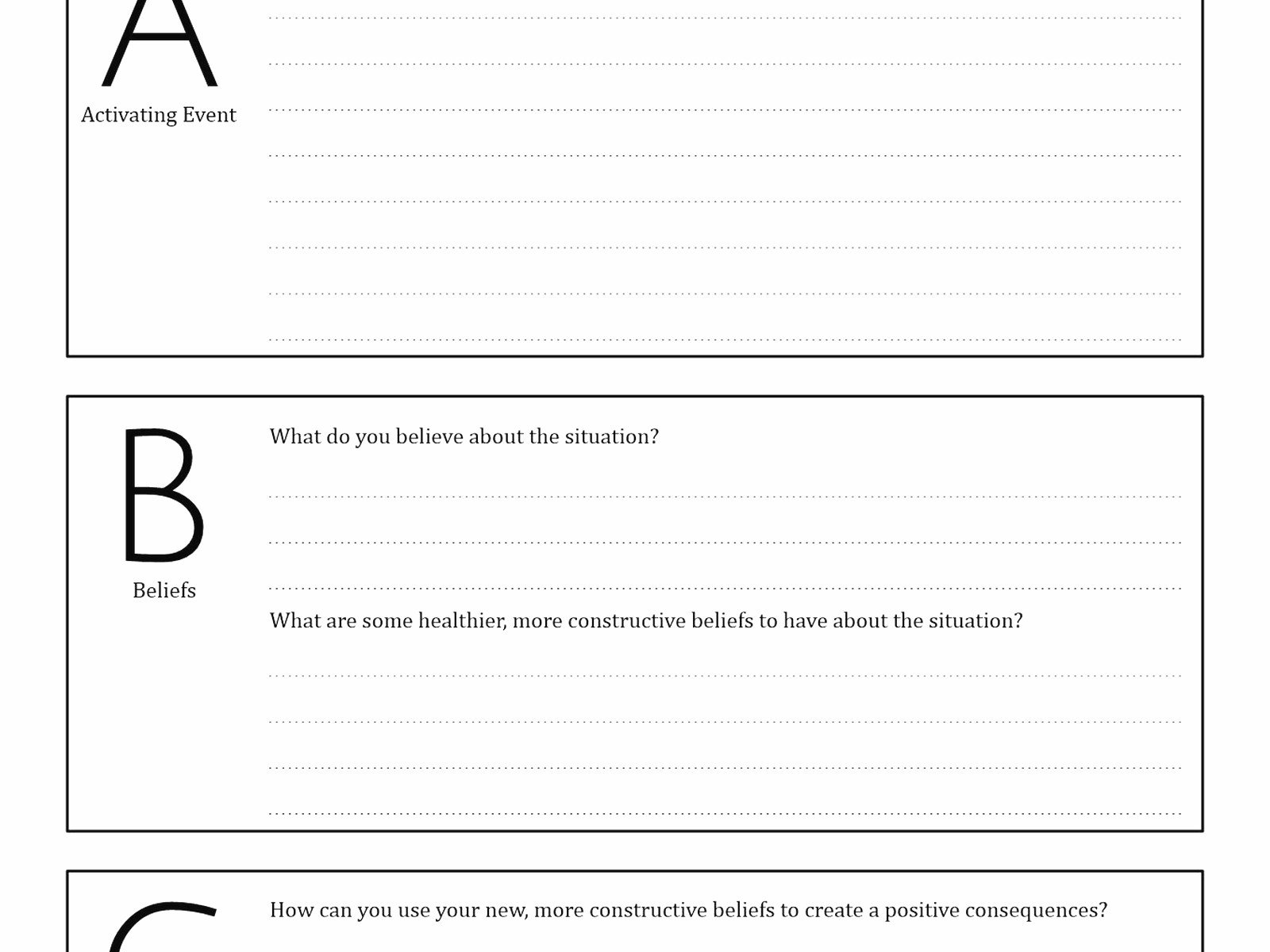
The ABC model is one of those foundational CBT tools that sounds deceptively simple until you actually try to use it with real situations. A stands for Activating Event, B for Beliefs, and C for Consequences. The premise is that events don’t directly cause our emotional responses—our beliefs about those events do.
I remember sitting in a supervision session back in 2019 when my supervisor pulled out an ABC worksheet for a case I was stuck on, and honestly I was kinda annoyed because I thought I already understood it. Turns out I was skipping the B part almost entirely and just drawing straight lines from events to feelings, which is exactly what CBT is designed to interrupt.
The activating event is whatever happened in the external world. Your boss sent a terse email. Your friend didn’t text back. You got stuck in traffic. Someone cut in front of you at the grocery store. It’s the objective, observable situation—or at least as objective as we can get, because even describing events we tend to inject interpretation.
Here’s where people mess up the A part: they describe it with embedded judgments. “My boss was rude to me” isn’t an activating event, it’s already got belief baked into it. “My boss sent an email that said ‘See me at 3pm’ with no other context” is closer to the actual event. You want facts that a camera could record.
The beliefs section is where the actual therapeutic work happens, and it’s the part that gets skipped or misunderstood constantly. Your beliefs are the thoughts, interpretations, assumptions, and evaluations you have about the activating event. They’re often automatic—you don’t sit there consciously deciding to think them. They just appear.
Common beliefs include things like “This means I’m going to get fired” or “They must hate me” or “I can’t handle this” or “This shouldn’t be happening.” Notice these are interpretations, predictions, evaluations. They’re not facts even though they feel like facts when you’re inside them.
What genuinely irritates me about how ABC worksheets get presented in therapy content is that they’re often shown as this neat, linear process where you fill in boxes and suddenly have insight. In reality, identifying your beliefs takes practice because we’re so fused with them. When I first started using these worksheets myself—summer 2022 I was writing like three worksheet roundups a week and started actually using them because I figured I should probably know what I’m recommending—I kept writing feelings in the B section instead of thoughts.
You have to learn to distinguish between “I feel anxious” (that’s a consequence) and “I’m thinking this situation is dangerous” (that’s a belief). The belief comes first temporally, even if you notice the feeling first.
Consequences are the emotional, behavioral, and physical results of your beliefs. Not of the activating event—of your beliefs about it. This is the crucial distinction. If your boss sends that terse email and you believe “I’m about to get fired,” your consequences might include anxiety, stomach tension, difficulty concentrating, avoiding your boss, or obsessively rehearsing what you’ll say at 3pm. If you believe “My boss is probably just busy and wants to check in about the project deadline,” your consequences might be mild curiosity or no particular emotional response at all.
Same activating event. Different beliefs. Completely different consequences.
The consequences section should include emotions (anxious, angry, sad, guilty), behaviors (avoided, snapped at someone, went for a walk, drank wine), and physical sensations (tight chest, headache, nausea, tension). You want to track all three because they’re interconnected and sometimes one is more noticeable than the others.
Now let’s talk about how to actually use this thing, because having a blank ABC worksheet in front of you when you’re upset is… well, it’s not gonna automatically help. You need a situation to work with, ideally something specific and recent. “My anxiety in general” is too broad. “What happened Tuesday morning when I saw my ex’s Instagram post” is specific enough to analyze.
Start with C if that’s easier. Sometimes you notice the consequence first—you’re anxious, you’re angry, you just yelled at your partner—and you work backwards. What just happened (A)? What was I thinking about what happened (B)? There’s no rule that says you have to fill it out in ABC order, and actually working backwards from the feeling can sometimes help you identify the activating event more clearly.
When you’re filling in the beliefs section, you’re looking for hot thoughts—the beliefs that carry the most emotional charge. You might have multiple thoughts about a situation, but usually one or two are driving the emotional response. You can test this by asking “If I really believed [thought], would that explain how I’m feeling?” If yes, you’ve found a hot thought.
My cat just knocked over my water bottle and I’ve gotta stop and clean this up, but anyway—hot thoughts are usually the ones worth challenging or examining further, which is where the ABC model connects to the rest of CBT.
Some versions of the ABC worksheet include a D section for Disputation and an E section for new Effect. That’s where you examine the evidence for and against your belief, consider alternative interpretations, and notice how your emotional response shifts when you hold different beliefs. But honestly that’s moving into a full ABCDE model and we’re talking specifically about the basic ABC structure here.
The point of the ABC worksheet isn’t to eliminate negative emotions or convince yourself that bad things aren’t happening. It’s to see the space between what happens and how you feel about it. That space is where your beliefs live, and beliefs can be examined, questioned, and sometimes modified in ways that events cannot.
You can’t change the fact that your boss sent a terse email. You can examine whether your interpretation of what that email means is accurate or helpful.
One thing I notice when people first start using ABC worksheets is they’ll identify a belief and then immediately judge themselves for having it. “I shouldn’t think this way” becomes another layer of belief to work through. The worksheet is descriptive, not prescriptive. You’re just mapping what’s happening in your cognitive-emotional system, not deciding whether you’re doing it right or wrong.
Sometimes the activating event is internal rather than external. A physical sensation (heart racing) or a memory (remembering something embarrassing from five years ago) can trigger beliefs and consequences just like external events do. The model still works the same way—there’s still a gap between the trigger and your interpretation of what it means.
I’ve seen ABC worksheets formatted a dozen different ways. Three columns, three rows, a triangle diagram, a flowchart. The format matters less than understanding the relationships between the components. Event influences belief influences consequence. And here’s the thing that took me way too long to fully grasp—consequences can become new activating events.
You believe your boss is angry, you feel anxious (consequence), then you avoid your boss (behavioral consequence), then your boss seems even more distant (new activating event), and the cycle continues. This is how anxiety and depression maintain themselves. The ABC model helps you see these cycles by slowing down the process and examining each component.
Some therapists use ABC worksheets as homework between sessions. You track situations throughout the week, bring them in, and work through them together. Others use them in session to break down something that just happened or a recurring pattern. I think they’re most useful when you’re first learning to distinguish between events, thoughts, and feelings—once you get the hang of it, you can do the analysis in your head without writing it down.
But writing it down has value, especially when you’re emotionally activated. It externalizes the process and makes the components easier to see. When everything’s swirling in your head, putting it on paper creates some separation.
The beliefs section is where you’ll often find cognitive distortions—those patterns of thinking that CBT identifies as common and problematic. All-or-nothing thinking, catastrophizing, mind reading, fortune telling, emotional reasoning. When you write down your beliefs explicitly, these patterns become more visible. “I always mess everything up” is all-or-nothing thinking. “They definitely think I’m incompetent” is mind reading. “This feeling means something terrible is going to happen” is emotional reasoning.
You don’t need to memorize the list of cognitive distortions to use an ABC worksheet effectively, but being familiar with them helps you spot patterns in your own thinking. Oh, there I go again predicting disaster without evidence. Oh, I’m mind reading what they think of me.
The model assumes a certain logical relationship between beliefs and emotions, which mostly holds true but isn’t absolute. Sometimes emotions arise from physiological states or trauma responses that bypass the belief system entirely, or at least don’t follow the neat ABC sequence—that’s where other therapeutic approaches come in, and why CBT isn’t the only tool anyone needs. But for a huge range of everyday emotional struggles, the ABC model provides a useful framework for understanding what’s happening and where intervention might be helpful.
When I’m filling out an ABC worksheet myself, I usually have to revise the beliefs section several times because my first pass is too surface level. The thought “This is bad” isn’t specific enough. Bad how? Bad in what way? What does “bad” mean in terms of consequences I’m predicting or values I think are being violated? Getting to the underlying belief takes some digging.
You might find it helpful to ask yourself questions like: What does this event mean about me? What does it mean about my future? What does it mean about other people? What am I afraid will happen now? These questions can uncover the beliefs that are generating your emotional response.
The ABC model works for positive emotions too, not just difficult ones. If you get good news and feel elated, there’s still a belief mediating that response—perhaps “This means I’m successful” or “This validates my hard work” or “Now things will be easier.” Understanding the beliefs behind positive emotions can be useful too, especially if those beliefs are fragile or depend on external validation.
I’ll stop here because we’ve covered the core components, how they relate to each other, common mistakes people make using the worksheets, and practical tips for filling them out.