# Understanding Behavioural Activation Worksheets
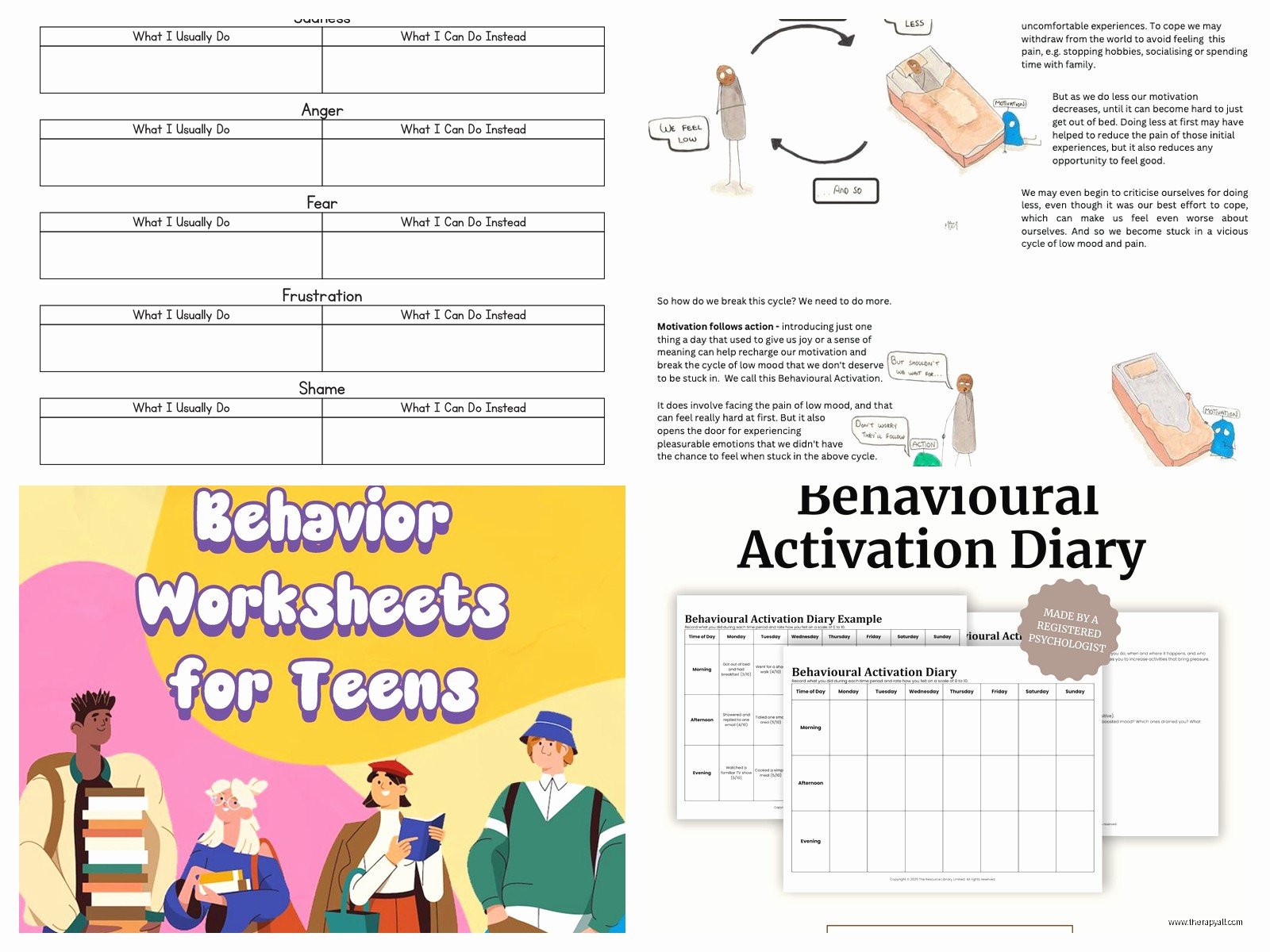
Behavioural activation is one of those therapeutic interventions that sounds simple until you actually try to explain it to someone who’s deep in a depressive episode. The basic premise: when you’re depressed, you withdraw from activities, which makes you more depressed, which makes you withdraw more. It’s a loop. Behavioural activation breaks that loop by systematically getting you to re-engage with activities that align with your values and give you a sense of accomplishment or pleasure.
I remember back in 2019, I had a client who printed out every single worksheet I recommended and brought them to session in a three-ring binder organized by color. She’d done maybe 10% of them. The issue wasn’t motivation—it was that half the worksheets out there are overcomplicated, ask too many questions, or just feel like homework from a class you’re already failing.
## What Actually Makes a Good Behavioural Activation Worksheet
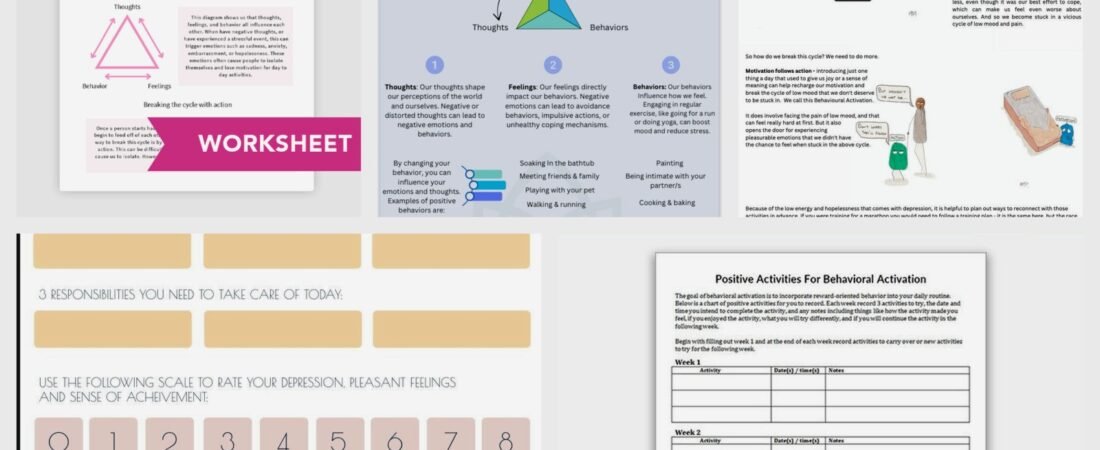
The worksheets that work aren’t the ones with twelve columns and tiny font. You need something that tracks three basic elements: the activity itself, the context (when and where), and how you felt afterward. Some versions include a rating scale for mood before and after, which can be useful if you’re the kind of person who likes data. I’m gonna be honest—some people hate rating their mood on a 1-10 scale because it feels reductive, but it does help you spot patterns over time.
A functional worksheet typically includes:
- Day and time of the activity
- Description of what you did
- Who you were with (or if you were alone)
- Mood rating before the activity
- Mood rating after
- Notes section for anything you noticed
The notes section is actually the most important part, even though it looks like an afterthought on most templates. That’s where you write things like “felt weird at first but got easier” or “didn’t want to go but glad I did” or “this sucked and I’m not doing it again.” You need that qualitative data because numbers alone won’t tell you that going to the gym at 6am makes you feel virtuous but also resentful.
## Where to Find Free PDF Resources
There are approximately eight million behavioural activation worksheets floating around the internet, and honestly, about 60% of them are just slightly reworded versions of the same basic template. The ones I actually recommend come from a few specific sources.
**Therapist Aid** has a solid behavioural activation worksheet that’s clean, not overly busy, and includes helpful instructions at the top. They update their resources regularly, and you can download PDFs without creating an account or getting added to seventeen mailing lists, which—thank god—is rare these days.
**Psychology Tools** offers both free and paid resources. Their free behavioural activation worksheets are professional-grade and actually designed by clinicians who understand how therapy works in practice, not just in theory. The paid versions have more variety and specialized formats, but the free ones are totally sufficient for most people.
**Cognitive Behavioral Therapy Los Angeles** (yes, that’s their actual organization name) has downloadable PDFs that are straightforward and don’t try to reinvent the wheel. Sometimes you just need the wheel.
**Get.gg** and **Positive Psychology** both have collections that include behavioural activation materials, though you’ll need to sift through other CBT and DBT stuff to find exactly what you want. My cat just knocked over my water bottle while I’m writing this—anyway, the resources are there but the websites can be kinda cluttered.
## The Activity Hierarchy Worksheet
One specific type of behavioural activation worksheet that deserves its own section is the activity hierarchy or activity scheduling worksheet. This is where you list potential activities and rate them by difficulty level. The idea is you start with low-difficulty activities and gradually work up to harder ones.
What drives me absolutely up the wall is when these worksheets don’t acknowledge that “difficulty” is subjective and changes day to day. Taking a shower might be a 2/10 on a good day and an 8/10 when you’re in the thick of depression. The worksheets that work best have space for you to re-rate activities or note when something that was previously difficult becomes easier.
You create categories like:
- Easy activities (can do even on worst days): brushing teeth, opening curtains, sitting outside for 5 minutes
- Moderate activities (doable on okay days): short walk, calling a friend, cooking a simple meal
- Challenging activities (require more energy): social events, exercise class, tackling a project
The progression isn’t linear, though, and—wait, I should mention that some people never move past “easy” activities for weeks and that’s fine. Progress looks different for everyone, and the worksheet shouldn’t make you feel like you’re failing if you’re still stuck on the basics.
## Activity Monitoring vs. Activity Scheduling
These are two different types of worksheets and people confuse them constantly. Activity monitoring is retrospective—you track what you actually did and how you felt. Activity scheduling is prospective—you plan activities in advance and then note whether you completed them.
I usually start clients with monitoring because scheduling can feel overwhelming when you’re already struggling. You don’t need the additional pressure of failing to complete a schedule you made for yourself. Monitoring just asks you to notice what you’re already doing, which builds awareness without adding obligation.
Once someone has a week or two of monitoring data, patterns emerge. You might notice you feel slightly better on days when you leave the house, even if it’s just to get mail. Or that talking to your sister always tanks your mood. Or that you actually do more than you give yourself credit for, which is common—depressed people tend to discount their accomplishments.
Then you can move to scheduling, where you deliberately plan activities that the data suggests might help. The worksheet format is similar but includes a checkbox or completion column.
## Values-Based Activity Selection
Here’s something that most basic behavioural activation worksheets skip entirely: the connection to values. Just doing random activities isn’t the point. You want to engage in behaviours that align with what matters to you.
Summer of 2021 I was writing a series on depression interventions and I started actually using these worksheets myself, not because I was depressed but because I was curious. I noticed that activities connected to learning (which I value) gave me more sustained mood improvement than activities connected to, say, entertainment. Your values might be completely different—family, creativity, health, social justice, spirituality, whatever.
Some worksheets include a values assessment section where you identify your top values and then brainstorm activities related to each one. If you value connection, your activities might include texting a friend or joining a community group. If you value achievement, you might break a project into small tasks. If you value pleasure—which is totally valid and often neglected—you might schedule time for hobbies or sensory experiences.
The worksheet should have space to note which value each activity connects to, because that reinforces why you’re doing it beyond just “because the worksheet says so.”
## Common Formatting Features in Printable PDFs
Most downloadable behavioural activation worksheets come in standard 8.5×11 format, which is practical but also means they all kinda look the same. Some are designed as weekly logs with each day getting a section. Others are single-day formats that you print multiple copies of. There are also monthly overview versions that give you a bird’s-eye view of patterns.
The weekly format works well if you want to see patterns across several days at once. The daily format gives you more space to write detailed notes. The monthly format is better for long-term tracking but doesn’t allow for much detail.
I’ve seen worksheets formatted as:
- Simple tables with rows and columns
- Hourly schedules (like a planner page)
- Open-ended journal-style prompts
- Checklist formats with pre-populated activities
- Hybrid versions that combine several approaches
The checklist versions annoy me because they assume everyone’s life looks the same. They’ll have things like “go for a walk” and “call a friend” and “practice a hobby” which, sure, fine, but what if your hobby is something you can’t do right now, or what if you don’t have friends you can call, or what if walking isn’t accessible to you? The open formats that let you define your own activities are more useful.
## How to Actually Use These Worksheets
You print the PDF. You keep it somewhere visible. You fill it out, ideally at the same time each day so it becomes routine. That’s the mechanics, anyway.
The reality is that most people print worksheets with good intentions and then the paper sits on their desk for three weeks gathering coffee stains. If you’re working with a therapist, bringing the completed worksheet to session creates accountability. If you’re using it independently, you might need to set a phone reminder or pair it with an existing habit.
Some people photograph their completed worksheets and keep a digital folder. Some people prefer to handwrite everything. There’s no wrong way as long as you’re actually tracking the information.
One trick that helps: don’t wait until the end of the day to fill it out. Your memory of how you felt at 9am is gonna be distorted by how you feel at 10pm. Fill it out shortly after each activity, or at least a few times throughout the day.
## Customizing Templates for Different Needs
The standard behavioural activation worksheet assumes you can engage in varied activities throughout the day, but that’s not everyone’s reality. If you’re dealing with chronic illness, caregiving responsibilities, limited mobility, or financial constraints, the typical suggestions don’t apply.
You can modify worksheets to focus on:
- Micro-activities that take less than 5 minutes
- Sedentary or low-energy activities
- Activities possible within your current constraints
- Social activities that don’t require leaving home
- Free or low-cost options only
I worked with someone once who couldn’t leave her apartment due to agoraphobia, and we created a customized worksheet that tracked things like “opened the window,” “sat in a different room,” “listened to new music”—activities that someone else might not even count but for her were significant behavioral changes.
## Digital vs. Printable Versions
There are apps that do behavioural activation tracking—Moodpath, Daylio, and others—but a lot of people still prefer paper. There’s something about physically writing that creates a different kind of engagement. You’re also not adding more screen time to your day, which matters if you’re already spending hours on your phone or computer.
That said, digital versions have advantages. They can send reminders, generate graphs automatically, and you can’t lose them in a pile of mail. Some people use both: print the worksheet, fill it out by hand, then photograph it and store it digitally.
The PDFs I’m recommending here are designed for printing, but you could also fill them out on a tablet if you have a stylus and prefer that approach.
## What the Research Actually Says
Behavioural activation has solid empirical support for treating depression. Studies show it’s as effective as cognitive therapy for many people, and some research suggests it works faster. The mechanism isn’t mysterious—when you re-engage with rewarding activities, your brain gets positive reinforcement, which gradually shifts your overall mood and motivation.
The worksheets are just tools to facilitate that process. They help you be systematic and intentional rather than random about which activities you choose. They also provide data you can review to see what’s actually helping versus what you thought would help but doesn’t.