# Understanding CBT Techniques Without the Jargon
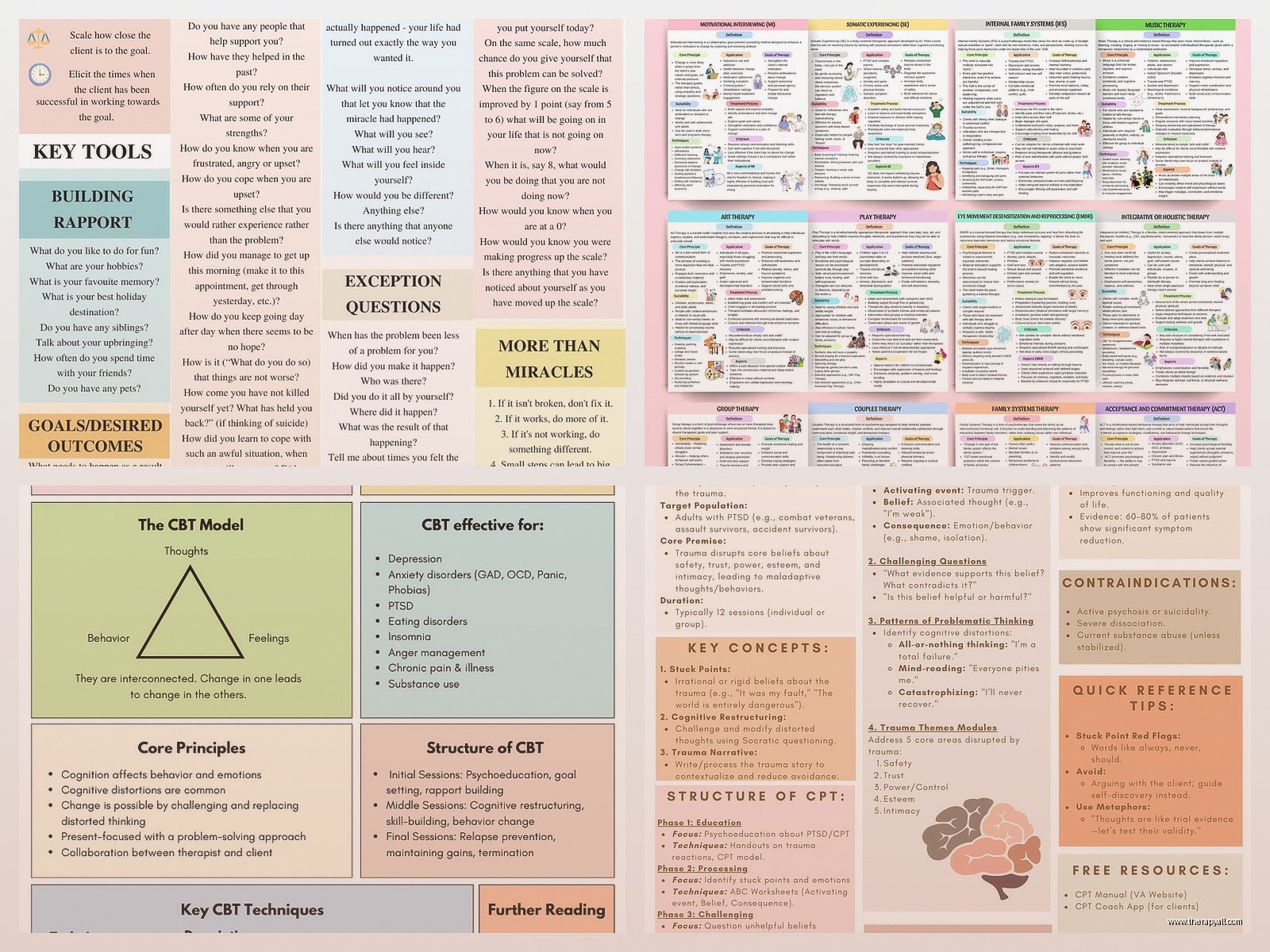
Cognitive Behavioral Therapy operates on a simple premise: thoughts influence feelings, feelings influence behaviors, and the whole system feeds back into itself. You change one element, the others shift too. Most people walk into therapy expecting to lie on a couch and talk about their childhood for months, but CBT is different—it’s structured, time-limited, and focuses on what’s happening right now in your brain.
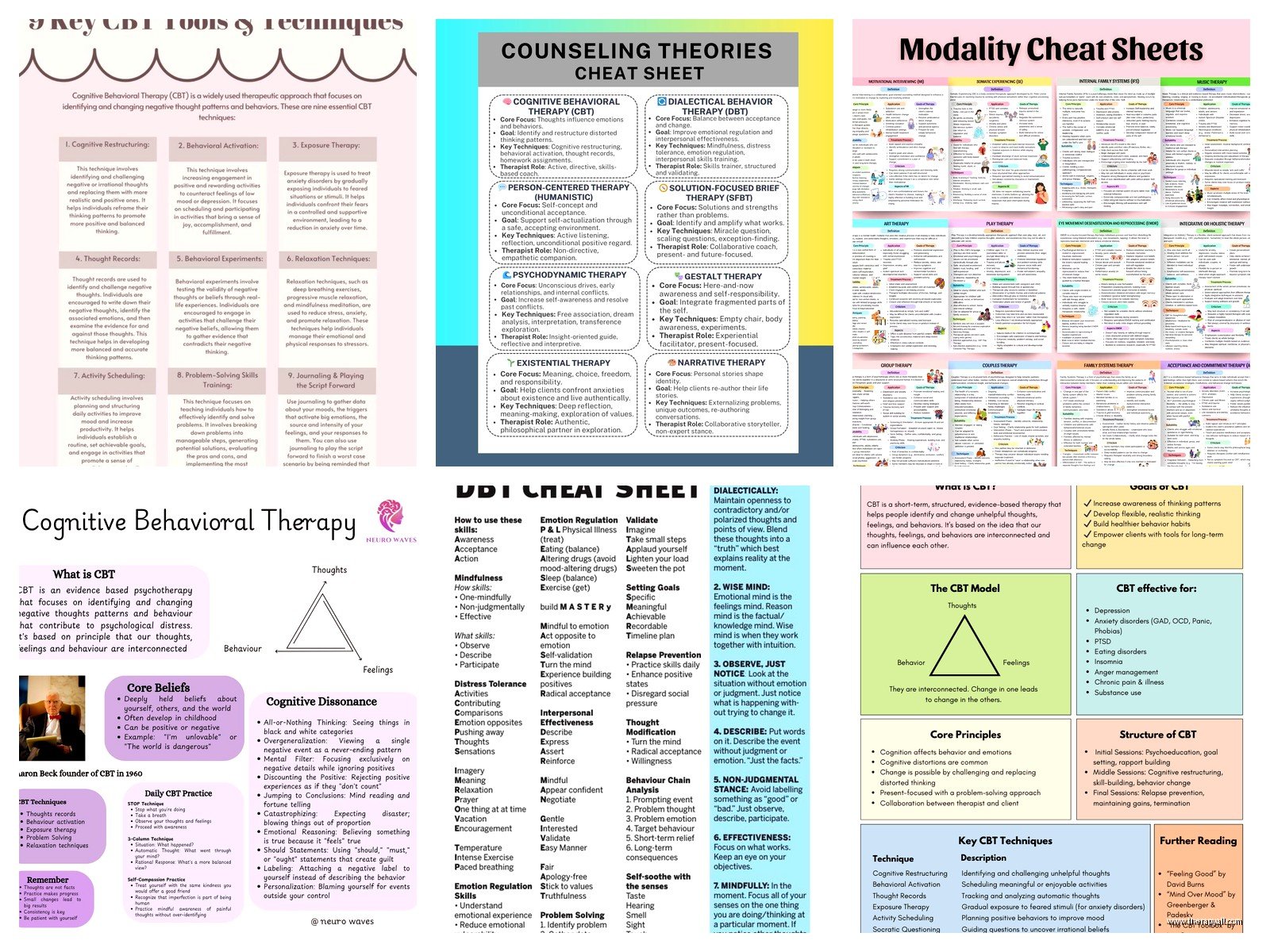
I remember sitting in a coffee shop in 2019, trying to explain to a friend why her therapist kept asking her to track her thoughts. She kept saying “but I just want to feel better” and I had to literally draw the cognitive triangle on a napkin—thoughts at the top, feelings on one corner, behaviors on the other. Something clicked for her when she could see it visually. That’s kinda what a good cheat sheet does: makes the abstract concrete.
## The Cognitive Triangle and Why It Matters
Every CBT technique circles back to this triangle. Your thought (“I’m going to fail this presentation”) triggers a feeling (anxiety, dread), which drives a behavior (avoiding preparation or over-preparing to the point of exhaustion). The technique isn’t about positive thinking—that misconception drives me absolutely nuts. I see these Instagram infographics that make CBT sound like “just think happy thoughts!” and it’s so reductive it’s almost harmful.
CBT asks you to examine whether your thought is accurate, helpful, or based on evidence. Not whether it’s positive. There’s a massive difference.
## Thought Records: The Foundation Tool
This is where most CBT work starts. A thought record has several columns:
**Situation**: What happened? Be specific. “Monday morning meeting” not “work was stressful.”
**Automatic Thought**: The thought that popped up immediately. Usually it’s harsh, absolute, and feels completely true in the moment.
**Emotion**: Name it. Anxious, angry, sad, ashamed. Rate the intensity 0-100.
**Evidence For**: What supports this thought being true?
**Evidence Against**: What contradicts it?
**Alternative Thought**: A more balanced perspective based on the evidence.
**New Emotion Rating**: How intense is the feeling now?
You’re gonna feel ridiculous doing this the first few times. Writing down “I think everyone hates me” in the middle of a spiral feels absurd, but the act of externalizing the thought strips some of its power. I started using thought records myself during a rough patch in 2021—not because I was seeing a therapist at the time, but because I was writing content about them constantly and figured I should actually test whether they worked. They do, but they’re tedious as hell.
## Cognitive Distortions: Learning to Spot Your Brain’s Favorite Lies
Your brain has patterns. Once you learn to recognize them, you can interrupt them. Here are the big ones:
**All-or-Nothing Thinking**: Everything is black or white. If you’re not perfect, you’re a complete failure. No middle ground exists.
**Catastrophizing**: Jumping to the worst possible outcome. “I made a typo in that email” becomes “I’ll get fired and lose my house.”
**Mind Reading**: Assuming you know what others think. Usually you assume they’re thinking negative things about you.
**Should Statements**: Rigid rules about how you or others “should” behave. Creates guilt when you don’t meet these standards, anger when others don’t.
**Overgeneralization**: One negative event becomes a pattern. “I failed this test” turns into “I always fail everything.”
**Discounting the Positive**: Dismissing good things that happen. “They only complimented me because they feel sorry for me.”
**Emotional Reasoning**: “I feel it, therefore it must be true.” Feeling like an impostor means you are one.
The trick is labeling them in real-time. When you catch yourself catastrophizing, literally say (out loud or in your head): “I’m catastrophizing.” It sounds too simple to work, but… it kinda does? My cat knocked over a plant yesterday and I immediately thought “this apartment is a disaster, I can’t keep anything alive”—caught myself, laughed, labeled it as overgeneralization, and just cleaned up the dirt.
## Behavioral Experiments: Testing Your Predictions
This technique gets overlooked in cheat sheets and it shouldn’t. You make a prediction based on an anxious thought, then you test it.
Anxious thought: “If I don’t rehearse my presentation 20 times, I’ll completely freeze up and humiliate myself.”
Experiment: Rehearse only 5 times. See what actually happens.
Or: “If I don’t text back immediately, my friend will think I don’t care and stop talking to me.”
Experiment: Wait 2 hours to respond. Monitor what happens.
You’re collecting data about whether your anxious predictions match reality. Usually they don’t. I had a client once who was convinced that if she said no to plans, people would exclude her forever—she tested it by declining one invitation, and not only did no one get mad, someone actually thanked her for being honest about her bandwidth.
## Exposure Hierarchies for Anxiety
If you’re avoiding something due to anxiety, you build a ladder. Bottom rung is the least scary version of the feared situation, top rung is the most terrifying.
Let’s say you have social anxiety about parties:
1. Watch a video of a party
2. Plan to attend a party
3. Arrive at a party, stay 10 minutes
4. Arrive at a party, stay 30 minutes
5. Arrive at a party, initiate one conversation
6. Arrive at a party, stay the whole time, talk to multiple people
You start at the bottom. You stay with each step until your anxiety decreases—not until it disappears completely, but until it drops by about half. Then you move up. Avoidance makes anxiety stronger. Approach, even gradual approach, weakens it.
The mistake people make is jumping to step 6 immediately, having a panic attack, and deciding exposure “doesn’t work.” You gotta build the tolerance incrementally.
## Behavioral Activation for Depression
Depression tells you to stay in bed, isolate, cancel plans. Those behaviors make depression worse, which makes you want to isolate more. It’s a vicious cycle.
Behavioral activation breaks it by scheduling activities based on two categories: **mastery** (things that give you a sense of accomplishment) and **pleasure** (things that used to be enjoyable, even if they don’t sound appealing right now).
You don’t wait until you feel motivated. You do the activity first, and motivation sometimes follows. Sometimes it doesn’t, and that’s okay too—you still interrupted the inertia.
Start small. “Take a shower” counts. “Walk around the block” counts. I see these productivity-culture versions of behavioral activation that are like “start your passion project!” and that’s… not the point when someone is depressed. The point is movement, any movement.
## Graded Task Assignment
When a task feels overwhelming, you break it into the smallest possible steps. Not just small steps—absurdly small steps.
“Clean the kitchen” becomes:
– Put three dishes in the dishwasher
– Wipe down one counter
– Take out the trash
– Wipe down the other counter
– Sweep
Each step is separate. You can stop after any step and it still counts as progress. This technique saved me during a particularly brutal deadline season in summer 2022—I was writing like three worksheet roundups a week and everything felt impossible, so I started breaking articles into “write 200 words” chunks instead of trying to bang out 2000 words at once.
## Worry Time and Thought Postponement
If you’re a chronic worrier, trying to stop worrying doesn’t work. Instead, you schedule it.
Pick a 15-minute window each day. That’s your designated worry time. When worries pop up during the day, you write them down and tell yourself “I’ll think about this at 4pm.” Then at 4pm, you sit with your list and worry intentionally.
What usually happens: half the worries seem irrelevant by 4pm, and the act of postponing them proves you can have some control over when you engage with anxious thoughts. It sounds gimmicky but the research on it is actually solid.
## Socratic Questioning
This is how therapists help you challenge thoughts without just telling you “you’re wrong.” You ask yourself:
– What’s the evidence for this thought?
– What’s the evidence against it?
– Is there an alternative explanation?
– What’s the worst that could happen? Could I cope with it?
– What’s the best that could happen?
– What’s most realistic?
– What would I tell a friend who had this thought?
– Will this matter in a year?
The last question—”what would I tell a friend”—is weirdly powerful because most people are way harsher to themselves than they’d ever be to someone they care about.
## Activity Scheduling and Time Structuring
Depression and anxiety both thrive in unstructured time. You create a schedule that includes self-care, responsibilities, and pleasurable activities. Not a minute-by-minute agenda (that creates different problems), but enough structure that you’re not just drifting through the day reacting to whatever feels most urgent or distressing.
I used to think structured schedules were just for people who “needed” that kind of thing, but after trying it myself I realized how much decision fatigue contributes to mental health struggles. When you’ve already decided that Tuesday evening is for reading and Thursday evening is for calling a friend, you’re not constantly negotiating with yourself about what to do.
## Problem-Solving Framework
CBT distinguishes between problems you can solve and problems you can only cope with. For solvable problems:
1. Define the problem specifically
2. Brainstorm solutions (all of them, even bad ones)
3. Evaluate each solution’s pros and cons
4. Pick one and try it
5. Review how it went
For problems you can’t solve (chronic illness, someone else’s behavior, the past), you shift to acceptance and coping strategies instead of spinning in problem-solving mode.
The hardest part is figuring out which category your problem falls into, honestly.
## Core Beliefs and Intermediate Beliefs
Automatic thoughts sit on the surface, but underneath are deeper beliefs. Core beliefs are broad, absolute statements about yourself, others, or the world: “I’m unlovable,” “People can’t be trusted,” “The world is dangerous.”
Intermediate beliefs are rules and assumptions: “If I’m perfect, then people will accept me,” “I must always be productive or I’m worthless.”
You don’t tackle core beliefs directly at first—they’re too entrenched. You start with automatic thoughts, and over time, as you challenge enough surface-level thoughts, the deeper beliefs start to shift. Or at least loosen their grip.
## Cost-Benefit Analysis
When you’re stuck in a behavior pattern or holding onto a thought, you can map out:
**Advantages of keeping this thought/behavior**:
– It feels safe
– It’s familiar
– It protects me from disappointment
– I don’t have to take risks
**Disadvantages**:
– It limits my life
– It maintains my anxiety
– It prevents connection
– It’s exhausting
Sometimes people discover that a thought or behavior has been serving a purpose—providing safety, avoiding vulnerability—and that awareness alone helps them decide whether the cost is worth it.
## Relaxation and Grounding Techniques
These aren’t technically CBT-specific, but they show up in most CBT protocols because you can’t process thoughts clearly when your nervous system is in fight-or-flight.
**5-4-3-2-1 grounding**: Name 5 things you see, 4 you can touch, 3 you hear, 2 you smell, 1 you taste.
**Progressive muscle relaxation**: Tense and release muscle groups systematically.
**Paced breathing**: Slow your exhale down, usually to a count of 4 in, 6 out.
These techniques don’t fix the underlying thought patterns but they create enough physiological calm that you can actually use the cognitive tools.