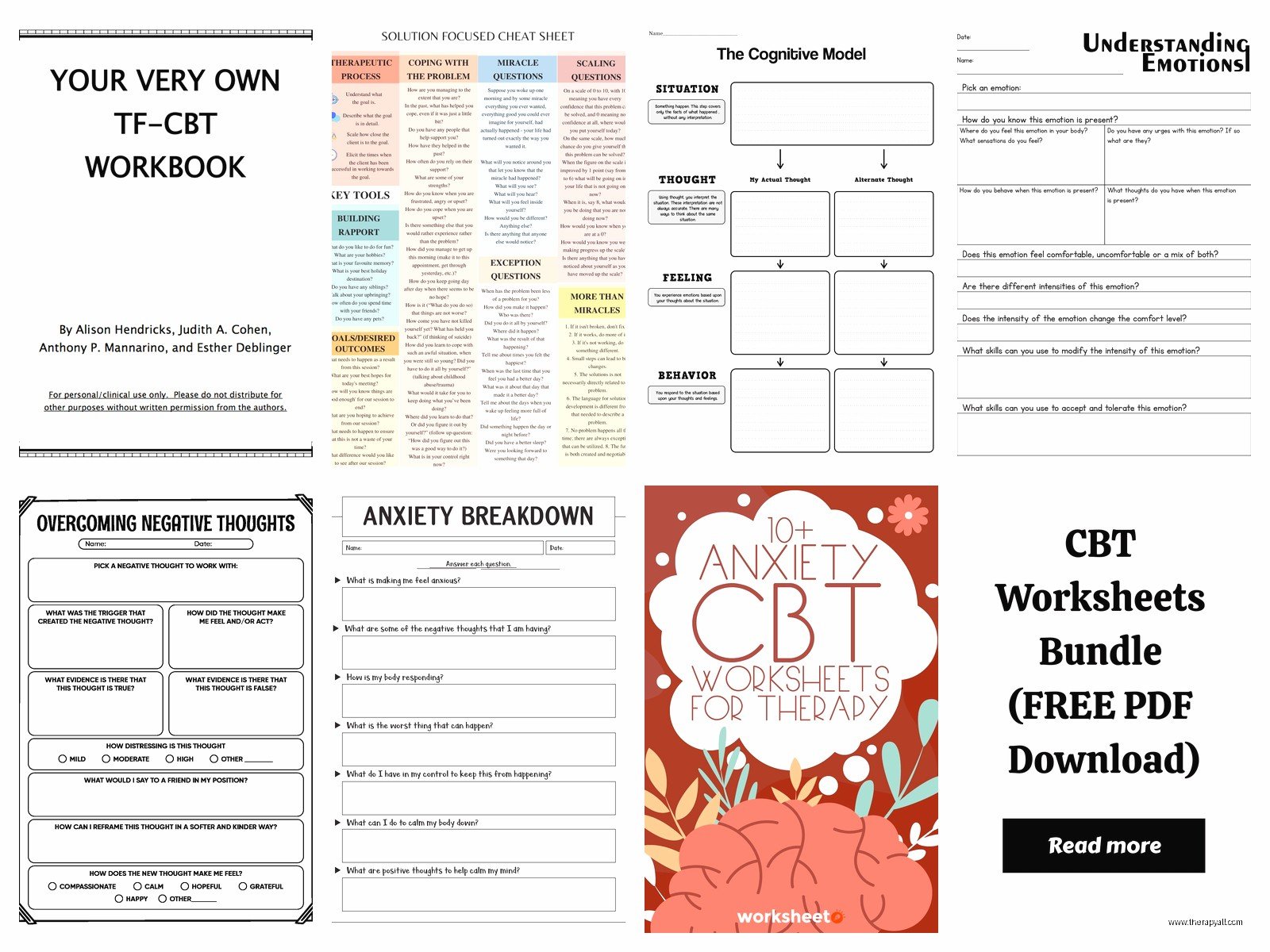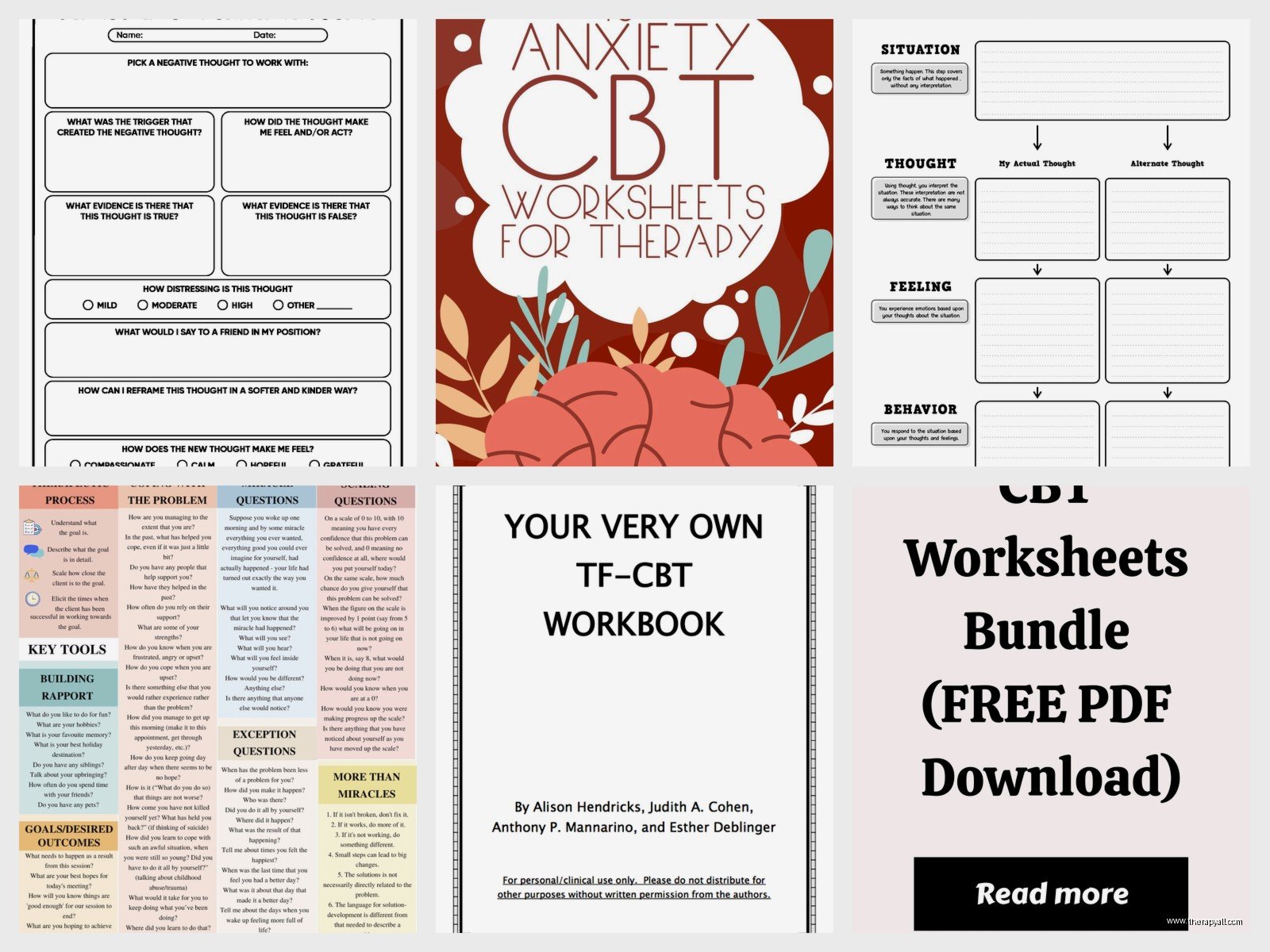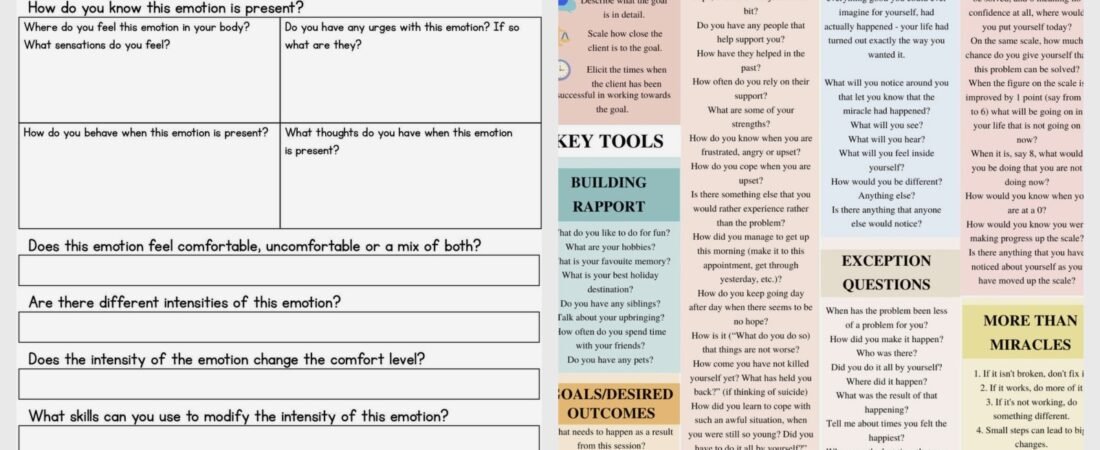
CBT worksheets for depression work because they externalize thought patterns that normally loop inside your head without any structure or accountability. You write down the automatic thought, you identify the cognitive distortion, you generate an alternative response. The format matters more than people think—something about pen on paper or even typing into a fillable PDF creates a pause between stimulus and reaction that most depressed brains desperately need.
I remember summer 2019, I was helping a colleague organize a resource library for a community mental health center and we had literally hundreds of worksheets. Most were garbage. Clipart borders, confusing instructions, questions that asked things like “What would your best self say?” which—look, when you’re depressed, your best self is not a accessible concept. That annoyed me then and it still does now. The worksheets that actually help are the ones that ask concrete questions with concrete answer formats.
Thought Records: The Core CBT Worksheet
The thought record is the foundational tool. You’re capturing the sequence: situation, automatic thought, emotion, physical sensation, behavior. Then you examine the thought for distortions and develop a balanced response. The standard format has five to seven columns depending on which CBT model you’re following—Beck’s original, Burns’ version, or one of the newer adaptations.
What makes thought records effective for depression specifically is that depression creates this fog where everything feels equally bad and equally permanent. Writing it down breaks that up. You start seeing patterns. You notice that you use words like “always” and “never” constantly, or that you jump to worst-case scenarios specifically about social situations but not about, say, your ability to make coffee.
The mistake people make is treating thought records like a one-time assignment. You gotta do them repeatedly, even when they feel mechanical or stupid. I’ve seen clients who filled out maybe 30 thought records before they started automatically catching their own distortions in real-time. That’s when the worksheet becomes internalized and you don’t need it anymore, or you need it less.
Behavioral Activation Logs
Depression kills motivation through a pretty straightforward mechanism: you stop doing things, you feel worse, you do even less, you feel even worse. Behavioral activation worksheets interrupt this by tracking activities and their effect on mood. You’re not trying to feel better first and then do things—you do things and notice whether mood shifts at all.
The worksheet format is usually a daily schedule broken into hourly or two-hour blocks. You write what you actually did and rate your mood before and after. Some versions include columns for sense of accomplishment and sense of pleasure, rated separately. That distinction matters because sometimes an activity doesn’t make you happy but it does make you feel competent, and that competent feeling is its own antidepressant.
I started using these myself in 2022 when I was writing constantly and barely leaving my desk and my cat would just stare at me like I was furniture. I tracked my activities for two weeks and realized I felt significantly better on days when I went outside before 10am, even if it was just to buy milk or whatever. Sounds obvious but depression makes obvious things invisible.
The evidence base here is solid. Behavioral activation as a standalone treatment performs about as well as full CBT protocols for mild to moderate depression. The worksheet is the delivery mechanism—it’s how you implement the intervention without needing a therapist in the room every day.
Activity Scheduling Worksheets
This is different from activity logging because you’re planning ahead instead of recording what already happened. You identify activities that historically gave you pleasure or mastery, then you schedule them into your week like appointments. The worksheet usually has you rate anticipated difficulty and importance, then after you complete the activity, you rate actual difficulty and mood impact.
Depression lies to you about how hard things will be. The worksheet creates a dataset that proves the lie. You think going to the grocery store will be a 9/10 difficulty, you do it, it was actually a 4/10, and your mood improved slightly. Do this enough times and your brain starts updating its predictions.
What’s kinda fascinating is that the act of scheduling itself seems to help. There’s something about externalizing intention—writing “Tuesday 2pm: walk around the block”—that reduces the executive function load when Tuesday at 2pm actually arrives. You’re not deciding whether to walk, you’re just following the plan that past-you made.
Common Problems with Activity Scheduling
People schedule way too much. They’re gonna have this perfect day with yoga and meal prep and calling three friends and organizing the closet. Then they do maybe one thing, feel like failures, abandon the worksheet entirely. You need to schedule like two or three small things maximum. Brush teeth counts. Making the bed counts. The bar needs to be underground when you’re depressed.
Cognitive Distortion Identification Sheets
These worksheets list the common distortions—all-or-nothing thinking, overgeneralization, mental filtering, discounting the positive, jumping to conclusions, magnification, emotional reasoning, should statements, labeling, personalization—and ask you to identify which ones show up in your automatic thoughts. Some versions include definitions and examples for each distortion.
I’ve seen worksheets that have 10 distortions, some with 15, one terrible one that listed 23 which is just… no. You’re not gonna remember 23 categories. The classic Burns list of 10 is plenty. What matters is learning to spot your personal top three or four. Most people overuse maybe three distortions repeatedly. Mine are overgeneralization and mental filtering, and I know this because I’ve filled out these worksheets more times than I can count, both professionally and personally.
Depression has favorite distortions. Mental filtering—only noticing the negative—is huge. So is emotional reasoning, the “I feel worthless therefore I am worthless” logic. Overgeneralization turns one setback into a permanent pattern. When you’re working with depression specifically, you’re gonna see these three constantly.
Mood Monitoring Charts
Simple daily or hourly mood ratings on a scale, usually 0-10. You’re creating a visual record of mood fluctuation. This serves multiple purposes: it shows that mood actually does vary (depression makes you feel like you’re always at a 2, but the chart shows you hit 4 or 5 sometimes), it helps identify triggers and patterns, and it provides outcome data to see if interventions are working.
The worksheet format matters. Some use line graphs, some use bar charts, some just have boxes for numbers. I prefer the ones with space to note what was happening during high or low points. Context makes the data useful. A mood drop at 3pm every day might correlate with blood sugar, or with checking email, or with the time your ex usually posted on social media back when you were still looking.
You can add layers—track sleep, exercise, social contact, medication adherence alongside mood. More variables means more potential insights, but it also means more work to fill out the sheet. Start simple. Just mood and maybe one other variable.
Core Belief Worksheets
These go deeper than automatic thoughts to identify underlying schemas. The format usually involves listing evidence for and against a core belief, then developing a more balanced belief statement. For depression, common core beliefs include “I’m unlovable,” “I’m incompetent,” “I’m defective,” or “The world is hostile.”
This is more advanced CBT work. You probably shouldn’t start here. Automatic thoughts are surface level—”My friend didn’t text back, she hates me”—and those are easier to challenge. Core beliefs are foundational—”I am fundamentally unworthy of love”—and those require more… I don’t know, they require more evidence accumulation and they’re more emotionally charged to examine.
The worksheet structure helps because you’re forced to generate disconfirming evidence. You write the belief at the top: “I’m incompetent.” Then you list every piece of evidence you can think of that this is true. Then—and this is the hard part—you list evidence against it. Things you’ve accomplished, skills you have, times you solved problems. Depression makes the “against” column really hard to populate, which is exactly why you need the worksheet format. You sit there and you force yourself to write something, anything.
Downward Arrow Technique Worksheets
This is a specific format for getting from automatic thought to core belief. You write the automatic thought, then ask “If that were true, what would it mean about me?” and write the answer. Then you ask the same question about that answer. You keep going down until you hit bedrock—the core belief that’s generating all the thoughts above it.
Example: “I made a mistake at work” → “If true, what does that mean?” → “I’m bad at my job” → “If true?” → “I’ll get fired” → “If true?” → “I won’t be able to support myself” → “If true?” → “I’m fundamentally incapable and will end up alone and destitute.” There’s your core belief.
It’s kinda brutal to see it written out like that, but also useful. You can’t challenge what you can’t see.
Gratitude and Positive Data Logs
Before you roll your eyes—I know, I know. Gratitude journals got so oversold and oversimplified that they became parody. But the CBT version is different from the Instagram wellness version. You’re not trying to force positivity or spiritual growth. You’re counteracting the mental filtering distortion by deliberately recording neutral or positive experiences that depression would otherwise erase from memory.
The worksheet has you write three things daily. They don’t need to be profound. “Coffee was hot” counts. “Didn’t rain” counts. You’re building a dataset of non-negative experiences because depression’s default is to act like nothing good ever happens. The worksheet proves that’s not accurate.
Research shows this works for depression specifically when combined with other CBT techniques. Alone? Probably not sufficient. But as part of a larger protocol, it helps correct the negative bias in memory and attention.
Worry Time Scheduling Sheets
This one’s more common for anxiety but works for depression too, especially when rumination is a major feature. You schedule a specific 15-30 minute period each day as designated worry time. When intrusive thoughts or rumination starts outside that window, you write it down on the worksheet and tell yourself you’ll think about it during worry time. During worry time, you go through the list and actually engage with each item.
What happens is most items on the list feel irrelevant or resolved by the time worry time arrives. The urgency was artificial. The worksheet makes that visible. You’re also containing the rumination instead of letting it colonize your entire day.
I’ve used this one personally and it felt really stupid at first, like obviously my brain isn’t gonna cooperate with this arbitrary schedule. But it kinda did? Not perfectly, but enough to matter.
Problem-Solving Worksheets
Depression impairs problem-solving ability, which creates a vicious cycle where solvable problems feel insurmountable. The worksheet breaks problem-solving into steps: define the problem specifically, brainstorm all possible solutions without judgment, evaluate pros and cons of each solution, choose one, make an action plan, implement it, evaluate the outcome.
The structure compensates for the cognitive impairment. You’re not holding all these steps in your working memory—they’re externalized on paper. Each step has its own section on the worksheet. You fill them out in order. It’s mechanical and that’s the point.
Depression makes everything feel like one giant unsolvable problem. The worksheet forces specificity. Not “my life is a mess” but “I haven’t paid my electric bill and the due date is Friday.” That’s a solvable problem. You can break it into steps. You can generate solutions. You can pick one and try it.
Evidence-Based Selection Criteria
Not all CBT worksheets are created equal and the market is absolutely flooded with stuff that’s either oversimplified to uselessness or so complicated it requires a graduate degree to understand. When you’re looking for worksheets—whether you’re a therapist building a resource library or someone trying to self-help—look for ones that are based on established CBT protocols, have clear instructions, use concrete language, and have been tested in research settings.
Beck Institute has free resources. The Academy of Cognitive Therapy certifies materials. Some publishers like PESI and New Harbinger specialize in evidence-based tools. Avoid anything that mixes CBT with manifesting or law of attraction content—that’s not CBT anymore, that’s something else entirely.
The worksheets I’ve described here are all standard components of CBT for depression protocols that have decades of research support. They work not because they’re magic but because they systematically target the maintaining factors of depression: negative thought patterns, behavioral withdrawal, cognitive distortions, and problem-solving deficits. You fill them out consistently, you start seeing your patterns, you start interrupting those patterns, symptoms improve. It’s not quick and it’s not always dramatic, but the effect sizes in research are solid and it beats placebo consistently.