# CBT Worksheets: Printable Tools for Cognitive Behavioral Therapy
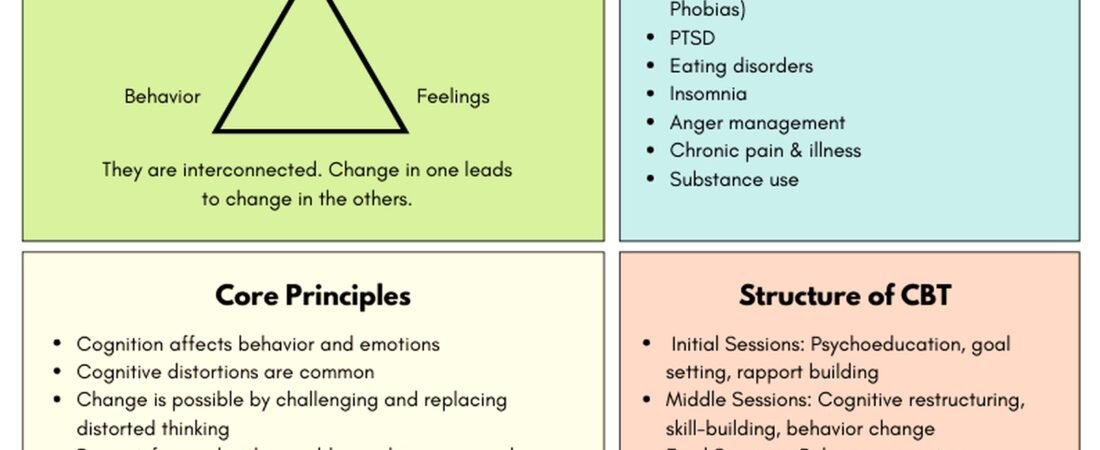
CBT worksheets are structured paper or digital tools designed to help people practice cognitive behavioral therapy techniques outside of therapy sessions. They guide you through identifying thought patterns, challenging cognitive distortions, tracking behaviors, and developing coping strategies using the core framework of CBT—that thoughts, feelings, and behaviors are interconnected and that changing one element can shift the others.
I started compiling CBT worksheet resources back in 2018 when I was writing for a mental health platform that kept getting requests for “printables” because apparently everyone wanted something tangible they could fill out with a pen. The demand was massive. You’d think worksheets would be straightforward to create, but the number of poorly designed, confusing, or just flat-out ineffective ones floating around online genuinely annoyed me. Some looked like they were made in Microsoft Word 2003 with clip art borders, and others were so academically dense that they’d intimidate anyone not already familiar with CBT theory.
## The Basic Structure of CBT Worksheets
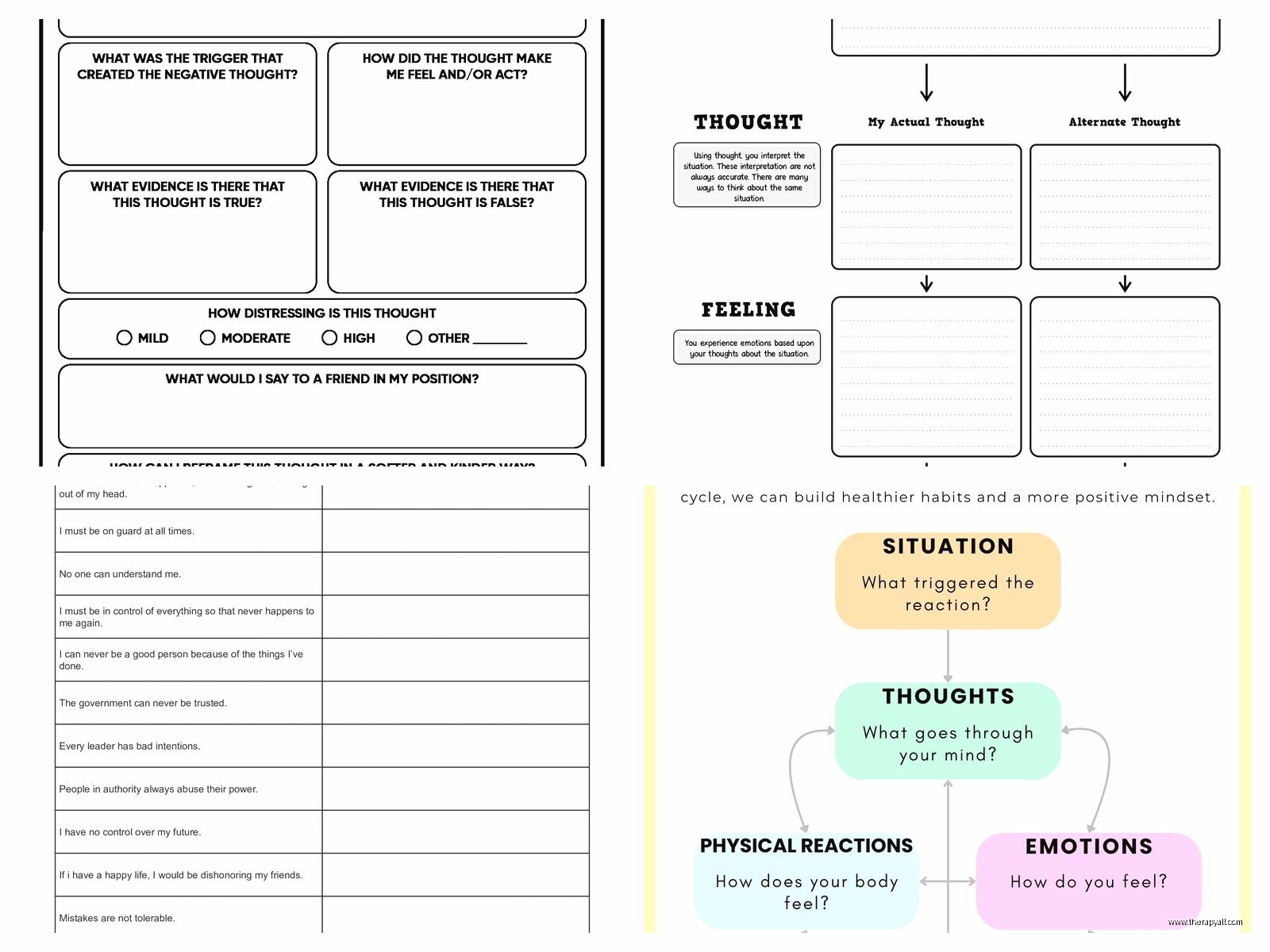
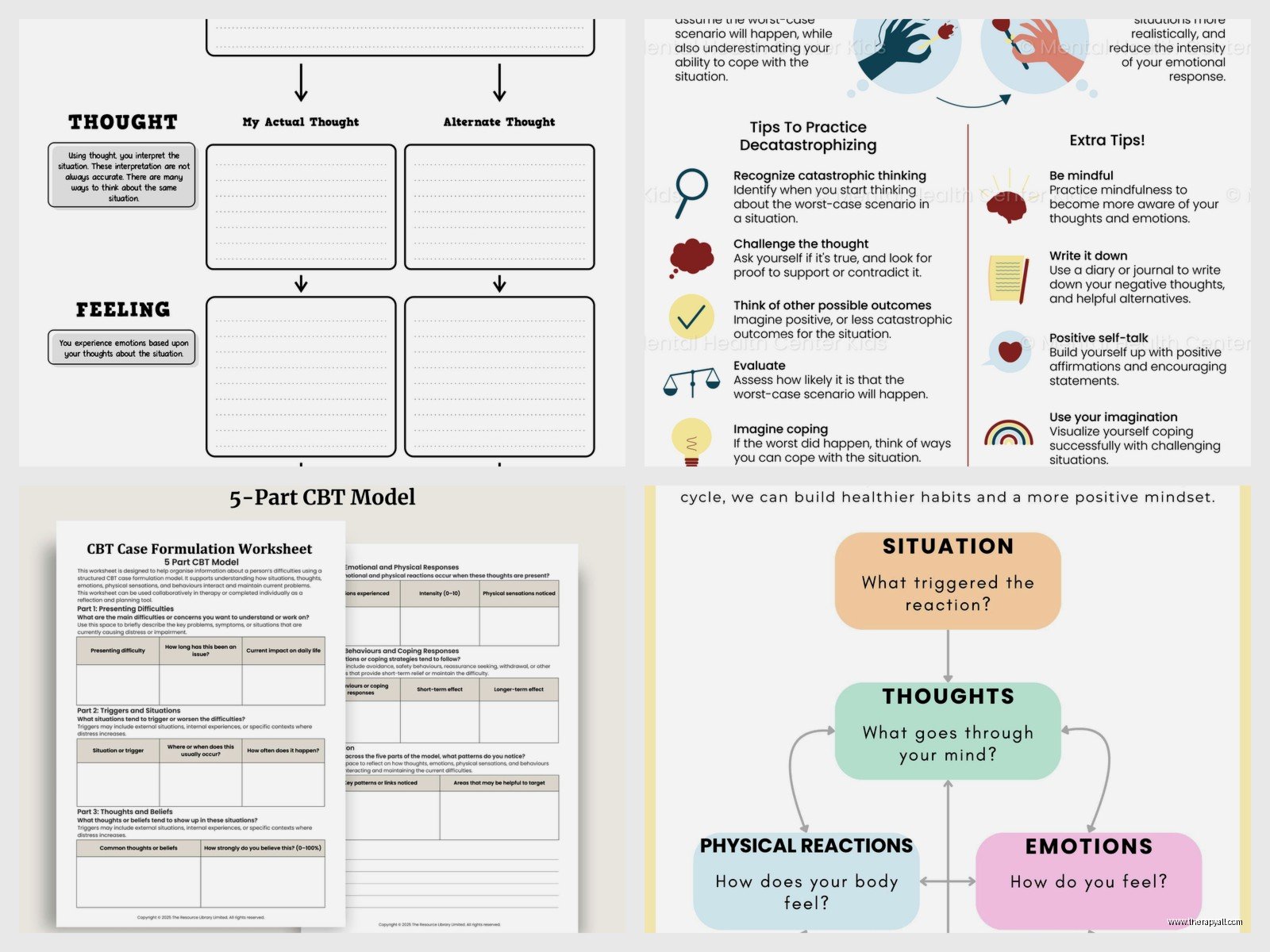
Most CBT worksheets follow a pattern that mirrors the cognitive model. The classic thought record is probably the most widely used format. It typically has columns for: situation or trigger, automatic thoughts, emotions, physical sensations, evidence for and against the thought, alternative or balanced thought, and outcome or re-rated emotion intensity.
You fill these out when you notice a shift in your mood or when you’re experiencing distress. The idea is to slow down the automatic process that happens when something triggers an emotional reaction. Instead of going straight from trigger to feeling terrible, you’re inserting this structured analysis step.
There are also behavioral activation worksheets that help you schedule activities when you’re dealing with depression and tend to withdraw from things that used to bring pleasure or accomplishment. These usually have you list activities, rate them for pleasure and mastery, schedule them into your week, and then track whether you actually did them and how you felt afterward.
Exposure hierarchy worksheets are used for anxiety disorders, particularly phobias and OCD. You list feared situations, rate them on a scale of 0-100 for anxiety level, then work your way up from least to most anxiety-provoking in a gradual way.
## Thought Records and Cognitive Restructuring
The thought record is the workhorse of CBT worksheets. I remember summer 2019, I was reviewing about fifteen different thought record templates for an article, and I started filling them out myself for random daily annoyances just to see which format felt most intuitive—turned out the seven-column version was too much for most situations, but the three-column felt too simplified to actually change anything.
When you use a thought record, you’re essentially becoming a detective of your own mind. You catch the thought—often something that flashed through so quickly you barely noticed it consciously—and you write it down verbatim. This is harder than it sounds because we’re not used to observing our thoughts as separate from ourselves.
Then you identify the emotion. Not “bad” or “stressed” but the actual specific emotion: anxious, sad, angry, ashamed, guilty, disappointed. You usually rate the intensity on a scale, commonly 0-100 or 0-10.
The evidence columns are where the actual cognitive work happens. You list facts that support your automatic thought, then facts that contradict it. This is where people often get stuck because our brains are really good at confirmation bias—finding evidence for what we already believe. The worksheet forces you to actively search for contradicting evidence.
After examining the evidence, you generate an alternative or more balanced thought. This shouldn’t be some toxic positivity spin. If your thought is “I’m gonna fail this presentation,” the balanced thought isn’t “I’m amazing and it’ll be perfect”—it’s more like “I’m nervous but I’ve prepared adequately and even if I stumble, it won’t be catastrophic.”
## Common Cognitive Distortion Worksheets
These worksheets help you identify specific types of thinking errors. The main distortions include all-or-nothing thinking, overgeneralization, mental filtering, discounting the positive, jumping to conclusions (mind reading and fortune telling), magnification or minimization, emotional reasoning, should statements, labeling, and personalization.
A good cognitive distortion worksheet will list these with definitions and examples, then have you identify which ones show up in your own thinking. Some versions have you track these over a week to spot patterns—maybe you notice you do a ton of mind reading in social situations or catastrophizing about health stuff.
I’ve noticed that people kinda latch onto certain distortions based on their specific struggles. Someone with social anxiety might be all about mind reading and personalization, while someone with depression hits the mental filtering and discounting the positive hard.
## Behavioral Activation and Activity Scheduling
When you’re depressed, your behavior changes—you withdraw from activities, stay in bed longer, avoid social contact, stop doing hobbies. This then reinforces the depression because you’re not getting positive reinforcement from your environment. Behavioral activation worksheets interrupt this cycle.
You start by monitoring your current activities, usually in hourly blocks throughout the day, and rating your mood during each activity. This baseline helps you see patterns—maybe your mood tanks in the evening when you’re just scrolling your phone, or you feel slightly better after showering even though it felt impossible to start.
Then you schedule activities that are either enjoyable or give you a sense of accomplishment. You don’t have to feel like doing them. That’s the whole point. You schedule them and do them regardless of motivation, because the worksheet is essentially your external structure when your internal motivation is shot.
My cat destroyed one of my printed activity schedules last week by knocking coffee all over it, which was actually kind of fitting because I hadn’t filled it out anyway—even people who write about this stuff struggle with the actual doing of it.
## Exposure Hierarchy and Anxiety Worksheets
For anxiety-related issues, exposure worksheets help you face feared situations gradually. You can’t just throw yourself into your biggest fear and expect that to work out well. You need a ladder approach.
The worksheet has you list situations related to your fear, rate them for expected anxiety, then organize them from least to most anxiety-provoking. If you have social anxiety, your hierarchy might start with “make eye contact with a cashier” at the bottom and build up to “give a presentation to 50 people” at the top.
You work through these systematically, staying in each situation until your anxiety decreases by at least half. You track your peak anxiety, how long it took to decrease, and what you learned. This data collection is crucial because it helps you see that anxiety does decrease on its own if you stay in the situation, and it also helps you notice when your predictions about how awful something will be don’t match reality.
Safety behavior worksheets are related—these help you identify subtle avoidance strategies you might not realize you’re using. Like, you might go to the party (exposure) but stay glued to your phone the whole time (safety behavior that prevents you from actually facing the social anxiety).
## Problem-Solving Worksheets
These are more structured than just brainstorming. You define the problem specifically, list all possible solutions without judging them yet, evaluate the pros and cons of each solution, choose one to try, make a specific action plan, implement it, and then evaluate the outcome.
The step-by-step format keeps you from getting overwhelmed or stuck in rumination. When you’re anxious or depressed, your problem-solving abilities actually decline, so having the external structure of a worksheet helps compensate for that cognitive impairment.
## Core Belief and Schema Worksheets
These are deeper-level worksheets that address underlying beliefs rather than just surface automatic thoughts. Core beliefs are fundamental assumptions about yourself, others, and the world—stuff like “I’m unlovable” or “People can’t be trusted” or “The world is dangerous.”
A core belief worksheet might have you identify the belief, list experiences that seem to support it, examine evidence against it, consider alternative beliefs, and track experiences that support the new belief. This work is slower and more intensive than thought records because core beliefs are—well, they’re kinda baked in from early experiences and they’re more resistant to change.
Some worksheets use a downward arrow technique where you start with an automatic thought and keep asking “What would that mean about me?” until you hit the core belief underneath. Like, “I made a mistake at work” → “What does that mean?” → “I’m incompetent” → “What does that mean?” → “I’ll get fired” → “What does that mean?” → “I’m a failure” ← there’s your core belief.
## Sleep and Worry Worksheets
CBT-I (CBT for Insomnia) uses specific worksheets to track sleep patterns and implement sleep restriction and stimulus control. You log your bedtime, time you tried to fall asleep, estimated time to fall asleep, number of awakenings, time spent awake during the night, final wake time, time out of bed, and sleep quality rating.
This data helps identify patterns and calculate your sleep efficiency, which then guides treatment recommendations. Most people are shocked when they actually track this stuff because their perception of their sleep is often worse than reality—or sometimes they realize they’re spending way too much time in bed awake, which weakens the bed-sleep association.
Worry time worksheets are used for generalized anxiety. You schedule a specific 15-30 minute period each day for worrying, and when worries pop up outside that time, you write them down to address during worry time. It sounds ridiculous but it actually works for some people because it contains the worry and also helps you realize that most worries feel less urgent later.
## Values and Goals Worksheets
These help you clarify what matters to you across life domains—relationships, career, health, personal growth, recreation—and then set specific goals aligned with those values. You’re not gonna suddenly become motivated just by filling out a worksheet, but it can help when you’re feeling lost or when your behavior has drifted far from what you actually care about.
The worksheet usually has you rate how important each domain is to you, rate your current satisfaction in that area, identify your values in that domain, and set a specific behavioral goal. The key is making the goal specific and behavioral, not vague and outcome-focused—”call one friend per week” rather than “be more social” or “have better friendships.”
## Practical Tips for Using CBT Worksheets
You need to actually write on them. Thinking through the questions mentally doesn’t have the same effect. The act of writing slows down your thinking and creates more distance from the thoughts.
Don’t wait until you feel like using them. Use them when you notice a mood shift or when you’re in the situation you’re working on. Some people set reminders or keep worksheets in specific locations—thought records by the bed for morning anxiety, activity schedules on the fridge, whatever works.
Reviewing completed worksheets is valuable. You might notice patterns you didn’t see in the moment—the same core belief showing up repeatedly, or evidence that your feared predictions rarely come true.
If a worksheet format doesn’t work for you, modify it. There’s no sacred version. Some people need fewer columns, some need more structure, some do better with digital versions, some need paper. I’ve seen people adapt worksheets into voice memos, spreadsheets, or even… I think someone told me once they used a whiteboard system, which honestly sounds like it would get erased too easily but whatever works.
## Digital vs. Printable Formats
Printable PDFs are still the most common format. You download them, print them, fill them out by hand. The advantage is tactile—some people process better when physically writing. The disadvantage is you end up with stacks of paper and it’s harder to search through past entries or spot patterns.
Digital fillable PDFs let you type directly into the form. Apps have emerged that basically digitize common CBT worksheets with added features like reminders, pattern tracking, and graphing mood over time. Some people find apps more convenient because they always have their phone, but others find them less effective because there’s something about handwriting that engages the brain differently.
I honestly flip back and forth. Sometimes I want the app convenience, sometimes I print stuff out because staring at another screen when I’m already on screens all day feels exhausting—wait, that’s getting off topic.
## Common Mistakes and Limitations
People often fill out worksheets superficially, especially thought records. They write “bad” for the emotion instead of identifying the specific feeling. They write vague thoughts instead of the actual specific thought. They rush through the evidence columns. The worksheet only works if you actually engage with it properly.
Another mistake is using worksheets as a substitute for therapy when you actually need professional help. Worksheets are tools to support therapy or for mild to moderate symptoms. They’re not sufficient for severe depression, active suicidal ideation, psychosis, or complex trauma. You need an actual human therapist for that stuff.
Some people become overly reliant on worksheets and can’t practice the skills without them. Eventually you want to internalize the process—to automatically notice thoughts, challenge them, consider evidence—without needing to write it all down every time.
Worksheets also don’t work for everyone. Some people find them too rigid or analytical. Some people’s problems aren’t primarily cognitive—maybe they need more behavioral interventions, or maybe CBT isn’t the right approach at all. That’s fine. Therapy isn’t one-size-fits-all.
## Finding Quality CBT Worksheets
Professional organizations like the Association for Behavioral and Cognitive Therapies (ABCT) and the Beck Institute have reputable resources. Many evidence-based therapy workbooks include worksheets—books by David Burns, Judith Beck, Christine Padesky, Dennis Greenberger.
Free resources exist but quality varies wildly. Therapist Aid has decent free worksheets. Psychology Tools has both free and paid options. Some are fine, some are oversimplified to the point of uselessness.
If you’re working with a therapist, they should be providing worksheets or recommending specific ones. They can also adapt them to your specific needs, which is way more effective than just grabbing random ones online.
The best worksheet is the one you’ll actually use consistently. Doesn’t matter if it’s the most theoretically perfect format if you never fill it out.