# Cognitive Defusion Techniques PDF – Complete Guide
Cognitive defusion is when you learn to separate yourself from your thoughts instead of treating them like absolute truth. ACT—Acceptance and Commitment Therapy—developed this idea, and it’s probably one of the most underrated techniques in the therapy world because everyone’s so obsessed with challenging thoughts CBT-style.
I remember back in 2019, I was reviewing like a dozen different ACT workbooks for a roundup article, and half of them explained defusion in the most convoluted way possible. One book used a metaphor about clouds and I just kept thinking “this is gonna confuse more people than it helps.” The basic principle is simple: you don’t have to believe every thought your brain produces, and you don’t have to argue with those thoughts either. You just… notice them and let them exist without giving them power.
## What Cognitive Defusion Actually Means
Fusion is when you’re stuck to your thoughts. Like, if you think “I’m a failure,” and you’re fused with that thought, you experience it as a fact about yourself. Your brain says it, you believe it, you feel terrible, you maybe avoid doing things because why bother if you’re a failure anyway.
Defusion is creating distance. The thought “I’m a failure” becomes “I’m having the thought that I’m a failure” or even “my brain is doing that failure story again.” Sounds like semantics, but it genuinely changes how you relate to the thought. You’re not trying to prove the thought wrong or replace it with a positive affirmation—you’re just recognizing it as mental activity, not reality.
The annoying thing about cognitive defusion content is that so many PDFs and worksheets out there present it like this mystical mindfulness practice that takes years to master. Nah. You can start doing basic defusion techniques in about five minutes, and some of them are honestly kinda silly, which is part of the point.
## Why You’d Want a PDF Guide for This
PDFs are practical because you can save them, print them, scribble on them during a session or when you’re having a rough morning. I’ve written enough mental health content to know that people don’t always want to dig through a 300-page workbook—they want the techniques, the examples, the actual steps.
A good cognitive defusion PDF should include:
- Clear explanations of what defusion is and isn’t
- Specific techniques with step-by-step instructions
- Examples of common thoughts and how to defuse from them
- Practice exercises you can actually do
- Space to write or track your own experiences
You want something you can reference quickly when you’re spiraling at 2am or when a client asks you to explain it again because the first explanation didn’t land.
## Core Cognitive Defusion Techniques
### Naming the Story
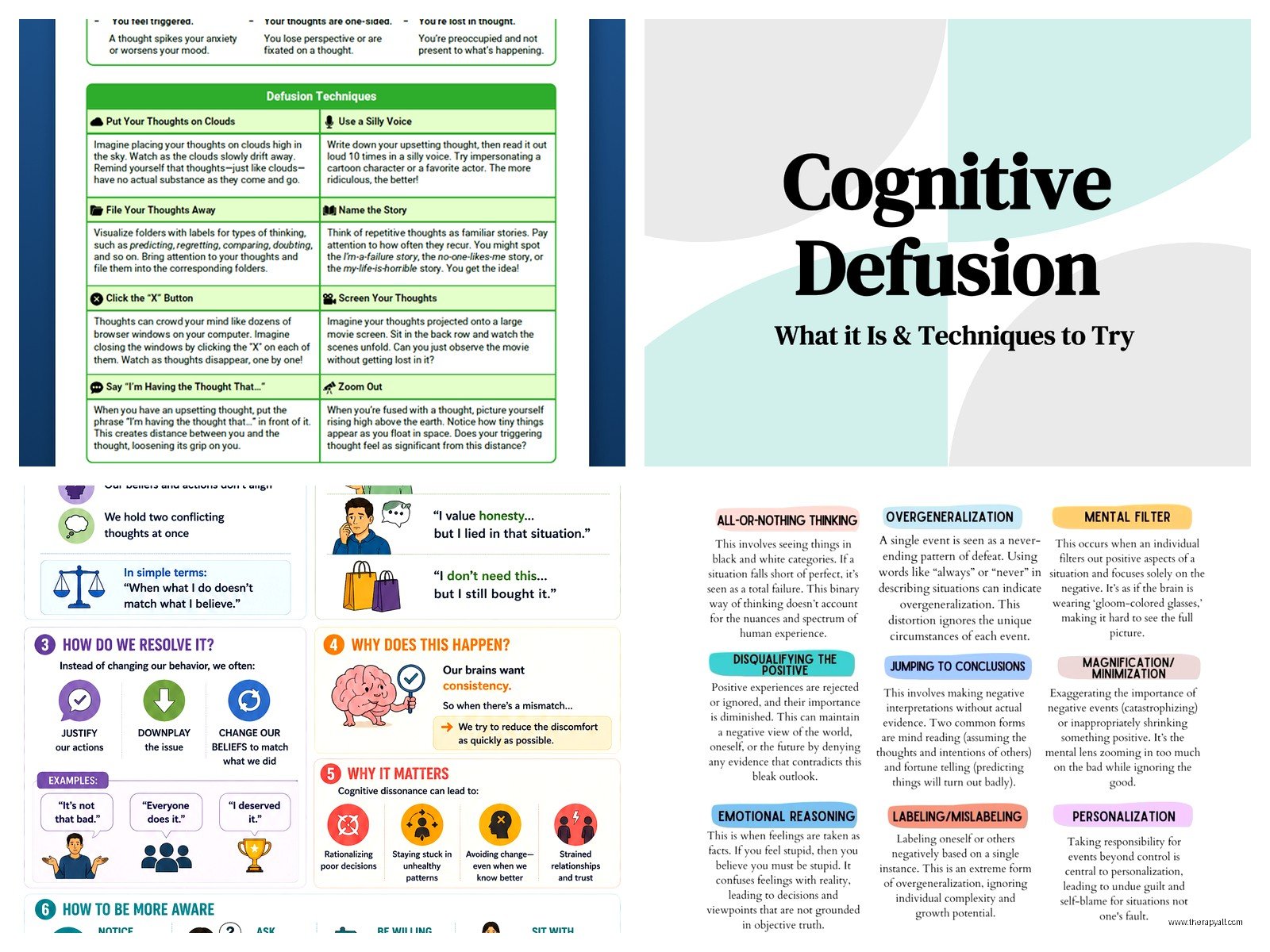
Your mind tells stories. “The I’m-not-good-enough story.” “The everyone-hates-me story.” “The something-terrible-is-about-to-happen story.” When you notice a familiar thought pattern, you can literally name it. Like, out loud or in your head: “Oh, there’s the not-good-enough story again.”
This creates distance because you’re framing it as a narrative your mind produces, not an accurate description of reality. I use this one myself more than I probably should admit—my brain has a greatest-hits collection of anxiety stories and sometimes just naming them makes them less… sticky.
### Thanking Your Mind
Sounds ridiculous, I know. When your brain offers up an unhelpful thought like “you’re definitely gonna mess this up,” you respond with “thanks, mind” or “thank you for that thought.” You’re not agreeing with it. You’re acknowledging that your brain is doing its job (trying to protect you, predict problems, whatever) without buying into the content.
Some people find this technique patronizing or fake-feeling at first, but it actually works for a lot of folks once they get over the weirdness.
### Silly Voices
This one’s my favorite to recommend even though it feels absolutely absurd. Take the thought that’s bothering you and repeat it in a cartoon voice. Sing it to the tune of “Happy Birthday.” Say it in a pompous British accent or like a robot or however you want.
The point is to break the thought’s power by making it ridiculous. Your brain can’t take “I’m worthless” as seriously when you’ve just sung it like a opera performer. It’s exposing the thought as just words, just sounds, not some deep truth about who you are.
I had a client years ago who would say her anxious thoughts in a Darth Vader voice and she said it helped more than any cognitive restructuring we’d tried. Sometimes the simplest techniques are the most effective, even if they don’t sound very… professional.
### Leaves on a Stream Visualization
This is more of a mindfulness-based defusion exercise. You imagine sitting by a stream, and each thought that comes up, you place it on a leaf and watch it float away. You don’t grab the leaf, you don’t jump in after it, you just let it go downstream.
Some PDFs present this with a guided script you can read or record yourself reading. It’s useful for practicing the skill of noticing thoughts without engaging with them. Though honestly I find the stream metaphor a little overused—the therapy content world loves water metaphors for some reason.
### The Thought Is Not the Thing
If you think “there’s a tiger in this room,” that doesn’t mean there’s actually a tiger in the room. Your thought about danger isn’t the same as actual danger. This seems obvious when you say it about tigers, but we forget this constantly with thoughts about ourselves.
“I’m unlovable” is a thought about yourself, not a fact about yourself. The thought exists, sure, but it’s not the same as the reality of who you are. A good PDF will have you practice identifying the difference between thoughts and the things thoughts refer to.
### Physicalizing the Thought
Write the thought on a piece of paper. Carry it around in your pocket. Literally hold the thought in your hand as a physical object. This externalizes it—puts it outside of you instead of having it feel like it’s part of your identity.
Or you can imagine the thought as an object. What color is it? What shape? How heavy? This sounds kinda weird but it’s another way of creating distance. You’re relating to the thought as something you observe rather than something you are.
### Noticing the Thought
Just prefix everything with “I’m noticing that I’m having the thought that…” So instead of “I’m anxious,” you think “I’m noticing that I’m having the thought that I’m anxious.” Instead of “I can’t do this,” you think “I’m noticing that I’m having the thought that I can’t do this.”
It’s wordy, yes, but that’s the point. You’re adding enough distance that you can see the thought as a mental event rather than a truth. With practice, you don’t need the whole phrase—you just get better at automatically recognizing thoughts as thoughts.
## When Cognitive Defusion Actually Helps
Defusion is particularly useful when:
- You’re stuck in rumination and challenging the thoughts isn’t working
- You have repetitive negative self-talk that you’ve heard a million times
- You’re dealing with intrusive thoughts that get worse when you try to argue with them
- You need to take action despite having unhelpful thoughts
- You’re trying to be more psychologically flexible
It’s not about feeling better necessarily—it’s about being able to move forward even when your mind is being unhelpful. You can have the thought “this is pointless” AND still do the thing. The thought doesn’t have to go away for you to live your life.
## What a Complete PDF Guide Should Cover
I’ve seen so many half-done defusion PDFs that just list a couple techniques with no context. A complete guide needs to actually explain the theory enough that you understand why you’re doing what you’re doing, even if—wait, my cat just knocked over my water bottle, hang on—even if the theory section is relatively brief.
### The ACT Context
You gotta explain where cognitive defusion comes from. ACT is all about psychological flexibility, which means being present, choosing your values, and taking action even when your mind is giving you all kinds of reasons not to. Defusion is one piece of that larger framework.
The guide should mention the other ACT processes too, at least briefly: acceptance, present moment awareness, self-as-context, values, committed action. You don’t need a dissertation on each one, but people should understand that defusion isn’t meant to exist in isolation.
### Fusion vs. Defusion Examples
Concrete examples matter so much. Show what fusion looks like versus what defusion looks like with the same thought:
**Fused**: “I’m having a panic attack, this means something is seriously wrong with me, I need to leave right now, I can’t handle this.”
**Defused**: “I’m noticing thoughts about panic and danger. My body is doing the anxiety thing. These are uncomfortable sensations and thoughts, and I can stay here even though my mind is telling me to run.”
See the difference? The second one isn’t pretending the panic isn’t happening, but it’s also not treating the panicked thoughts as commands that must be followed.
### Practice Exercises
A PDF should include exercises you can actually do. Fill-in-the-blank style stuff, like:
“A thought I frequently fuse with: _______________”
“This thought reworded as ‘I’m having the thought that…’: _______________”
“If this thought were an object, it would look like: _______________”
“This thought sounds like which story my mind tells: _______________”
### Common Obstacles
Every technique has obstacles. With defusion, common ones include:
It feels fake or like you’re just playing word games. Yeah, it sorta is playing with words, but that’s because thoughts ARE just words in your head. The game is the point.
Some thoughts feel too true to defuse from. Like, if you think “I have anxiety” and you do actually have diagnosed anxiety, defusing from that seems weird. But you can defuse from “my anxiety means I’m broken” or “I’ll never be able to do normal things because of my anxiety.” You’re defusing from the interpretations and predictions, not necessarily from observations.
It doesn’t make the thoughts go away. Right, it’s not supposed to. That’s what annoys me most about how some people present defusion—they make it sound like if you do it right, you’ll stop having negative thoughts. Nah. You’ll just get better at not being controlled by them.
### When to Use Which Technique
Different techniques work for different people and different situations. Some folks love the silly voices thing, other people find it stupid and prefer the more mindful approaches. A complete guide should acknowledge this and maybe include a decision tree or suggestions for matching techniques to preferences.
If you like humor and don’t take yourself too seriously: silly voices, thanking your mind
If you prefer calm and contemplative approaches: leaves on a stream, physicalizing thoughts
If you like analytical and precise methods: naming the story, noticing language
If you want something quick you can do anywhere: “I’m having the thought that…”
## Creating Your Own Defusion PDF
If you’re making a PDF for yourself or for clients, keep it simple. I’ve created probably a dozen different versions over the years for different articles and client handouts, and the ones that actually get used are never the overly designed ones with tons of graphics and fancy fonts.
Include white space. Leave room for people to write. Don’t cram everything onto one page—spreading it across multiple pages is fine, people can print what they need.
Use real examples, not generic ones. “I’m not good enough” shows up in every mental health worksheet ever made. Use something more specific like “I’m boring and people only talk to me out of pity” or “I’m falling behind everyone else my age and I’ll never catch up.” Specific examples help people recognize their own thought patterns.
Add a section for personalization where people write their own most common fused thoughts and practice different defusion techniques with those specific thoughts.
## Integration with Other Approaches
Cognitive defusion isn’t meant to replace other therapy techniques. You can use it alongside CBT, DBT skills, mindfulness practices, whatever else you’re working with. Some thoughts you might want to cognitively restructure (challenge and evaluate), and other thoughts you might just want to defuse from.
Generally, defusion works well for:
- Thoughts that are repetitive and you’ve already challenged them a hundred times
- Thoughts that get worse the more you engage with them
- Thoughts where the content isn’t even the real problem—it’s your relationship to the thought
CBT-style challenging works better for:
- Thoughts that are based on clear cognitive distortions you haven’t examined yet
- Thoughts where looking at evidence actually helps
- Situations where you need to problem-solve, not just accept
## Tracking Progress with Defusion
A good PDF might include a tracking sheet where you note which thoughts you practiced defusion with, which technique you used, and how it went. Not to judge yourself, just to notice patterns.
You might find that certain techniques work better for you, or that defusion helps more with some types of thoughts than others. That’s useful information. I always tell people that mental health tools are like… you’re building a toolkit, and different tools work for different jobs. Not everything works for everyone, and that’s fine.
## Resources to Include in a PDF
If you’re creating a comprehensive guide, you’d want to include references to ACT books and resources for people who want to go deeper. “The Happiness Trap” by Russ Harris is the usual go-to recommendation. “Get Out of Your Mind and Into Your Life” by Steven Hayes is more academic but still accessible.
You might also link to apps or audio recordings of guided defusion exercises, though those go out of date quickly so maybe just mention that these exist rather than specific recommendations.
The PDF format is useful because it’s static—you create it once and it stays that way, unlike apps that update and change and suddenly don’t work the same way. I wrote a whole series on therapy apps in summer 2021 and half of them don’t even exist anymore or they got bought out and completely changed, which is why I’ve gotten kinda skeptical about recommending apps too specifically.
## Making It Practical
The whole point of a PDF guide is that it’s practical and usable. Theory is fine, but people need to be able to actually apply this stuff. Every section should answer “okay, but what do I actually DO?”
Include scripts they can read aloud. Include fill-in-the-blank exercises. Include examples that cover different types of thoughts—anxious thoughts, depressive thoughts, self-critical thoughts, obsessive thoughts.
Make it printable-friendly if people want hard copies. Single-column layout, reasonable font size, not too many colors if you’re using any.
And honestly, don’t make it too long. A complete guide can be 10-15 pages and cover everything someone needs to start practicing cognitive defusion. You don’t need 50 pages of content—that just makes it less likely people will actually use it.