
Mental Health, Therapy resources
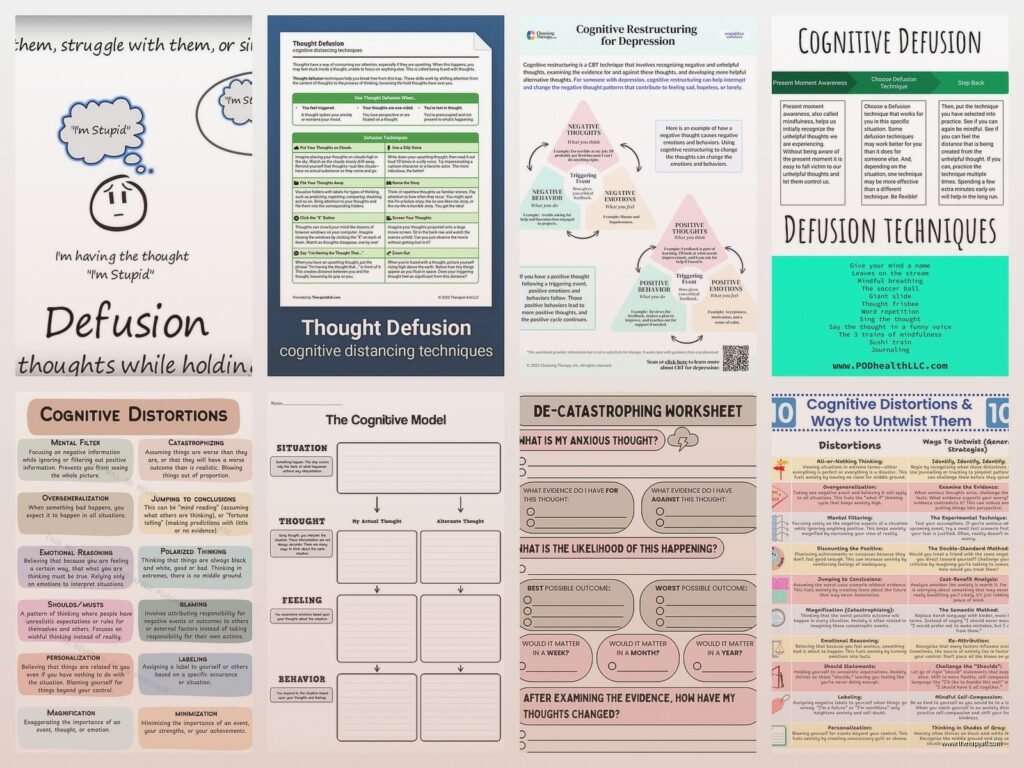
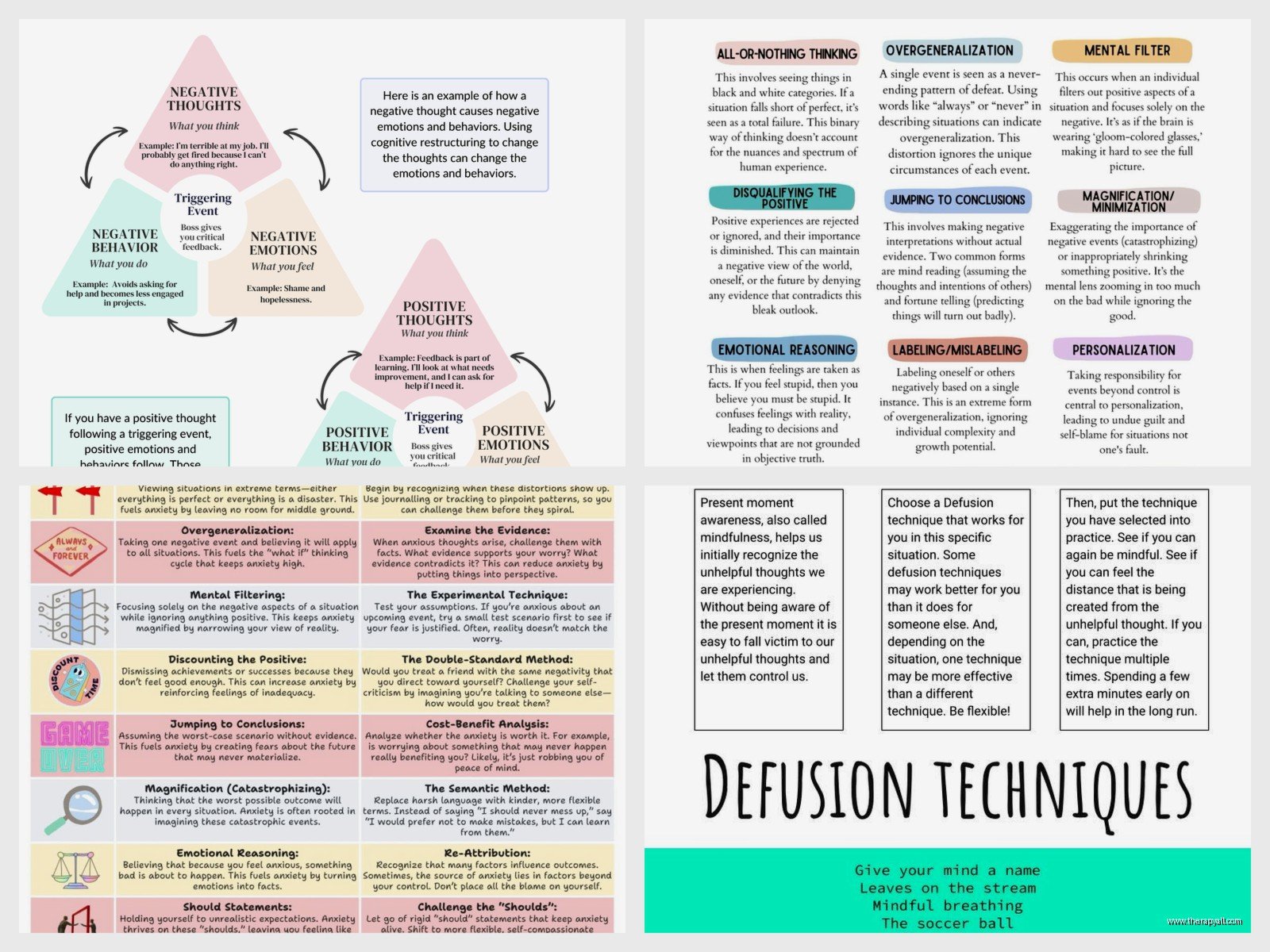
Cognitive Defusion Worksheet: ACT Techniques to Detach from Thoughts
Jun
# Understanding Cognitive Defusion and Why Your Brain Won’t Shut Up
Cognitive defusion is the practice of creating distance between yourself and your thoughts. Instead of treating thoughts as absolute facts that demand immediate action or emotional response, you learn to observe them as mental events—just noise your brain produces. It’s a core component of Acceptance and Commitment Therapy (ACT), developed by Steven Hayes in the 1980s.
The basic premise: thoughts are not commands. They’re not necessarily true. They’re just… thoughts.
I remember sitting with a client in 2019 who kept saying “I am worthless” and treating it like an unchangeable fact about her identity. When I asked her to say “I’m having the thought that I am worthless,” she looked at me like I’d just asked her to solve quantum physics. But that tiny shift—that’s defusion. You’re not eliminating the thought. You’re changing your relationship to it.
## Why Traditional Thought-Stopping Doesn’t Work
Here’s what annoys me: the number of poorly designed “cognitive defusion worksheets” that are basically just thought records with a different label slapped on. Real cognitive defusion isn’t about challenging thoughts or replacing them with positive ones. That’s cognitive restructuring from CBT. Defusion doesn’t care if the thought is true or false—it just wants you to stop being so fused with it that you can’t function.
Fusion means you’re stuck to your thoughts. The thought “I’m going to fail” becomes your identity, your future, your reality. You can’t see around it. Defusion is like… okay, that thought is there, noted, moving on.
## Core ACT Techniques for Defusion
**The Leaves on a Stream Exercise**
You visualize your thoughts as leaves floating down a stream. Each thought gets placed on a leaf. You watch it drift away. You don’t grab the leaf. You don’t jump in after it. You just observe.
I used to think this exercise was kind of cheesy until I actually tried it myself during a particularly anxious week in 2021 when my cat got sick and I was convinced every symptom meant something catastrophic. Watching my catastrophic thoughts float away on imaginary leaves actually helped. Who knew.
The worksheet version asks you to:
– Write down the recurring thought
– Close your eyes and visualize the stream
– Place the thought on a leaf
– Describe what you noticed (Did you grab the leaf? Did you follow it?)
**The Silly Voices Technique**
Take your negative thought and say it out loud in different voices. Cartoon character voices. Sing it to “Happy Birthday.” Say it in a robot voice or like a sports announcer.
This sounds ridiculous and it is. That’s the point. When you hear “I’m a failure” in Elmo’s voice, your brain has a harder time treating it as a serious threat assessment.
On a worksheet, you’d write:
– The thought in normal language
– How it sounds in a silly voice (describe it)
– What happened to the emotional charge
**The Thought Labeling Exercise**
Instead of engaging with thought content, you just label what type of thought it is. “That’s a judgment thought.” “That’s a worry thought.” “That’s a memory thought.” “That’s a prediction thought.”
You’re essentially training your brain to recognize patterns without getting dragged into the story. A good worksheet includes:
– The original thought
– The category/label
– How believable it feels before labeling (0-10)
– How believable after (0-10)
## Building Your Own Defusion Worksheet
The most effective worksheets I’ve seen—and honestly created, because I spent most of 2020 and 2021 developing therapy resources for various platforms—include these sections:
**Section 1: The Thought Capture**
Write down the exact thought. Not a summary. The actual words your brain said. “I’m gonna screw this up” not “I felt anxious about the presentation.”
**Section 2: Fusion Check**
Rate how fused you are with this thought (0-10). If you’re at an 8 or above, you probably believe this thought IS reality, not just a mental event.
**Section 3: Choose Your Technique**
List 3-4 defusion techniques. Check which one you’ll try. Having options matters because not every technique works for every person or every thought.
**Section 4: The Practice**
Actually do the technique. Write what happened. This isn’t journal therapy where you process feelings—this is documentation of the defusion practice.
**Section 5: Post-Practice Fusion Rating**
Rate fusion again. Did it decrease? Sometimes it doesn’t, and that’s information too.
## Common Defusion Techniques for Worksheets
**Thanking Your Mind**
When you notice a thought, you literally say (out loud or internally) “Thanks, mind, for that thought.” It’s weirdly effective because it creates separation. YOU are not the thought. Your mind produced it. You can thank it and move on without buying what it’s selling.
Worksheet prompt: Write the thought, then write “Thank you, mind, for the thought that ___________.” Notice how it feels different.
**The Observer Exercise**
You practice noticing that there’s a part of you observing your thoughts. You’re not just the thinker—you’re also the noticer. This gets existential fast, but the worksheet keeps it practical:
– What thought are you having?
– Who is noticing that thought?
– Can you observe the thought without being the thought?
**Physicalizing the Thought**
If your thought was an object, what would it be? What color, shape, texture, temperature? This sensory description pulls you out of the verbal content and into creative observation, or something like that—honestly this one works better in session than on paper but some people really connect with it.
**The “I’m Having the Thought That…” Prefix**
This is deceptively simple. Whatever your thought is, put “I’m having the thought that…” in front of it.
“I’m worthless” becomes “I’m having the thought that I’m worthless.”
That little bit of language creates distance. You’re not describing reality. You’re describing a mental experience.
## What Makes a Defusion Worksheet Actually Useful
Most worksheets fail because they’re too long or too vague. You don’t need five pages of questions. You need:
1. Specific thought capture (not feelings, not situations, the actual thought)
2. One clear defusion technique with instructions
3. Space to note what happened
4. A fusion rating before and after
I’ve seen worksheets that try to combine defusion with values work and committed action and it’s just… no. One skill per worksheet. Master defusion first.
The other thing that makes worksheets useless: when they don’t explain WHY you’re doing this. Defusion isn’t about feeling better (though that might happen). It’s about reducing the control thoughts have over your behavior. You can have the thought “I’m going to fail” AND still study for the exam. That’s defusion in action.
## Specific Worksheet Formats That Work
**The Quick Defusion Card**
Fits on an index card. Front side: the thought. Back side: “This is just a thought. I can notice it and still choose my action.” You physically flip the card. The action of flipping reinforces the mental shift.
**The Defusion Log**
A running document where you track:
– Date/time
– Thought
– Fusion level
– Technique used
– Outcome
– What you did anyway (the committed action)
This format shows patterns over time. You start seeing which thoughts show up repeatedly, which techniques work best for you.
**The Metaphor Worksheet**
ACT loves metaphors. A worksheet might ask you to:
– Choose a metaphor (thoughts as clouds, as cars driving by, as pop-up ads)
– Describe your thought within that metaphor
– Practice observing it through that lens
The metaphor creates automatic distance because you’re translating the thought into a different format.
## When Defusion Worksheets Actually Get Used
Here’s the reality: most worksheets get downloaded, maybe filled out once, then forgotten. The ones that stick are either:
1. Incredibly simple (one thought, one technique, done)
2. Required homework from a therapist
3. Part of a specific crisis plan
I assign defusion worksheets when clients are stuck in rumination loops. When the same thought shows up seventeen times a day and they keep engaging with it like it’s a new problem each time. The worksheet becomes a pattern interrupt.
You see the thought, you recognize it (“oh, this again”), you pull out the worksheet, you do the technique. Eventually you won’t need the worksheet—the defusion becomes automatic.
## The Limits of Worksheets for Defusion
Worksheets are tools, not solutions. They can’t replace therapy, especially if you’re dealing with trauma or severe mental health conditions. Defusion techniques can actually backfire if you’re using them to avoid processing legitimate emotions or experiences that need attention.
Also—and this matters—some thoughts DO require action. If your thought is “I should call 911 because I’m having chest pain,” defusion is not the skill to use. Discernment is part of this practice. Most thoughts don’t require immediate action. Some do.
A good worksheet might include a decision tree: Is this thought actionable right now? Does it require a response? Or is this my brain doing its anxiety thing again?
## Designing Your Own Practice
You don’t actually need a formal worksheet. You can create a defusion practice using:
– Voice memos where you record thoughts and then play them back
– A dedicated notebook where you draw your thoughts as cartoons
– Sticky notes with one thought each that you physically move around
– A spreadsheet if you’re that kind of person (I’ve had clients who love data tracking)
The format matters less than consistent practice. Defusion is a skill. It gets stronger with repetition.
When I’m working on mental health content and I notice myself fusing with thoughts about whether the article is good enough or if I’m explaining things clearly, I literally stop and do a quick defusion technique. Usually the silly voice one because it makes me laugh and breaks the seriousness spiral.
The point isn’t to never have negative thoughts. Your brain is gonna produce those regardless. The point is to stop treating every thought like it’s the morning briefing from the CEO of your life. Most thoughts are more like spam email. You can notice them, delete them, and move on with what actually matters.

ADHD & Neurodiversity
Life Planner Bundle – Life Organizer
Self-Care & Personal Growth
Acceptance And Commitment
Anxiety & Stress
Stress Processing Journal & Reflection Worksheets For Daily Self – Care
Self-Care & Personal Growth
Self – Reflection Guided Journal With Guided Prompts 30
Emotional Wellness
Decision Processing – Thought Processing Journal For Daily Self – Care
Therapist Resources
Physiotherapist Journal PDF Planner Tracker Or Log Book
Self-Care & Personal Growth
Customizable Self – Confidence & Self – Esteem Guided Journal
ADHD & Neurodiversity
ADHD Behavior Tracker PDF Planner Tracker Or Log Book