# Cognitive Restructuring Worksheet Basics
Cognitive restructuring is the process of identifying and challenging distorted thought patterns that contribute to emotional distress and problematic behaviors. A cognitive restructuring worksheet gives you a structured format to examine your automatic thoughts, evaluate their accuracy, and develop more balanced alternatives.
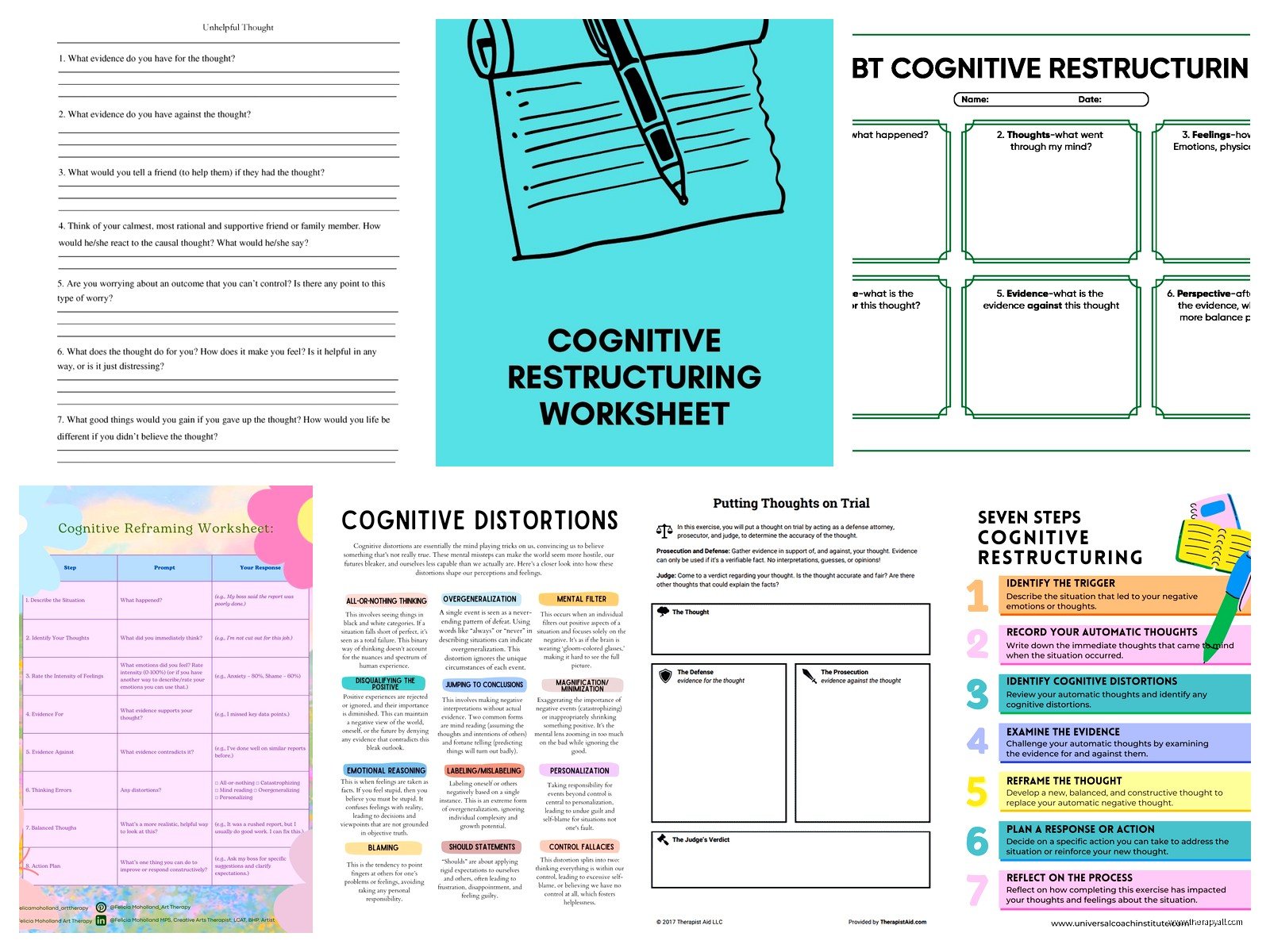
The typical worksheet includes several columns or sections. You start by identifying the situation that triggered a negative emotional response. Then you write down the automatic thoughts that came up, rate your belief in those thoughts, identify the emotions you felt and their intensity, examine the evidence for and against the thoughts, develop alternative balanced thoughts, and re-rate your emotional response.
I remember back in 2019 working with a client who insisted she didn’t have “thoughts” before feeling anxious, she just “felt anxious suddenly.” We spent three sessions with worksheets before she could catch that split-second thought of “everyone’s judging me” that happened so fast she’d been missing it for years. That’s actually super common—automatic thoughts are called automatic because they happen without conscious effort.
## The Column Breakdown
Most cognitive restructuring worksheets follow a similar structure, though the exact format varies. Here’s what each section actually does:
**Situation:** This is the objective description of what happened. Not your interpretation, just the facts. “My boss didn’t reply to my email” not “My boss is mad at me.” People mess this up constantly and it derails the whole exercise. You gotta keep it factual or you’re already starting with a distorted thought.
**Automatic Thoughts:** These are the immediate thoughts that popped into your head during or right after the situation. They’re usually negative, exaggerated, and feel completely true in the moment. Common examples include “I’m going to fail,” “Nobody likes me,” “I can’t handle this,” or “Something terrible will happen.”
**Emotions:** Name the specific emotions you felt and rate their intensity on a scale of 0-100. Be specific—”bad” isn’t an emotion. Anxious, angry, sad, ashamed, guilty, frustrated—these are emotions. Rating intensity matters because you’ll re-rate later to see if restructuring the thought actually changed how you feel.
**Evidence For:** This is where you list any facts that support your automatic thought. And I mean actual facts, not more interpretations or assumptions. This section is often shorter than people expect.
**Evidence Against:** Facts that contradict or don’t support your automatic thought. This is usually where the worksheet gets interesting because you’re forced to acknowledge information you’ve been ignoring or discounting.
**Alternative Thought:** A more balanced, realistic thought that takes into account all the evidence. Not a positive affirmation or toxic positivity statement, just a more accurate thought.
**Re-rate Emotions:** After developing alternative thoughts, you re-rate the intensity of your emotions to see if they’ve shifted.
## Common Cognitive Distortions
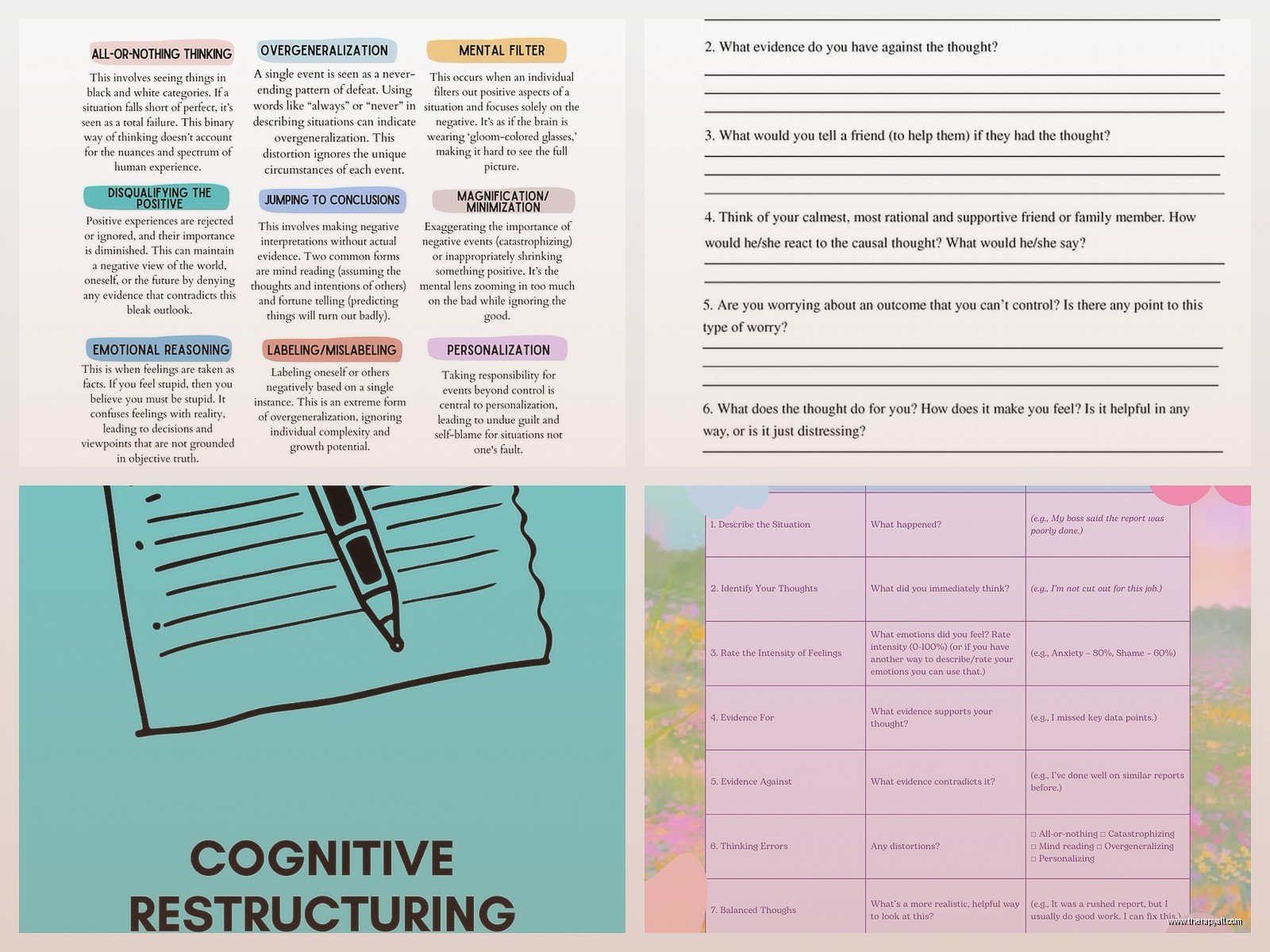
Worksheets are way more effective when you can identify which cognitive distortion you’re dealing with. These are the systematic errors in thinking that keep showing up:
**All-or-Nothing Thinking:** Seeing things in black and white categories. If your performance isn’t perfect, you see yourself as a total failure. There’s no middle ground.
**Overgeneralization:** Taking one negative event and turning it into a never-ending pattern. “I didn’t get that job” becomes “I’ll never get hired anywhere.”
**Mental Filter:** Focusing exclusively on negative details while filtering out positive aspects. You get nine compliments and one criticism, and you obsess over the criticism for weeks.
**Discounting the Positive:** When positive experiences don’t count for some reason. “That success was just luck” or “They’re only being nice because they feel sorry for me.”
**Jumping to Conclusions:** Making negative interpretations without actual evidence. This includes mind reading (assuming you know what others are thinking) and fortune telling (predicting the future negatively).
**Magnification and Minimization:** Exaggerating the importance of negative things or shrinking the importance of positive things. Also called the “binocular trick.”
**Emotional Reasoning:** Assuming that negative emotions reflect reality. “I feel stupid, therefore I must be stupid.”
**Should Statements:** Criticizing yourself or others with “should,” “must,” or “ought” statements. These create guilt and frustration.
**Labeling:** Attaching a negative label to yourself or others instead of describing the specific behavior. “I’m a loser” instead of “I made a mistake.”
**Personalization:** Blaming yourself for things that aren’t entirely your responsibility or taking things personally that aren’t about you.
## How to Actually Use the Worksheet
Here’s the thing that genuinely annoys me about most articles on cognitive restructuring—they make it sound easy and intuitive when it’s actually kinda awkward and difficult at first. You’re gonna feel stupid writing this stuff down. That’s normal.
Start by carrying the worksheet with you or keeping it accessible on your phone. When you notice a strong emotional reaction, that’s your cue to fill one out. Don’t wait until the end of the day when you’ve forgotten the specific thoughts.
Fill out the situation and automatic thoughts sections first, while the experience is fresh. Be as specific as possible. Vague entries like “I felt bad at work” don’t give you enough information to work with. “During the team meeting when I suggested the new timeline and Sarah frowned” is specific enough to examine.
Write down multiple automatic thoughts if several came up. Sometimes there’s a chain—”She frowned” leads to “She thinks my idea is stupid” leads to “I shouldn’t have spoken up” leads to “Everyone thinks I’m incompetent.”
The evidence sections are where people get stuck. You have to be honest here, which means acknowledging evidence that contradicts your preferred narrative. I spent summer 2021 writing worksheet guides for a therapy app and testing them myself, and let me tell you, writing down evidence against my anxious thoughts felt like betraying myself somehow—like I was being forced to admit my anxiety was lying to me.
When developing alternative thoughts, avoid toxic positivity. Don’t go from “I’m terrible at my job” to “I’m amazing at everything I do.” That won’t feel believable and won’t change your emotional response. Go for something like “I make mistakes sometimes, but I also have specific skills my boss has complimented, and I’ve successfully completed most of my projects.”
The alternative thought should feel at least somewhat believable. If it doesn’t, you might need to gather more evidence or adjust the thought until it feels more realistic.
## When Worksheets Don’t Work
Sometimes you fill out a worksheet correctly and your emotional rating barely budges. This doesn’t mean you failed or the technique doesn’t work for you.
First, check if you’re working on a core belief rather than an automatic thought. Core beliefs are deeper, more rigid beliefs about yourself, others, or the world. “I’m unlovable” is a core belief. “She didn’t text back because she hates me” is an automatic thought. Core beliefs take longer to shift and usually need multiple worksheet sessions plus other therapeutic work.
Second, make sure you’re not just intellectually understanding the alternative thought without emotionally believing it. You can know logically that your thought is distorted while still feeling like it’s true. This gap is normal and closes with repeated practice.
Third, sometimes the situation involves actual problems that need solving, not just thought distortion. If you’re anxious about an upcoming presentation because you haven’t prepared, cognitive restructuring won’t fix that—you need to prepare. The worksheet might help you realize “I’ll definitely fail” is distorted and “I might struggle but I can handle it” is more accurate, but you still need to address the practical problem.
## Variations and Digital Options
The standard multi-column worksheet isn’t the only format. Some variations include:
**Thought Records:** Similar to cognitive restructuring worksheets but sometimes simplified with fewer columns. Often used in CBT.
**ABCDE Model:** Developed by Albert Ellis for REBT (Rational Emotive Behavior Therapy). A is Activating Event, B is Beliefs, C is Consequences, D is Disputation, E is Effective New Beliefs.
**Socratic Questioning Worksheets:** These guide you through a series of questions to examine your thoughts rather than using a column format. Questions like “What evidence supports this thought?” and “What would I tell a friend in this situation?”
**Triple Column Technique:** A simplified version with just automatic thought, cognitive distortion, and rational response.
Digital apps now offer cognitive restructuring tools with smartphone notifications and tracking features. Some people find these more convenient than paper worksheets, though I personally still prefer paper because… I don’t know, my cat knocked my phone off the table last week and I lost three days of entries before I realized they hadn’t synced, so maybe I’m just bitter about that.
## Integration with Other Techniques
Cognitive restructuring worksheets work best when combined with other CBT techniques. Behavioral experiments test whether your thoughts are accurate by trying out new behaviors and seeing what actually happens. Exposure exercises help you confront feared situations while practicing cognitive restructuring in real time.
Mindfulness can be incorporated by noticing thoughts without immediately believing or engaging with them. You might observe “I’m having the thought that I’ll fail” rather than “I’ll fail.” This creates some distance from automatic thoughts.
Activity scheduling helps when depression makes you believe “Nothing will be enjoyable” or anxiety makes you think “I can’t handle going out.” By scheduling and completing activities, you generate evidence against these thoughts.
## Common Mistakes
**Being too vague:** “I felt bad” and “People were annoying” don’t give you enough to work with.
**Skipping the emotion rating:** Without the initial rating, you can’t measure if restructuring actually helped.
**Writing what you think you should write:** The worksheet only helps if you’re honest about your actual thoughts, even if they sound irrational or embarrassing.
**Forcing positive thinking:** The goal isn’t to replace negative thoughts with positive ones, it’s to develop realistic, balanced thoughts.
**Doing it once and giving up:** Cognitive restructuring is a skill that improves with practice. One worksheet won’t change long-standing thought patterns, or wait—actually sometimes one worksheet does create a breakthrough moment, but that’s not typical.
**Using it as self-punishment:** Some people use the worksheet to beat themselves up about having distorted thoughts. That defeats the purpose. Automatic thoughts happen to everyone.
**Not reviewing completed worksheets:** Going back through old worksheets helps you spot patterns in your thinking and see which alternative thoughts were most helpful.
## Adapting for Specific Issues
**Anxiety:** Focus on examining catastrophic predictions and probability overestimation. Include a column for “What’s the worst that could realistically happen?” and “How likely is that really?”
**Depression:** Pay attention to all-or-nothing thinking and discounting positives. You might need to actively hunt for evidence against negative thoughts because depression makes this information harder to access.
**Anger:** Look for should statements and personalization. Add a column for “Other possible explanations for their behavior” to counter mind reading.
**Social Anxiety:** Focus on mind reading and spotlight effect thinking. Consider adding “What percentage of people actually noticed or cared?” to reality-test your assumptions.
The worksheet is just a tool, and like any tool, it’s more effective for certain jobs than others. It won’t fix trauma, it won’t cure severe mental illness, and it won’t solve practical life problems. But for identifying and challenging the distorted thoughts that make difficult situations worse, it’s one of the most researched and effective techniques we have. You just gotta actually use it consistently, which is the hard part nobody likes to talk about.