
Mental Health, Therapy resources
Cognitive Therapy Homework: Assignments That Support Your Progress
Jul
Cognitive therapy homework isn’t some optional extra credit assignment you can skip if you’re feeling lazy. It’s the actual mechanism through which change happens outside the therapy room. You spend maybe 50 minutes a week with your therapist, which leaves 10,030 other minutes where your brain is doing its thing, and that’s where homework comes in.
I remember back in 2019 working with a client who would show up every week, have these brilliant insights during session, nod enthusiastically about practicing the skills we discussed, and then arrive the next week having done absolutely nothing. We were basically having the same conversation on repeat for like two months. Finally I just said, “Look, this is kinda like going to a piano teacher, learning the scales, and then never touching the piano until your next lesson.” That clicked for her in a way all my professional explanations hadn’t.
Thought Records: The Foundation That Everyone Hates At First
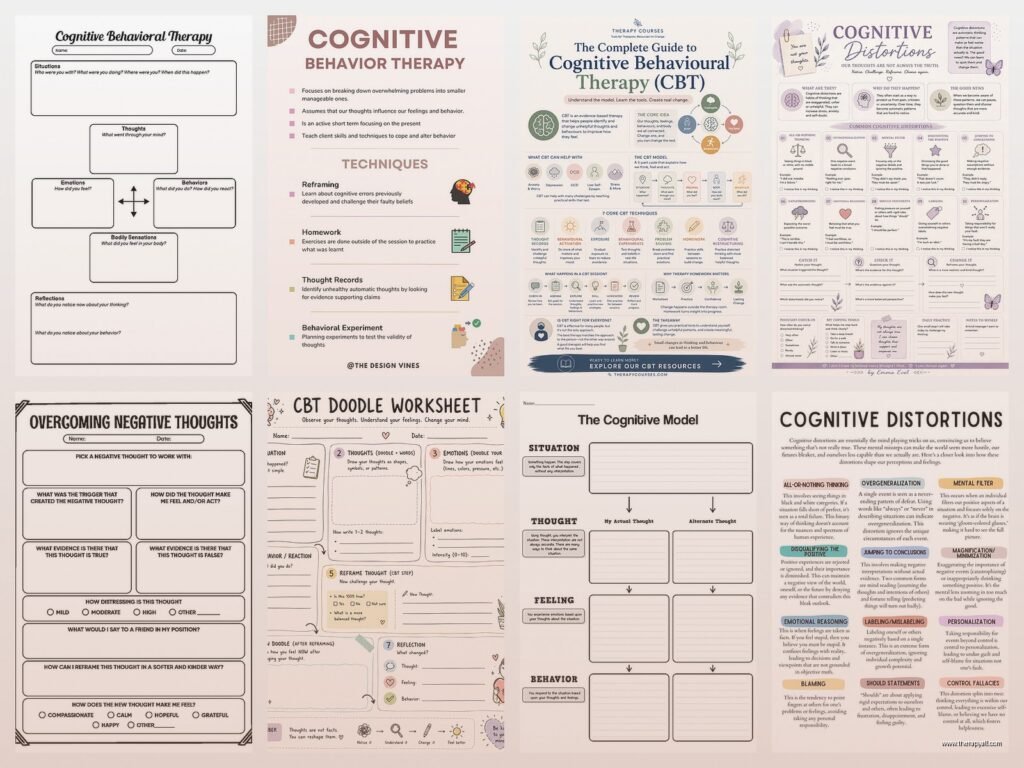
Thought records are probably the most common cognitive therapy homework assignment, and they’re also the thing people resist the most. The basic structure involves identifying a situation that triggered distress, noting what automatic thoughts popped up, recognizing the emotions and their intensity, examining the evidence for and against those thoughts, and developing a more balanced perspective.
The seven-column thought record is standard, though some therapists use five columns or even simplified three-column versions. You write down the activating event in column one. Column two captures your automatic thoughts—those immediate interpretations your brain makes. Column three lists emotions and rates their intensity on a 0-100 scale. Column four asks for evidence supporting the automatic thought. Column five wants evidence against it. Column six is where you generate an alternative or balanced thought. Column seven has you re-rate your emotions.
What genuinely annoys me is when therapists hand clients a blank thought record template without adequate explanation and just expect them to figure it out. I’ve seen so many poorly designed worksheets that are cluttered, use jargon, or have tiny boxes that make writing impossible. Summer 2021 I was reviewing cognitive therapy resources for a series I was writing, and probably 60% of the thought record templates I found were basically unusable—either too complex for beginners or so oversimplified they missed the point entirely.

The evidence columns are where the actual cognitive work happens. You’re not just positive thinking your way out of distress. You’re examining whether your interpretation of events actually holds up under scrutiny. A thought like “I’m going to fail this presentation and everyone will think I’m incompetent” gets tested against reality: Have you failed presentations before? Do you have evidence of competence in other areas? Is “everyone will think I’m incompetent” actually how professional environments work, or is that catastrophizing?
Behavioral Experiments: Testing Your Predictions
Behavioral experiments take cognitive therapy out of your head and into real-world testing. The premise is simple: your anxious or depressive thoughts make predictions about what will happen, and you can actually test whether those predictions are accurate.
The structure involves identifying a specific belief or prediction, designing an experiment to test it, predicting the outcome, conducting the experiment, and then reviewing what actually happened versus what you predicted. Someone with social anxiety might believe “If I speak up in a meeting, everyone will judge me and think my ideas are stupid.” The behavioral experiment would be speaking up in a meeting and observing the actual response.
I use behavioral experiments in my own life, honestly. I had this whole thing about thinking people would be annoyed if I asked questions in professional webinars, so I tested it by asking a question in three consecutive webinars and tracking responses. Turns out people either responded helpfully or didn’t respond at all, and exactly zero people seemed annoyed. My cat knocked over my water bottle during one of them and I had to scramble to mute myself, which was mortifying but also… not related to the question I’d asked.
The key with behavioral experiments is making them specific and measurable. “I’m gonna be more social” isn’t an experiment—it’s too vague. “I will initiate one conversation with a coworker on Monday and observe whether they seem annoyed or engaged based on their verbal responses and body language” is an actual experiment with observable outcomes.
Activity Scheduling and Monitoring
Activity scheduling addresses the behavioral component of depression and anxiety. When you’re depressed, you withdraw from activities, which decreases opportunities for positive reinforcement, which makes depression worse. Activity scheduling breaks that cycle by intentionally planning activities and tracking them.
There are different versions of this homework. Basic activity monitoring involves tracking what you actually do hour-by-hour and rating each activity for pleasure and mastery (accomplishment). This gives you data about which activities genuinely improve your mood versus which ones you think should improve your mood but actually don’t.
Activity scheduling takes it further by planning specific activities in advance. You’re not waiting until you feel motivated—you’re scheduling activities and doing them regardless of motivation. This is crucial because motivation follows action in depression, not the other way around. You schedule a 20-minute walk at 3pm Tuesday, and you do it even though you don’t feel like it, and then you track whether your mood shifted.
The pleasure and mastery ratings are both important because they serve different functions. Pleasure activities provide immediate mood boosts. Mastery activities build self-efficacy and combat feelings of worthlessness, even if they don’t feel immediately enjoyable. Doing your laundry might rate low on pleasure but high on mastery.
Graded Exposure Hierarchies
For anxiety disorders, graded exposure is homework that systematically confronts feared situations. You create a hierarchy of feared situations ranked by difficulty (usually 0-100), and then you work through them gradually, starting with lower-difficulty items.
Someone with social anxiety might rank “making eye contact with a stranger” at 30, “asking a store employee for help” at 50, “attending a small social gathering” at 70, and “giving a presentation to 20 people” at 95. The homework involves deliberately exposing yourself to these situations, staying in them until anxiety decreases (habituation), and recording what happened.

The exposure needs to be prolonged enough for habituation to occur. If you expose yourself to a feared situation but escape as soon as anxiety spikes, you actually reinforce the fear. You gotta stay in the situation until your anxiety comes down at least 50%, which sometimes means sitting with discomfort for 30-45 minutes or even longer for some situations.
Response prevention is the other critical piece, especially for OCD. You expose yourself to the trigger but prevent the compulsive response. If you have contamination fears, you might touch a doorknob (exposure) but not wash your hands afterward (response prevention). This is genuinely hard homework, and it requires careful planning with a therapist.
Tracking Forms and Why They Matter
Every exposure needs documentation. You record the situation, your predicted anxiety level, your actual peak anxiety level, how long you stayed in the situation, your anxiety level at the end, and what you learned. This data serves multiple functions—it shows you that anxiety does decrease with time, it reveals when your predictions are inaccurate, and it gives you and your therapist information about what’s working.
Core Belief Worksheets
Core beliefs are those deep, fundamental assumptions you hold about yourself, others, and the world. They’re different from automatic thoughts—they’re more stable and global. Automatic thoughts are situation-specific (“I messed up this email”), while core beliefs are broad (“I’m incompetent”).
Core belief worksheets involve several types of homework. The downward arrow technique is one method for identifying core beliefs. You start with an automatic thought and keep asking “What does that mean about me?” until you hit the underlying belief. “I made a mistake at work” → “What does that mean?” → “It means I’m not good at my job” → “What does that mean?” → “It means I’m a failure.”
Once you’ve identified a core belief, the homework shifts to examining evidence for and against it, looking for exceptions, and developing alternative beliefs. The historical test examines where the belief came from—usually childhood experiences or significant events. The continuum technique challenges all-or-nothing core beliefs by placing yourself on a continuum rather than in an extreme category.
Positive data logs are homework assignments where you specifically track experiences that contradict your negative core belief. If your core belief is “I’m unlovable,” you record any moments—however small—where someone showed care or affection. This sounds cheesy, and I’ll admit I rolled my eyes at it initially when I first encountered it in grad school, but the data collection aspect actually makes it more cognitive and less “gratitude journal” vibes.
Worry Time and Rumination Postponement
This homework technique addresses excessive worry and rumination by containing it to specific times. You schedule 15-30 minutes of “worry time” each day. When worries pop up outside that scheduled time, you write them down and postpone thinking about them until worry time arrives.
During the scheduled worry time, you deliberately worry about the items on your list. Often what happens is that the worries seem less urgent or important by the time worry time rolls around. Or you realize you’ve been worrying about the same three things on repeat for weeks, which itself is useful information.
The homework component involves tracking when worries occur, what you do with them (postpone or engage), and what happens during scheduled worry time. Some people find that having permission to worry later actually reduces the urgency of the worry in the moment. Others find that when they sit down for worry time, they can’t actually generate the same level of concern they felt earlier.
Challenging Cognitive Distortions
Cognitive distortions are systematic errors in thinking—all-or-nothing thinking, overgeneralization, mental filtering, catastrophizing, emotional reasoning, should statements, labeling, personalization. The homework involves identifying which distortions you use most frequently and actively challenging them.
You might keep a distortion log where you record situations, the distorted thought, which distortion category it falls into, and a more balanced alternative. This is similar to thought records but with specific focus on the type of thinking error involved.
What I’ve noticed is that most people have like two or three distortions they rely on heavily and barely use the others. Someone might catastrophize constantly but never engage in personalization. Knowing your patterns makes the homework more efficient because you can—wait, I was gonna say something else but I just remembered this client who insisted that “should statements” weren’t a distortion because “people should follow basic social norms” and we had this whole debate about the difference between preferences and demands.
Imagery Rescripting
For trauma or distressing memories, imagery rescripting homework involves revisiting a traumatic memory in imagination and changing elements of it. This isn’t about denying what happened—it’s about changing the meaning or your role in the memory.
The homework typically involves writing out the original memory, identifying the most distressing moment, and then rewriting the scene with changes. You might imagine your adult self entering the scene to protect your child self, or you might change how you responded, or you might imagine a different outcome. After rescripting, you read or imagine the new version repeatedly.
This homework should really only be done with therapist guidance, especially for significant trauma. It’s not something you just download a worksheet for and try at home. The rescripting needs to address the specific meanings and beliefs that formed during the trauma.
Making Homework Actually Happen
The biggest obstacle to cognitive therapy homework is just not doing it. Compliance rates are honestly pretty low across studies—somewhere between 20-50% of clients complete homework consistently.
Strategies that improve homework completion include making assignments very specific (not “practice challenging your thoughts” but “complete one thought record about work-related anxiety by Thursday”), starting small, connecting homework to goals the client actually cares about, troubleshooting obstacles in advance, and reviewing homework every single session.
If homework isn’t reviewed in session, clients stop doing it. That’s just reality. The review doesn’t have to take the whole session, but it needs to happen consistently. I also think therapists need to be honest when they assign homework that’s too ambitious or doesn’t fit the client’s current capacity. There’s no point assigning three thought records a day if someone is barely getting out of bed.
Some people do better with app-based homework tracking, others need paper worksheets, some want text reminders, others need accountability from their therapist. The format matters less than finding what actually works for that specific person and their life circumstances.
ADHD & Neurodiversity
Life Planner Bundle – Life Organizer
Self-Care & Personal Growth
Acceptance And Commitment
Anxiety & Stress
Stress Processing Journal & Reflection Worksheets For Daily Self – Care
Self-Care & Personal Growth
Self – Reflection Guided Journal With Guided Prompts 30
Emotional Wellness
Decision Processing – Thought Processing Journal For Daily Self – Care
Therapist Resources
Physiotherapist Journal PDF Planner Tracker Or Log Book
Self-Care & Personal Growth
Customizable Self – Confidence & Self – Esteem Guided Journal
ADHD & Neurodiversity
ADHD Behavior Tracker PDF Planner Tracker Or Log Book