# Coping Skills Worksheets for Adults (Free PDF Download)
Coping skills worksheets are structured tools designed to help you identify, practice, and track strategies for managing stress, emotional distress, and challenging situations. They’re not magic fixes—they’re essentially guided exercises that prompt you to think through your responses to stressors in a more deliberate way instead of just reacting on autopilot.
I remember back in 2021, I was reviewing like forty different coping skills PDFs for a roundup article and realized most of them were just recycling the same five techniques with different fonts. It made me annoyed because adults deserve more than clipart of people doing deep breathing exercises. We need worksheets that actually address the complexity of adult stressors—work conflicts, financial anxiety, relationship patterns that have been going on for years, not just “name three things you’re grateful for.”
## What Makes a Coping Skills Worksheet Actually Useful
The best worksheets function as both assessment and action plan. They help you figure out what’s triggering your stress response and then guide you toward specific interventions that match your situation. Generic advice doesn’t work because your nervous system at 9 PM after a fight with your partner is different from your nervous system at 2 PM when you’re overwhelmed at work.
Effective worksheets typically include:
- A section for identifying the specific stressor or emotional state
- Prompts that help you notice physical sensations and thought patterns
- Multiple coping strategy options categorized by type
- Space to track what worked and what didn’t
- Follow-up questions that help you refine your approach over time
You want something that acknowledges you’re an adult with limited time and energy. If a worksheet requires forty-five minutes to complete, you’re probably not gonna use it when you’re actually stressed.
## Categories of Coping Skills Worth Worksheeting
Most evidence-based worksheets organize coping skills into categories because different types of stress require different responses. You can’t think your way out of a panic attack, and you can’t just “relax” your way through a legitimate problem that requires action.
**Emotion-focused coping** targets how you feel about a situation. These worksheets might ask you to identify and label emotions, challenge catastrophic thinking, or practice self-compassion. They’re useful when the stressor itself can’t be changed immediately—like waiting for medical test results or dealing with someone else’s behavior.
**Problem-focused coping** helps you tackle the actual issue causing stress. Worksheets in this category guide you through breaking down overwhelming problems into manageable steps, identifying resources, and creating action plans. I use these when I’m procrastinating on something that’s making me anxious, which is like… often.
**Sensory or body-based coping** involves physical strategies—breathing exercises, progressive muscle relaxation, movement, temperature changes. Worksheets here might include tracking which physical interventions calm your nervous system fastest. My cat knocked over my coffee while I was filling out one of these last week and I realized the startle response and cleanup actually regulated me more than the worksheet, which was sort of funny and also the point—sometimes you need physical interruption.
**Social coping** addresses connection and support-seeking. These worksheets help you identify who in your life is safe to reach out to, what kind of support you need (listening vs. advice vs. distraction), and how to ask for it.
## Common Worksheet Formats You’ll Encounter
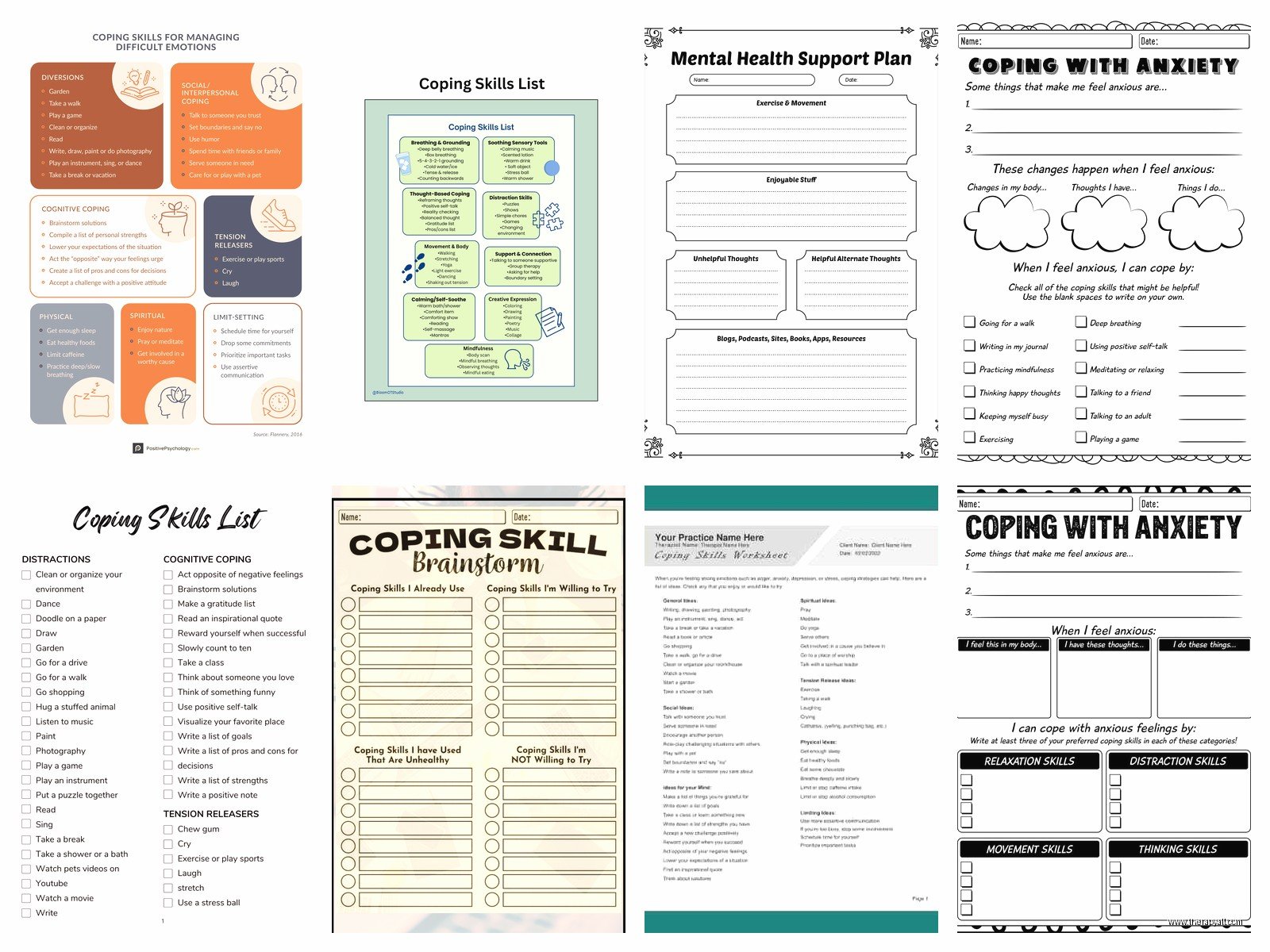
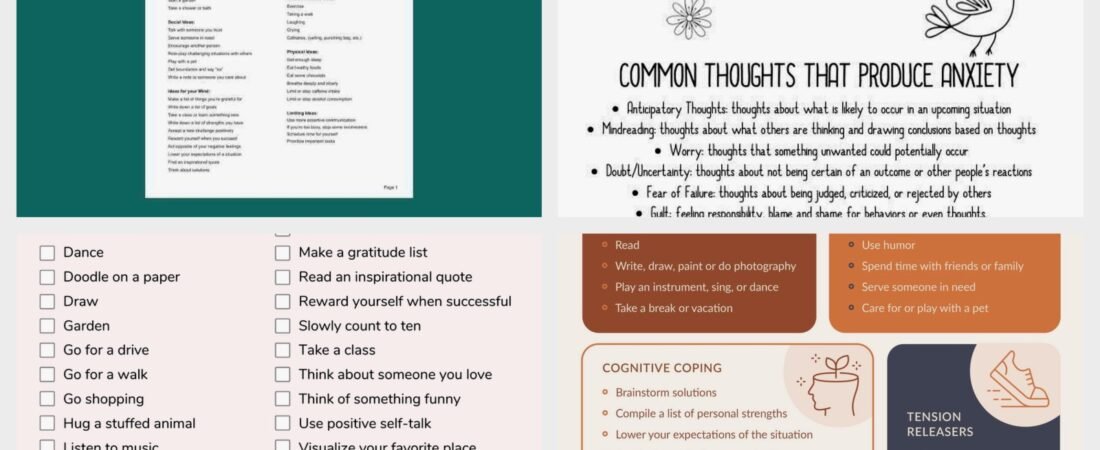
**The Coping Skills Menu or Toolbox** lists dozens of strategies organized by category. You check off or highlight the ones you’ve tried, want to try, or find most effective. The benefit is having everything in one place when your brain is too fried to remember that yes, taking a shower sometimes helps. The downside is decision paralysis when you’re looking at seventy options.
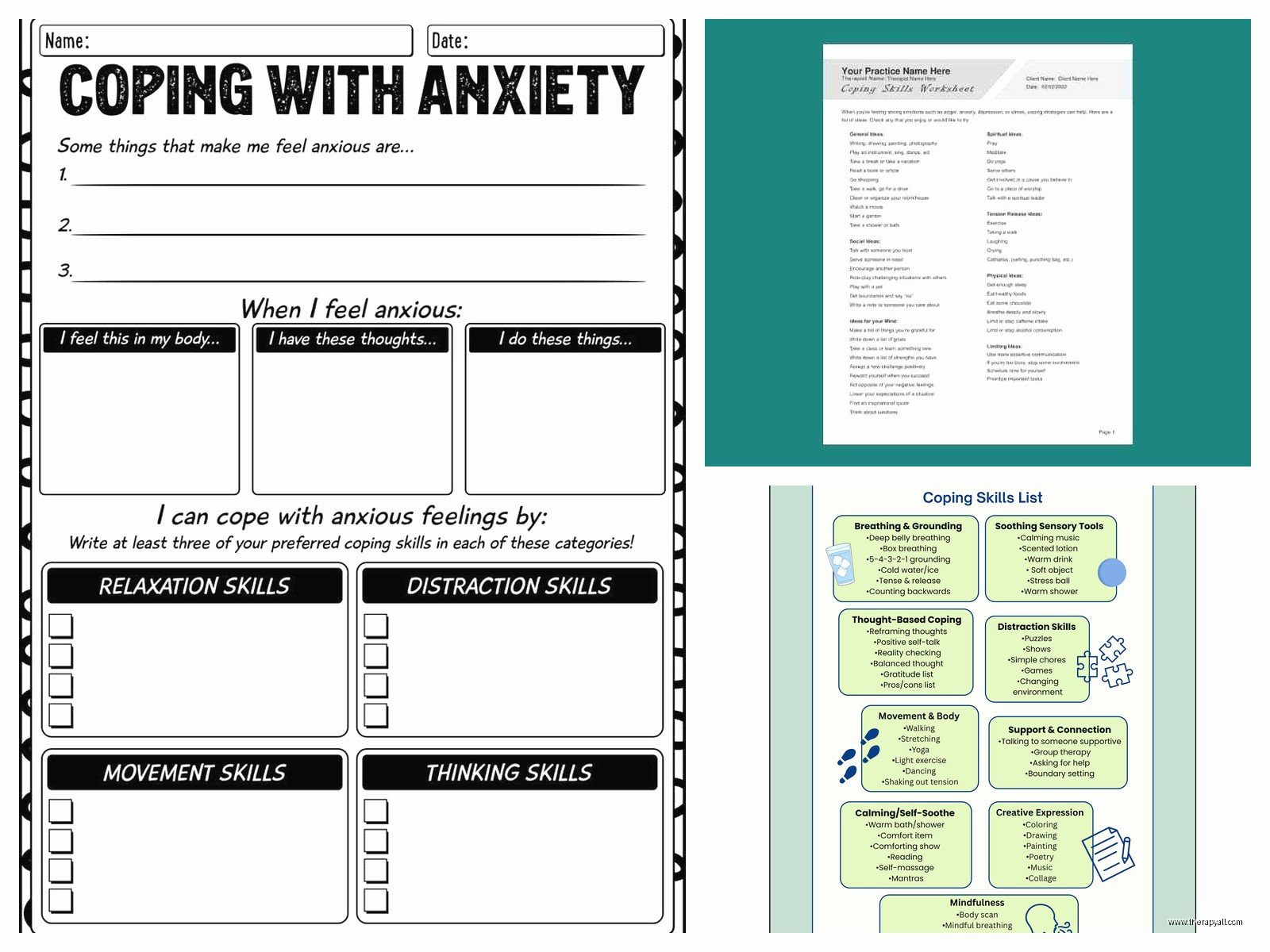
**Situation-Specific Tracking Sheets** walk you through one stressful event from start to finish. You document what happened, your automatic thoughts, physical sensations, what you tried, and what the outcome was. Over time, these reveal patterns—like maybe you always catastrophize about work emails after 8 PM, or physical exercise works better for you than journaling.
**Skill-Building Practice Logs** focus on developing one specific technique through repeated practice. If you’re learning grounding exercises or cognitive restructuring, these worksheets provide structure for daily or weekly practice with space to note what you’re noticing.
**Crisis Planning Worksheets** are different—they’re meant to be completed when you’re relatively stable so you have a clear plan for moments when your coping capacity is maxed out. They typically include warning signs, emergency contacts, and your most reliable crisis interventions.
## What to Actually Look for in Free PDFs
Here’s what genuinely matters when you’re downloading worksheets: Can you actually use them? I’ve seen beautifully designed PDFs that are completely impractical—tiny text boxes, complex instructions, or they assume you’ll print them in color.
Check that the worksheet:
- Has enough writing space if it’s meant to be filled out
- Uses clear, direct language without therapy jargon
- Doesn’t require you to already understand psychological concepts
- Can be saved digitally or printed in black and white
- Includes some kind of instruction or example
The most useful ones I’ve found are honestly kinda plain-looking. They prioritize function over aesthetics, which makes sense when you’re trying to use one during an actual stressful moment.
## How to Use These Without Making It Another Chore
One thing that bugs me about mental health content is this assumption that everyone has time for elaborate self-care routines. Most adults I know are already overwhelmed. Adding worksheet homework can backfire if it becomes another thing you feel guilty about not doing.
Start with one worksheet type that addresses your most frequent stressor. Maybe you fill it out once a week, or maybe you just keep it accessible and use it when you need it. There’s no rule that says you have to complete every section or use it perfectly.
Some people keep digital versions on their phone. Others print one copy and laminate it so they can write on it with dry-erase markers and reuse it. I’ve done both and honestly the digital version is easier because I can fill it out quickly without hunting for a pen, but—wait, this depends on whether you find screens soothing or activating when you’re stressed.
## Specific Worksheet Types Worth Downloading
**The 5-4-3-2-1 Grounding Worksheet** guides you through the sensory grounding technique (5 things you see, 4 things you can touch, etc.) with space to write responses. It’s straightforward and works for anxiety, dissociation, or overwhelm. You probably don’t need a worksheet for this technique once you’ve practiced it a few times, but having it written out helps when your brain is too scattered to remember the sequence.
**Cognitive Distortion Identification Sheets** list common thinking patterns—catastrophizing, black-and-white thinking, mind-reading—and ask you to identify which ones show up in your stress response. These are useful if you notice your thoughts spiraling but can’t quite pinpoint what’s happening. The act of naming the distortion sometimes creates enough distance to shift your response.
**Coping Skills Inventory** is basically an audit of what you already do and whether it’s helpful or harmful. It’ll list things like “scroll social media,” “call a friend,” “drink alcohol,” “go for a walk” and you rate how often you do each one and whether it actually helps. This can be uncomfortably revealing—you might realize you’re relying heavily on strategies that make things worse.
**Opposite Action Worksheets** come from DBT and they’re for when your emotional urge doesn’t match what would actually be effective. Like when you’re anxious and want to avoid, but avoidance will make the anxiety worse. The worksheet walks you through identifying the emotion, the urge, and the opposite action. I used one of these when I was avoiding a difficult conversation for weeks and it finally pushed me to just send the text.
**Stress Management Planning Sheets** help you prepare for known stressors. If you have a difficult event coming up—family gathering, medical appointment, work presentation—you can use these to identify potential challenges and plan specific coping responses in advance. They work better than just hoping you’ll handle it well in the moment.
## The Problem With Most Free Mental Health Worksheets
A lot of free PDFs available online are either oversimplified to the point of uselessness or they’re clearly designed by someone who doesn’t understand how stressed brains actually function. I’ve seen worksheets that require you to write paragraphs when you can barely form a sentence. I’ve seen ones with instructions so complicated you’d need to be calm to figure them out, which defeats the purpose.
There’s also this thing where—and this genuinely annoys me—many free resources treat adults like children. Pastel colors, simplistic affirmations, cartoony illustrations. Adults dealing with serious stress need tools that respect their intelligence and lived experience, not something that looks like it was designed for a middle school guidance counselor’s office.
The best worksheets acknowledge that coping is complex and often imperfect. They don’t promise that if you just do the exercise everything will be fine. They’re realistic about the fact that sometimes you’ll try multiple strategies before finding what works, and sometimes what worked last week won’t work this week.
## Actually Downloading and Organizing Your Collection
You’re gonna end up with a lot of PDFs if you start collecting these. Create a dedicated folder on your device or in your cloud storage. Name files clearly—”Grounding-5-4-3-2-1.pdf” is better than “worksheet-final-v2.pdf” when you’re trying to find something quickly.
Some people print a few favorites and keep them in a binder or folder. Others create a “crisis folder” on their phone’s home screen with their most-used worksheets easily accessible. Whatever system you choose, the point is reducing barriers to actually using them when you need them.
If you find a worksheet you really like, consider filling out a “master copy” with your go-to responses and strategies, then saving that as a reference. When you’re in the middle of a stressful moment, having your own previous insights available can be more helpful than starting from scratch.
## When Worksheets Aren’t Enough
These tools are useful for building awareness and practicing skills, but they’re not substitutes for professional support when you need it. If you’re using coping skills worksheets and still feeling consistently overwhelmed, that’s information worth paying attention to.
Worksheets work best for:
- Everyday stress management
- Building your self-awareness about patterns
- Supplementing therapy work
- Practicing specific techniques between therapy sessions
- Having a structured approach when you’re feeling scattered
They’re less effective for acute mental health crises, trauma processing, or situations where the stressor is ongoing and severe. In those cases, you need more than a PDF—you need actual professional intervention.
I think worksheets get positioned sometimes as this complete solution when really they’re just one tool among many. They’re helpful when they’re helpful, and when they’re not, you need something else. That’s not a failure of the worksheet or of you—it’s just the reality that different situations require different levels of support.