
Mental Health, Therapy resources
Counselor vs. Therapist: What’s the Difference and Which Do You Need?

Aug
The terms “counselor” and “therapist” get used interchangeably all the time, and honestly, I’ve watched people tie themselves in knots trying to figure out which professional they’re supposed to see. I remember sitting in a coffee shop in 2019, overhearing someone on the phone saying “I need a therapist, not a counselor, this is serious,” and I wanted to lean over and explain that it’s not actually that simple. But I didn’t, because that would’ve been weird.
The confusion makes sense because there’s significant overlap in what these professionals do. Both provide talk-based support for mental health concerns. Both sit across from you (or on a screen now, I guess) and help you work through difficult emotions, relationships, trauma, or life transitions. But the distinctions matter when you’re trying to figure out who to call.
The Credential Differences
Here’s where it gets technical. “Therapist” isn’t actually a protected term in most places. You can’t just call yourself a licensed therapist without credentials, but the word itself is broader than you’d think. Therapists typically include licensed clinical social workers (LCSWs), licensed professional counselors (LPCs), licensed marriage and family therapists (LMFTs), psychologists, and psychiatrists. Each of these has different educational requirements and scope of practice.
Counselors usually hold a master’s degree in counseling or a related field. They complete somewhere between 2,000 to 4,000 hours of supervised clinical experience depending on the state. The title “Licensed Professional Counselor” or “Licensed Mental Health Counselor” means they’ve met specific state requirements, passed exams, and maintain continuing education.
Therapists who are psychologists have doctoral degrees—either a PhD or PsyD. That’s years more education, dissertation research, internships. Psychiatrists are medical doctors who can prescribe medication. Social workers come from a different educational track entirely, focusing on systems and environmental factors alongside individual treatment.
What drives me absolutely up the wall is when articles act like there’s this clean hierarchy where therapists are “more qualified” than counselors. That’s not how it works. An LPC with ten years of trauma-focused experience is gonna be more helpful for PTSD than a newly licensed psychologist who specialized in organizational behavior.
What Counselors Actually Do
Counselors often work with specific, present-focused issues. Career transitions, relationship problems, grief, stress management, adjustment to life changes. They’re trained in various therapeutic modalities—cognitive behavioral therapy, solution-focused brief therapy, person-centered approaches. You sit down with a counselor when you’re dealing with something that’s disrupting your life but might not require long-term intensive treatment.
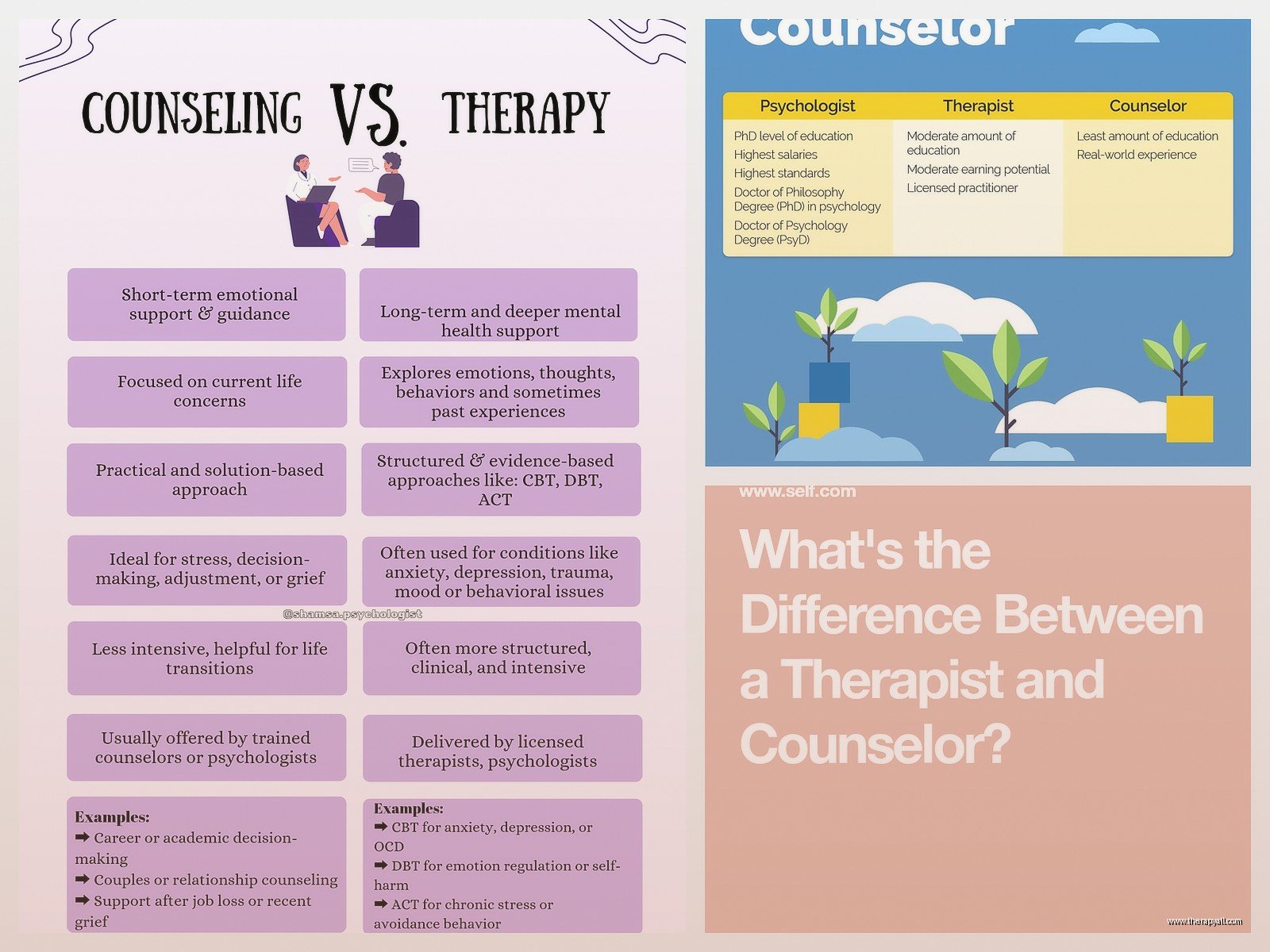
School counselors, rehabilitation counselors, career counselors—these are specialized types who work in specific settings. A school counselor helps students with academic planning, social issues, and crisis intervention. They’re not doing deep psychotherapy with a seventh-grader, but they’re absolutely providing mental health support.
I’ve written probably dozens of articles about counseling approaches, and the thing people don’t realize is how much counselors focus on psychoeducation. Teaching you about anxiety responses, explaining how your thoughts influence emotions, giving you actual frameworks to understand what’s happening in your brain. It’s not just nodding sympathetically, though I know that’s the stereotype.
What Therapists Do Differently
When someone says “therapist,” they usually mean a mental health professional who provides psychotherapy for diagnosable mental health conditions. Depression, anxiety disorders, bipolar disorder, personality disorders, complex trauma. The work tends to be longer-term, more intensive, and focused on deeper psychological patterns.
Therapists are trained to conduct assessments, make diagnoses (except in some cases where that requires a psychologist or psychiatrist), create treatment plans, and provide evidence-based interventions. A licensed clinical social worker might do therapy that looks identical to what a licensed professional counselor does—same room, same techniques, same outcomes.
Psychologists can do psychological testing and assessment that other professionals can’t. IQ tests, personality assessments, neuropsychological evaluations. If you need to know whether you have ADHD or a learning disability, you’re seeing a psychologist for formal testing.
My cat just knocked over my water bottle and I’m trying to type while sopping up water with a towel, so if this section feels scattered, that’s why.
Insurance and Practical Differences
Insurance companies list providers by their license type, not by whether they call themselves a counselor or therapist. You’ll see LPC, LCSW, LMFT, PhD, PsyD. The reimbursement rates sometimes vary—psychologists often get higher rates than counselors, even when providing the same service. It’s frustrating and doesn’t reflect actual competence, just degree level and lobbying power.
Some insurance panels are easier to get on with certain credentials. In my experience writing about this stuff and talking to professionals, LCSWs often have an easier time getting on insurance panels than LPCs in some states, which has nothing to do with who’s better qualified and everything to do with historical relationships between insurers and professional organizations.
If you’re paying out of pocket, counselors sometimes charge less than therapists with doctoral degrees. Sometimes. It varies wildly by location, specialization, and demand. A highly specialized counselor with a niche practice might charge more than a general practice psychologist.
The Scope of Practice Thing
This is where state laws make everything complicated. In some states, LPCs can diagnose and treat the full range of mental health disorders independently. In others, they need supervision or collaborative agreements with physicians. Psychologists can practice independently everywhere (once licensed), but they can’t prescribe medication except in a handful of states with additional training.
Social workers often have the broadest scope because they’re trained to address environmental and systemic factors. They might help you access disability benefits, connect with community resources, navigate housing issues—stuff that other mental health professionals aren’t necessarily trained to do, or… wait, I’m getting off track because I just remembered I need to explain the supervision piece.
Before licensure, counselors and therapists work under supervision. You might see someone with a title like “Licensed Associate Counselor” or “Psychological Associate.” They’re in training, accumulating hours, working toward full licensure. They’re qualified to provide therapy, but they have someone overseeing their work. This doesn’t mean they’re less effective—sometimes newer professionals are more up-to-date on recent research and more energetic about treatment.
Specializations Matter More Than Titles
Here’s what actually matters when you’re choosing someone: their specialization and experience with your specific issue. A counselor who’s worked with eating disorders for fifteen years is your person if you have an eating disorder. Not the therapist who’s a generalist with a fancier degree.
Professional certifications often indicate specialized training. EMDR certification for trauma, Gottman training for couples work, DBT intensive training for borderline personality disorder and emotion regulation. These certifications are available to both counselors and therapists. The alphabet soup after someone’s name tells you what additional training they’ve pursued.
I spent summer 2021 writing profiles of different therapy specializations, and I started noticing that the professionals who were most effective weren’t necessarily the ones with the most degrees—they were the ones who’d pursued specific training in their niche and stuck with it for years. Someone who does nothing but OCD treatment is gonna help you more than someone who sees a little bit of everything.
When You Need Which One
If you’re dealing with a specific stressor—job change, divorce, grief, college adjustment—a counselor is absolutely appropriate. If you have a diagnosed mental health condition or suspect you do, you want someone who can assess and treat that, which could be a counselor or therapist depending on their training.
For medication management, you need a psychiatrist or a psychiatric nurse practitioner. For psychological testing, you need a psychologist. For anything involving the legal system—custody evaluations, competency assessments—you typically need a psychologist with forensic training.
You don’t need the most qualified person on paper. You need someone who’s qualified to treat your issue and who you actually connect with. I’ve seen people waste months with a highly credentialed professional they didn’t click with when they could’ve been making progress with someone who had fewer letters after their name but better rapport.
The Modality Question
Both counselors and therapists practice various therapeutic modalities. Cognitive behavioral therapy, psychodynamic therapy, humanistic approaches, family systems work. The modality matters more than the title. If you need CBT for panic disorder, find someone trained in CBT who treats panic disorder. Whether they’re an LPC or LCSW or psychologist is secondary.
Some modalities require specific certification. You can’t just call yourself an EMDR therapist without completing the training. Same with DBT—there’s a whole adherence model for programs that want to call themselves comprehensive DBT. These certifications are available to counselors and therapists alike.
The Supervision and Consultation Piece
Even fully licensed professionals get supervision or consultation. It’s considered best practice. A counselor might consult with a psychiatrist about medication questions. A therapist might get supervision on a particularly complex case. This isn’t a weakness—it’s how good clinical work happens.
If you’re seeing someone who’s pre-licensed, ask about their supervision. Who’s overseeing their work? How often do they meet? This isn’t a red flag, it’s just information. Pre-licensed clinicians often have more oversight than fully licensed ones, which can actually be an advantage.
Cost and Accessibility Differences
Counselors sometimes work in community mental health settings where fees are on a sliding scale. College counseling centers employ counselors. Employee assistance programs often connect you with counselors for short-term work. These settings make mental health support more accessible.
Psychologists in private practice often have higher fees because of the doctoral degree and because they can. Market forces, not clinical necessity. An LPC with the same years of experience might charge $100-150 per session while a psychologist charges $200-300. Both might be excellent at what they do.
The Reality of Finding Someone
Most people don’t actually choose based on credential type. They choose based on who’s available, who takes their insurance, who has evening appointments, who’s not three months out for intake. The practical barriers matter more than the credential distinctions.
You search Psychology Today or your insurance directory, you filter by issue and maybe location, you call people who have openings. If someone’s a good fit and can help you, the fact that they’re an LPC versus an LMFT versus a psychologist becomes kinda irrelevant.
What you’re looking for: someone licensed in your state, someone with experience treating your concerns, someone you can afford, someone whose approach makes sense to you. Read their profile or website. Do they explain things in a way that resonates? Do they seem like someone you could talk to?
Red Flags Regardless of Title
Whether they call themselves a counselor or therapist, watch out for: promising quick fixes, pushing a single approach for everything, not maintaining boundaries, guaranteeing outcomes, not being transparent about costs and policies. Good clinical work has certain hallmarks that cross credential types.
Check their license. Every state has an online verification system. Make sure they’re actually licensed and in good standing. This sounds obvious, but people skip this step and then end up working with someone who’s had complaints or isn’t actually credentialed.
The bottom line is that “counselor” and “therapist” overlap significantly in practice. The legal and educational distinctions exist, they matter for certain purposes, but when you’re sitting in a room trying to figure out your anxiety or work through a breakup, what matters is whether this person can help you. Their credential type is less important than their training in your specific issue, their years of experience, and whether you feel like they actually get what you’re dealing with.
ADHD & Neurodiversity
Life Planner Bundle – Life Organizer
Self-Care & Personal Growth
Acceptance And Commitment
Anxiety & Stress
Stress Processing Journal & Reflection Worksheets For Daily Self – Care
Self-Care & Personal Growth
Self – Reflection Guided Journal With Guided Prompts 30
Emotional Wellness
Decision Processing – Thought Processing Journal For Daily Self – Care
Therapist Resources
Physiotherapist Journal PDF Planner Tracker Or Log Book
Self-Care & Personal Growth
Customizable Self – Confidence & Self – Esteem Guided Journal
ADHD & Neurodiversity
ADHD Behavior Tracker PDF Planner Tracker Or Log Book