# Understanding EFT Couples Therapy Worksheets
Emotionally Focused Therapy worksheets for couples aren’t your typical fill-in-the-blank exercises you’d find in a self-help book at the airport. They’re structured tools designed to help partners identify attachment patterns, recognize negative cycles, and build what Sue Johnson calls “secure emotional bonds.” The worksheets guide couples through specific stages of EFT, which is kinda brilliant when you think about it because therapy homework that actually mirrors the clinical model tends to stick better than generic communication exercises.
I remember back in 2019 sitting in a workshop where a therapist kept insisting that worksheets were “too clinical” for couples work and would kill the spontaneity. I watched her hand out these vague journaling prompts instead, and honestly? Couples need structure. They need to know what they’re looking for. EFT worksheets provide that roadmap without turning therapy into a corporate team-building exercise.
## The Core Components of EFT Worksheets
EFT operates on attachment theory, so the worksheets zero in on how partners seek connection, what happens when they feel threatened, and how they can reach for each other in healthier ways. You’ll typically see worksheets organized around the three stages of EFT: de-escalation, restructuring interactions, and consolidation.
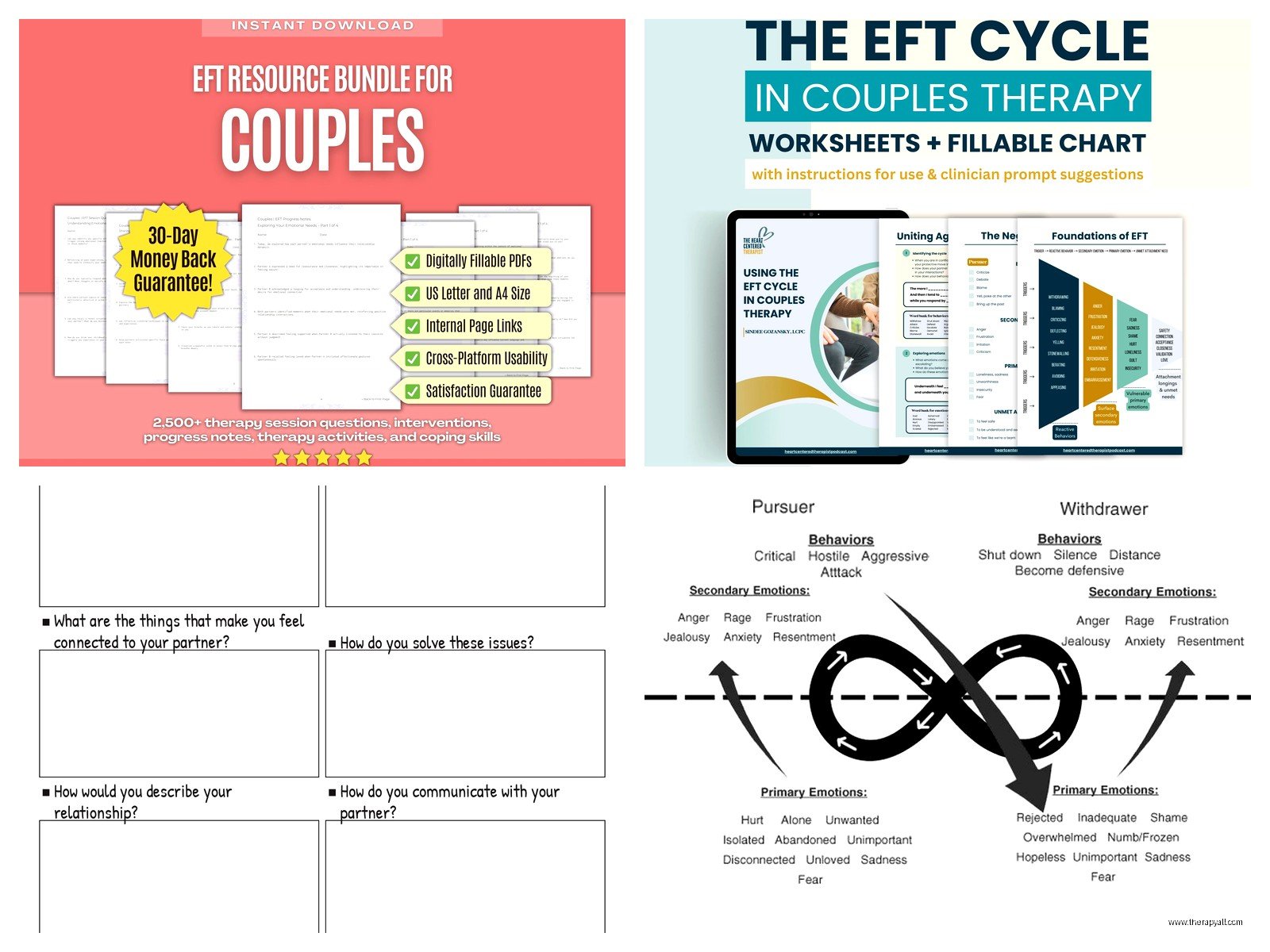
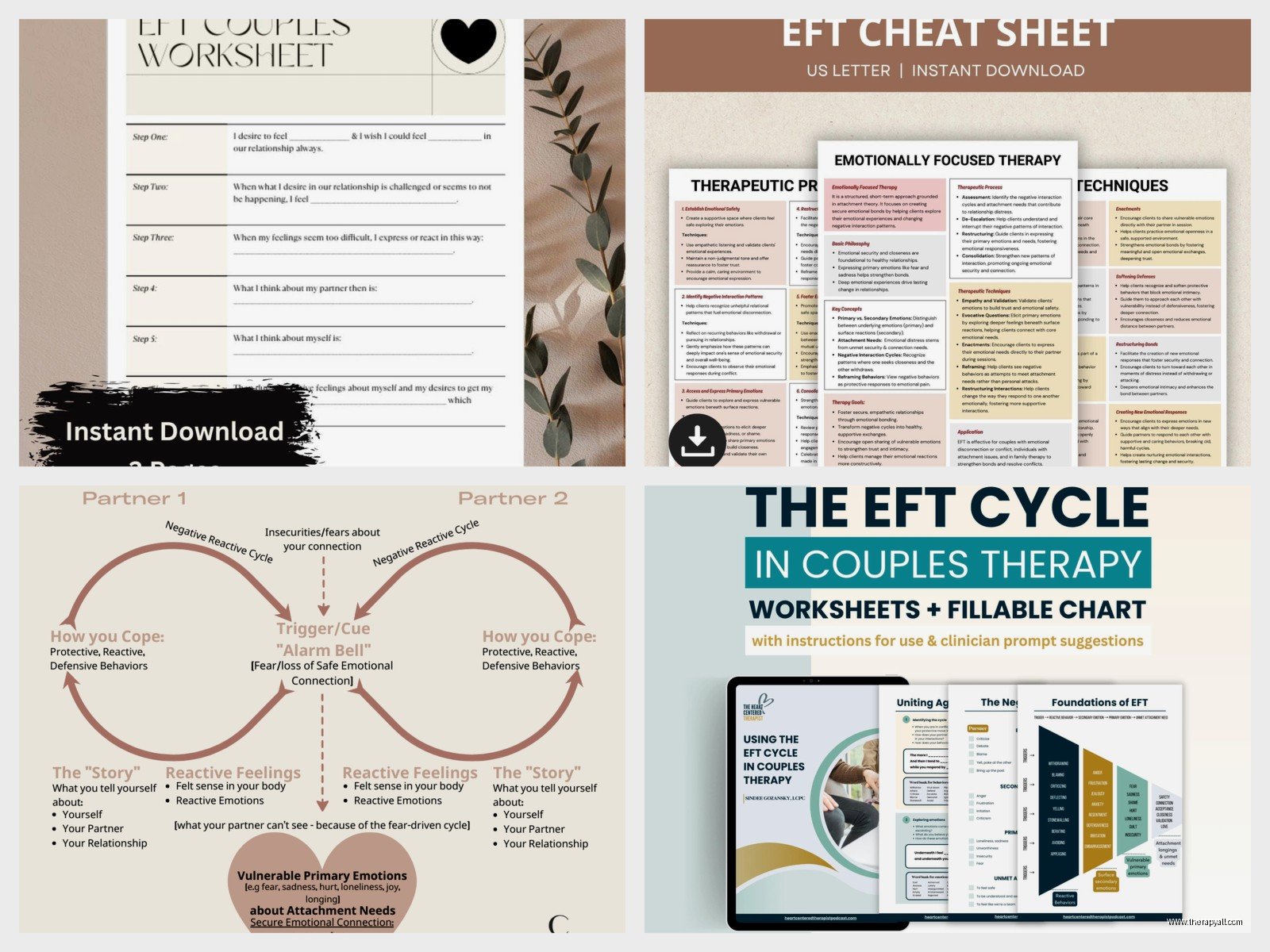
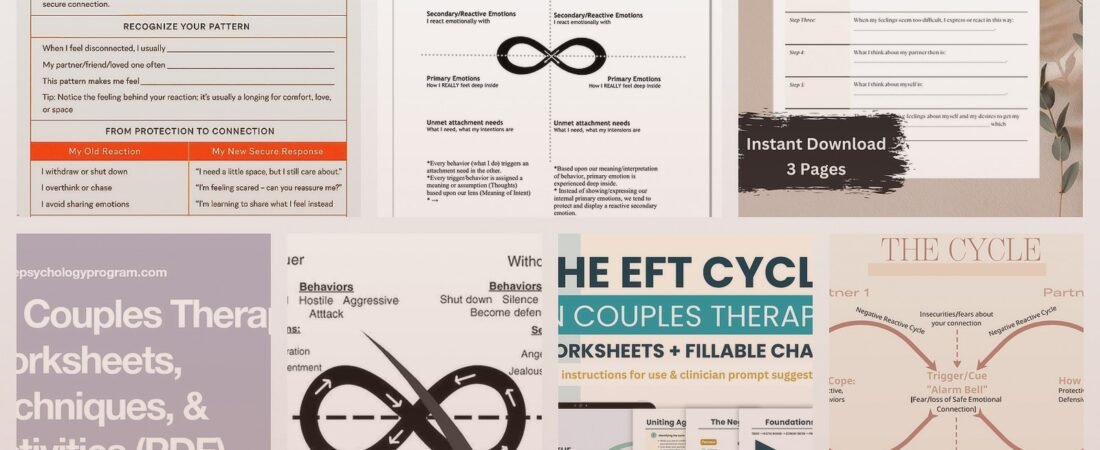
The de-escalation worksheets help couples map their conflict cycle. There’s usually a diagram—sometimes it’s a circle, sometimes it’s more of a figure-eight pattern—where each partner identifies their primary emotion, their secondary reactive emotion, and their protest behavior. One partner might write “I feel scared you’ll leave” as primary, “I feel angry” as secondary, and “I criticize your parenting” as the protest behavior. The other partner sees this written out and suddenly it’s not just an attack, it’s a fear response.
What drives me absolutely nuts is when I see EFT worksheets that skip the somatic piece entirely. Johnson’s work is deeply rooted in how we experience attachment panic in our bodies, but some worksheet creators just ignore that and focus only on thoughts. You end up with couples intellectualizing their way through exercises without actually accessing the vulnerable emotions that need to shift. Bad design, lazy adaptation of the model.
## Identifying Negative Cycles Through Written Work
The negative cycle worksheet is probably the most used tool in EFT couples work. Partners separately complete sections about what triggers them, how they feel when triggered, what they do in response, and how that impacts their partner. Then they compare notes. The structure usually looks like this: trigger → primary feeling → protective action → partner’s experience of that action → partner’s response → cycle continues.
I’ve used these myself—not in a relationship context exactly, but I went through a phase where I was testing every worksheet I wrote about, and seeing my own patterns on paper was… uncomfortable? Clarifying? Both. You realize how predictable your defensive moves are once you write them down three sessions in a row.
The worksheets ask questions like “What happens inside you when your partner withdraws?” or “When you feel criticized, where do you feel it in your body?” Partners learn to distinguish between “I’m angry” and “I’m actually terrified you don’t need me anymore, and anger is just easier to show.” That distinction is everything in EFT.
## Accessing Underlying Emotions
Stage one worksheets transition into stage two tools that help partners get underneath their protective stances. These worksheets are more reflective and require slowing down. You might see prompts like “When I can’t reach you, the story I tell myself is…” or “What I’m most afraid of in our relationship is…”
The goal is to access what Johnson calls “attachment fears”—the deep stuff about being unlovable, being abandoned, being too much or not enough. Couples fill these out individually first, which I think is crucial because writing something in your own handwriting before you say it out loud gives you time to actually feel it rather than just performing vulnerability.
There’s often a worksheet that maps attachment injuries too. These are the specific moments when one partner desperately needed the other and they weren’t there—or worse, they were the source of the hurt. The worksheet guides the injured partner through describing the event, what they needed, what happened instead, and how it changed their sense of safety in the relationship. The other partner has a section for understanding and responding, but not defending. That’s harder than it sounds.
## Restructuring Interactions With Bonding Exercises
Stage two EFT worksheets include what are basically scripts for new interactions. I know that sounds mechanical, and some therapists hate this part, but couples in distressed patterns need explicit permission and language for reaching differently. The worksheets might have sentence stems like “When I feel disconnected from you, what I really need is…” or “I’m learning that when I withdraw, it leaves you feeling…”
My cat just knocked over my water bottle and I’m gonna just… okay, cleaned up.
These worksheets help partners practice what Johnson calls “hold me tight” conversations—structured dialogues where one partner shares a vulnerability and the other partner responds with reassurance and presence. The worksheet version breaks it into steps: Partner A shares a moment they felt alone, names their fear, and makes a request. Partner B reflects what they heard, acknowledges the impact, and offers comfort or commitment. Then they switch.
It feels awkward on paper at first. Couples tell me it seems forced or artificial, and yeah, it is at first. But you’re literally rewiring decades of defensive relating, so some scaffolding helps. The worksheets remove the pressure of improvising intimacy when you don’t trust the process yet.
## Tracking Secure Base Behaviors
There are worksheets designed to help couples notice when they’re actually getting it right, which is important because distressed couples have a negativity bias that makes them miss positive bids. These tracking sheets ask partners to note daily moments when they felt emotionally safe, when their partner responded to a need, or when they successfully repaired after a disconnection.
The format is usually simple: date, situation, what happened, how it felt, what it means about the relationship. Over time you build evidence that things are shifting. I’ve seen couples bring these tracking worksheets into session with genuine excitement because they caught themselves doing something new and they want credit for it. That’s actually a good sign—it means they’re re-engaging with hope.
## Consolidation Worksheets and Future Planning
Stage three worksheets focus on solidifying new patterns and troubleshooting future challenges. You’ll see exercises where couples identify their early warning signs that they’re slipping back into the old cycle, and they create a plan for catching it faster. There might be a worksheet for “our relationship story” where partners write about how they got stuck, what they learned, and how they want to move forward.
Some worksheets include sections for sexual intimacy, which makes sense given that EFT views sex as an attachment behavior, not just a physical act. Partners explore what emotional safety they need before they can be sexually vulnerable, or how disconnection shows up in their physical relationship. These worksheets tend to be more open-ended because the specifics vary so much between couples.
There’s also usually some kind of relational vision worksheet where couples describe their ideal relationship in concrete terms—not vague stuff like “better communication” but specific behaviors like “I want to be able to tell you when I’m scared without you immediately trying to fix it” or “I want to reach for your hand when we’re driving and know you’ll take it.”
## How Therapists Actually Use These Tools
In practice, therapists don’t just hand out worksheets and hope for the best. They’re integrated into session work and assigned as between-session exercises. A therapist might work through the first part of a cycle-mapping worksheet during a session, coaching partners through the emotions and responses, then send them home to complete it more fully and bring it back for discussion.
The worksheets serve as conversation starters and documentation of progress. When a couple insists nothing has changed, you can pull out worksheets from three months ago and show them concrete evidence of shifting patterns. That external record matters because memory is unreliable, especially when you’re in distress.
Some therapists create their own EFT-adapted worksheets based on specific client needs. I’ve seen customized versions for couples dealing with infidelity, addiction, trauma, or major life transitions—the core EFT structure remains but the prompts address the specific attachment injuries those situations create.
## Common Mistakes With EFT Worksheets
People treat these worksheets like personality quizzes sometimes, filling them out quickly without actually sitting with the emotional content. The point isn’t to complete the worksheet, it’s to use the worksheet as a tool for accessing and communicating vulnerable emotions. If you’re breezing through it in ten minutes, you’re probably not going deep enough.
Another mistake is using EFT worksheets without understanding the model itself. The worksheets only work if both partners grasp the basic premise that their conflict isn’t about the dishes or the money—it’s about attachment panic and bids for connection. Without that frame, the exercises just feel like more couples homework that doesn’t address the real problem.
And honestly some couples use worksheets to avoid actual conversation, which defeats the purpose entirely. They’ll complete everything separately and never discuss it, or they’ll read their answers at each other without listening. The worksheet is supposed to facilitate emotional engagement, not replace it.
## Accessing Quality EFT Worksheets
You can find EFT couples worksheets through therapist resource sites, Sue Johnson’s official materials through ICEEFT, and various mental health platforms that create therapy homework tools. Quality varies widely. The best worksheets directly reference EFT concepts like primary versus secondary emotions, protest behaviors, and attachment needs. They include psychoeducation sections that explain the theory, not just blank spaces to fill in.
Watch out for worksheets labeled “EFT” that are actually just generic communication exercises with attachment language slapped on. Real EFT worksheets should feel uncomfortable to complete because they’re asking you to access and articulate emotions you’ve probably been avoiding. If it feels too easy or surface-level, it’s probably not hitting the attachment system where change actually happens.
Some therapists give these out as PDFs, others use them in workbook format, and I’ve seen a few apps attempting to digitize the process though I’m not sure that works as well—something about physically writing out your attachment fears hits differently than typing them into an app between checking your email and scrolling social media, but maybe that’s just me being old-fashioned about it.
The worksheets work best when both partners commit to the process, which requires some baseline willingness to examine their own contribution to the cycle rather than just cataloging their partner’s failures. Without that mutual investment, you end up with one person doing deep emotional work on paper while the other person writes “I don’t know” in every blank space.