# Imago Relationship Therapy Worksheets – Free PDF & Printable Resources
Imago Relationship Therapy uses structured dialogue to help couples understand childhood patterns that show up in their adult relationships. The worksheets supporting this approach break down communication into specific steps that prevent the usual pattern where one person talks, the other person prepares their defense, and nobody actually hears anything.
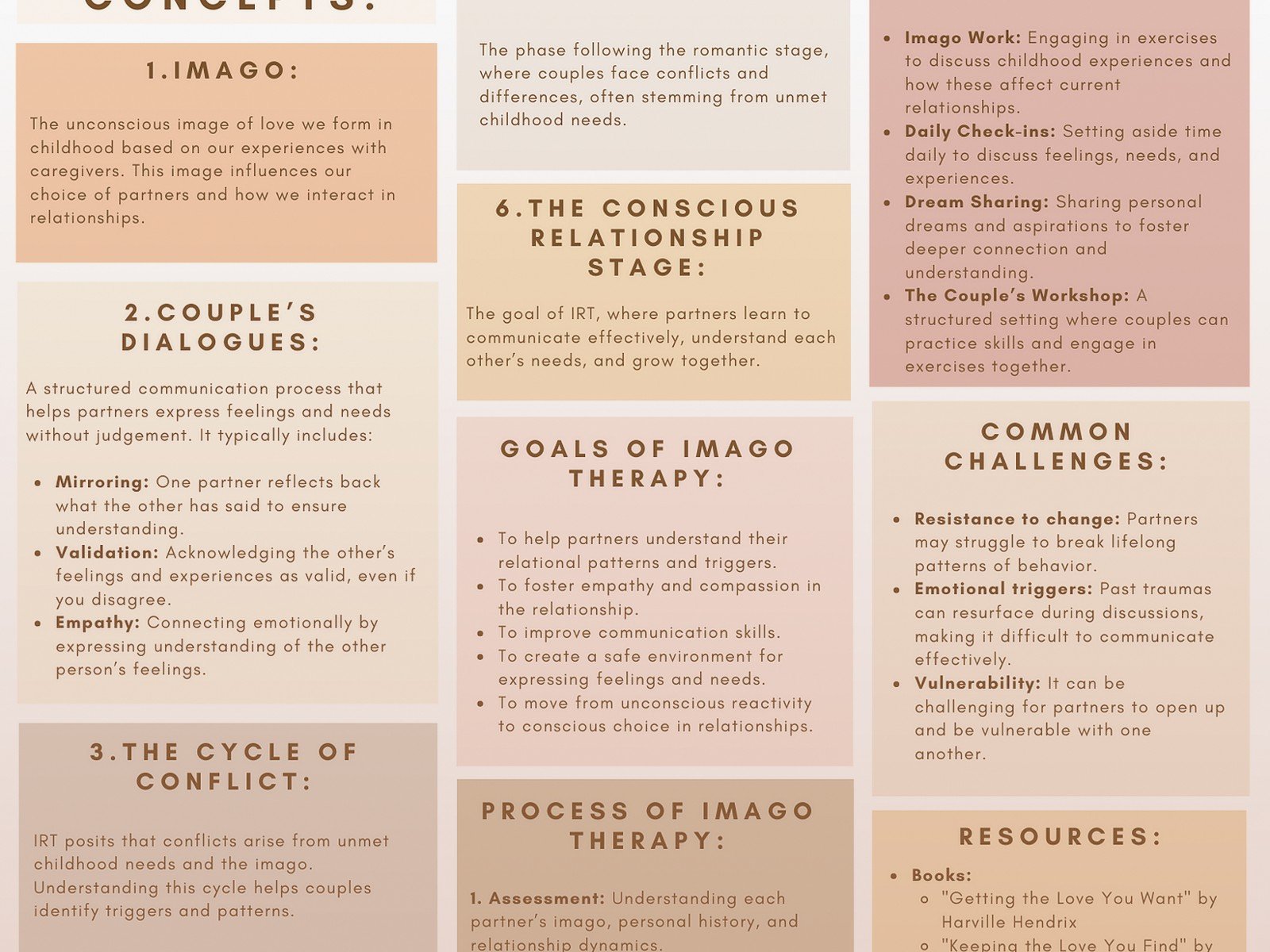
The core idea is that we’re attracted to partners who have both the positive and negative traits of our primary caregivers. Then we try to get them to give us what we didn’t get as kids, which obviously doesn’t work, and that’s where the fighting starts. Imago worksheets give you a framework to interrupt that cycle without needing a therapist in the room every single time.
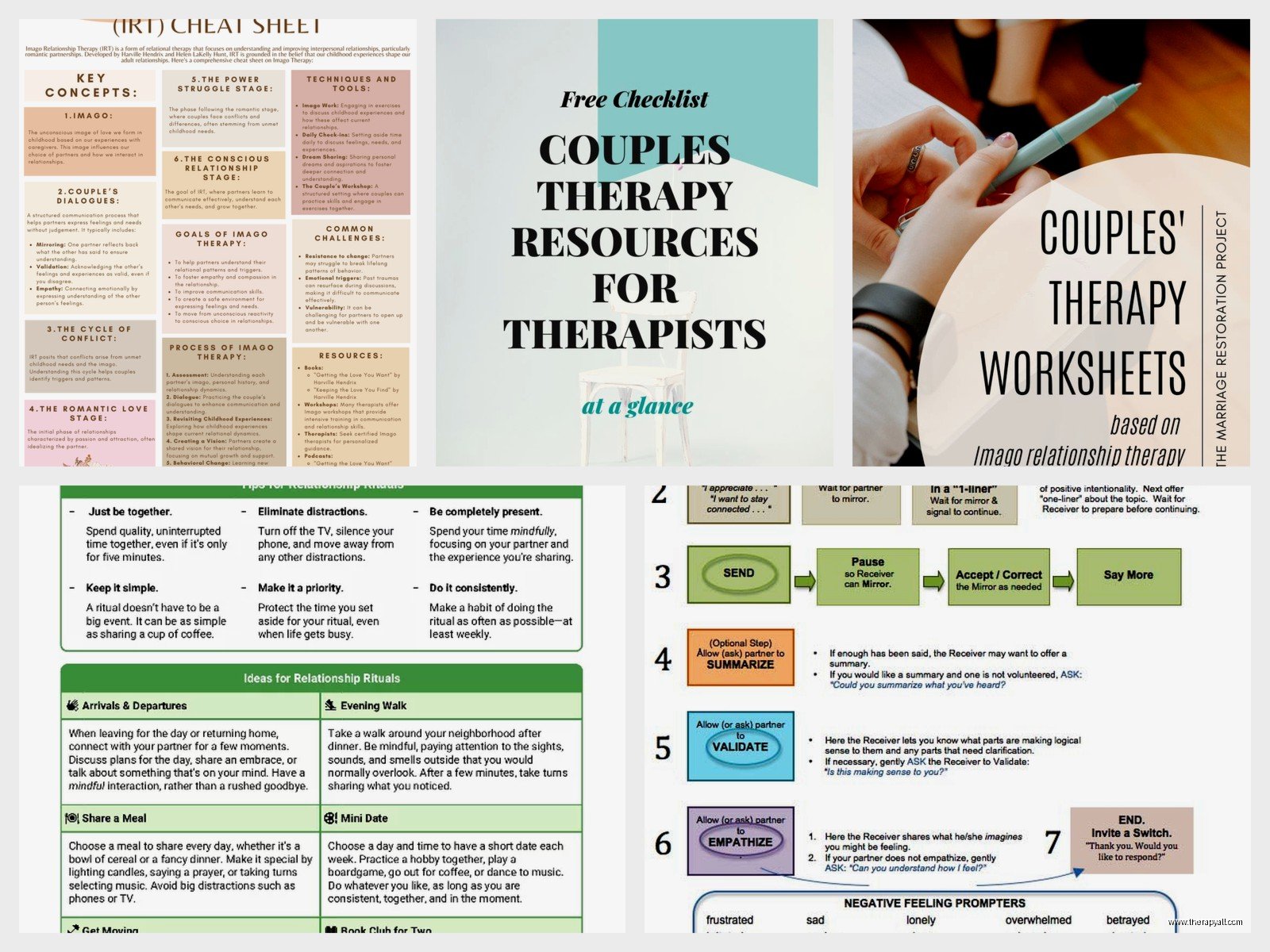
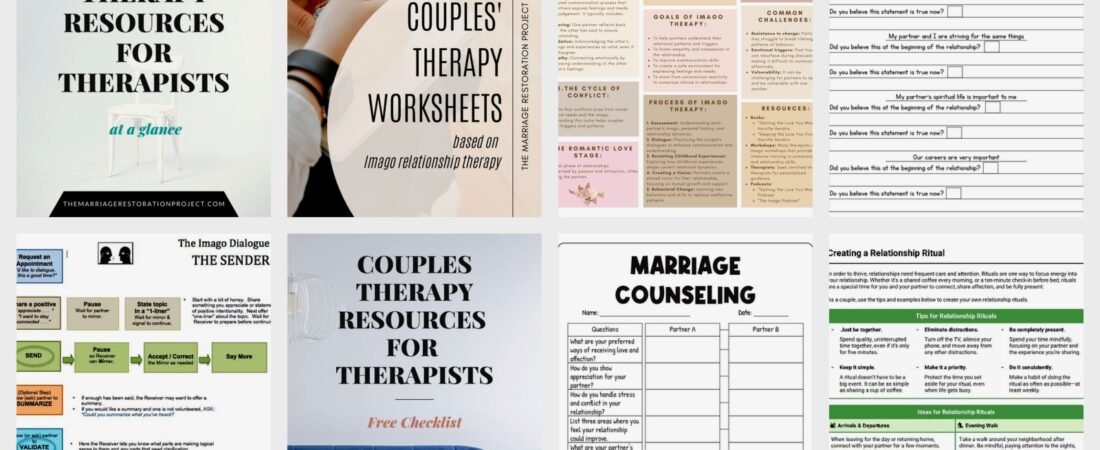
## The Imago Dialogue Worksheet
This is the foundational tool. It structures conversations into three parts: mirroring, validation, and empathy. I remember back in 2019 when I was writing a roundup of couples therapy resources and actually tried the Imago dialogue with my sister after a stupid argument about whose turn it was to deal with our mom’s birthday planning—we weren’t romantic partners obviously, but the structure worked anyway, which surprised me.
The mirroring section requires the listener to repeat back what they heard without adding anything. It sounds robotic at first. You’re literally saying “What I hear you saying is…” or “Let me see if I got that right…” and then parroting their words. The speaker then says “yes, you got it” or corrects what was misunderstood.
Most free PDF versions of this worksheet include sentence stems like:
– “What I heard you say was…”
– “Is there more about that?”
– “Did I get that right?”
The validation piece comes next. This is where you acknowledge that what they said makes sense from their perspective, even if you disagree with the facts or the conclusion. The worksheet usually has a line that says something like “That makes sense because…” or “I can see how you would think that given…”
Then empathy. You imagine what they might be feeling and name it. The worksheet prompts you with “I imagine you might be feeling…” followed by a list of feeling words because most people, myself included, are terrible at identifying emotions beyond mad, sad, or fine.
What annoys me is when these worksheets present the dialogue as this magical fix without explaining that it feels completely unnatural for the first dozen times you use it. Nobody warns you that you’ll want to jump in and correct or defend yourself constantly, or that saying “is there more about that?” when your partner just criticized you feels like swallowing glass.
## Childhood Wounds Worksheet
This worksheet maps your early experiences with caregivers and identifies patterns. You list your primary caregivers, describe their positive and negative traits, and then note how those traits show up in your current partner.
The typical structure includes:
– Caregiver names and relationship to you
– Three positive traits for each
– Three negative or frustrating traits for each
– Unmet childhood needs
– How these patterns appear in your current relationship
You’re supposed to notice that you married someone who withholds affection just like your dad did, or someone who’s critical like your mom, or whatever your particular setup is. The worksheet then asks what you needed as a child that you didn’t get—attention, consistency, emotional safety, whatever.
I’ve seen versions that include a section for your “imago” which is the composite picture of your caregivers’ traits. Some worksheets make you draw an actual face, which feels kinda silly but apparently helps some people visualize it.
The free PDFs floating around online vary in quality. Some are just text boxes with questions. Others have those annoyance scales or rating systems that are supposed to help you quantify childhood pain, which—I’m just gonna say it—feels reductive.
## Behavior Change Request Worksheet
This one translates complaints into specific, doable requests. Instead of “you never listen to me” you end up with “I would like you to put your phone face-down when we’re having dinner and make eye contact when I’m talking about my day.”
The worksheet format usually looks like:
**Frustration:** (the complaint in its raw form)
**Hidden need:** (what you actually need)
**Specific behavior:** (what the other person could do)
**Frequency:** (how often)
**Positive impact:** (why it matters to you)
The structure forces specificity. You can’t just say “be more present” because that means nothing. You have to describe what present looks like in observable terms.
Most couples hate this worksheet at first because writing down “I need you to hug me for at least 15 seconds when you come home from work” feels transactional and unromantic. But the alternative is staying mad that your partner doesn’t automatically know what you need, so.
Free printable versions sometimes include examples, which helps. Without examples, people write requests that are still too vague (“be nicer to me”) or that are actually criticisms disguised as requests (“stop being such a jerk about my mother”).
## Reimaging Exercise Worksheet
This is where you essentially re-parent each other. The worksheet identifies childhood wounds and then creates opportunities for your partner to provide what was missing. If you didn’t get enough physical affection as a kid, you might ask your partner for specific types of touch. If you needed more words of affirmation, you request that.
The worksheet typically includes:
– The childhood wound (described briefly)
– What you needed but didn’t get
– How your partner could provide a “corrective experience”
– A specific ritual or practice to implement this
I’ll be honest, this one feels weird. You’re asking your adult romantic partner to act sort of like a parent figure, which—yeah, there’s something uncomfortable about that. But Imago theory says we’re doing this unconsciously anyway, so might as well make it conscious and intentional.
My cat keeps knocking the papers off my desk and it’s making me think about how worksheets need to be simple enough that you don’t lose track when you’re interrupted, which most of the free PDFs are not.
The reimaging worksheet works better when it’s not about huge trauma stuff but about smaller unmet needs. Like if you never got celebrated as a kid, your partner can make a point of acknowledging your accomplishments. If you felt invisible, they can practice really seeing you and saying so.
## Containment Exercise Worksheet
When someone’s really triggered and flooding with emotion, this worksheet provides structure for getting through it without damaging the relationship. One partner is the “container” and the other is expressing frustration. The container basically just listens and validates without defending or fixing.
The structure is:
**Set-up:** Both partners agree on timing (usually 10-15 minutes)
**Expression:** The frustrated partner vents using “I” statements
**Container responses:** Mirroring and validation only, no problem-solving
**Completion:** A specific ending ritual (thank you, physical touch, whatever)
What I find interesting is that the person containing has to hold space for anger or pain that might be about them without reacting. The worksheet includes reminders like “this is not the time to defend yourself” and “your job is only to understand, not agree.”
Summer of 2021 I was writing worksheet roundups constantly and started using this one with friends, not just romantic relationships, and it actually worked for processing smaller grievances before they became huge things. Or sometimes it revealed that the small grievance was actually pointing to something bigger, which—well, that’s useful information too, even if it’s uncomfortable.
Free versions of this worksheet sometimes skip the most important part, which is the agreement on timing and the explicit ending. Without those boundaries, the exercise just becomes one person dumping on the other indefinitely.
## Parent-Child Dialogue Worksheet
Though Imago is primarily for couples, there are worksheets adapted for parent-child relationships. These follow the same mirroring structure but with age-appropriate language and shorter time frames because kids can’t sustain the formal dialogue for long.
The worksheet might include:
– Simplified sentence stems (“You’re saying that…” instead of “What I hear you saying is…”)
– Feeling charts with faces for younger kids
– Shorter sections since attention spans are limited
– Space for drawing instead of writing for children who aren’t writing yet
Parents use this when there’s been a rupture—a fight, a misunderstanding, a broken promise. The structure helps the kid feel heard without the parent getting defensive, which is harder than it sounds when your eight-year-old is telling you that you embarrassed them in front of their friends.
I’ve seen some truly badly designed versions of this worksheet that are clearly just the adult version with a few words swapped out. Kids need bigger fonts, more white space, and way less text. If a child has to read three paragraphs of instructions before starting, you’ve already lost them.
## Appreciation and Gratitude Worksheet
This one counters negativity bias by creating a practice of noticing what’s working. Partners write down specific things they appreciate about each other, focusing on behaviors rather than general traits.
The format usually includes:
**What they did:** (specific observable behavior)
**How it affected you:** (your emotional response)
**What it meant to you:** (the deeper significance)
So instead of “I appreciate that you’re thoughtful,” you write “I appreciate that you remembered I had a stressful meeting and texted me good luck in the morning. It made me feel supported and less alone. It meant that you’re paying attention to my life even when you’re busy with yours.”
The worksheet often suggests doing this daily or weekly as a ritual. Some versions have space for 30 days of appreciations, which seems aspirational given that most couples can barely remember to do it once.
What genuinely bugs me about appreciation worksheets in general is when they’re framed as the solution to relationship problems. Like, no, if there are serious issues, writing down three nice things about your partner isn’t gonna fix it. But as part of a larger practice, it does shift attention toward what’s working instead of only focusing on complaints.
## Relationship Vision Worksheet
This helps couples articulate what they actually want their relationship to look and feel like. You each write your individual vision and then work toward a shared one.
Questions typically include:
– How do we want to spend our time together?
– What values do we want to prioritize?
– How do we want to handle conflict?
– What does a good day/week/year look like?
– How do we want to support each other’s growth?
The worksheet then has a section for identifying where your visions align and where they differ. The differences aren’t necessarily problems—they’re just information about what needs to be negotiated.
I remember a couple I worked with briefly in 2020 who discovered through this worksheet that one person envisioned lots of quiet evenings at home and the other wanted frequent social events with friends, and they’d just never explicitly talked about this even though they’d been together for years. The worksheet didn’t solve the mismatch but it named it clearly, which is the first step.
Free PDF versions vary wildly in how much structure they provide. Some are basically just blank pages with “write your vision here” at the top. Others have 50 detailed questions that take hours to complete. The sweet spot is probably 8-12 focused questions that get at the important stuff without being overwhelming.
## Where to Find Free Imago Worksheets
Most Imago therapists offer a few basic worksheets on their websites as lead magnets. The quality is inconsistent. Some are professionally designed PDFs with clear instructions. Others look like they were made in Microsoft Word in 2003.
The official Imago Relationships International website has some resources, though many require signing up for their mailing list. Various therapist blogs and mental health platforms share adapted versions that may or may not strictly follow Imago protocols.
You’ll find worksheets on sites like Therapist Aid, but those are often simplified versions that miss some of the nuance. Which is fine for getting started, but if you’re serious about the approach, you’ll probably want resources from actual Imago-trained therapists.
Pinterest has a surprising number of these worksheets, though you have to wade through a lot of relationship quote graphics to find them. The search function is terrible and you’ll end up looking at wedding planning boards half the time.
Some couples therapy apps include Imago-style exercises, though they’re usually behind a paywall. The free versions might give you one or two worksheets as a sample.
## Using These Worksheets Without a Therapist
You can absolutely use Imago worksheets on your own, but it’s harder than it looks. The dialogue structure feels artificial, and without a therapist to keep you on track, it’s easy to slip back into your usual argument patterns.
Start with the simplest worksheet first—usually the basic dialogue structure. Don’t try to process your deepest childhood wounds in week one. Practice the mirroring format with low-stakes topics like planning the weekend or deciding what to have for dinner.
Set a timer. Seriously, the time boundary helps. Otherwise the “sender” talks for 45 minutes and the “receiver” is completely checked out.
Read the instructions fully before starting, which nobody does, and then you end up confused halfway through about whose turn it is to talk or whether you’re supposed to be validating or empathizing and the whole thing falls apart.
Some worksheets work better than others without professional guidance. The appreciation worksheet is pretty straightforward. The childhood wounds worksheet might bring up stuff that’s too big to handle alone, and that’s worth knowing before you start.