Music therapy worksheets in PDF format give you structured activities that use music to help people express emotions they can’t always put into words. These aren’t just “listen to a song and feel better” exercises—they’re designed tools that integrate musical elements with psychological frameworks to facilitate emotional processing, self-awareness, and communication.
What Music Therapy Worksheets Actually Do
Music therapy worksheets function as guided frameworks that combine auditory stimulation with reflective prompts. They direct attention toward how music affects emotional states, memories, and physical sensations. You might have a worksheet that asks someone to identify which instruments in a piece trigger anxiety versus calm, or one that maps specific songs to different periods of grief.
I remember back in 2019 working with a therapist who kept printing generic “rate your mood” worksheets and just adding a music note clipart at the top. That’s not music therapy—that’s regular therapy with a Spotify playlist playing in the background, and it annoyed the hell out of me because people would search for actual music therapy resources and find that garbage. Real music therapy worksheets integrate musical elements into the therapeutic process itself.
The activities typically fall into several categories: lyric analysis, playlist creation with intentionality, rhythm and movement exercises, songwriting prompts, and listening logs that track emotional responses. Each serves a different function in emotional expression.
Lyric Analysis Activities
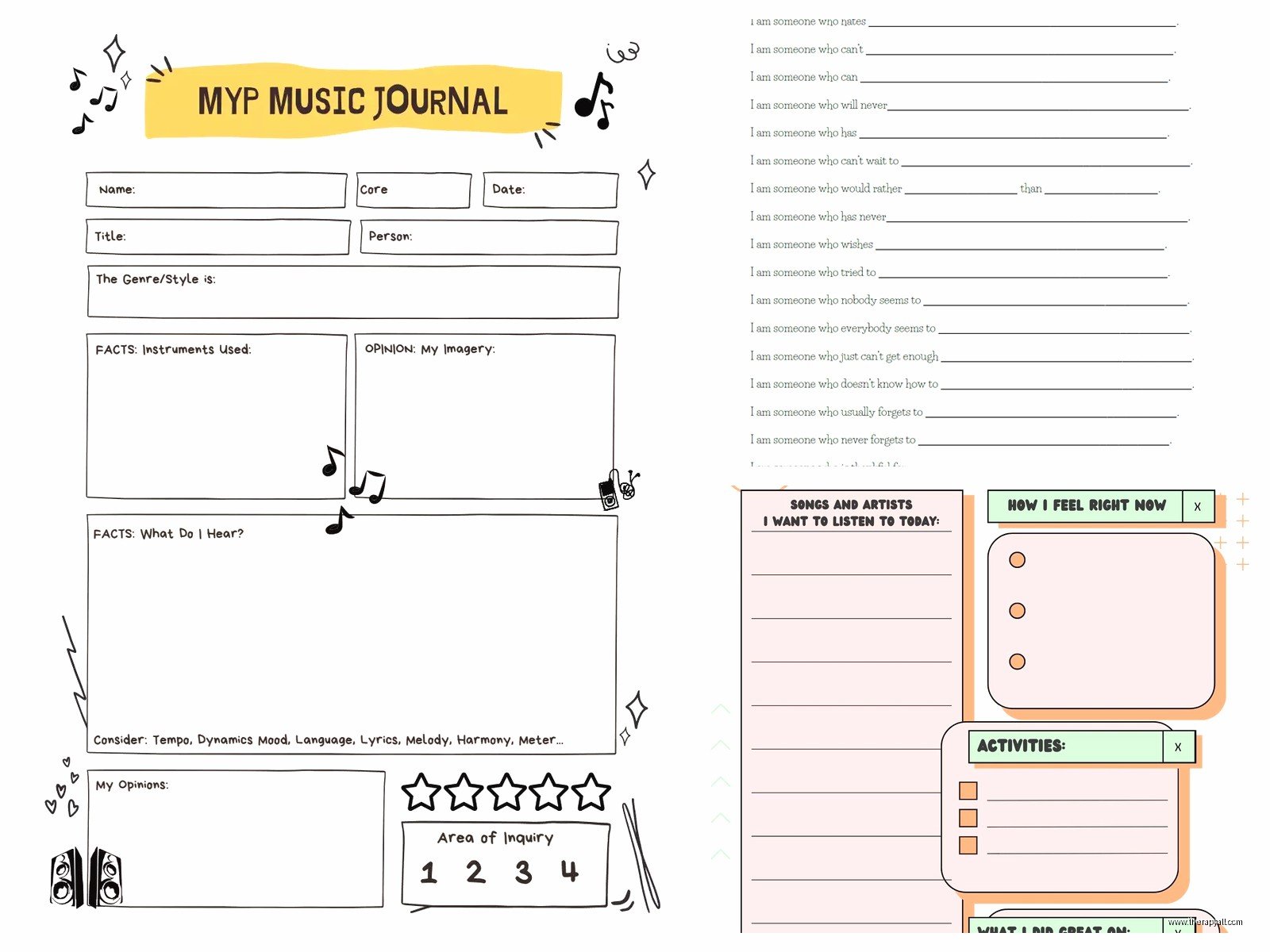
Lyric analysis worksheets present song lyrics alongside prompts that ask you to identify themes, personal connections, or emotional resonance. These work particularly well for people who struggle with abstract emotional concepts because lyrics provide concrete language they can react to.
A standard worksheet might include a printed lyric excerpt, followed by questions like “Which line describes how you felt this week?” or “If you could change one word in this chorus to match your experience, what would it be?” The specificity matters—vague prompts like “how does this make you feel” produce vague responses.
You can also use lyric rewriting exercises where someone takes an existing song structure and writes their own words. This removes the pressure of creating melody or rhythm from scratch while still allowing personal expression. I’ve seen worksheets that provide just the rhyme scheme and syllable count from popular songs, then leave blanks for new content.
Song Metaphor Mapping
Some worksheets ask you to treat an entire song as a metaphor for your current situation. You map different musical elements to different aspects of your life—maybe the percussion represents your anxiety level, the melody represents your relationships, the tempo represents how rushed you feel. Then you document how these elements interact throughout the song and whether that mirrors your actual experience.
This gets people thinking about their emotions as dynamic and layered rather than single-note experiences, which is kinda the whole point.
Playlist Creation Worksheets
Structured playlist creation differs from just making a Spotify queue. These worksheets guide intentional song selection based on therapeutic goals. You might create a “emotional journey” playlist that moves deliberately from one feeling state to another, or a “parts of self” playlist where each song represents a different aspect of your identity.
The worksheet typically includes spaces to list songs, explain why each was chosen, note the intended emotional progression, and reflect on the experience of listening to the completed playlist. Some include musical analysis sections where you identify what specific musical elements (tempo, key, instrumentation) contribute to each song’s emotional impact.
I’ve used these myself when I was going through a particularly frustrating period in summer 2021—I was writing content about emotional regulation while feeling completely dysregulated, and actually sitting down with one of these worksheets to build a “versions of anger” playlist helped me see that I was experiencing like four different types of anger I’d been lumping together.
Mood Regulation Playlists
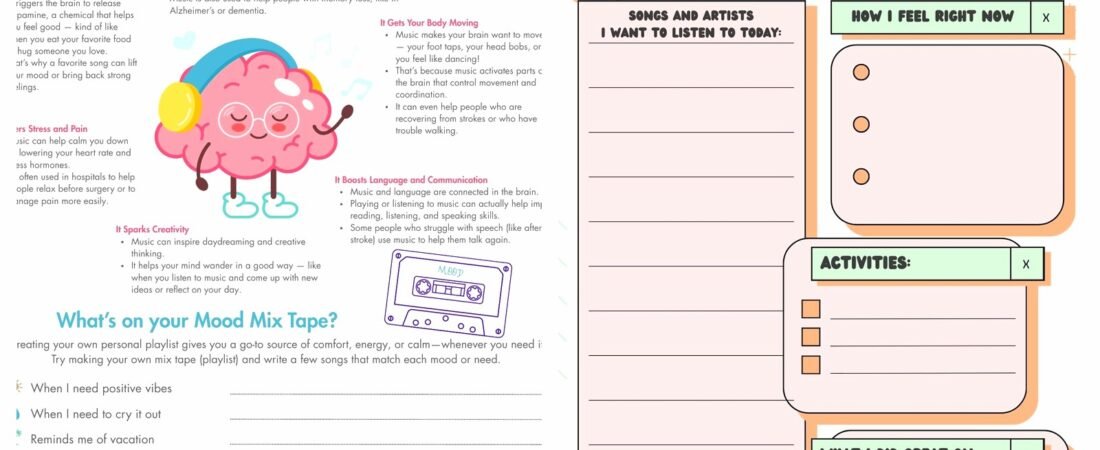
These worksheets specifically target emotional regulation. They ask you to curate songs for different regulatory needs: songs that help you sit with sadness without spiraling, songs that discharge anger safely, songs that interrupt rumination, songs that facilitate crying when you’re emotionally numb.
The reflection component is crucial. You document not just what songs you chose but when you used the playlist, whether it achieved the intended effect, and what adjustments might improve it. This creates a personalized emotional regulation tool that you built with deliberate awareness.
Rhythm and Movement Documentation
These worksheets accompany activities where you physically respond to music through movement, tapping, or creating rhythm. You’re documenting the relationship between rhythmic patterns and emotional or physical states.
A basic version might ask you to listen to different rhythm patterns and note where in your body you feel each one, what emotion each evokes, and whether the rhythm matches or contrasts with your current internal state. More complex versions involve creating your own rhythms using household objects or body percussion, then analyzing what those self-created rhythms reveal about your emotional state.
The body-based component addresses something verbal therapy often misses—people hold emotions physically, and rhythm activities can access that. My cat actually interrupted a video call once by knocking over a container of pens while I was explaining this exact concept to a colleague, and honestly the scattered pen sounds kinda proved the point about rhythm being everywhere.
Tempo and Energy Tracking
Some worksheets focus specifically on tempo. You listen to songs at different BPMs (beats per minute) and track your physiological and emotional responses. Does 120 BPM increase your anxiety? Does 60 BPM make you sleepy or calm—there’s a difference?
This information becomes practical. If you know that 80-90 BPM music helps you focus without anxiety, you can build work playlists in that range. If you know that anything above 140 BPM triggers panic responses, you can make informed choices about your auditory environment.
Songwriting and Composition Prompts
These worksheets guide original music creation, even for people with no musical training. They break songwriting into manageable components and provide structure that reduces overwhelm.
Simple versions might offer a repetitive chord progression (even just two chords) and ask you to create a melody by humming or speaking words rhythmically. You document your lyrics, the emotion you intended to convey, and whether the creation process itself was therapeutic regardless of the product.
More detailed worksheets include sections for different song components—verse themes, chorus emotional peaks, bridge perspective shifts. They might provide rhyme schemes or suggest syllable patterns. Some include prompts like “write a verse from the perspective of your anxiety” or “create a chorus that your younger self needed to hear.”
Musical Letter Writing
This variation asks you to write a song or musical piece as a letter to someone or something—a person who hurt you, a version of yourself, an emotion you’re struggling with, a future you hope for. The worksheet guides you through deciding on musical mood, choosing instruments or sounds that represent the recipient, and crafting lyrics or sounds that communicate what words alone can’t… or maybe what words could say but music says differently, I guess both are valid.
Listening Logs and Response Tracking
These worksheets create structured documentation of your responses to music over time. You’re building a personal database of how different musical elements affect you.
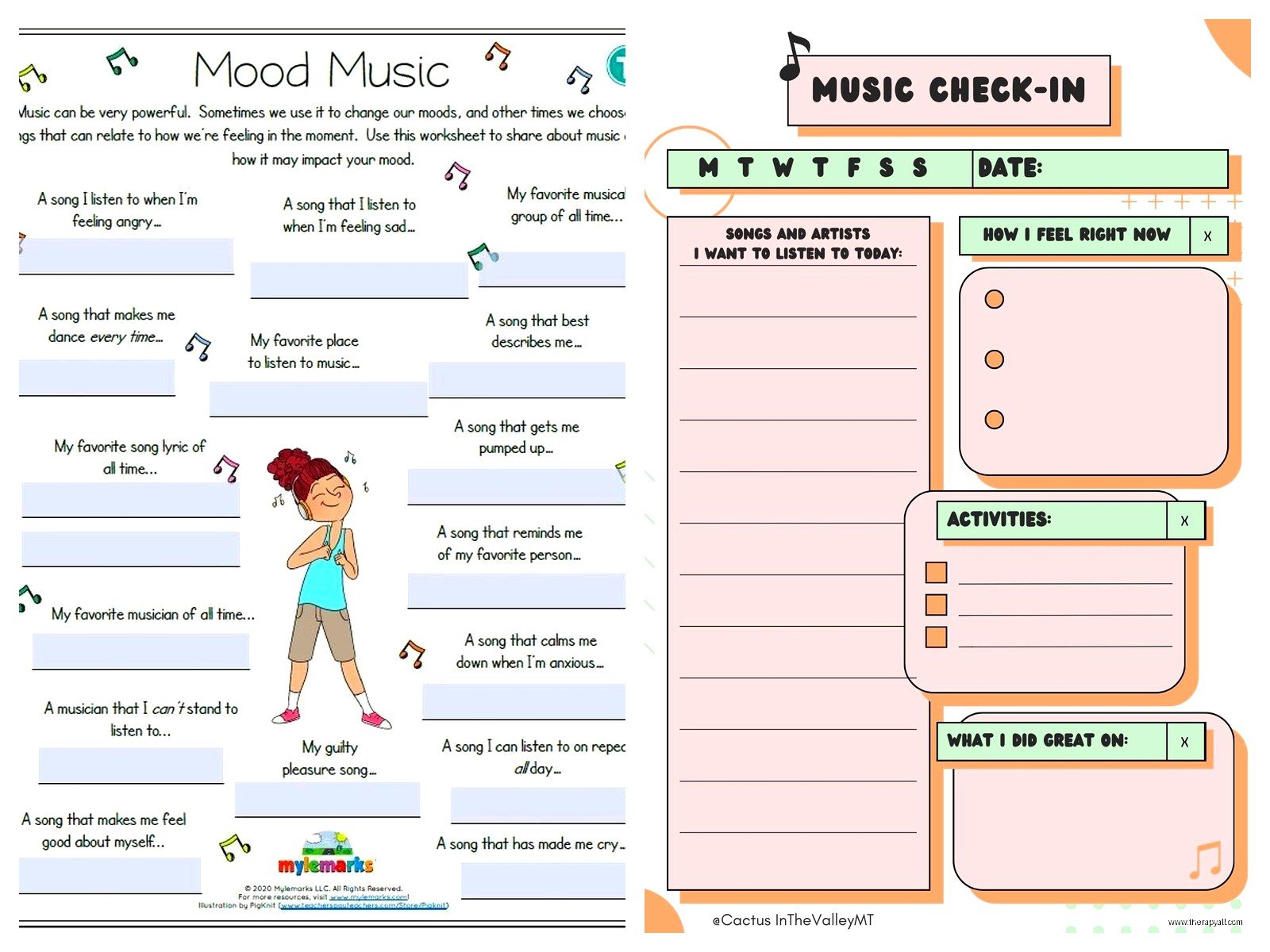
A daily listening log might include columns for: song title, time of day, current mood before listening, musical elements you noticed (tempo, key, instruments, dynamics), mood after listening, physical sensations during listening, memories triggered, and any urges or impulses that arose.
Over weeks or months, patterns emerge. You might notice that minor keys don’t actually make you sad—they make you contemplative. Or that songs with prominent bass lines ground you when you’re dissociating. This data informs future musical choices for emotional regulation.
Trigger and Resource Identification
Some worksheets specifically track which songs or musical elements trigger distress versus providing comfort. This is gonna sound obvious but you’d be surprised how many people keep listening to their “sad playlist” and wondering why they feel worse.
The worksheet asks you to identify specific triggers: Is it the lyrics? The melody? The associations? The memories connected to when you first heard it? Then it guides you toward building a “resource playlist” of songs that consistently provide comfort, energy, or regulation without harmful triggers.
Guided Imagery and Music Worksheets
These combine music listening with visualization exercises. The worksheet provides a specific piece of music (usually instrumental) and guides you through a structured imagery experience while listening.
You might be asked to imagine walking through a landscape that matches the music, then document what you encountered, how the landscape changed with the music, and what emotions arose. Other worksheets ask you to visualize the music as colors, shapes, or weather patterns, then reflect on what those visualizations reveal about your current emotional state.
The post-listening reflection section asks detailed questions about the imagery that emerged, any resistance you felt, moments where the music and imagery aligned or conflicted, and what the overall experience revealed.
Music and Memory Worksheets
These explore the connection between specific songs and autobiographical memories. You document songs that trigger particular memories, analyze why those connections exist, and decide whether engaging with those musical memories is therapeutic or harmful right now.
A structured worksheet might ask you to list songs from different life periods, note what each song makes you remember, identify the emotions connected to those memories, and reflect on whether your relationship to those songs has changed as you’ve processed the associated experiences.
Some versions include timeline activities where you create a musical autobiography—choosing songs that represent different ages or life events, then analyzing patterns in your musical choices and what they reveal about your emotional development.
Group Music Therapy Worksheets
These adapt music therapy activities for group settings. They include sections for individual responses plus group discussion prompts and collaborative activities.
A group worksheet might have everyone listen to the same piece, document individual responses, then include prompts for sharing and discussion. Other versions involve collaborative playlist creation where each group member contributes songs based on specific criteria, then the group analyzes the collective choices.
The structure helps prevent group music activities from becoming just “let’s all share our favorite songs” sessions without therapeutic direction.
Format and Accessibility Considerations
PDF worksheets need specific design elements to function well. Adequate space for written responses matters—tiny boxes frustrate people. Clear instructions prevent confusion. Including both lined and unlined response spaces accommodates different preferences.
Some worksheets benefit from including QR codes or links to specific songs or playlists, though this obviously only works for digital versions. Others include notation examples or rhythm patterns that people can reference.
Accessibility means providing versions with larger text, high contrast, and compatibility with screen readers. Some people need audio versions of the instructions. Others need simplified language versions.