
Mental Health, Therapy resources
REBT Worksheet: Rational Emotive Behavior Therapy in Practice
Jun
# Understanding REBT Worksheets and How They Actually Work
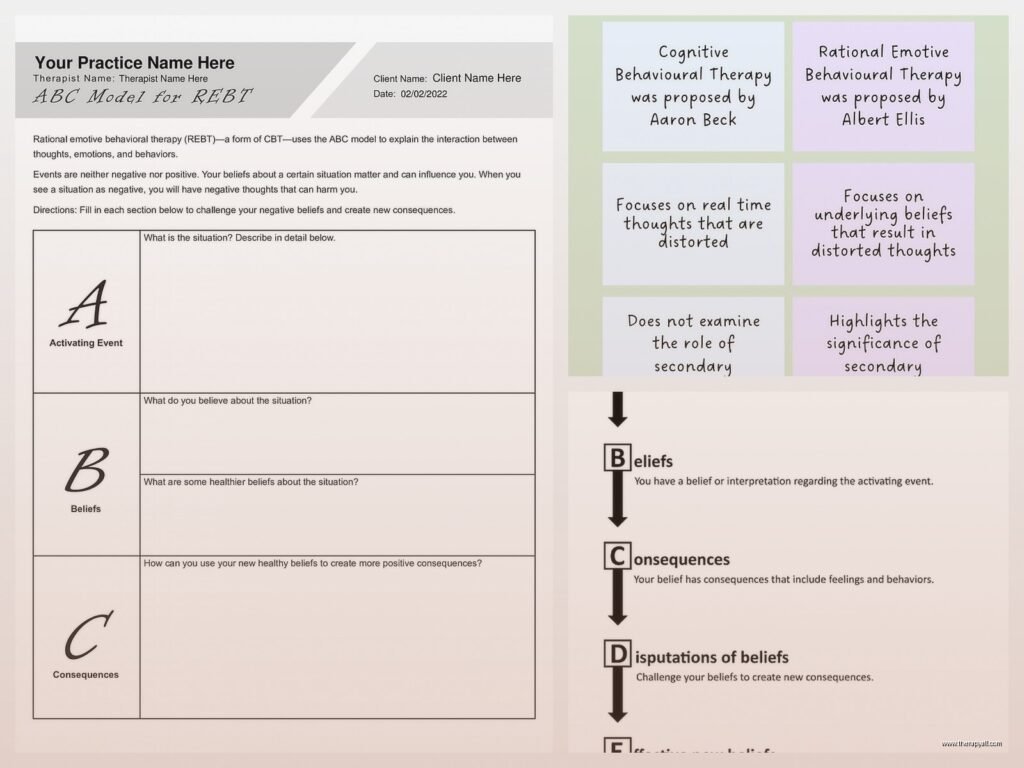
REBT worksheets are structured tools that help you identify irrational beliefs and replace them with rational ones using the ABC(DE) model developed by Albert Ellis in the 1950s. The worksheet format breaks down your emotional reactions into components: the Activating event, your Beliefs about that event, the emotional and behavioral Consequences, then Disputing those beliefs and establishing new Effects.
I remember back in 2019 when I was shadowing a therapist who specialized in REBT, and she had this client who kept writing “I’m stupid” in the belief column every single time, regardless of what the activating event was. Like, the event could be “my boss didn’t say hello” and the belief would be “I’m stupid.” We had to basically start from scratch and teach her what a belief about an event actually meant versus just global self-criticism.
The activating event section is where you write down what happened. Not your interpretation, not your feelings about it, just the facts. This is harder than it sounds because most people want to write “My friend was rude to me” when what actually happened was “My friend didn’t respond to my text for six hours.” You have to strip away the judgment and stick to observable facts.
## The ABC Model Components
The belief section is where most of the actual therapeutic work happens. You’re supposed to identify what you told yourself about the activating event. REBT distinguishes between rational beliefs (preferences, wishes, desires) and irrational beliefs (demands, musts, shoulds). Irrational beliefs typically fall into three categories: demandingness (“I must perform perfectly”), awfulizing (“It’s terrible and catastrophic if I don’t”), and low frustration tolerance (“I can’t stand it when things don’t go my way”).
What genuinely irritates me is when REBT worksheets just have a tiny box for “beliefs” without any guidance about how to dig deeper. Like, you’re asking someone who’s never done cognitive work before to spontaneously identify their core irrational beliefs? Most people will write surface-level stuff like “I felt bad” which isn’t a belief at all. Good worksheets include prompting questions: “What did this event mean about you?” “What did you predict would happen?” “What rule or standard were you applying?”
The consequences section splits into two parts: emotional consequences and behavioral consequences. Emotional consequences are your feelings—anxiety, depression, anger, guilt. Behavioral consequences are what you actually did—avoided the situation, snapped at someone, had a panic attack, scrolled social media for three hours. You need both because sometimes people are very disconnected from their emotions but can clearly see their behaviors, or vice versa.
## The Disputation Process
Disputing is where you challenge the irrational belief. There are several types of disputes you can use. Empirical disputes ask “Where’s the evidence?” If your belief is “I must never make mistakes or I’m worthless,” you’d ask yourself whether there’s actually evidence that making a mistake equals worthlessness. Logical disputes examine whether the belief makes logical sense—does it follow that because you want something, you absolutely must have it? Functional disputes look at whether holding this belief helps you or hurts you.
I’ve gotta say, the disputation section is where people either get it or they really, really don’t. Some clients would write disputes like “I shouldn’t think this way” which is just… another demand. Or they’d write “I’m not stupid” in response to “I must be perfect” which doesn’t address the demandingness at all.
My cat knocked over my coffee this morning right onto a stack of printed REBT worksheets I was reviewing and honestly the irony of having to dispute my own irrational beliefs about ruined work wasn’t lost on me.
## Effective New Beliefs and Effects
The E section—sometimes worksheets use it for “Effective new belief” and other times for “Effect” or both—is where you write out a rational alternative belief and note how you’d feel and behave differently if you actually believed it. A rational alternative to “I must perform perfectly or I’m worthless” might be “I’d prefer to do well, but I’m a fallible human who will sometimes make mistakes, and that doesn’t determine my worth as a person.”
The new effects should show moderated emotions (concern instead of anxiety, sadness instead of depression, annoyance instead of rage) and more adaptive behaviors. This is important because REBT doesn’t aim to make you feel nothing—it aims to help you have appropriate emotional responses that match the actual severity of the situation.
## Common REBT Worksheet Formats
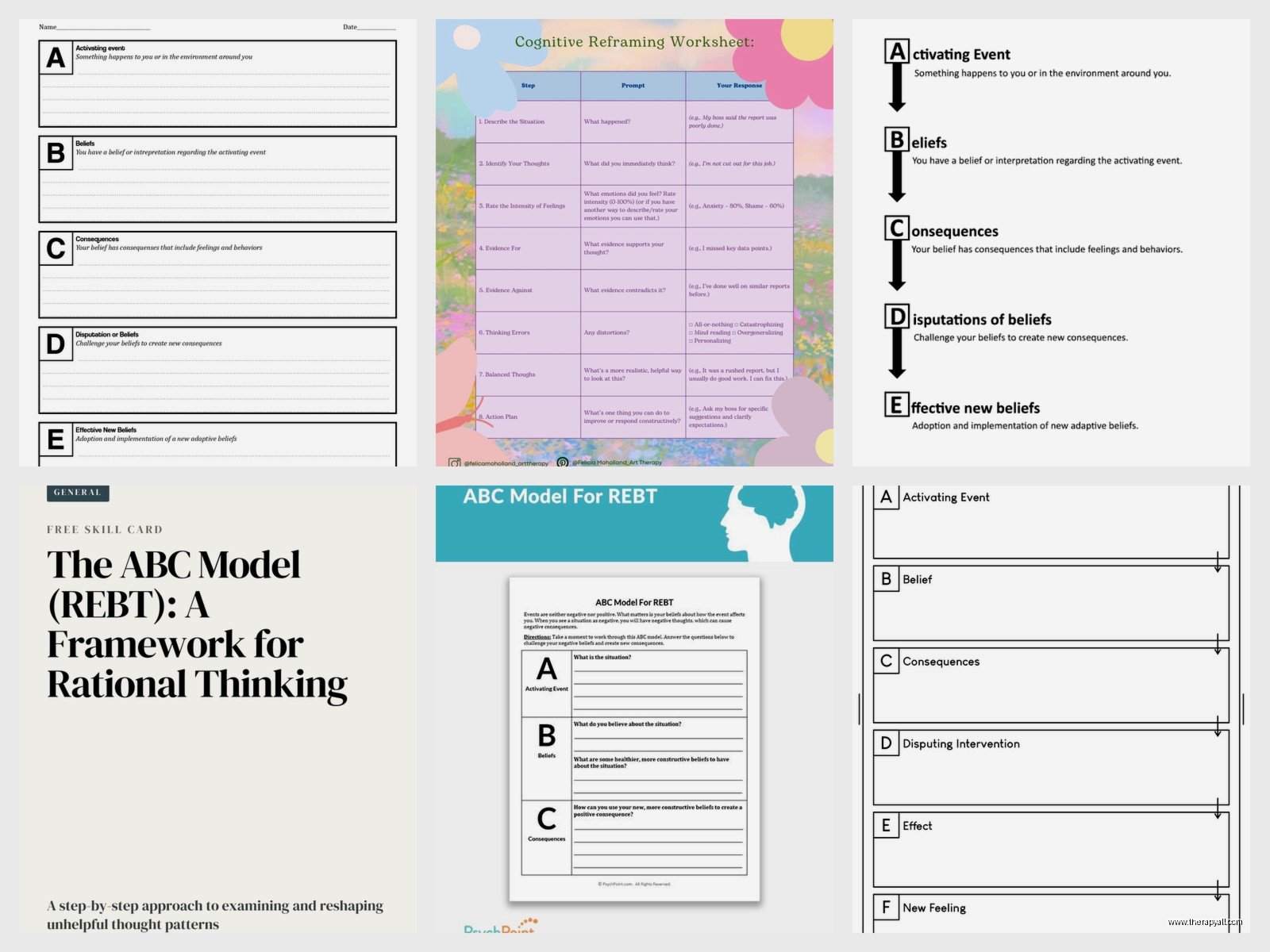
Some REBT worksheets use a simple five-column format with A-B-C-D-E across the page. Others use a more elaborate format with separate sections for rational versus irrational beliefs, multiple dispute types, and detailed effects. I’ve seen worksheets that are two pages long with subsections for each component and honestly, those can be overwhelming for someone just starting out. The sweet spot is probably something that gives enough structure without being so detailed that you spend 45 minutes filling it out.
There are also specialized REBT worksheets for specific issues. Anxiety-focused worksheets might emphasize awfulizing beliefs and include sections for rating the actual probability versus your perceived probability of the feared outcome. Anger worksheets focus on demandingness and frustration tolerance. Depression worksheets often highlight global self-rating and worth issues.
## Actually Using These Things in Practice
When you first start using an REBT worksheet, you should pick a specific recent event that triggered moderate distress—not your most traumatic experience, not something mild you barely remember. Moderate distress gives you enough material to work with but won’t overwhelm you while you’re learning the process.
You work through it in order, though sometimes you have to circle back. Like, you might get to the consequences section and realize you didn’t actually capture the full activating event, or you might be disputing a belief and realize there’s a deeper belief underneath it. That’s normal. The worksheet is a tool, not a straightjacket.
I think it was summer 2021, I was creating a worksheet guide and got so deep into examples that I started using my own recent situations, and then I realized I was just doing free therapy on myself through fake “sample” scenarios. Which, honestly, saved me some money.
The frequency matters too. Using an REBT worksheet once won’t rewire your thinking patterns. You need repetition. Some therapists assign one worksheet per day, others suggest doing one whenever you notice strong negative emotions. The goal is to internalize the process so eventually you can do it mentally without the paper—though plenty of people keep using worksheets long-term because they like having the structured format.
## Digital Versus Paper Formats
Paper REBT worksheets have the advantage of tactile engagement and you can carry them anywhere without battery concerns. Digital versions—whether in apps or fillable PDFs—offer searchability and the ability to track patterns over time more easily. Some apps will analyze your entries and point out recurring irrational beliefs, which can be genuinely helpful or kinda creepy depending on your perspective.
The problem with a lot of digital REBT tools is they try to gamify the process or add mood tracking and habit streaks and all this extra stuff that… look, sometimes you just need a straightforward worksheet without points and badges and notifications. I’m not trying to build a streak. I’m trying to challenge my irrational belief that my worth depends on my productivity, and a productivity app seems like maybe the wrong container for that work.
## Integration with Other Therapeutic Approaches
REBT worksheets can work alongside other therapy modalities. They pair well with behavioral activation for depression—you dispute beliefs that keep you inactive, then schedule activities. They complement exposure therapy for anxiety—you identify and dispute catastrophic beliefs before and after exposures. Some therapists combine REBT worksheets with mindfulness practices, though Ellis himself was skeptical of mindfulness because he thought it could become another form of avoidance.
You can also use REBT worksheets for interpersonal issues by working through beliefs about how others “should” behave or what rejection “means” about you. The format stays the same but the content shifts to relational events and beliefs about relationships, respect, fairness, all that stuff.
## What Makes a Good REBT Worksheet
A good REBT worksheet has clear instructions for each section—not just labels but guidance. It provides examples, especially for the disputation section where people get stuck most often. It has enough space to write thorough responses without being so spacious that you feel pressure to fill every inch with text.
The best worksheets I’ve seen include a reference section listing common irrational belief patterns and types of disputes. Some include rating scales for emotional intensity before and after the exercise. A few have a notes section for insights or patterns you notice over time, which is actually pretty useful when you’ve done enough worksheets to start seeing your recurring themes.
What doesn’t help is when worksheets are formatted in tiny font with cramped spaces, or when they use clinical jargon without explanation, or when they’re designed to look “therapeutic” with lots of pastel colors and inspirational quotes in the margins, because—nah, that’s not what we’re doing here. This is cognitive work, not a vision board.
## Troubleshooting Common Issues
If you can’t identify your beliefs, work backwards from your emotions. What would you have to believe for this emotion to make sense? If you’re anxious, you’re probably predicting something bad. If you’re guilty, you probably think you violated some standard. If you’re angry, someone probably violated your standard.
If your disputes feel hollow or unconvincing, you might be writing what you think you “should” believe rather than working toward what you could actually believe. Rational beliefs don’t have to be positive—they just have to be non-absolute and evidence-based. “This situation sucks but I can handle it” is rational. “Everything is fine and happens for a reason” is… not what REBT is going for.
If you’re not noticing any emotional or behavioral change after disputing, you either haven’t hit the actual core irrational belief yet, or you’re going through the motions without really engaging with the questions. It’s also possible you need more repetition—one worksheet won’t undo years of practiced irrational thinking.
## Customizing for Your Needs
You can modify REBT worksheets for your situation. Some people add a section for physical sensations if they’re very disconnected from emotions but very aware of body responses. Others add a “evidence for and against” section before the disputation to lay groundwork. Some people skip the formal effects section and just journal briefly about how they feel after completing the worksheet, or they just… stop after disputation because they’ve gotten what they needed.
The rigid structure helps when you’re learning, but once you understand the model you can adapt it. I’ve seen people use voice memos to talk through the ABC model instead of writing, or use the worksheet as an outline for a conversation with their therapist rather than completing it solo.

ADHD & Neurodiversity
Life Planner Bundle – Life Organizer
Self-Care & Personal Growth
Acceptance And Commitment
Anxiety & Stress
Stress Processing Journal & Reflection Worksheets For Daily Self – Care
Self-Care & Personal Growth
Self – Reflection Guided Journal With Guided Prompts 30
Emotional Wellness
Decision Processing – Thought Processing Journal For Daily Self – Care
Therapist Resources
Physiotherapist Journal PDF Planner Tracker Or Log Book
Self-Care & Personal Growth
Customizable Self – Confidence & Self – Esteem Guided Journal
ADHD & Neurodiversity
ADHD Behavior Tracker PDF Planner Tracker Or Log Book