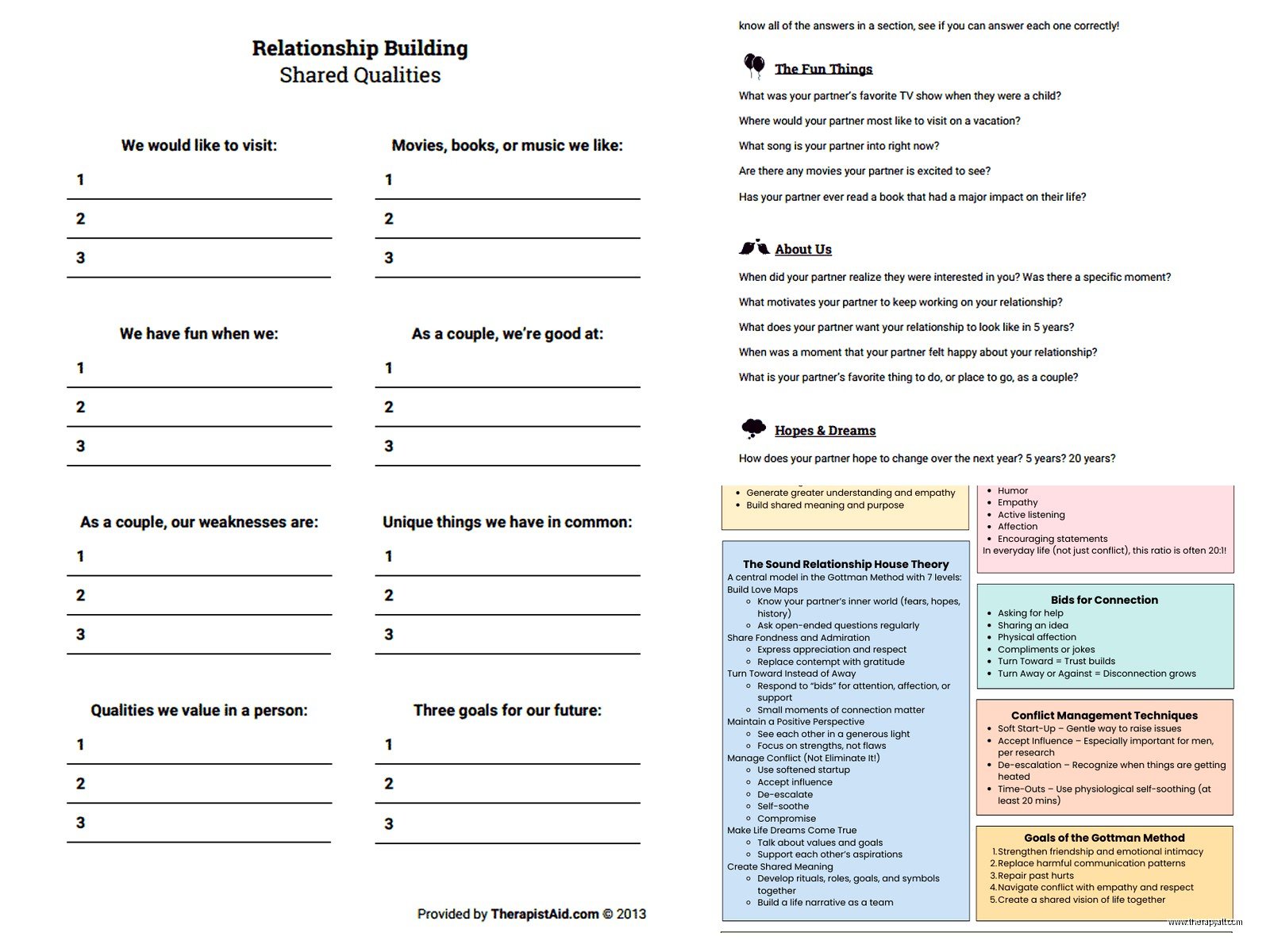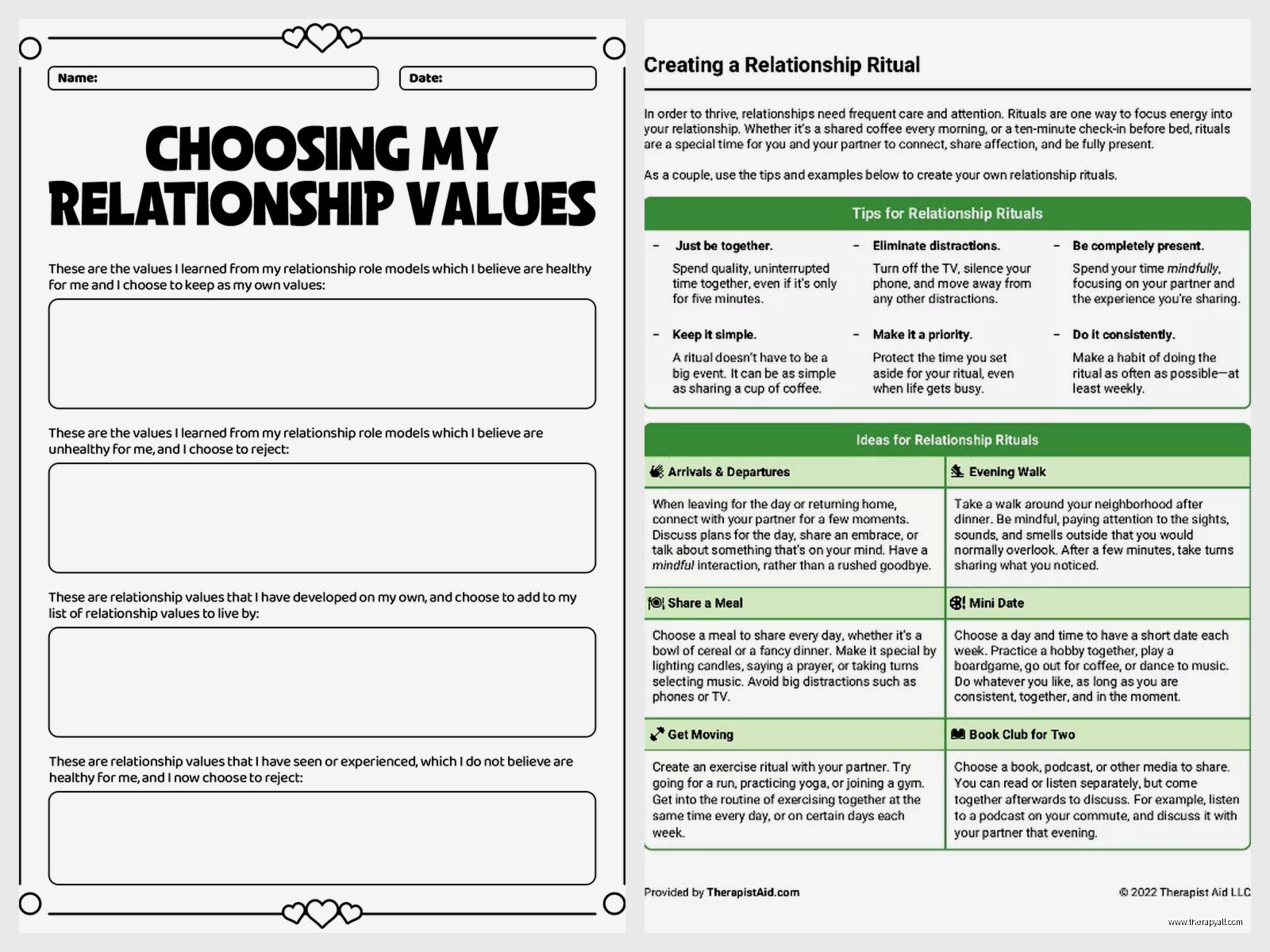
Relationship therapy worksheets work because they force couples to sit down and actually articulate what’s happening between them instead of just circling the same arguments in their heads. I remember back in 2019 sitting with a couple who’d been married eleven years and watching them realize mid-worksheet that they’d never actually asked each other what “quality time” meant to them specifically—they’d just been assuming and getting mad about the assumptions.
The structure matters more than people think. A worksheet isn’t just questions on paper. It’s a container that holds space when emotions are running too hot or when avoidance has become the default mode. You’re essentially creating a third point in the room that both people can look at instead of just staring each other down across the kitchen table.
Communication Pattern Mapping
Most couples get stuck in about three or four recurring loops. The worksheet approach here asks both partners to identify their typical conflict sequence—not the content of what you fight about, but the actual pattern. Person A does X, Person B responds with Y, Person A escalates to Z, and then somebody leaves the room or shuts down.
I use a simple three-column format: What I do, What happens next, What I’m actually feeling. The gap between column one and column three is where all the damage lives. Someone stonewalls because they’re overwhelmed, but their partner reads it as contempt. Someone pursues because they’re terrified of disconnection, but their partner experiences it as attack.
You map maybe three recent conflicts this way. Not to solve them—that comes later—but just to see the choreography. I had this one client who kept saying “I don’t even know what we fight about anymore, it just happens” and after filling out the pattern map she was like, oh, we do the same dance every single Sunday night before the work week starts.
The worksheet should include a section for identifying your own role in the pattern, which people hate. Everyone wants to fill out the part about what their partner does wrong. But the therapeutic value is in recognizing your own repetitive moves. I do this thing where I go cold and factual when I’m hurt, and for years I didn’t realize how that landed on the other side—just looked like I didn’t care, when actually I cared so much I was trying not to combust.
Emotional Needs Inventory
This one sounds kinda therapy-speak cheesy but it actually works. You list out core emotional needs—safety, appreciation, autonomy, affection, validation, whatever framework you’re using—and each person rates how well those needs are currently being met in the relationship. Then, and this is the part that matters, you write specific behavioral examples.
Not “I need more appreciation” but “I need you to acknowledge when I handle the morning routine with the kids so you can sleep in.” Not “I need affection” but “I need you to touch my shoulder when you walk past me, not just when you want sex.”
The specificity is everything. I spent probably six months in 2021 writing needs-based worksheets for different platforms and I got so annoyed at how vague most of them were. Just listing abstract needs doesn’t give anyone anything actionable. Your partner can’t read your mind, and “be more present” means seventeen different things to seventeen different people.
The worksheet should also include a section for barriers—what gets in the way of meeting these needs. Sometimes it’s practical stuff like work schedules or exhaustion. Sometimes it’s old injuries that haven’t been addressed. Sometimes it’s that you’ve never actually told your partner what you need because you think they should just know, which, nah, that’s not how humans work.
I include a rating scale for how comfortable you feel expressing each need directly. That reveals a lot. If you’re rating your comfort level as 2 out of 10 for expressing your need for emotional safety, that’s its own issue that probably predates this relationship.
Appreciation and Resentment Log
This is the one that makes people cry in session, just warning you. Two columns: things I appreciate about my partner, things I resent. You write both. You have to write both.
The appreciation side can feel forced at first, especially if you’re in a rough patch. People write stuff like “pays the bills on time” or “good with the dog” and you can feel how far they’ve drifted from actual warmth. But you keep writing, and usually something shifts around item seven or eight—suddenly there’s something real, something that touches the original reasons you chose this person.
The resentment side is where people often start, because resentment is what’s loud. It’s taken up residence and it’s playing music at 2am. The worksheet asks you to be specific here too, and to note how long you’ve been carrying each resentment. Some of them are fresh—you’re mad about last Tuesday. Some of them are three years old and have calcified into your understanding of who your partner is.
Here’s what gets therapeutic about this exercise: you share both lists with each other, but with a specific protocol. The listening partner can’t defend or explain, just acknowledge what they’re hearing. “I hear that you resent that I committed us to hosting Thanksgiving without asking you first.” That’s it. The defending comes later, in a different conversation, ideally with a therapist.
My cat just knocked over my water bottle and I’m gonna let it drip because I’m on a roll here, but—the point is that acknowledgment without defensiveness is incredibly hard and incredibly necessary. The worksheet structure helps because you’ve both agreed to the rules before you start. You’re not ambushing each other, you’re following a format.
Timing the Exercise
Don’t do this worksheet when you’re actively fighting or right after a blowup. You need some baseline emotional regulation first. I usually suggest a neutral time, maybe weekend morning after coffee, when you’re not rushed. Set a timer for 30 minutes and commit to stopping when it goes off even if you’re not finished. You can always come back to it.
Some couples do better filling out their sections separately first, then coming together to share. Others want to sit at the same table and work through it together. Depends on your dynamic and how much space you need to think without your partner’s presence influencing your answers.
Conflict Resolution Framework Worksheet
This one walks through a current unresolved conflict using a structured format. State the problem from your perspective, state what you think your partner’s perspective is, identify what you actually want (not what you want them to stop doing, but what outcome you’re hoping for), and list possible compromises.
The section where you articulate your partner’s perspective is the one that stops people in their tracks. You’d think after years together people would be able to do this easily, but we’re so stuck in our own experience that we genuinely don’t know what it looks like from the other side. I’ve watched people write two sentences and then just sit there, stuck, realizing they’ve never actually tried to understand their partner’s position—they’ve just been building counterarguments.
When you share what you wrote about your partner’s perspective, they get to correct or confirm. “Actually, it’s not that I don’t care about your family, it’s that I feel overwhelmed by how much social obligation there is and I don’t know how to say no without disappointing everyone.” Oh. That’s different from “my partner hates my family.”
The compromise section should include multiple options, not just one. Relationships aren’t single-solution systems. You need a range of possibilities, some that lean toward what you want, some that lean toward what they want, some that are genuinely middle ground. The worksheet should push you to generate at least five options, even if some of them seem unrealistic at first.
Attachment and Trigger Mapping
This gets more psychological but it’s useful for couples who keep hitting the same raw spots. The worksheet asks you to identify moments when you felt most activated or reactive in the relationship, then trace back to what fear or old wound got touched.
Your partner said they needed space and you spiraled into panic—maybe that connects to abandonment fears from childhood or a previous relationship where “space” meant the beginning of the end. Your partner criticized how you loaded the dishwasher and you shut down for two days—maybe that touches a wound about never being good enough, about being controlled, about competence being questioned.
I gotta say, the number of major relationship conflicts that are actually about dishwashers or tone of voice or whose turn it is to call the plumber is basically zero. It’s always about the underlying fear or injury. The worksheet helps you map from the surface event to the deeper material.
There should be a section for identifying your attachment responses—do you pursue, withdraw, or freeze when you feel threatened in the relationship. And then, what does your partner do that most reliably triggers that response, and what do you need instead. Not what you need them to never do (controlling), but what repair or reassurance would help when you’re activated.
Weekly Connection Worksheet
This is more maintenance than crisis intervention. A simple check-in structure you do together once a week: What went well between us this week, what felt hard, what do I need from you in the coming week, what’s one way I can show up better for you.
It sounds almost too simple, but the regularity is what makes it work. You’re building a habit of actually talking about the relationship instead of just being in it. Most couples only discuss their relationship when something’s wrong, which means every relationship conversation becomes heavy and loaded.
The weekly worksheet creates a routine container for both appreciation and concerns. You mention the good stuff so it doesn’t just evaporate into the background. You mention the small tensions before they become big resentments. You make requests while they’re still requests, not demands born from months of unmet needs.
I started using a version of this in my own life around 2020 and honestly it felt ridiculous at first, like we were having a business meeting about our relationship. But after a few months it just became normal, and we started catching issues early instead of letting them pile up until someone explodes about something that happened six weeks ago but we never discussed.
What Makes These Worksheets Actually Work
It’s not magic. It’s structured attention. You’re agreeing to pause the autopilot and actually look at what’s happening between you. The worksheet format helps because it’s concrete—you’re writing things down, you can’t just talk in circles or rely on vague feelings.
The other thing is that worksheets externalize the process. Instead of “we need to talk” which everyone hates, it’s “let’s do that worksheet our therapist suggested” or “should we fill out the connection check-in.” You’re collaborating on a task together rather than confronting each other.
But they only work if both people actually do them. If one person is filling out worksheets and the other is rolling their eyes or giving one-word answers, you don’t have a worksheet problem, you have a willingness problem. That’s a different conversation, probably one that needs to happen with a professional in the room.
The worksheets I find most valuable include space for both reflection and action. You’re not just processing feelings endlessly—you’re identifying concrete next steps. “This week I will…” or “The specific thing I’m asking for is…” Otherwise it’s just journaling about your relationship, which has value but doesn’t create change by itself.