
Mental Health, Therapy resources
Study Therapy – Everything You Need to Know

Jul
What Study Therapy Actually Is
Study therapy isn’t a formal type of therapy you’d find listed in the DSM or something a therapist advertises on their Psychology Today profile. It’s more of an umbrella term for therapeutic approaches that help people who struggle with academic performance, learning challenges, test anxiety, procrastination, and the emotional fallout that comes with all of that. I remember back in 2019, I was consulting with a college counseling center and this student came in absolutely convinced they needed “study therapy” because they’d seen it mentioned on Reddit, and I had to explain that what they probably needed was a combination of cognitive behavioral techniques for test anxiety plus maybe an ADHD screening. The term gets thrown around a lot.
The core idea is using psychological principles and therapeutic techniques to address the mental and emotional barriers that interfere with learning and academic success. You’re not just getting tips on how to highlight your textbook more effectively. We’re talking about unpacking why you freeze up before exams, why you can’t start that paper until 2am the night before it’s due, or why you read the same paragraph seventeen times and retain nothing.
Who Actually Benefits From This
Students with diagnosed learning differences like ADHD, dyslexia, or processing disorders obviously benefit, but honestly, so do high-achieving students who’ve developed maladaptive perfectionism. I’ve worked with people across that entire spectrum. The student who can’t focus for more than four minutes is dealing with different issues than the one who rewrites their notes six times because they’re not “perfect enough,” but both are struggling with the psychological component of studying.
Test anxiety is probably the most common reason people seek out this kind of support. When your hands shake so badly you can barely hold a pencil during an exam, or when you know the material backwards and forwards but blank completely when the test is in front of you, that’s not a study skills problem. That’s an anxiety problem that happens to show up during academic situations.
Procrastinators are another big group, though what genuinely annoys me is when people treat procrastination like it’s just laziness or poor time management. It’s almost always about anxiety avoidance or perfectionism or sometimes even a trauma response. I’ve seen so many articles that are like “just use the Pomodoro Technique!” and it’s like… nah, if someone is procrastinating because starting the task triggers shame about past academic failures, a tomato timer isn’t gonna fix that.
The Actual Techniques Used
Cognitive Behavioral Therapy (CBT) is probably the most common framework. You’re looking at the thoughts that interfere with studying—”I’m going to fail anyway,” “I’m too stupid for this,” “everyone else understands this better than me”—and challenging them. It’s not about positive thinking or affirmations. It’s about examining evidence, identifying cognitive distortions, and developing more balanced thoughts.

A lot of study therapy work involves behavioral activation too, which means breaking tasks down into smaller steps and building momentum. If you’ve been avoiding studying for a calculus exam for three weeks, you don’t start with “study all of Chapter 7.” You start with “open the textbook to page 143” and build from there. The behavioral piece is about reducing avoidance and creating positive associations with study behaviors instead of just dread.
Mindfulness techniques come up frequently, especially for attention issues and test anxiety. I’m talking about actual mindfulness practices—noticing when your mind wanders during reading, practicing bringing attention back without judgment, doing brief body scans before exams to release physical tension. Not the Instagram version of mindfulness where you just… I don’t know, light a candle and hope for the best.
Exposure Therapy for Test Anxiety
This one’s interesting because people don’t usually think of exposure therapy in an academic context. But if someone has severe test anxiety, you might do graduated exposure to test-like situations. Start with low-stakes practice quizzes at home, then timed practice tests, then practice tests in the actual classroom, building up tolerance to the anxiety-provoking stimuli. My cat jumped on my keyboard right as I was writing this and I lost my train of thought but—yeah, exposure hierarchies work really well for this.
Executive Function Coaching
This overlaps with study therapy, especially for ADHD folks. You’re working on planning, organization, time management, task initiation, and working memory. It’s not just “here’s a planner, use it.” It’s understanding why traditional organizational systems don’t work for your brain and developing personalized strategies. Someone with ADHD might need external accountability, body doubling, or very specific environmental modifications that wouldn’t occur to a neurotypical study skills tutor.
Common Misconceptions That Drive Me Crazy
The biggest one is that study therapy is just tutoring with feelings. It’s not. A tutor helps you understand the content. A therapist or counselor doing study therapy helps you understand and modify the psychological barriers preventing you from engaging with the content. These are related but different things, and you might need both.
Another misconception is that if you need this kind of support, you’re not “college material” or you’re not smart enough. I’ve worked with incredibly intelligent people who just happen to have brains that don’t mesh well with traditional academic structures. Intelligence and the ability to perform well in conventional educational settings are not the same thing.
People also think this is only for students who are failing. Plenty of people seek study therapy because they’re getting Bs but having panic attacks three times a week, or because they’re maintaining a 4.0 but spending literally every waking hour studying and have no life outside academics. Success at the cost of your mental health isn’t actually success.
How It Actually Works in Practice
If you’re working with a therapist or counselor who does this kind of work, sessions might look different from traditional talk therapy. You might spend time actually studying during sessions so the therapist can observe your process and identify where things break down. Are you getting distracted? Experiencing intrusive thoughts? Engaging in avoidance behaviors? Perfectionism showing up in how you take notes?
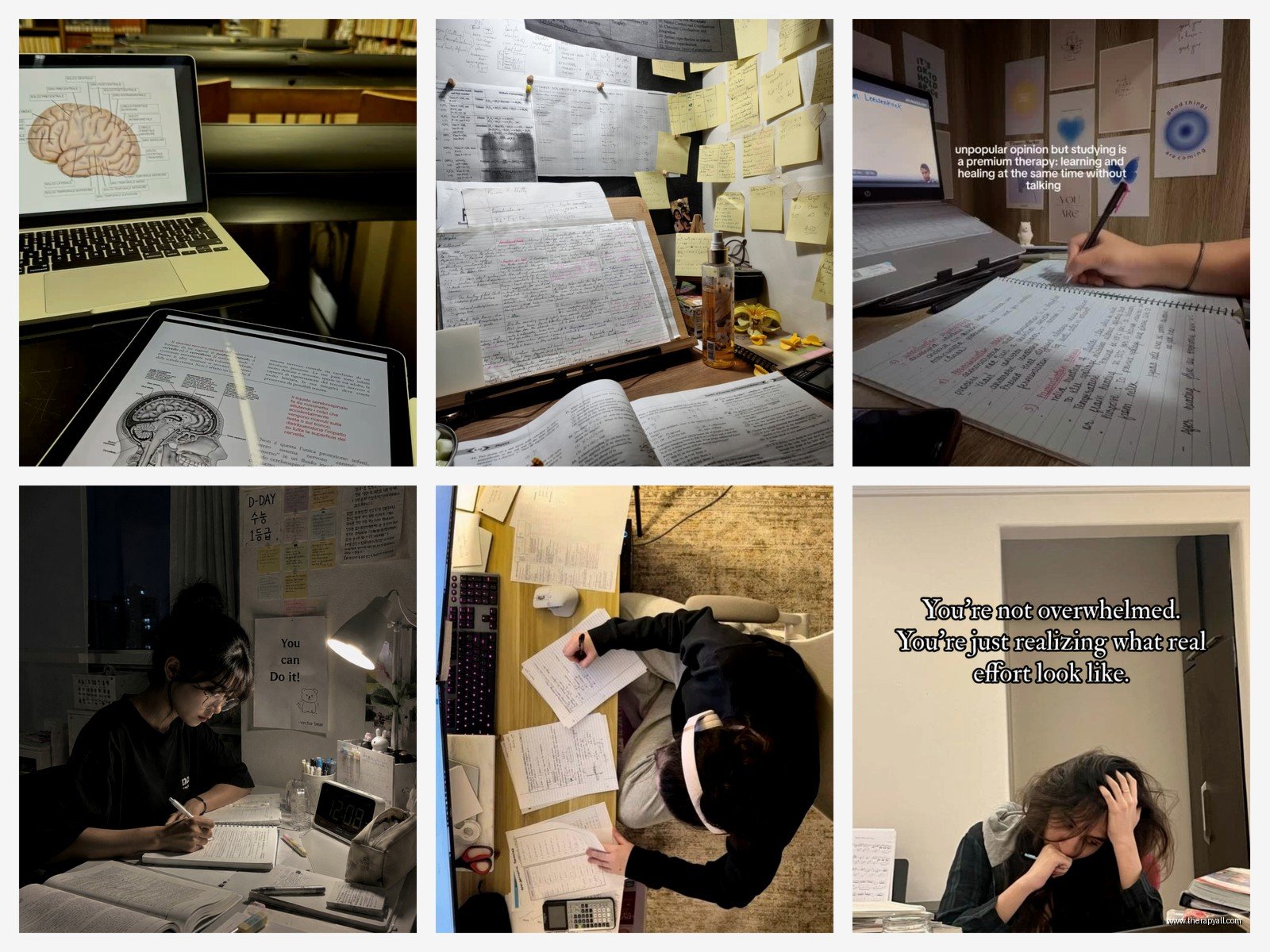
There’s usually homework, which I know sounds ironic—homework to help with homework. But you’re practicing the techniques between sessions. Maybe you’re tracking your thoughts before, during, and after study sessions. Maybe you’re doing exposure exercises. Maybe you’re testing out different environmental modifications to see what actually helps your focus.
Some practitioners use biofeedback or neurofeedback, particularly for attention issues, though the evidence base is kinda mixed on that. Heart rate variability training can help with test anxiety for some people. But honestly, a lot of the most effective interventions are pretty straightforward CBT and behavioral strategies.
The Self-Help Version
You don’t necessarily need a therapist to apply some of these principles. If your study struggles are mild to moderate and not tied to significant mental health issues, you can work on some of this yourself.
Start by actually tracking what happens when you try to study. Not just “I procrastinated” but specifically: What time was it? What were you supposed to be studying? What did you do instead? What were you thinking right before you avoided it? What were you feeling physically? You need data before you can identify patterns.
Challenge your thoughts about studying and academic performance. Write them down. “I’m going to fail this test” becomes “I’m worried I might not do well, but I’ve passed tests before when I felt this way.” It feels silly at first but it actually works if you stick with it.
Break everything down smaller than you think you need to. If “write essay” feels overwhelming, your first task is “open Google Docs and write thesis statement.” That’s it. Build from there. The resistance you feel toward a task is often proportional to how big and undefined it feels in your mind.
When You Actually Need Professional Help
If your study struggles are accompanied by significant anxiety, depression, or other mental health symptoms, you need actual therapy, not just study tips. If you’re having panic attacks, if you’re experiencing suicidal thoughts related to academic stress, if you’re engaging in self-harm—these require professional intervention.
Similarly, if you suspect you have ADHD, a learning disability, or another neurological difference affecting your academic performance, you need proper assessment and diagnosis. A therapist who does study therapy might be part of your support team, but you also need psychoeducational testing and possibly medication management or accommodations.
I worked with someone once who’d been struggling for years with what they thought was just procrastination and poor motivation, and it turned out they had pretty significant ADHD plus a reading processing disorder. No amount of time management strategies were going to fix that without addressing the underlying issues and getting appropriate accommodations. Sometimes you need the structural supports, not just the psychological ones, or actually you need both working together.
Finding Someone Who Does This
Not every therapist advertises study therapy specifically, but many therapists who work with students, adolescents, or young adults incorporate these approaches. Look for people who mention academic stress, test anxiety, perfectionism, or ADHD in their specialties.
College counseling centers often have people who specialize in this, though they’re usually pretty overbooked. Some universities have academic success centers that employ counselors or psychologists specifically for this purpose, separate from the regular counseling center.
Educational therapists are another option—they’re not always licensed mental health professionals, but they’re trained in learning differences and often use therapeutic techniques. The certification standards vary though, so you gotta check credentials carefully.
You can also work with a regular therapist on these issues even if they don’t specifically advertise study therapy. Any competent therapist should be able to apply CBT principles to academic anxiety or help you work through perfectionism that shows up in school settings. You’re just looking for someone who takes your academic struggles seriously as a mental health concern, not someone who’s gonna tell you to just try harder or manage your time better.
What the Research Actually Says
The evidence base for specific “study therapy” as a distinct modality is limited because it’s not really a distinct modality—it’s an application of established therapeutic approaches to academic contexts. But the research on those underlying approaches is solid.
CBT for test anxiety has strong evidence. Multiple meta-analyses show it’s effective for reducing anxiety and often improving test performance as a secondary benefit. The techniques work.
Behavioral interventions for procrastination show good results, particularly when combined with cognitive restructuring. Just telling people to use a planner doesn’t work, but teaching them to identify and challenge the thoughts driving avoidance while also implementing behavioral strategies does help.
Mindfulness-based interventions for attention and academic stress have growing evidence, though the effects are generally modest. They’re helpful as part of a broader approach but probably not sufficient on their own for significant difficulties.
For ADHD specifically, the gold standard is still medication plus behavioral interventions. Therapy alone for moderate to severe ADHD usually isn’t enough, but therapy plus medication works better than medication alone for academic outcomes.
ADHD & Neurodiversity
Life Planner Bundle – Life Organizer
Self-Care & Personal Growth
Acceptance And Commitment
Anxiety & Stress
Stress Processing Journal & Reflection Worksheets For Daily Self – Care
Self-Care & Personal Growth
Self – Reflection Guided Journal With Guided Prompts 30
Emotional Wellness
Decision Processing – Thought Processing Journal For Daily Self – Care
Therapist Resources
Physiotherapist Journal PDF Planner Tracker Or Log Book
Self-Care & Personal Growth
Customizable Self – Confidence & Self – Esteem Guided Journal
ADHD & Neurodiversity
ADHD Behavior Tracker PDF Planner Tracker Or Log Book