
Mental Health, Therapy resources
Therapeutic Activities – Complete Guide

Aug
What Therapeutic Activities Actually Are
Therapeutic activities are structured or semi-structured exercises designed to support mental health treatment goals. They’re not just “things that make you feel better”—they have specific purposes tied to symptom management, skill-building, emotional regulation, or cognitive restructuring. I remember back in 2019, a client brought in one of those adult coloring books and asked if that counted as therapy homework. It was kinda awkward because she’d spent like $40 on fancy markers, and I had to explain that while coloring can be relaxing, it wasn’t addressing her specific anxiety triggers we’d identified.
These activities can happen in session with a therapist, assigned as homework between sessions, or used independently as part of a self-care routine. The key difference between a therapeutic activity and just a hobby is intentionality—you’re using it to work toward a specific mental health outcome, not just passing time.
Categories of Therapeutic Activities
Cognitive-Based Activities
These target thought patterns and help you identify, challenge, or restructure unhelpful thinking. Thought records are probably the most common—you write down the situation, your automatic thought, the emotion it triggered, evidence for and against the thought, and a more balanced perspective. They’re tedious as hell, honestly, which is why compliance rates are so low. I’ve seen therapists try to jazz them up with apps and fancy worksheets, but at the end of the day you’re still gonna be sitting there writing “I think everyone hates me” for the fifteenth time.
Cognitive restructuring exercises work similarly but focus more on identifying cognitive distortions like all-or-nothing thinking, catastrophizing, or mind-reading. You learn to spot these patterns and actively challenge them. Behavioral experiments are another category where you test out your anxious predictions in real life—like if you think asking a question in class will make everyone think you’re stupid, you actually ask the question and document what happens.
Emotional Regulation Activities
These help you identify, tolerate, and manage intense emotions without making things worse. DBT has a whole arsenal here—the TIPP skills for crisis moments (Temperature, Intense exercise, Paced breathing, Progressive relaxation), emotion tracking logs, opposite action exercises where you do the opposite of what your emotion is urging you to do.
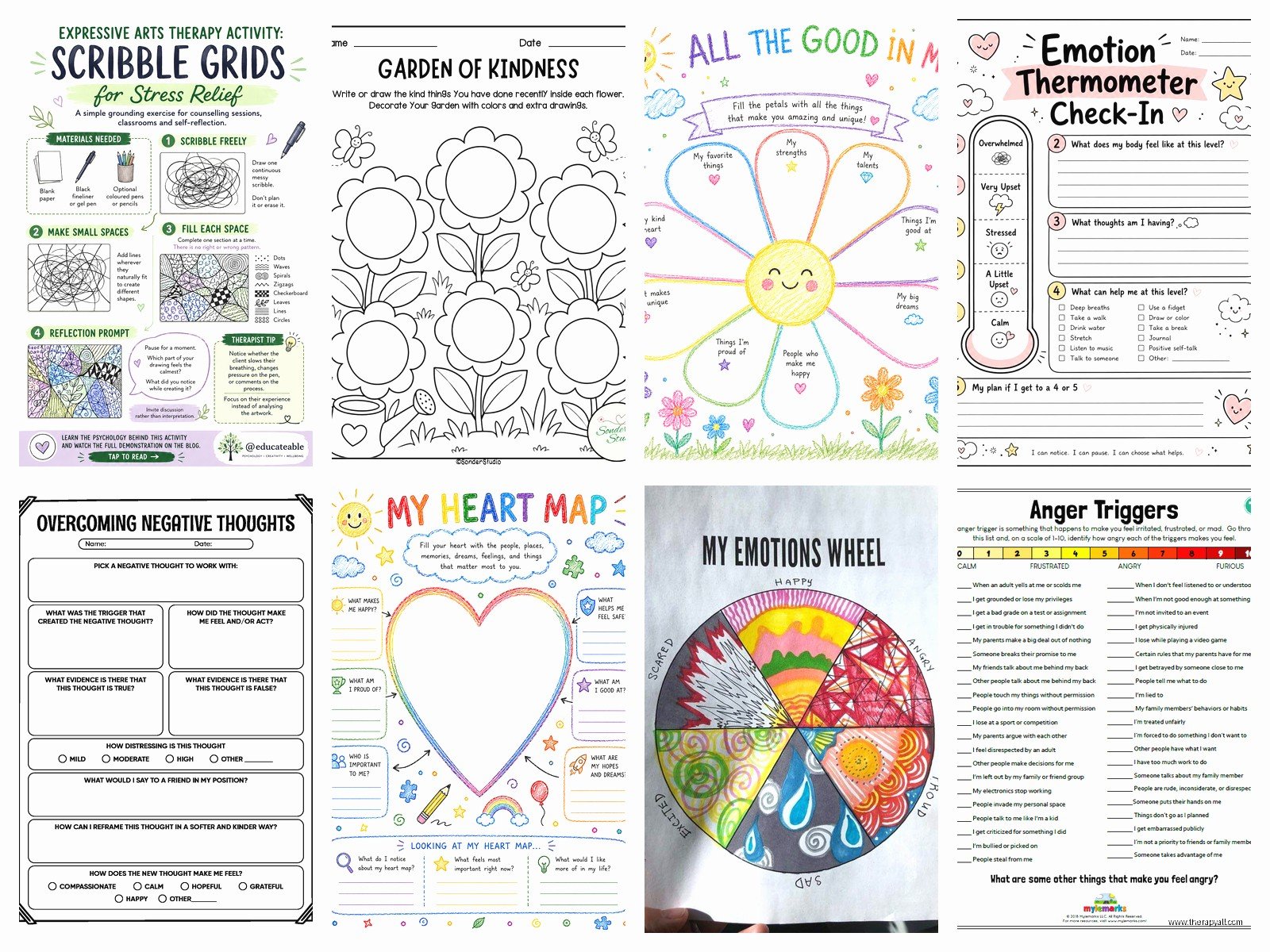
I spent summer 2021 writing content about emotional regulation and started actually tracking my own emotions just to see if it worked, and—okay this is embarrassing—I realized I was labeling like 80% of my feelings as either “fine” or “stressed” which is pathetically limited emotional vocabulary for someone with a psychology degree.
Mindfulness exercises technically fit here too, though they’re so oversaturated in mental health content that I find them almost useless to write about anymore. Everyone’s already heard “focus on your breath” a thousand times. The ones that actually work are more specific—like mindful eating where you spend 5 minutes with a single raisin, or body scan meditations that systematically move through each body part.
Behavioral Activation Activities
These are huge for depression treatment. The basic premise is that depression makes you withdraw from activities, which makes you more depressed, which makes you withdraw more—it’s a cycle. Behavioral activation breaks that by scheduling activities that provide either pleasure or a sense of accomplishment, even when you don’t feel like doing them.
You create activity schedules, rate activities based on enjoyment and mastery, and gradually increase engagement with life. It sounds simple but it’s actually one of the most evidence-based interventions for depression. The tricky part is that people expect to feel motivated before they do the activity, but it works the opposite way—you do the activity first, then motivation and mood follow.
Exposure-Based Activities
These are for anxiety disorders, OCD, PTSD, and phobias. You create a hierarchy of feared situations ranked by anxiety level, then systematically expose yourself to them starting with lower-anxiety items. The exposure continues until your anxiety naturally decreases through a process called habituation.
There’s in vivo exposure (real-life situations), imaginal exposure (visualizing the feared situation), and interoceptive exposure (deliberately triggering physical sensations you fear, like making yourself dizzy if you have panic disorder). What drives me absolutely nuts is when people confuse exposure therapy with just “facing your fears” in some vague motivational sense. Exposure therapy is highly structured, gradual, and should be done with proper support—not just throwing yourself into terrifying situations and hoping for the best.
Creative and Expressive Activities
Art therapy, music therapy, drama therapy, writing exercises—these use creative mediums to process emotions, trauma, or experiences that are hard to verbalize. You might create a collage representing different parts of yourself, write a letter to your younger self, or use clay to externalize and then physically destroy something representing your anger.
Journaling falls here too, with different types serving different purposes: gratitude journals, stream-of-consciousness writing, prompted journaling with specific questions, narrative therapy writing where you rewrite your story from different perspectives. My cat knocked over my coffee onto a journal I was keeping last month and honestly I wasn’t even that upset because I’d been forcing myself to do gratitude journaling and it felt performative anyway.
How to Choose the Right Activity
The activity needs to match your specific goal and diagnosis. If you have social anxiety, thought records about social situations make sense. If you have depression, behavioral activation is probably more useful than cognitive work initially because depression makes it hard to engage in the mental effort required for thought challenging—you need to get moving first.
Consider your learning style too. Some people are visual and do better with diagrams and drawings. Others are more analytical and prefer worksheets with clear structures. Some need movement-based activities because sitting still makes them more anxious.
The activity should be challenging enough to be therapeutic but not so overwhelming that you avoid it. This is called the therapeutic window or zone of proximal development. Too easy and you’re not building new skills; too hard and you’ll just get discouraged and quit.
Common Therapeutic Activities and How They Work
Grounding Techniques
These bring you back to the present moment when you’re dissociating, having a flashback, or spiraling in anxiety. The 5-4-3-2-1 technique has you identify 5 things you see, 4 you can touch, 3 you hear, 2 you smell, 1 you taste. There’s also physical grounding like holding ice cubes, stamping your feet, or splashing cold water on your face.

Mental grounding includes describing your environment in detail, doing math problems, or reciting something you’ve memorized. The point is to interrupt the distress by forcing your brain to focus on concrete, present-moment information.
Values Clarification Exercises
These help you identify what actually matters to you, which then guides behavioral choices. You might sort value cards into categories, write your own eulogy or obituary to clarify how you want to be remembered, or complete sentences like “I feel most alive when…” or “I couldn’t imagine my life without…”
The Bulls-Eye worksheet from ACT has you rate how closely your current actions align with your values in different life domains. It’s surprisingly confronting when you realize you say family is your top value but you haven’t called your sister in three months, or whatever the gap is between stated values and actual behavior.
Progressive Muscle Relaxation
You systematically tense and then relax different muscle groups, usually starting with your feet and moving up to your face. The tensing part is actually important—it helps you notice the difference between tension and relaxation, and some people hold so much chronic tension they don’t even realize their shoulders are up by their ears until they deliberately tense and release them.
This works for anxiety because it activates the parasympathetic nervous system and also gives you something concrete to focus on, which interrupts worry spirals. It takes like 15-20 minutes for a full body scan.
Behavioral Chain Analysis
This is a DBT tool for understanding problem behaviors. You map out everything that happened before, during, and after a specific incident—the vulnerability factors that day, the prompting event, your thoughts and feelings, the problem behavior itself, and the consequences. It looks like a flowchart and can get really detailed.
The goal is to identify where you could have intervened differently and what skills you needed in that moment. It’s time-consuming and requires honest self-reflection, which is probably why it’s more effective in therapy sessions than as homework… people tend to skip the uncomfortable parts when they’re doing it alone.
Safety Planning
For people with suicidal ideation, a safety plan lists specific warning signs, coping strategies, people to contact, and ways to make the environment safer. It’s different from a no-harm contract, which research shows doesn’t actually work. A safety plan is collaborative, detailed, and includes internal coping strategies you can use before reaching out to others.
It should be accessible—like in your phone or wallet, not buried in a notebook somewhere. And it needs to be updated as circumstances change.
How to Actually Use Therapeutic Activities
Consistency matters more than intensity. Doing a grounding technique for 3 minutes every day is more effective than doing an hour-long meditation once a month and then feeling guilty about not keeping it up. You build skills through repetition, not through occasional heroic efforts.
Track what you’re doing and what happens. This could be as simple as a checkmark on a calendar or as detailed as rating your mood before and after. The data helps you see patterns and figure out what’s actually working versus what just seems like it should work.
Expect it to feel weird or artificial at first. You’re learning new skills, and new skills always feel awkward before they become automatic. I remember one client who refused to do thought records because she said it felt “fake” to challenge her thoughts when she “knew” they were true—but that’s kind of the whole point, you’re practicing a new way of thinking that doesn’t feel natural yet.
Modify activities to fit your life. If the worksheet says to do something for 20 minutes but you only have 5, do a shortened version. If the suggested activity doesn’t resonate, find an equivalent that serves the same purpose. The therapeutic principle matters more than the specific format.
What Doesn’t Work
Using activities as avoidance. Sometimes people use “self-care” activities to avoid dealing with actual problems—like journaling about your feelings instead of having the difficult conversation you need to have, or doing breathing exercises instead of leaving a harmful situation. Activities should support you in making changes, not replace the changes themselves.
Doing activities without understanding why. If you don’t know what the activity is supposed to accomplish, you can’t tell if it’s working. This happens a lot with therapy homework—clients do the worksheet because their therapist said to, but they don’t connect it to their treatment goals, so it feels pointless.
Expecting immediate results. Most therapeutic activities work cumulatively. You’re not gonna do one thought record and suddenly have zero anxiety—you’re building a skill that gets stronger with practice over weeks and months.
Integration with Professional Treatment
Therapeutic activities work best as part of comprehensive treatment, not as a replacement for therapy or medication when those are needed. They’re tools that support the work you’re doing with a professional, or they’re maintenance strategies after you’ve completed treatment.
If you’re working with a therapist, talk to them about which activities align with your treatment plan. They can help you troubleshoot when activities aren’t working or suggest modifications. And honestly, tell them if you’re not doing the homework—we’d rather problem-solve why it’s not happening than have you feel guilty and lie about it, which just wastes everyone’s time and makes therapy less effective.
ADHD & Neurodiversity
Life Planner Bundle – Life Organizer
Self-Care & Personal Growth
Acceptance And Commitment
Anxiety & Stress
Stress Processing Journal & Reflection Worksheets For Daily Self – Care
Self-Care & Personal Growth
Self – Reflection Guided Journal With Guided Prompts 30
Emotional Wellness
Decision Processing – Thought Processing Journal For Daily Self – Care
Therapist Resources
Physiotherapist Journal PDF Planner Tracker Or Log Book
Self-Care & Personal Growth
Customizable Self – Confidence & Self – Esteem Guided Journal
ADHD & Neurodiversity
ADHD Behavior Tracker PDF Planner Tracker Or Log Book