
Mental Health, Therapy resources
Therapeutic Workbooks – Complete Guide

Aug
What Therapeutic Workbooks Actually Are
Therapeutic workbooks are structured, self-guided resources that walk you through specific mental health concepts, exercises, and interventions. They’re basically the homework portion of therapy packaged into a book format. You get psychoeducation, prompts, worksheets, tracking tools, and exercises all organized around a particular issue like anxiety, depression, trauma, or relationship patterns.
I remember back in 2019, I was reviewing this massive DBT workbook for a blog post and my cat knocked over my coffee directly onto page 47, which was ironically the distress tolerance section. Had to buy another copy just to finish the review, but honestly that moment taught me more about distress tolerance than the actual worksheet did.
These workbooks differ from regular self-help books because they require active participation. You’re not just reading about cognitive distortions, you’re identifying your own, writing them down, challenging them, and tracking changes over time. The format forces engagement rather than passive consumption.
The Main Types You’ll Encounter
CBT workbooks are probably the most common. They focus on identifying thought patterns, challenging cognitive distortions, behavioral experiments, and exposure hierarchies. These follow a pretty predictable structure: psychoeducation chapter, identification exercises, challenging/reframing sections, then practice scenarios.
DBT workbooks tackle emotional regulation, distress tolerance, interpersonal effectiveness, and mindfulness. They’re typically more skills-focused than CBT workbooks and include a lot of acronyms. TIPP, PLEASE, DEAR MAN, all that stuff. The exercises tend to be more concrete and action-oriented.
ACT workbooks—Acceptance and Commitment Therapy—work with values clarification, cognitive defusion, and committed action. These get kinda philosophical and include more metaphor-based exercises. You’ll see a lot of “passengers on the bus” type scenarios and exercises about separating yourself from your thoughts.
Trauma-focused workbooks usually draw from multiple modalities. They might include elements of EMDR, somatic experiencing, and narrative therapy. These require more caution because they can be activating, and honestly, I get annoyed when publishers don’t put clear warnings about this on the cover. Not every trauma workbook is appropriate for self-guided use.
Then you’ve got issue-specific workbooks for things like grief, addiction recovery, eating disorders, OCD, or specific phobias. These narrow the focus but go deeper into particular symptom patterns and coping strategies.
How They’re Structured
Most therapeutic workbooks follow a modular format. Each chapter or section addresses a specific concept or skill. You get an explanation of the concept, why it matters, how it shows up in daily life, then the actual exercises.
The exercises themselves vary. You might see thought records where you track situations, automatic thoughts, emotions, and alternative responses. Or behavioral activation schedules where you plan activities and rate mood before and after. Exposure hierarchies that rank feared situations from least to most anxiety-provoking. Values assessments that help clarify what actually matters to you versus what you think should matter.
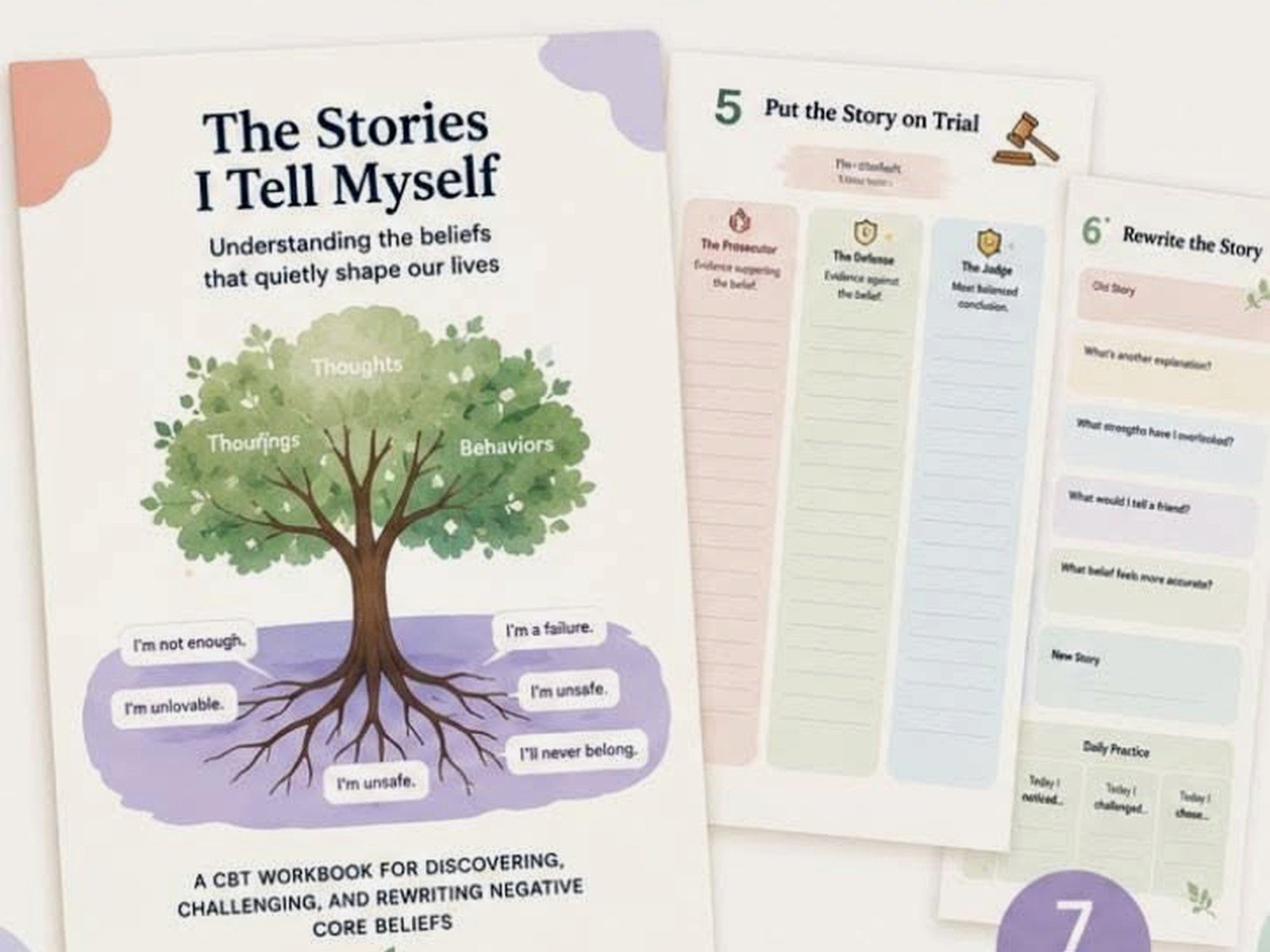
Good workbooks build progressively. Early chapters establish foundational concepts and simpler exercises. Later chapters assume you’ve internalized earlier material and layer in more complex interventions. This scaffolding matters because jumping to chapter 8 without doing the groundwork in chapters 1-4 usually doesn’t work well.
Some workbooks include assessment tools at the beginning and end so you can measure progress. These might be standardized scales like the PHQ-9 for depression or GAD-7 for anxiety, or proprietary assessments the author developed.
Who Actually Benefits From Using Them
People already in therapy often use workbooks as supplemental homework. Your therapist might assign specific chapters or exercises that align with what you’re working on in sessions. This reinforces concepts and gives you structured practice between appointments.
I’ve written probably hundreds of workbook reviews at this point, and the feedback I get most often is from people using them while on therapy waitlists. When you’re looking at a three-month wait for an intake appointment, a good workbook provides structure and active coping strategies instead of just… waiting and spiraling.
Some people use workbooks as a bridge between therapy episodes. Maybe you did six months of therapy, made progress, terminated, but want to maintain skills and continue working on stuff independently. A workbook gives you that framework without the weekly appointments.
Then there are people who use workbooks instead of therapy, either because of access issues, cost, stigma, or preference. This works better for some issues than others. Mild to moderate depression or anxiety? A solid CBT workbook can be genuinely helpful. Complex trauma or active suicidal ideation? Nah, you need actual professional support.
The Evidence Base Question
Bibliotherapy—the formal term for using books as therapeutic interventions—has decent research support for certain conditions. Studies show that structured self-help materials can reduce symptoms of depression and anxiety, especially when based on CBT principles.
The effect sizes are generally smaller than therapist-delivered treatment but better than no treatment at all. For mild to moderate symptoms, guided self-help (where you have minimal therapist contact to support workbook use) performs almost as well as regular therapy in some studies.
But here’s what bugs me: publishers slap “evidence-based” on basically any workbook that mentions CBT or DBT, even if that specific workbook has never been studied. The underlying therapy model might be evidence-based, but that doesn’t automatically mean this particular author’s interpretation and exercise selection is effective. It’s kinda like saying a recipe is “evidence-based” because cooking food generally makes it edible.
How to Actually Choose One
Start with your primary concern. Don’t buy a general anxiety workbook if you specifically struggle with health anxiety or social anxiety. The more targeted, usually the better. General workbooks try to cover everything and end up being superficial.
Check the author’s credentials. Are they actually a licensed mental health professional with relevant clinical experience? Or are they a life coach who took a weekend certification course? Both might write helpful books, but you want to know what expertise you’re working with.
Look at the publication date. Mental health treatment evolves. A workbook from 1995 might contain outdated or even harmful approaches. Anything published in the last 10 years is generally safer, though classic workbooks like “Mind Over Mood” from 1995 have been updated in newer editions.

Read sample pages if possible. Does the writing style work for you? Some workbooks are very clinical and formal. Others are conversational. Some use a lot of metaphors and creative exercises. Others are straightforward and practical. There’s no best style, just what matches your preference.
Check the exercise-to-text ratio. You want substantial worksheets and exercises, not just chapters of explanation with a few token prompts. Flip through and see how much space is dedicated to you actually doing work versus reading about concepts.
Common Mistakes People Make
Buying multiple workbooks at once and completing none of them. I see this constantly. Someone gets motivated, orders four different workbooks, gets overwhelmed, and they all sit on a shelf. Pick one, commit to actually working through it, then get another if needed.
Skipping the psychoeducation sections to jump straight to exercises. I get it, reading about the cognitive model feels boring when you just want tools to feel better now. But understanding why an intervention works helps you apply it correctly and generalize it to new situations.
Doing exercises mentally instead of writing them down. The physical act of writing engages different cognitive processes and creates a record you can review. Mental exercises feel easier but are generally less effective. Yeah, it’s tedious to actually fill out thought records, but that’s kinda the point.
Treating workbooks like regular books you read once and finish. Therapeutic workbooks are meant to be used repeatedly. You come back to exercises multiple times, track patterns over weeks or months, and revisit chapters as issues resurface.
Using trauma workbooks without adequate support. This one actually worries me because trauma-focused exercises can be destabilizing if you don’t have coping skills in place or professional backup. At minimum, make sure you’ve worked through foundational skills like grounding and emotional regulation before diving into trauma processing.
The Digital Versus Print Question
Print workbooks have obvious advantages. You can write directly in them, flip back and forth easily, and there’s no screen time involved. Many people find the physical act of handwriting more engaging and memorable than typing.
Digital workbooks—PDFs or app-based versions—offer portability and the ability to print multiple copies of exercises you want to repeat. Some people prefer typing over handwriting. You can also fill them out on a tablet with a stylus, which splits the difference.
Some workbooks now come with companion apps or online portals with additional resources, tracking tools, or video demonstrations. These hybrid approaches can be helpful, though they also create another thing you need to remember to access and use.
I personally prefer print for most workbooks because I’m already staring at screens all day for work, but I keep PDFs of certain exercises I use repeatedly so I can print fresh copies without buying another book.
What Makes a Workbook Actually Good
Clear explanations without unnecessary jargon. You shouldn’t need a psychology degree to understand what the workbook is asking you to do or why. But it also shouldn’t be so oversimplified that it’s condescending.
Varied exercise types that accommodate different learning styles and preferences. Some people respond well to writing prompts, others to visual exercises, others to behavioral experiments. Good workbooks mix it up.
Realistic examples that reflect actual human complexity. I get so annoyed at workbooks that use absurdly simple examples like “I thought my friend was mad at me but then I asked and she wasn’t, so I learned not to assume.” Real cognitive distortions and behavioral patterns are messier and more entrenched than that.
Adequate space for responses. Nothing worse than a workbook that gives you three lines to process a complex emotional experience. If you’re asking someone to explore their trauma history or deepest fears, give them actual room to write.
Troubleshooting sections that address common obstacles. What if this exercise brings up intense emotions? What if you can’t identify any alternative thoughts? What if the behavioral experiment goes badly? Good workbooks anticipate these issues.
Specific Workbooks Worth Knowing About
The Anxiety and Phobia Workbook by Edmund Bourne is comprehensive and has been around forever. It covers pretty much every anxiety disorder and includes relaxation techniques, cognitive restructuring, exposure protocols, and medication information.
The Dialectical Behavior Therapy Skills Workbook by McKay, Wood, and Brantley is the go-to for DBT skills outside of formal DBT programs. It’s structured, thorough, and includes all four skill modules.
Mind Over Mood by Greenberger and Padesky is a CBT classic that’s been updated. It’s very structured and methodical, which some people love and others find too rigid.
The Complex PTSD Workbook by Arielle Schwartz is one of the better trauma workbooks for self-guided use because it emphasizes stabilization and resource-building before any trauma processing.
Get Out of Your Mind and Into Your Life by Steven Hayes is the foundational ACT workbook. Fair warning, it gets pretty philosophical and uses a lot of metaphors, which isn’t everyone’s style.
Summer 2022 I was writing like three worksheet roundups a week and I started actually using them myself, partly for authenticity in reviews but also because I realized I was giving advice about tools I’d never personally tried, which felt weird.
When Workbooks Aren’t Enough
If you’re working through a workbook and symptoms are getting worse instead of better, that’s a sign you need professional help. Same if you’re having suicidal thoughts, engaging in self-harm, or experiencing symptoms that interfere with basic functioning like getting to work or maintaining hygiene.
Some issues really do require the relational component of therapy. Attachment wounds, complex relationship patterns, personality disorders—these benefit from the dynamic of working with another person who can provide feedback, rupture and repair, and attunement. A workbook can’t do that.
If you find yourself unable to complete exercises because they’re too activating or you’re avoiding the workbook entirely, that’s information. Maybe you need a different workbook, or maybe you need therapist support to work through whatever’s blocking you.
ADHD & Neurodiversity
Life Planner Bundle – Life Organizer
Self-Care & Personal Growth
Acceptance And Commitment
Anxiety & Stress
Stress Processing Journal & Reflection Worksheets For Daily Self – Care
Self-Care & Personal Growth
Self – Reflection Guided Journal With Guided Prompts 30
Emotional Wellness
Decision Processing – Thought Processing Journal For Daily Self – Care
Therapist Resources
Physiotherapist Journal PDF Planner Tracker Or Log Book
Self-Care & Personal Growth
Customizable Self – Confidence & Self – Esteem Guided Journal
ADHD & Neurodiversity
ADHD Behavior Tracker PDF Planner Tracker Or Log Book