
Mental Health, Therapy resources
Therapy Practices – Everything You Need to Know

Jul
What Actually Counts as a Therapy Practice
Therapy practices are the structured methods, techniques, and frameworks therapists use during sessions. They’re not just “talking it out” — they’re evidence-based approaches with specific goals, protocols, and expected outcomes. Different practices work for different problems, and honestly, I got kinda annoyed when people started calling every breathing exercise or journaling prompt a “therapy practice.” That’s not how this works.
When I was writing content for three different mental health platforms back in 2019, I kept seeing the same confusion: people thought therapy was one thing, one approach. But therapy practices are incredibly varied. Some focus on changing thoughts, others on changing behaviors, some dig into your past, and others just want you to notice what’s happening right now without judgment.
Cognitive Behavioral Therapy (CBT)
CBT is probably the most researched therapy practice out there. It works on the idea that your thoughts, feelings, and behaviors are all connected, and if you change one, you can change the others. The therapist helps you identify automatic negative thoughts — those quick judgments your brain makes without you even noticing — and then test whether they’re actually true.
I remember when a client kept confusing CBT and DBT and I had to just draw the triangle on a napkin. Thoughts at the top, feelings on one corner, behaviors on the other. Change one point, the whole triangle shifts. That’s CBT in a nutshell.
You’ll typically get homework in CBT. Thought records, behavioral experiments, exposure tasks if you’re working on anxiety. The therapist isn’t just listening — they’re actively teaching you skills. Sessions are structured, usually around 12-20 weeks, and there’s a clear agenda each time.
CBT works well for depression, anxiety disorders, OCD, PTSD, eating disorders, and insomnia. It’s goal-oriented and practical, which some people love and others find too rigid.
Dialectical Behavior Therapy (DBT)
DBT started as a treatment for borderline personality disorder but now it’s used for anyone who struggles with intense emotions and impulsive behaviors. It’s actually based on CBT but adds in mindfulness, distress tolerance, emotion regulation, and interpersonal effectiveness skills.
The structure is different too. You usually have individual therapy once a week, a skills group once a week, and phone coaching when you’re in crisis. It’s a bigger commitment than most therapy practices, and it can last a year or more.
What I like about DBT is the dialectical part — holding two opposite truths at once. You can accept yourself as you are AND work toward change. You can validate someone’s feelings AND set boundaries. It’s not either/or thinking, which honestly feels more realistic than… wait, I was gonna say something else but my cat just knocked over my coffee and I lost my train of thought.
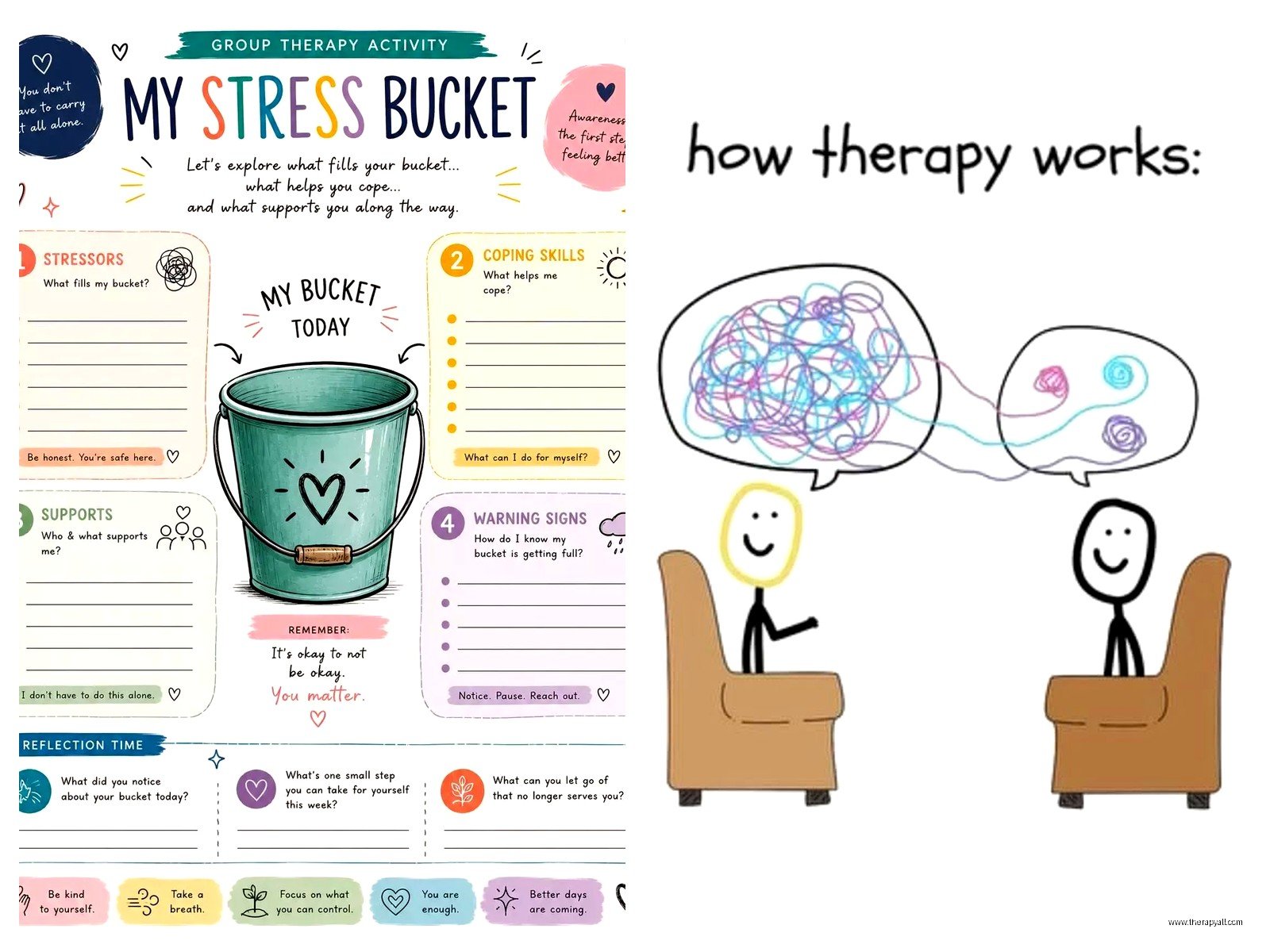
DBT teaches specific skills with actual names: TIPP, PLEASE, DEAR MAN, GIVE, FAST. They sound kinda silly but they’re acronyms to help you remember what to do when you’re overwhelmed. Distress tolerance skills are about surviving a crisis without making it worse. Emotion regulation is about understanding and changing emotional responses. Interpersonal effectiveness is basically assertiveness training.
Psychodynamic Therapy
This is the therapy practice most people picture when they think “therapy” — lying on a couch, talking about your childhood, exploring unconscious patterns. It comes from psychoanalysis but it’s less intense and shorter than traditional Freudian analysis.
Psychodynamic therapy assumes that your current problems are connected to unresolved conflicts from your past, especially early relationships. The therapist helps you see patterns in how you relate to others, how you defend against uncomfortable feelings, and how past experiences shape your present behavior.
Sessions are less structured than CBT. You might start wherever you want. The therapist pays attention to themes, defenses, transference (when you project feelings about someone else onto the therapist), and resistance (when you avoid certain topics).
I’ll be honest, psychodynamic therapy can feel frustrating if you want concrete tools and quick solutions. It’s more exploratory and insight-oriented. But for people who keep repeating the same relationship patterns or feel stuck in ways they don’t understand, it can be really helpful. It usually lasts longer than CBT, sometimes years.
Acceptance and Commitment Therapy (ACT)
ACT is about accepting what’s out of your control and committing to actions that align with your values. It’s not about feeling better — it’s about living better even when you feel bad. Which sounds harsh but it’s actually pretty liberating.
The core idea is psychological flexibility: being present, accepting your thoughts and feelings without fighting them, and choosing behaviors based on what matters to you rather than what feels comfortable. ACT uses a lot of metaphors and experiential exercises. You might do mindfulness practices, values clarification work, or defusion techniques to create distance from unhelpful thoughts.
One thing that annoyed me when I was writing ACT explainers is that people kept describing it as “just acceptance” or “giving up.” Nah. It’s the opposite. You accept the internal stuff you can’t control (anxiety, intrusive thoughts, grief) so you can focus your energy on external actions that actually move your life forward.
ACT works well for chronic pain, anxiety, depression, and situations where suffering is unavoidable — like grief or serious illness. It’s less about symptom reduction and more about living meaningfully despite symptoms.
Exposure and Response Prevention (ERP)
ERP is the gold standard treatment for OCD and it’s exactly what it sounds like. You expose yourself to the thing that triggers your obsession and then prevent yourself from doing the compulsion. Repeatedly. Until your anxiety goes down on its own.
It’s uncomfortable. That’s the point. If you have contamination OCD, you might touch a doorknob and not wash your hands. If you have harm OCD, you might hold a knife and not do your mental checking ritual. The exposure needs to be anxiety-provoking enough to matter but not so overwhelming that you can’t tolerate it.
ERP is usually done gradually with a hierarchy. You start with easier exposures and work up to harder ones. The therapist might do the exposure with you at first, then you practice on your own. You track your anxiety levels and learn that they peak and then come down naturally without the compulsion.

I’ve seen ERP work for people who’d been stuck in OCD cycles for decades. But it requires a therapist who really knows what they’re doing, because badly done exposure can make things worse or just retraumatize someone.
Eye Movement Desensitization and Reprocessing (EMDR)
EMDR is primarily used for trauma and PTSD. You focus on a traumatic memory while doing bilateral stimulation — usually following the therapist’s fingers with your eyes back and forth, or holding buzzers that alternate vibrating in each hand.
The theory is that trauma memories get stuck in your brain in an unprocessed state, and the bilateral stimulation helps your brain reprocess them so they’re less distressing. It sounds weird, and honestly the research on why it works is still evolving, but the research on whether it works is pretty solid.
EMDR has eight phases: history taking, preparation, assessment, desensitization, installation, body scan, closure, and reevaluation. The actual eye movement part is just one phase. A lot of the work is in targeting the right memories, identifying negative beliefs, and building resources before you even start processing trauma.
You don’t have to talk through the trauma in detail, which is different from exposure therapy for PTSD. Some people find that easier. Sessions can be intense though, and you need a therapist trained specifically in EMDR.
Motivational Interviewing (MI)
MI is less a standalone therapy and more a communication style that therapists use to help people resolve ambivalence about change. It’s used a lot in addiction treatment but also for any situation where someone knows they should change something but feels stuck.
The therapist doesn’t tell you what to do. Instead, they ask questions that help you explore your own motivations, values, and reasons for change. They roll with resistance instead of confronting it. They highlight discrepancies between your current behavior and your goals.
MI uses specific techniques: open-ended questions, affirmations, reflections, and summaries (OARS). The therapist listens for “change talk” — statements you make about wanting, needing, or planning to change — and reinforces it.
What’s interesting about MI is that it works by activating your own motivation rather than imposing external pressure. When I was writing about it in summer 2021, I kept thinking about how it’s basically the opposite of how most people try to help someone change, which is by telling them all the reasons they should.
Narrative Therapy
Narrative therapy treats you as the expert on your own life. The problem is the problem, not you. The therapist helps you “externalize” issues — so instead of “I am depressed,” it’s “depression is affecting my life.” This creates distance and makes the problem feel more manageable.
You explore the stories you tell about yourself and your life, identify dominant narratives that might be limiting you, and develop alternative stories that are more empowering. The therapist asks questions that highlight times when you resisted the problem or acted in ways that don’t fit the dominant story.
It’s less structured than CBT or DBT. Sessions follow wherever the conversation goes. The therapist might take notes and read them back to you, or write letters between sessions. Some people find it validating and empowering, others find it too abstract or slow-moving.
Solution-Focused Brief Therapy (SFBT)
SFBT focuses on solutions instead of problems. The therapist asks about times when the problem wasn’t happening or was less severe, what was different then, and how you can do more of that. They ask the “miracle question” — if you woke up tomorrow and your problem was solved, what would be different? How would you know?
Sessions are brief, usually 6-8, and very goal-oriented. You’re not exploring your past or your feelings in depth. You’re identifying what’s already working and building on it. You set small, concrete goals and track progress.
SFBT can feel superficial if you’re dealing with complex trauma or deep-rooted issues, but for specific, concrete problems — relationship conflicts, work stress, mild depression — it can be efficient and effective. It’s popular in settings where time is limited, like school counseling or employee assistance programs.
How Therapy Practices Actually Get Chosen
Therapists don’t just pick their favorite approach and use it for everyone. Well, some do, and that’s a problem. But ideally, the practice should match the problem and the person.
Some practices have strong evidence for specific disorders. CBT and exposure therapy for anxiety disorders. DBT for borderline personality disorder. EMDR for PTSD. Psychodynamic therapy for personality issues and relationship patterns. If you have one of these conditions, starting with the evidence-based practice makes sense.
But research shows that the therapeutic relationship matters more than the specific technique for a lot of issues. If you don’t trust your therapist or feel understood, the practice won’t work as well. So fit matters.
You should also consider your preferences. Do you want homework and structure, or open-ended exploration? Do you want to focus on the present and future, or understand your past? Do you want to reduce symptoms quickly, or make deeper changes over time? These aren’t right or wrong answers — they’re about what works for you.
What Happens in Actual Sessions
First sessions are usually assessment. The therapist asks about your symptoms, history, relationships, what brought you in, what you’ve tried before. They’re figuring out what’s going on and what approach might help. You should ask questions too — about their training, their approach, how they work.
In ongoing sessions, it depends on the practice. CBT sessions might start with a mood check, review homework, work on a specific skill, assign new homework. DBT sessions might review your diary card, troubleshoot a situation where you used or didn’t use a skill, practice a new skill. Psychodynamic sessions might start with “what’s on your mind?” and go from there.
Most therapy practices involve some talking, obviously, but also some doing. Role-plays, mindfulness exercises, writing, exposure tasks. You’re not just describing your problems — you’re actively working on them.
Sessions are usually 45-50 minutes, once a week, though some practices use different formats. DBT has the group and phone coaching. Some trauma therapists do longer sessions. Some brief therapies meet every other week.
Integrative and Eclectic Approaches
A lot of therapists don’t stick to one practice. They integrate techniques from multiple approaches or use different practices for different issues. This can be effective if the therapist knows what they’re doing and has a clear rationale. It can be confusing if they’re just throwing random techniques at you.
Some therapists call themselves “eclectic” which basically means they pull from whatever seems useful. Others use an integrative model that combines specific practices in a structured way — like CBT with mindfulness, or psychodynamic therapy with emotion-focused techniques.
If your therapist uses an integrative approach, ask them to explain their framework. What practices are they drawing from? Why? How do they decide what to use when? You should understand the plan, not just go along with whatever happens.
When a Therapy Practice Isn’t Working
Sometimes a practice doesn’t fit. Maybe CBT feels too surface-level for you, or psychodynamic therapy feels too slow, or DBT skills feel patronizing. That doesn’t mean therapy doesn’t work — it means that practice doesn’t work for you right now.
You should feel some progress within 8-12 sessions for most practices. Not necessarily “cured” but some shift — understanding yourself better, using new skills, feeling slightly less stuck. If nothing’s changing, talk to your therapist about it. Maybe the approach needs adjusting, or maybe you need a different practice altogether.
Sometimes the practice is fine but the therapist isn’t implementing it well. Not every CBT therapist is good at CBT. Not every trauma therapist should be doing EMDR. Training and experience matter. You can ask about their specific training in the practice they’re using.
And sometimes you just need a different therapist. The practice might be right but the person isn’t a good fit. That’s okay. Therapy is personal, and finding the right match matters more than sticking it out with someone who isn’t helping.
ADHD & Neurodiversity
Life Planner Bundle – Life Organizer
Self-Care & Personal Growth
Acceptance And Commitment
Anxiety & Stress
Stress Processing Journal & Reflection Worksheets For Daily Self – Care
Self-Care & Personal Growth
Self – Reflection Guided Journal With Guided Prompts 30
Emotional Wellness
Decision Processing – Thought Processing Journal For Daily Self – Care
Therapist Resources
Physiotherapist Journal PDF Planner Tracker Or Log Book
Self-Care & Personal Growth
Customizable Self – Confidence & Self – Esteem Guided Journal
ADHD & Neurodiversity
ADHD Behavior Tracker PDF Planner Tracker Or Log Book