# Therapy Sheets – Everything You Need to Know
Therapy sheets are structured worksheets, handouts, or printable tools designed to guide mental health work between sessions or during self-directed practice. They range from thought records and mood trackers to communication scripts and psychoeducation summaries. Most therapists use them, most clients encounter them, and most people searching for mental health resources online stumble into them at some point.
## What Therapy Sheets Actually Are
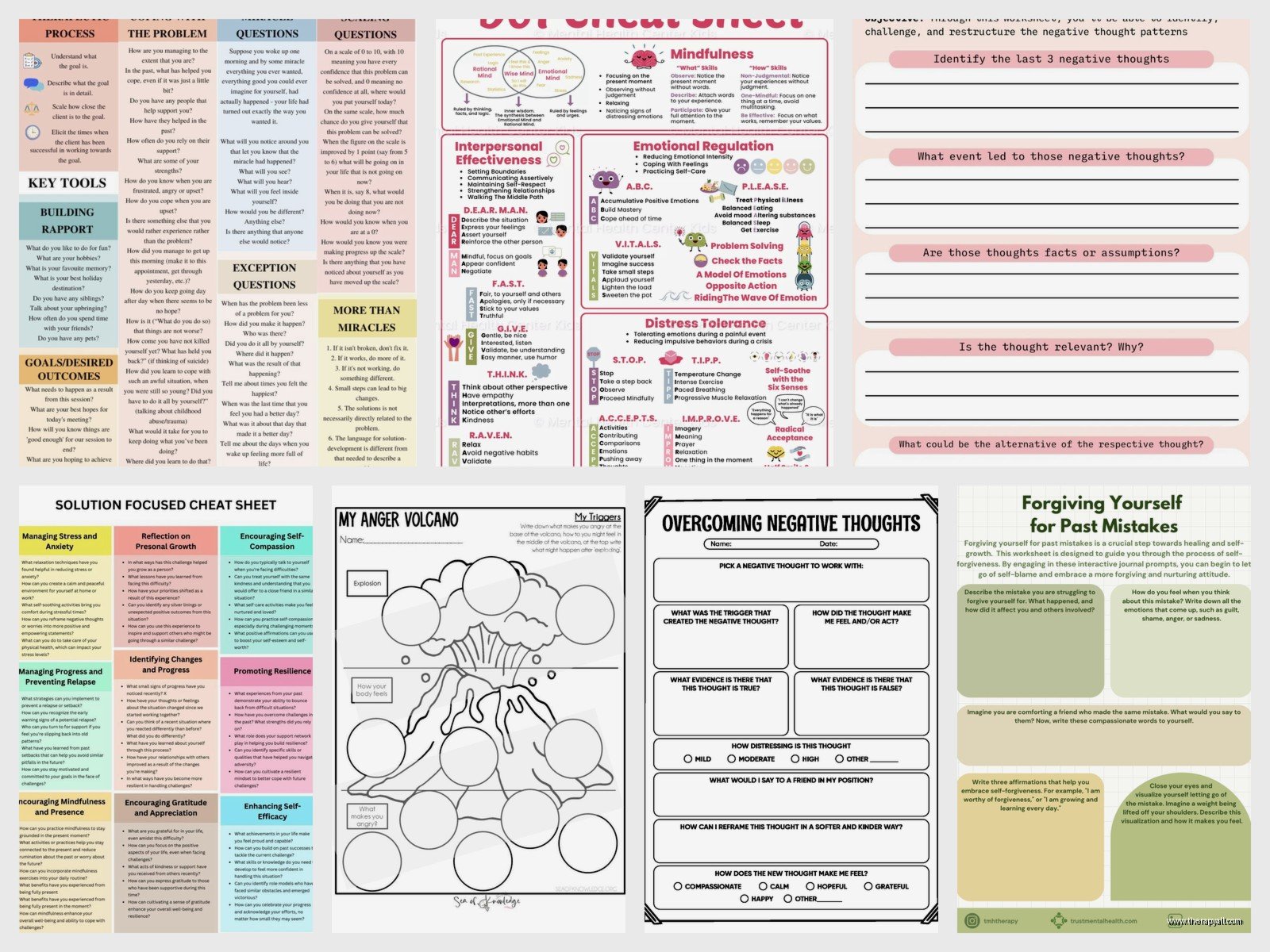
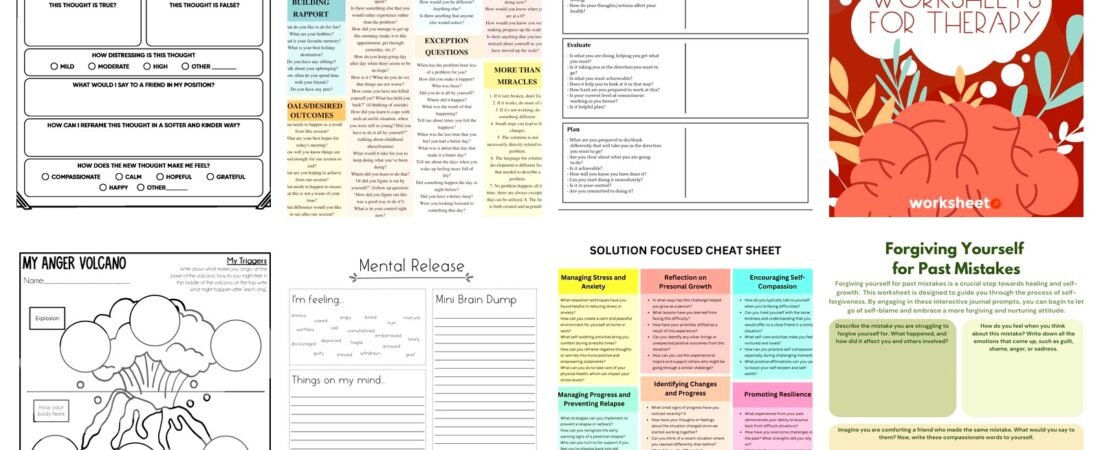
A therapy sheet is any paper or digital document that structures psychological work. That’s the broad definition. You’ve got cognitive behavioral therapy worksheets that walk you through identifying automatic thoughts. You’ve got dialectical behavior therapy handouts explaining distress tolerance skills. There are grief journals, anger logs, gratitude lists, exposure hierarchies, values clarification exercises, and about seventeen different versions of the same anxiety rating scale.
The format matters less than the function. Some are fill-in-the-blank. Some are checklists. Some are flowcharts or diagrams. I remember summer 2019 I was compiling a resource list for a clinic and I must’ve reviewed like two hundred different therapy sheets in a single week—my brain basically turned into a filing cabinet of prompts and rating scales.
They’re not the same as therapy itself, obviously. A worksheet can’t replace a trained professional who adapts interventions in real time. But they do extend therapeutic concepts into daily life, which is kinda the point of homework in most evidence-based treatments.
## Common Types You’ll Encounter
**Thought records** are probably the most recognizable CBT tool. You write down a situation, the automatic thought that popped up, the emotions and physical sensations you felt, then challenge the thought with evidence and generate a more balanced alternative. The classic version has like five or six columns. Some people love them. Some people find them tedious and never fill them out honestly.
**Mood trackers** ask you to rate your emotional state daily or multiple times per day. They help spot patterns—maybe your mood tanks every Sunday evening, or spikes right after you talk to your mother. You can track one emotion or several. Some include space for activities, sleep, medication, or triggers.
**Behavioral activation sheets** list activities and ask you to schedule them, then rate how much pleasure or accomplishment each one gave you. This is a depression intervention that counteracts the urge to withdraw and do nothing. You plan small achievable tasks and notice whether doing them shifts your mood even slightly.
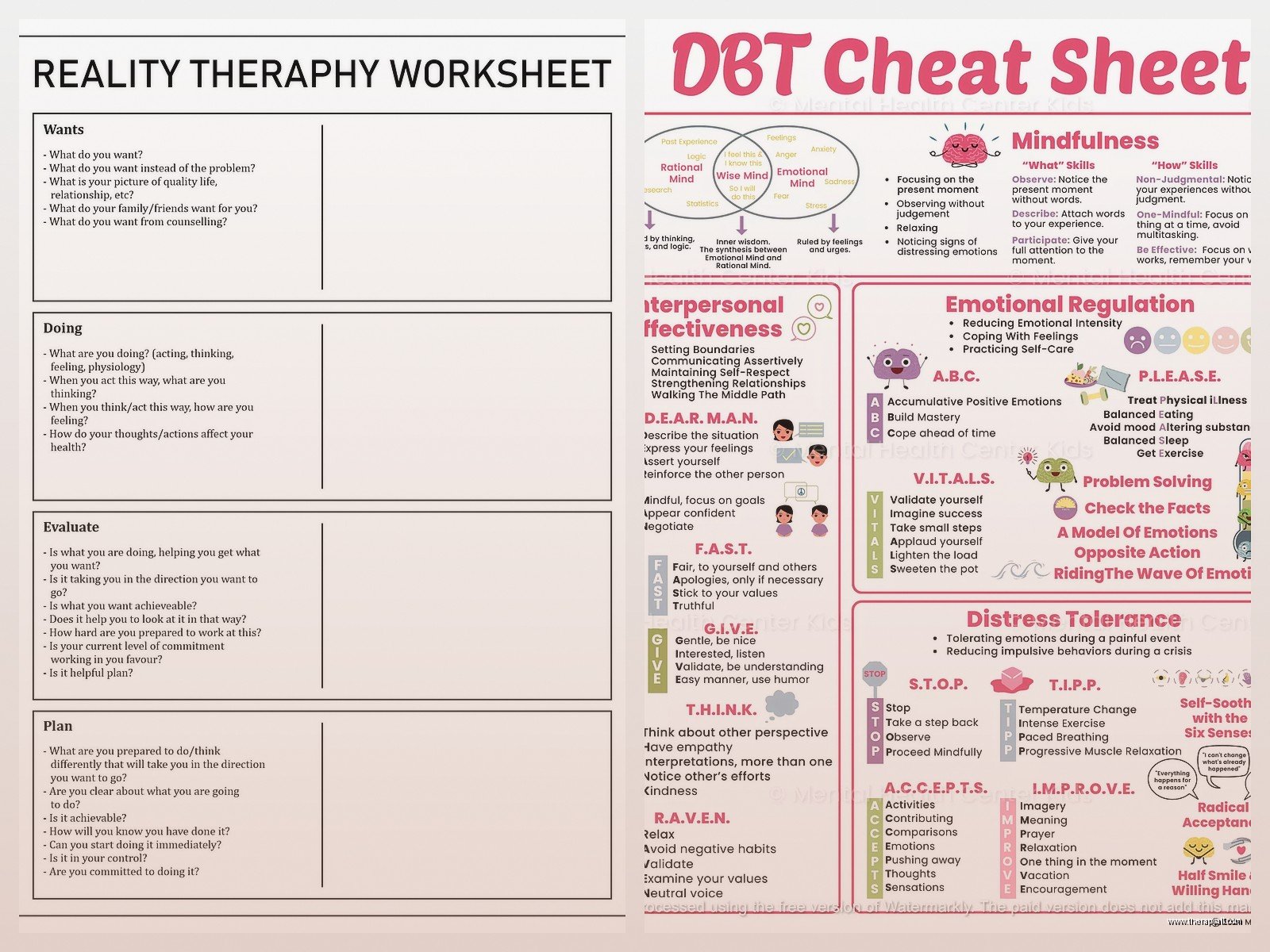
**Skills practice logs** are big in DBT. You write down which skill you used (maybe TIPP or STOP or Opposite Action), what the situation was, and how effective it felt. It’s accountability and also data collection so you and your therapist can see what’s actually working.
**Exposure hierarchies** list feared situations ranked from least to most anxiety-provoking. You work through them gradually. If you’re afraid of dogs, maybe the hierarchy starts with looking at dog photos and ends with petting an unfamiliar dog at a park.
**Communication worksheets** help you draft difficult conversations. Some use the DEAR MAN framework from DBT. Some just give you sentence starters like “I feel ___ when you ___ because ___.” They’re scaffolding for people who freeze up or get aggressive when emotions run high.
**Psychoeducation handouts** explain concepts. What is cognitive distortion? What’s the window of tolerance? How does trauma affect the nervous system? These aren’t interactive—they’re just information broken down into digestible chunks, often with diagrams.
## Where They Come From
Most therapy sheets originate from specific therapeutic modalities. CBT has the thought record. DBT has the diary card and skills handouts. Acceptance and Commitment Therapy has values worksheets and defusion exercises. Psychodynamic work uses them less, but even there you might get genograms or defense mechanism charts.
Therapists create custom sheets all the time. I’ve made my own versions when the standard ones didn’t fit a client’s needs—simpler language, different examples, more space to write, less space to write. Some practitioners sell their custom worksheets online. Some share them freely in professional forums.
Publishers also produce therapy workbooks, which are basically collections of sheets organized around a theme—anxiety, addiction, couples communication, whatever. The Guilford Press and New Harbinger are big names here. Then there are websites like Therapist Aid, Psychology Tools, and Worksheet Library that offer free and paid downloads.
## How They’re Supposed to Work
The idea is that you engage with the sheet outside of session. Your therapist introduces a concept during your appointment, then gives you a worksheet to practice that concept during the week. You bring it back next session and discuss what you noticed.
In self-directed work, you might download a sheet and use it on your own, no therapist involved. This happens a lot with people who can’t access therapy due to cost or availability, or who are supplementing their sessions with extra practice.
The sheet provides structure when your brain is too flooded or foggy to organize thoughts independently. It’s an external scaffold. Instead of trying to “just think differently” in some vague way, you have a step-by-step process. Write the thought. Rate the belief. List the evidence. That sort of thing.
## What Actually Happens in Practice
Compliance is hit or miss. Some clients fill out every worksheet religiously. Some never touch them. Some start strong and then life gets busy or the novelty wears off. There’s no moral judgment here—it’s just reality. Therapy homework completion rates are not great across the board, and that’s been studied pretty extensively.
You might sit down to fill out a thought record and realize you can’t remember what you were thinking three hours ago when the triggering event happened. Or the emotions are too big and the worksheet feels trivial, like trying to capture a hurricane in a Dixie cup. Or you do fill it out but you’re not really buying into the alternative thought you generated—you wrote what you think your therapist wants to see.
Sometimes the format itself is the barrier. If you hate writing by hand, a paper worksheet is gonna sit in your bag untouched. If you lose papers constantly, same problem. Digital versions help some people, but then you need to remember to open the file.
What genuinely annoys me is when therapy content creators act like worksheets are these magical cure-alls. “Just download this free anxiety worksheet and transform your life!” Nah. A worksheet is a tool, and tools only work if you use them correctly, consistently, and in the right context. They’re not pixie dust.
## Customization and Accessibility
Not everyone can engage with standard therapy sheets. Someone with a traumatic brain injury might need simpler language and shorter tasks. Someone with dyslexia might need specific fonts or audio versions. Non-native English speakers might need translations that aren’t just Google Translate copypasta but actually culturally adapted.
Kids need different sheets than adults. A seven-year-old isn’t gonna sit down with a six-column thought record. They might use a feelings faces chart or a worry monster drawing activity.
Cultural context matters too. Western therapy worksheets often emphasize individual autonomy and direct emotional expression. Those values don’t translate everywhere. A collectivist framework might require different prompts, different examples, different goals.
I’ve had to explain to more than one person that if a worksheet feels completely alien to your experience, that’s not necessarily resistance—it might just be a bad fit. You’re allowed to modify them or ignore them entirely and find something else that works.
## Digital vs. Paper
There are apps now that basically function as interactive therapy sheets. Mood tracking apps, CBT apps, journaling apps with prompts. Some people love the convenience and the data visualization features—graphs showing your mood trends over time, that kind of thing. Some people find them impersonal or annoying with their notification reminders.
Paper has advantages. You can spread it out on a table, doodle in the margins, physically cross things out. There’s no screen glare, no battery anxiety, no privacy concerns about data storage. Some people just think better with a pen in hand.
The best format is whichever one you’ll actually use. That sounds like a cop-out answer, but it’s true. I’ve seen people swear by bullet journals with hand-drawn trackers and other people who need the ping of a phone reminder or they forget mental health exists between sessions.
## Common Mistakes and Misconceptions
People sometimes treat therapy sheets like school assignments—something to complete for a gold star rather than a genuine exploration. They rush through, write the “right” answers, don’t sit with the discomfort that real self-examination brings. The worksheet becomes performative.
Another mistake is using them in crisis moments when you actually need immediate support, not a five-step cognitive restructuring process. If you’re in acute distress, a thought record probably isn’t the move. You need grounding techniques, crisis resources, or a person to talk to.
There’s also this thing where people collect therapy sheets like Pokémon cards. They download seventeen different anxiety worksheets and never use any of them. The collection itself feels productive, but it’s actually avoidance. I did this myself for a while—thought if I just had the *perfect* worksheet everything would click. Spoiler: it doesn’t work that way.
Oh, and one time my cat knocked over my coffee directly onto a stack of client worksheets I was reviewing and I had to email three people apologizing that their homework had mysterious brown stains on it. Not relevant to this topic but it was mortifying.
## When Therapy Sheets Are Most Useful
They shine when you’re learning a new skill and need repetition to make it stick. Like any skill—you don’t learn to play piano by thinking about it abstractly, you practice scales. Therapy sheets are scales for psychological skills.
They’re helpful for tracking patterns over time. Your memory is unreliable, especially when you’re depressed or anxious. A written record shows you data. “I thought I felt terrible all month, but actually I had five pretty okay days.”
They work well for people who process by writing or who need external structure. If your thoughts spiral without a container, a worksheet provides that container.
They’re useful in couples or family therapy when everyone needs to complete the same exercise separately and then compare responses. It creates a jumping-off point for discussion that’s less reactive than just talking in the moment.
## Limitations You Should Know About
Therapy sheets can’t account for the therapeutic relationship, which is arguably the most important factor in treatment outcomes. A worksheet doesn’t attune to you, doesn’t adjust based on your responses, doesn’t provide validation or challenge you at the right moments.
They assume a certain level of insight and literacy. Not everyone can identify their thoughts and feelings with the precision these tools require. That’s not a failure—it’s a developmental or neurological reality for some people.
Some psychological work isn’t suited to worksheets at all. Deep trauma processing, relational patterns, existential exploration—these things need dialogue, safety, and a skilled guide. You can’t worksheet your way through complex PTSD, though some symptoms might be manageable with structured tools.
There’s also the risk of intellectualizing. You can fill out worksheets perfectly, understand all the concepts, ace the homework, and still not feel any different because the work is happening entirely in your head and not connecting to your lived emotional experience. This is actually more common than you’d think, especially with people who are really smart and used to thinking their way through problems.
## Finding Quality Resources
Therapist Aid and Psychology Tools both have large libraries. They’re well-designed, evidence-based, and organized by disorder or modality. Some content is free, some requires a subscription.
If you’re working with a therapist, they might have recommendations or provide sheets directly. That’s usually the best route because they can tailor it to your specific situation.
Books like *Mind Over Mood* or *The Dialectical Behavior Therapy Skills Workbook* are essentially collections of therapy sheets with explanations. They walk you through concepts step by step.
Be wary of random Pinterest pins or Instagram infographics that claim to be therapy worksheets. Some are fine, but quality control is nonexistent. You might get something that misrepresents a therapeutic concept or oversimplifies to the point of uselessness.
## Integration with Actual Therapy
When therapy sheets work best, they’re integrated into a broader treatment plan. Your therapist explains the rationale, models how to use the sheet, reviews your completed work with you, and adjusts based on what you’re experiencing.
They’re not busy work. They’re not a substitute for your therapist doing their job. They’re an extension of the work you’re doing together, a way to practice between sessions so that the one hour per week isn’t the only time you’re engaging with these concepts and— wait, I wanted to mention that some therapists assign way too many worksheets and it becomes overwhelming, like you need a personal assistant just to manage your therapy homework, which defeats the purpose entirely.
You should feel free to tell your therapist if a worksheet isn’t working for you. A good therapist will problem-solve with you—maybe a different format, maybe a different exercise entirely, maybe just talking through the concepts instead.
## The Self-Help Context
Lots of people use therapy sheets without being in therapy. The self-help market is huge, and worksheets are a big part of it. This can be genuinely helpful for people with mild to moderate symptoms or people who are generally doing okay but want tools for specific situations.
The risk is that people use worksheets as a way to avoid getting professional help when they actually need it. If you’ve been downloading anxiety worksheets for two years and your anxiety is getting worse, that’s a sign that self-help isn’t sufficient.
There’s also the issue of misusing techniques. Without guidance, you might apply a worksheet incorrectly or use it for something it’s not designed for. Like using an exposure hierarchy for trauma when you actually need a trauma-informed approach that includes stabilization first.
But for some people, worksheets are a genuinely useful bridge. Maybe you’re on a waitlist for therapy. Maybe you’re in therapy but want extra practice. Maybe you’re in a maintenance phase and you just need occasional tune-ups. In those contexts, self-directed worksheet use makes sense.
## Specific Populations
Kids, as I mentioned, need developmentally appropriate versions. There are therapy sheets designed for teens that use language and examples relevant to their lives—school stress, peer pressure, identity stuff.
Older adults might need larger print, simpler navigation if it’s digital, or modifications for cognitive changes.
People with serious mental illness might need shorter worksheets that don’t demand too much executive function. Someone in a manic episode isn’t gonna sit down for a 45-minute journaling exercise.
Neurodivergent folks often need modifications. Autistic people might need very literal language and clear instructions. People with ADHD might need shorter formats or built-in breaks.
## Practical Tips for Using Them
Set a specific time. Don’t just tell yourself you’ll fill out the worksheet “sometime this week.” Pick Tuesday at 7 PM or whatever actually works for your schedule.
Keep them accessible. If they’re buried in a folder on your computer or at the bottom of your bag, you won’t use them. Put them somewhere visible.
Start small. Don’t commit to filling out three different worksheets every day. Pick one, do it consistently, add more if it’s actually helping.
Be honest. There’s no point in writing what you think you’re supposed to feel or think. The worksheet is for you, not for judgment.
Review what you write. Don’t just complete it and forget about it. Look back at previous entries. Notice patterns. That’s where the insight actually happens.
If a worksheet consistently feels unhelpful or triggering, stop using it. You’re not failing therapy by admitting a tool doesn’t work for you.