
Mental Health, Therapy resources
Therapy Toolkit – Everything You Need to Know

Jul
A therapy toolkit isn’t some mystical collection of healing crystals and affirmation cards, though I’ve seen people try to sell it that way online and it drives me absolutely crazy. It’s the actual, practical set of techniques, worksheets, exercises, and mental frameworks that therapists use with clients or that you can use on your own to manage mental health symptoms, build coping skills, and work through emotional challenges.
I remember back in 2019, I was working with this client who kept a literal binder of every worksheet we’d ever used together. She’d color-code them by mood and technique type, which honestly was more organized than my own filing system at the time. But what struck me was that she said having everything in one place made her feel like she had “proof” that she could handle hard moments, because she could flip through and see what worked before.
What Actually Goes in a Therapy Toolkit
The contents vary wildly depending on what therapeutic approach you’re working with, what symptoms you’re managing, and frankly what resonates with you as a person. Some people need structured worksheets. Others do better with apps or voice memos or—and I had one client who did this—elaborate spreadsheets tracking mood patterns.
Physical tools might include journals, mood trackers, grounding object collections (smooth stones, stress balls, fidget toys), printed worksheets from therapy sessions, and resource lists. You might have emergency contact cards, crisis hotline numbers, or a list of your own warning signs that you’re heading into a rough patch.
Digital tools have exploded in the last few years. There are apps for everything now: CBT thought records, DBT diary cards, meditation timers, mood tracking with data visualization, even apps that remind you to use your skills when your typing patterns suggest you’re stressed. Some of this is genuinely helpful, some of it is… well, it’s kinda like having seventeen different to-do list apps when you still don’t do the laundry.
Cognitive Behavioral Therapy (CBT) Tools
CBT tools focus on the relationship between thoughts, feelings, and behaviors. The thought record is probably the most common tool here—you write down a situation, identify the automatic thought that popped up, notice what emotions and physical sensations came with it, examine the evidence for and against that thought, and come up with a more balanced perspective.
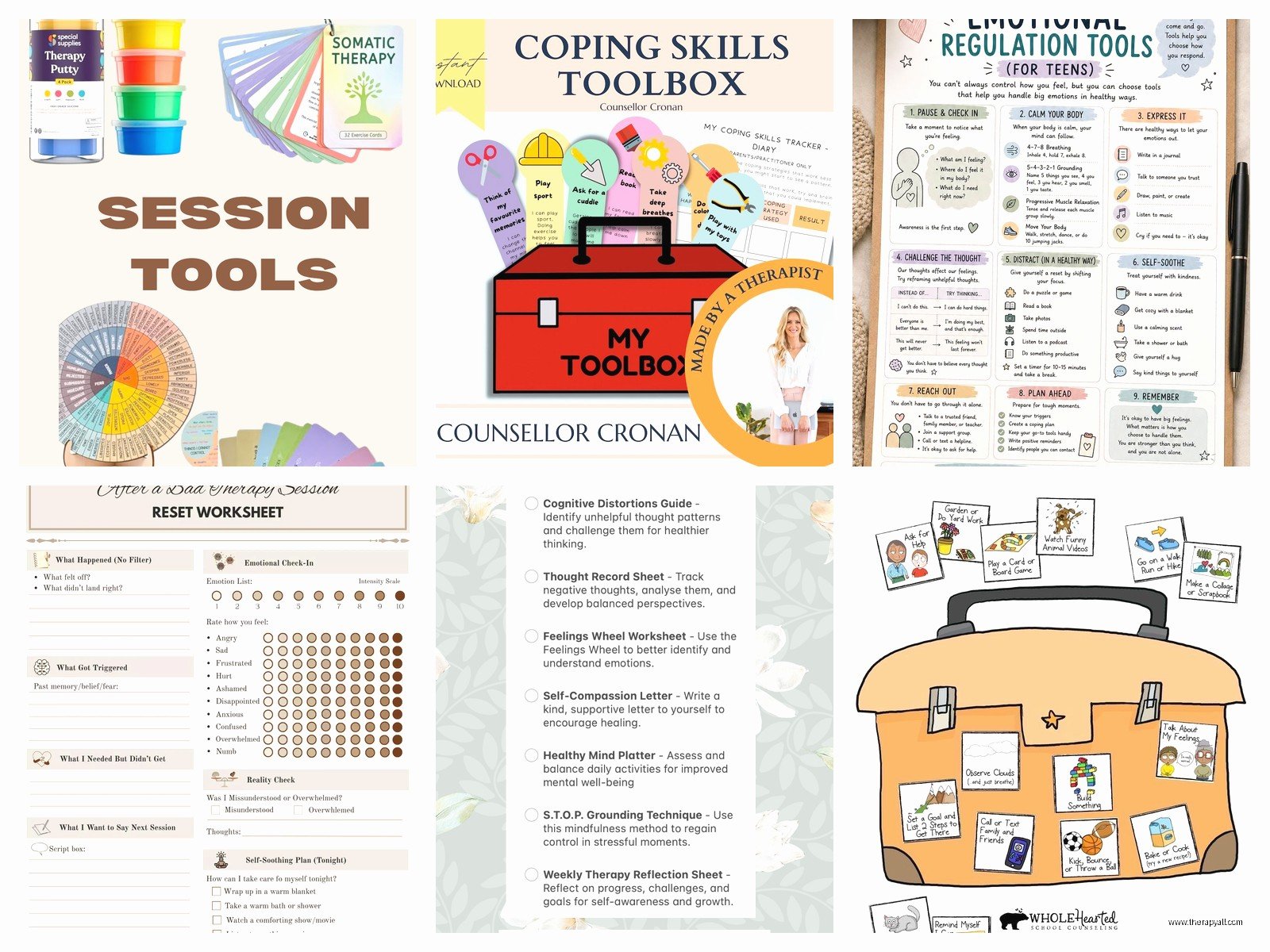
I’ve filled out hundreds of these, both with clients and honestly for myself during particularly anxious periods. Summer 2022 I was writing like three worksheet roundups a week and I started actually using them myself, which felt weirdly meta but was also useful because I could say “yeah, this one’s annoying to fill out” with authority.
Behavioral activation schedules are another CBT staple. You track activities and rate them for pleasure and mastery, which sounds simple but can be revelatory when you realize you’re spending zero time on things that actually make you feel competent or happy. The goal is to intentionally schedule more of those activities, even when—especially when—depression is telling you nothing matters.
Exposure hierarchies help with anxiety disorders. You list feared situations from least to most scary, then gradually work your way up the ladder. Cognitive restructuring worksheets help you identify thinking errors like catastrophizing, mind reading, or all-or-nothing thinking.
Dialectical Behavior Therapy (DBT) Tools
DBT has probably the most structured toolkit of any therapy approach. There are four main skill modules: mindfulness, distress tolerance, emotion regulation, and interpersonal effectiveness. Each module has specific techniques you’re supposed to practice, and there are worksheets and diary cards to track everything.
Distress tolerance skills are for crisis moments when you need to get through something without making it worse. TIPP skills (Temperature, Intense exercise, Paced breathing, Paired muscle relaxation) use physiology to calm your nervous system quickly. The STOP skill (Stop, Take a step back, Observe, Proceed mindfully) gives you a pause button when you’re about to do something impulsive.
My cat just knocked over my water bottle while I’m writing this, which is probably her commentary on how long this section is getting, but distress tolerance also includes radical acceptance skills—which are probably the hardest ones to actually use because accepting that something terrible is happening doesn’t mean you like it, it just means you’re acknowledging reality so you can figure out what to do next.
Emotion regulation skills help you understand and change emotional responses. The opposite action technique is particularly useful: when your emotion doesn’t fit the facts or isn’t effective, you do the opposite of what the emotion urges you to do. Anxious? Approach instead of avoid. Angry? Be gentle instead of aggressive.
Interpersonal effectiveness includes DEAR MAN (Describe, Express, Assert, Reinforce, stay Mindful, Appear confident, Negotiate) for asking for what you need, and GIVE (be Gentle, act Interested, Validate, use an Easy manner) for maintaining relationships. These acronyms can feel silly until you’re in an actual conflict and your brain is blank and you think “oh right, DEAR MAN” and suddenly you have a structure to work with.
Mindfulness and Grounding Techniques
Grounding techniques pull you into the present moment, which is useful for anxiety, dissociation, flashbacks, and panic attacks. The 5-4-3-2-1 technique is everywhere now: identify 5 things you can see, 4 you can hear, 3 you can touch, 2 you can smell, 1 you can taste. It works because it’s hard to be fully in a panic spiral while you’re actively cataloging sensory information.
Body scan meditations systematically bring attention to different parts of your body. Breathing exercises range from simple deep breathing to more structured approaches like box breathing (inhale 4 counts, hold 4, exhale 4, hold 4, repeat). Progressive muscle relaxation involves tensing and releasing muscle groups to reduce physical tension.
One thing that genuinely annoys me is when people present mindfulness as this cure-all that works for everyone, because it doesn’t. Some people find focusing on their breath makes anxiety worse. Some trauma survivors find body scans triggering. You gotta find what actually works for your nervous system, not what some app developer thinks should work.

Emotional Regulation Tools
Mood tracking is foundational but can be done a million different ways. Simple charts where you rate mood 1-10 daily. Complex spreadsheets tracking mood, sleep, medications, activities, social interaction, and looking for patterns. Apps that prompt you multiple times per day. Bullet journal mood mandalas. Whatever makes you actually do it consistently is the right method.
Emotion wheels help you get more specific than just “bad” or “fine.” They start with basic emotions in the center (happy, sad, angry, scared, disgusted, surprised) and branch out into more nuanced feelings. Turns out “I feel bad” might actually be disappointed, or discouraged, or embarrassed, or lonely, and knowing which one helps you figure out what you need.
PLEASE skills from DBT (treat PhysicaL illness, balance Eating, avoid mood-Altering substances, balance Sleep, get Exercise) sound obvious but are often the first things that fall apart when mental health declines. I’ve had clients insist their depression came out of nowhere when they’ve been sleeping 4 hours a night and eating one meal a day for weeks, and it’s like… yeah, your brain needs basic maintenance.
Trauma Processing Tools
These are more specialized and usually need therapist guidance, but they might be part of your toolkit if you’re working on trauma. EMDR (Eye Movement Desensitization and Reprocessing) uses bilateral stimulation—usually eye movements, but also tapping or audio tones—while processing traumatic memories.
Containment exercises help you mentally “put away” traumatic material when you’re not in session. You might visualize a container where you can store difficult memories until you’re ready to work with them. Safe place imagery creates a mental refuge you can access during distress.
Timeline work maps out your life events to identify patterns and make connections. Parts work or Internal Family Systems helps you understand different aspects of yourself that might be in conflict. Somatic experiencing focuses on physical sensations and how trauma lives in the body.
Anxiety Management Tools
Worry time is exactly what it sounds like—you schedule 15-30 minutes daily to worry intensely about everything, and when worries pop up outside that time, you write them down and postpone them. It sounds ridiculous but it actually helps contain rumination for a lot of people.
Uncertainty tolerance exercises gradually expose you to not knowing outcomes. Worry trees help you distinguish between productive and unproductive worry—if you can do something about it, make a plan; if you can’t, practice acceptance. Panic attack management plans outline specific steps to take when panic hits, because trying to remember coping skills while panicking is basically impossible.
Exposure response prevention (ERP) for OCD involves deliberately triggering obsessions without doing compulsions. This requires professional guidance but the tools might include exposure hierarchies, ritual prevention logs, and urge surfing techniques.
Depression Management Tools
Behavioral activation is huge for depression—you schedule activities even when you don’t feel like it, because waiting to feel motivated means you’ll wait forever. Activity logs track what you actually do versus what you planned, helping identify patterns of avoidance.
Gratitude practices get a lot of hype but need to be done carefully with depression, because “just be grateful” when you’re severely depressed can feel invalidating and make things worse. If you do them, they work better as specific observations (I’m glad my friend texted today) rather than forced positivity.
Self-compassion exercises counter the harsh self-criticism that often accompanies depression. This might include writing yourself letters from a compassionate perspective, or asking what you’d say to a friend in your situation, or—and this one’s harder than it sounds—just noticing when you’re being mean to yourself.
Interpersonal and Communication Tools
Assertiveness scripts help you plan difficult conversations. I-statements (“I feel X when Y happens because Z”) reduce defensiveness compared to you-statements (“You always do X”). Boundary-setting frameworks help you identify, communicate, and maintain limits.
Conflict resolution tools might include time-out agreements (we’ll pause this discussion if either person gets too activated), repair attempts (specific things you say to de-escalate), and post-conflict processing (talking about what happened after everyone’s calm).
Social support mapping identifies who in your life serves different functions—who can you call in crisis, who’s good for practical help, who’s your fun distraction person. Not everyone needs to be everything, and mapping this out prevents you from repeatedly asking for emotional support from someone who’s just not good at that.
Crisis Management Tools
Safety plans are essential if you’ve ever experienced suicidal thoughts. They outline warning signs, internal coping strategies, people you can contact, professionals you can call, ways to make your environment safer, and reasons for living. Creating one when you’re stable means you have it when you’re not.
Crisis cards are wallet-sized reminders of coping skills, emergency contacts, and reasons to keep going. Some people keep them in their phone, others want physical cards they can touch. Grounding kits might include sensory items specifically chosen for crisis moments—strong mints, ice packs, photos, meaningful objects.
Coping ahead plans walk through how you’ll handle predictable stressors. If you know family holidays are triggering, you plan exactly what skills you’ll use, when you’ll take breaks, who your support person is, and how you’ll leave if needed.
Building Your Own Toolkit
You don’t need every tool that exists. You need the ones that actually work for you, which requires experimentation and honest assessment. I’ve seen people collect therapy resources like Pokemon cards without ever using them, and I’ve also done this myself, so I’m not judging, but at some point you gotta actually try the stuff.
Start with your most pressing symptoms or challenges. If anxiety is your main issue, focus on anxiety tools before diving into interpersonal effectiveness skills. If you’re in crisis frequently, prioritize crisis management before worrying about long-term emotional regulation.
Practice skills when you’re calm, not just when you’re in distress. This is like—actually this is exactly like fire drills, you don’t wait until there’s a fire to figure out where the exits are. When you’re already panicking is not the time to learn box breathing for the first time.
Some tools will feel stupid or won’t work for you, and that’s fine. I cannot tell you how many clients have told me thought records feel pointless, or that certain grounding techniques make things worse, or that journaling just makes them ruminate more. Listen to your actual experience, not what’s supposed to work.
Keep your toolkit accessible. Digital tools need to be on your phone’s home screen, not buried in a folder. Physical items should be where you’ll actually use them. I had a client who kept a beautiful self-care kit in a decorative box on a high shelf, which was lovely but completely useless when she needed it at 2am.
Update your toolkit as you change. What works during a depressive episode might be different from what works during stable periods. New stressors might require new tools. Skills that felt impossible six months ago might be accessible now.
ADHD & Neurodiversity
Life Planner Bundle – Life Organizer
Self-Care & Personal Growth
Acceptance And Commitment
Anxiety & Stress
Stress Processing Journal & Reflection Worksheets For Daily Self – Care
Self-Care & Personal Growth
Self – Reflection Guided Journal With Guided Prompts 30
Emotional Wellness
Decision Processing – Thought Processing Journal For Daily Self – Care
Therapist Resources
Physiotherapist Journal PDF Planner Tracker Or Log Book
Self-Care & Personal Growth
Customizable Self – Confidence & Self – Esteem Guided Journal
ADHD & Neurodiversity
ADHD Behavior Tracker PDF Planner Tracker Or Log Book