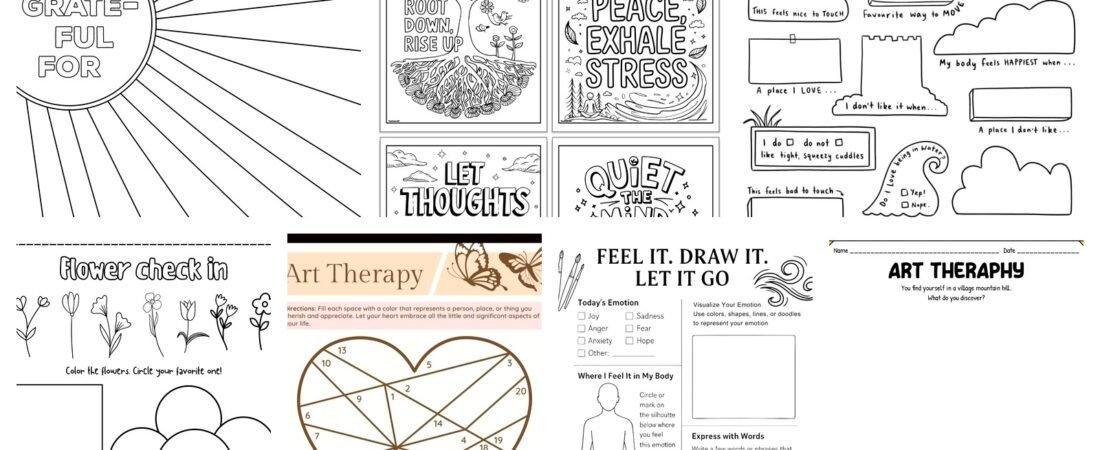
What Art Therapy Worksheets Actually Are
Art therapy worksheets combine visual creative tasks with structured prompts designed to help people explore emotions, process experiences, or develop coping skills. They’re not just coloring pages, though those can be part of it. The worksheets typically include instructions, sometimes psychoeducational content, and a creative component that asks you to draw, color, collage, or otherwise make something visual in response to a specific question or theme.
I remember back in 2019 sitting in a supervision meeting where another clinician kept insisting that art therapy worksheets were “dumbing down” the profession, that they weren’t real art therapy because they were too directive. And I just… look, I get the concern about oversimplification, but sometimes a parent needs something concrete to do with their anxious 10-year-old at 9 PM on a Tuesday, and a worksheet about drawing your worries as monsters is actually helpful. Not everything has to be a full clinical session with a registered art therapist to have value.
The printable versions are exactly what they sound like: PDFs or image files you download and print at home. Most free resources come from therapists, counselors, educators, or mental health organizations who want to make tools accessible without paywalls.
Why People Actually Use These Things
Parents use them when their kids are struggling and they don’t know how to start a conversation about feelings. Teachers use them in classrooms for social-emotional learning activities. Therapists and counselors use them as homework assignments between sessions or as warm-up activities. Some people just use them for personal reflection—I’ve done this myself, actually, particularly during the absolute chaos of summer 2022 when I was writing something like three or four mental health resource roundups every week and realized I was completely burnt out and needed to actually practice what I was researching.
The worksheets lower the barrier to entry for creative expression. You don’t need to be “good at art” because the structure is already there. You’re not staring at a blank page wondering what to do. Someone’s already given you the framework: draw yourself as a tree and label the roots with what grounds you, or create a color wheel of your emotions this week, or design a map of your safe spaces.
For kids especially, the visual component bypasses some of the verbal processing challenges. A seven-year-old might not be able to articulate “I feel overwhelmed by my parents’ divorce and I’m worried about disappointing both of them,” but they can draw two houses and show you through their picture where they feel safe and where they feel confused.
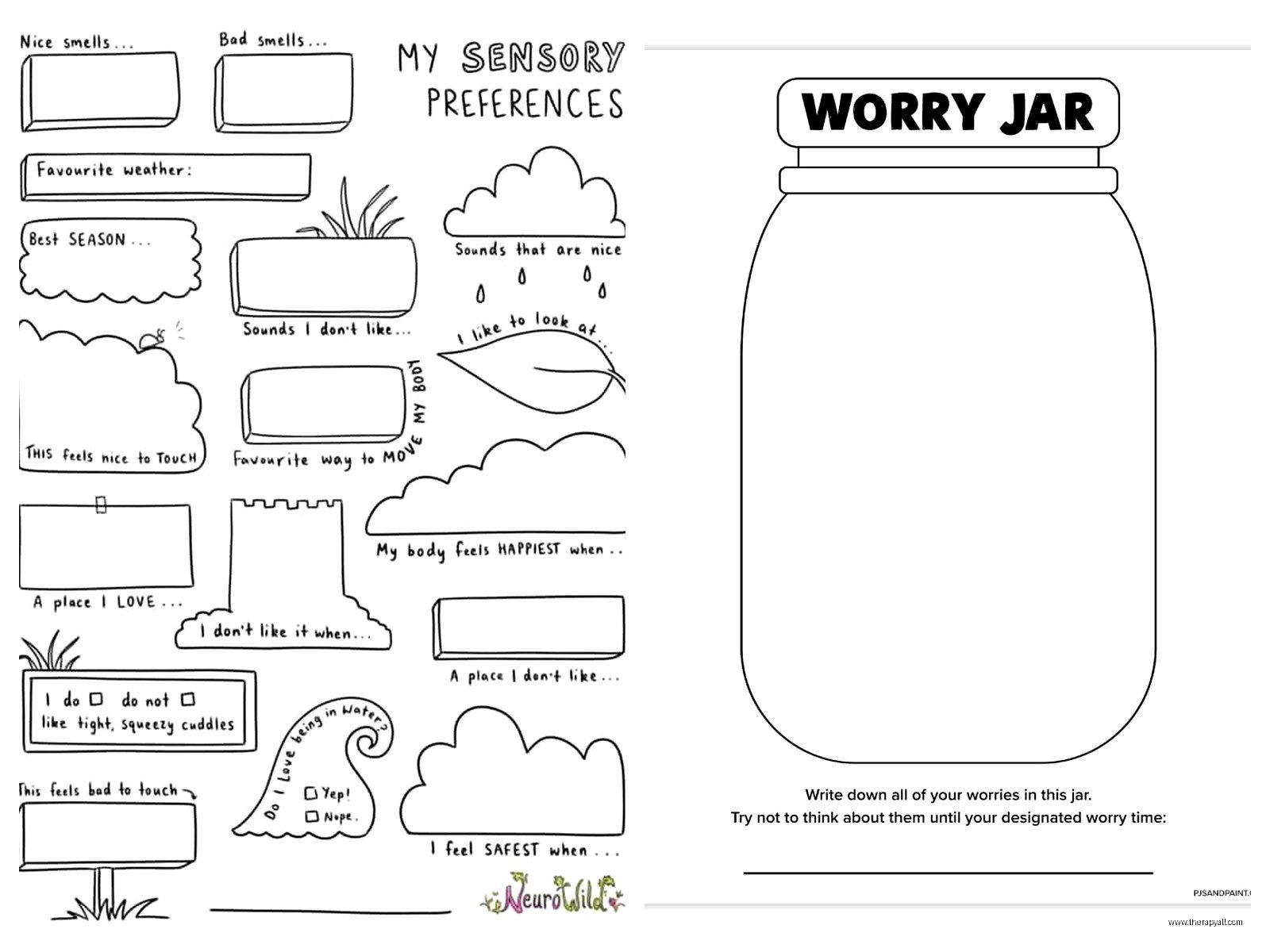
The Developmental Piece You Gotta Consider
Not all worksheets work for all ages, which seems obvious but you’d be surprised how many generic “art therapy printables” get shared without any age specification. A worksheet asking a five-year-old to “map their cognitive distortions” is absurd. They don’t have the abstract reasoning yet. But a teenager might find a simple “draw your feelings” prompt patronizing.
For young children (roughly ages 4-8), worksheets work best when they’re concrete and sensory. Prompts like “draw your family,” “color how you feel using these colors,” or “create a picture of something that makes you feel brave.” The instructions need to be simple. One or two sentences maximum.
Middle childhood (ages 8-12) can handle more complexity. They can work with metaphors and understand prompts like “if your anger was a weather pattern, what would it look like?” or worksheets that ask them to create before-and-after scenarios. They’re developing more sophisticated emotional vocabulary, so worksheets can include feeling word banks or scales.
Teenagers need worksheets that don’t feel childish. This is where I see a lot of free resources fail—they’re either too juvenile or they swing too far into clinical language that feels like homework. Teens respond better to prompts that acknowledge complexity: “create a visual representation of the different parts of yourself,” or “design an album cover for this chapter of your life.” Some of the best teen-focused worksheets I’ve seen incorporate elements of graphic novels, zine-making, or street art aesthetics.
Adults need permission to be messy and imperfect. The best adult worksheets explicitly state something like “this doesn’t need to be beautiful” or “stick figures are completely fine.” We carry so much baggage about artistic ability. I watched a client once spend fifteen minutes apologizing for her drawing skills before she even started a worksheet about her support system, and it just—it broke my heart a little because she was so focused on the product instead of the process.
Where to Find Free Printable Worksheets
Therapist Aid is probably the most comprehensive database. They have hundreds of worksheets organized by topic and therapeutic approach, though not all are specifically art-based. Their art therapy section includes things like emotion wheels, body maps, and creative journaling prompts. Everything’s available as a free PDF.
The Helpful Counselor offers a solid collection, many created by actual art therapists. Their worksheets tend to be more sophisticated in design and include more detailed instructions. They also provide worksheets in Spanish, which is unfortunately rare for free resources.
Teachers Pay Teachers has a weird mix—it’s primarily an education marketplace, but there’s a substantial free section. You have to filter carefully because quality varies wildly. Some are clearly created by people with mental health training; others are just… pretty coloring pages with feelings words slapped on top, which isn’t really the same thing.
Individual therapist blogs and websites are goldmines if you can find them. Many clinicians create and share their own worksheets. The design might not be as polished as commercial products, but the clinical thinking is often stronger. My cat just knocked over my coffee, hang on—okay, where was I.
Pinterest is both helpful and overwhelming. You’ll find thousands of pins linking to art therapy worksheets, but you’re gonna need to verify the sources. Some links are broken, some lead to sites that now require payment, and some are just reposts without credit to the original creator.
Types of Worksheets You’ll Actually Encounter
Emotion identification worksheets ask you to create visual representations of different feelings. These might be emotion wheels to color, faces to complete with different expressions, or prompts to draw what anger/sadness/joy looks like. These work across all age groups with adjusted complexity.
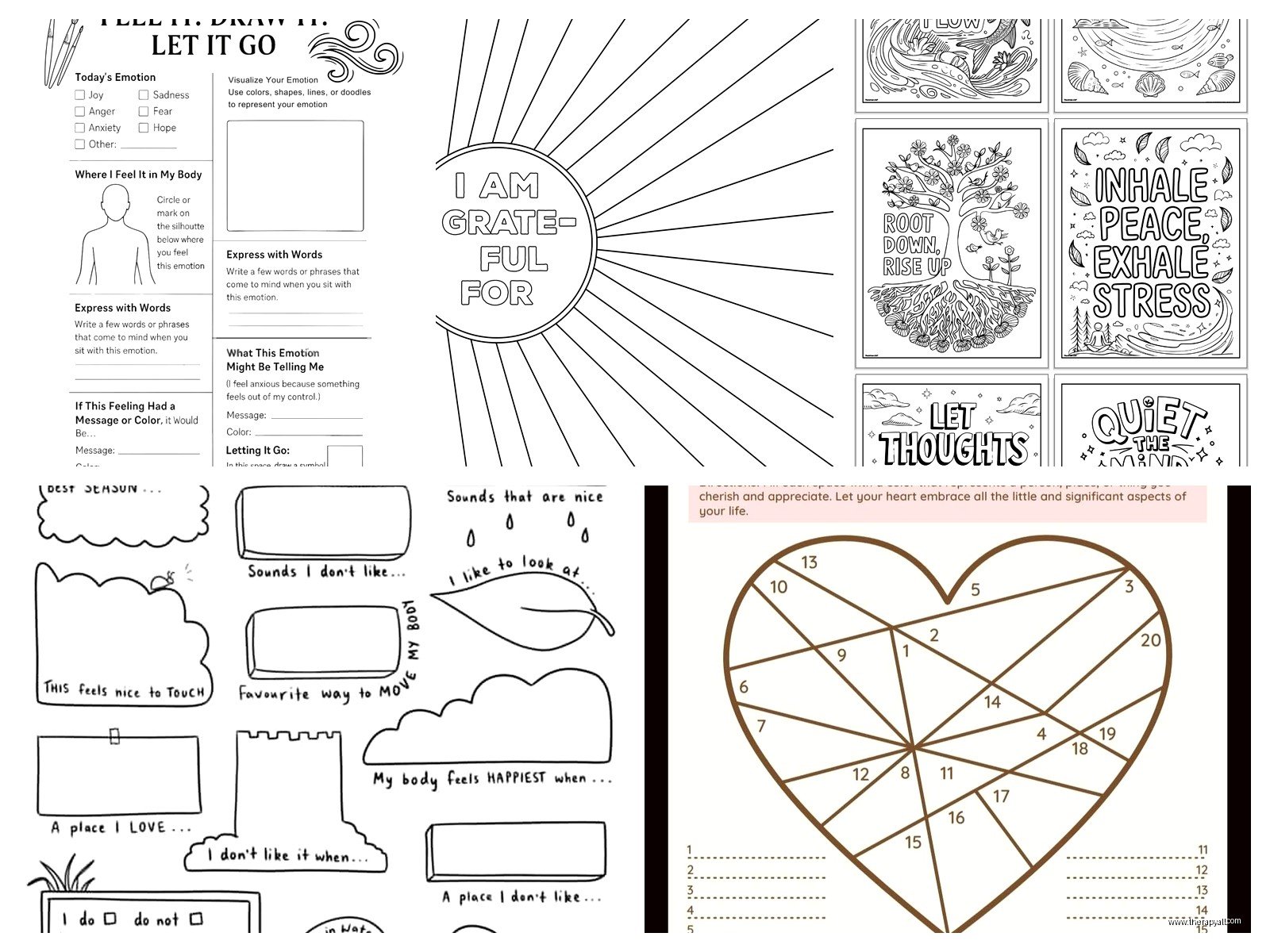
Body mapping worksheets provide an outline of a human body and ask you to mark where you feel different emotions, where you hold tension, or where you feel safe and strong. I use these constantly with clients who have trauma histories or who struggle with interoception.
Coping skills worksheets might ask you to create a “toolbox” of strategies, design a calm-down plan, or illustrate different techniques you can use when you’re overwhelmed. The visual component helps with memory and makes abstract concepts more concrete.
Relationship mapping worksheets help you visualize your social connections, family dynamics, or support systems. These often use circles, lines, or other shapes to represent people and relationships. You might draw yourself in the center and show who’s close, who’s distant, who’s supportive, who’s draining.
Narrative or story worksheets guide you through creating a visual story about an experience, a change you’re going through, or a goal you’re working toward. Comic strip formats work well for this, or storyboard-style layouts with multiple panels.
Mindfulness and grounding worksheets incorporate drawing or coloring with present-moment awareness. These might be mandala-style designs, nature scenes to complete, or prompts that ask you to draw what you notice with your five senses right now.
Self-concept worksheets explore identity, strengths, values, or self-image. Prompts might include creating a personal coat of arms, designing a poster about yourself, or completing sentence stems with drawings instead of words.
The Stuff That Genuinely Annoys Me
Here’s what drives me up the wall: worksheets that are just regular CBT or DBT worksheets with a tiny clip-art picture added and suddenly they’re calling it “art therapy.” That’s not art therapy. Art therapy uses the creative process itself as a therapeutic tool, not just as decoration for a thought record. The art is supposed to be the primary mode of exploration and expression, not an afterthought.
Also, and I cannot stress this enough, those worksheets that say “draw your depression” or “illustrate your trauma” without any guidance on what to do with those images afterward or how to manage what might come up. That’s potentially harmful. You can’t just ask someone to visualize their worst experiences and then leave them sitting with that. Where’s the containment? Where’s the processing? Where’s the reminder about grounding techniques if it becomes overwhelming?
How to Actually Use These Worksheets
You need materials, obviously. Basic supplies work fine: printer paper, pencils, crayons, markers, colored pencils. Some worksheets suggest collage materials like magazines, glue, and scissors. You don’t need fancy art supplies. I’ve seen profound work done with a ballpoint pen on printer paper.
Set up a space where you won’t be interrupted. This matters more than people think. If you’re constantly worried about someone walking in or you’re trying to do a worksheet while simultaneously watching TV or scrolling your phone, you’re not going to get much from it. Ten minutes of focused attention is better than thirty minutes of distracted half-effort.
Read the entire worksheet before you start. Understand what it’s asking. Some worksheets have multiple steps or build on themselves. You don’t want to get halfway through and realize you misunderstood the prompt—though honestly, sometimes those misunderstandings lead to interesting insights anyway, so maybe it’s not the end of the world.
Give yourself permission to modify. If a prompt doesn’t resonate, change it. If the worksheet asks you to draw but you want to collage, do that instead. The structure is a starting point, not a rigid rule. I’ve had clients who took a worksheet designed for drawing and instead wrote poetry around the edges, or used it as inspiration for a completely different creative project.
There’s no time limit. Some people complete a worksheet in fifteen minutes. Others return to the same one over days or weeks, adding layers or revising their images as their thinking evolves. Both approaches are valid.
What to Do with the Finished Product
Some people keep all their worksheets in a folder or binder. This creates a visual record of your process over time. You can look back and see patterns or notice how your perspective has shifted.
Others prefer to photograph their work and then discard the physical copy. This is particularly common with processing difficult emotions—there’s something cathartic about creating the image and then choosing to let it go.
If you’re working with a therapist, you might bring worksheets to sessions to discuss. The image becomes a jumping-off point for conversation. Your therapist might ask about color choices, what you included versus what you left out, or how it felt to create the piece.
You can also just… not do anything with them. Complete the worksheet, put it in a drawer, move on with your day. Not everything needs to be preserved or analyzed to death. Sometimes the value is entirely in the doing.
The Limitations Nobody Talks About
Worksheets are inherently directive, which means they guide your creative process in specific directions. This can be helpful when you need structure, but it also constrains spontaneous expression. You’re responding to someone else’s prompt, not generating purely from your own internal experience.
They’re not a replacement for actual therapy. I shouldn’t have to say this, but I do, because people sometimes use worksheets as a way to avoid seeking professional help when they really need it. Worksheets are tools. They can support therapeutic work, but they can’t replace the relationship, the trained observation, the responsive feedback that happens in therapy.
Cultural relevance varies widely. Most free worksheets are created from Western, individualistic therapeutic frameworks. The prompts might not resonate if you come from a collectivist culture or if your understanding of mental health is rooted in different traditions. I’ve noticed this particularly with worksheets about “self-care” or “putting yourself first”—those concepts don’t translate universally.
Some mental health conditions make creative tasks more difficult rather than easier. If you’re in a severe depressive episode, a worksheet asking you to “create a vision board for your future” might feel impossible or even cruel. If you’re experiencing psychosis, open-ended creative prompts might be destabilizing rather than helpful. The worksheets assume a baseline level of functioning that not everyone has all the time.
Specific Populations and Adaptations
For people with limited fine motor skills, worksheets can be adapted to use larger spaces, adaptive grips on drawing tools, or collage instead of drawing. Digital versions that can be completed on tablets with a stylus work well for some people.
For people who are blind or have low vision, tactile adaptations can include using textured materials, working with clay or playdough instead of two-dimensional drawing, or creating audio descriptions of what they would create if they were drawing.
For people with ADHD, shorter worksheets with very clear, simple prompts tend to work better than complex multi-step activities. Breaking a longer worksheet into smaller chunks across multiple sessions helps with completion.
For people working through trauma, worksheets need to include grounding reminders and shouldn’t push for detailed narrative recreation of traumatic events. The focus should be on containment, resource-building, and gradual processing, not on immediate deep diving into traumatic content. Worksheets that ask you to create safe spaces, identify supportive people, or practice grounding techniques are more appropriate than ones that ask you to illustrate traumatic memories.
I’ve seen some really good adaptations for group settings too, where worksheets become collaborative—each person contributes to a collective piece, or people create individual worksheets and then share themes and patterns they notice across the group.