
Mental Health, Therapy resources
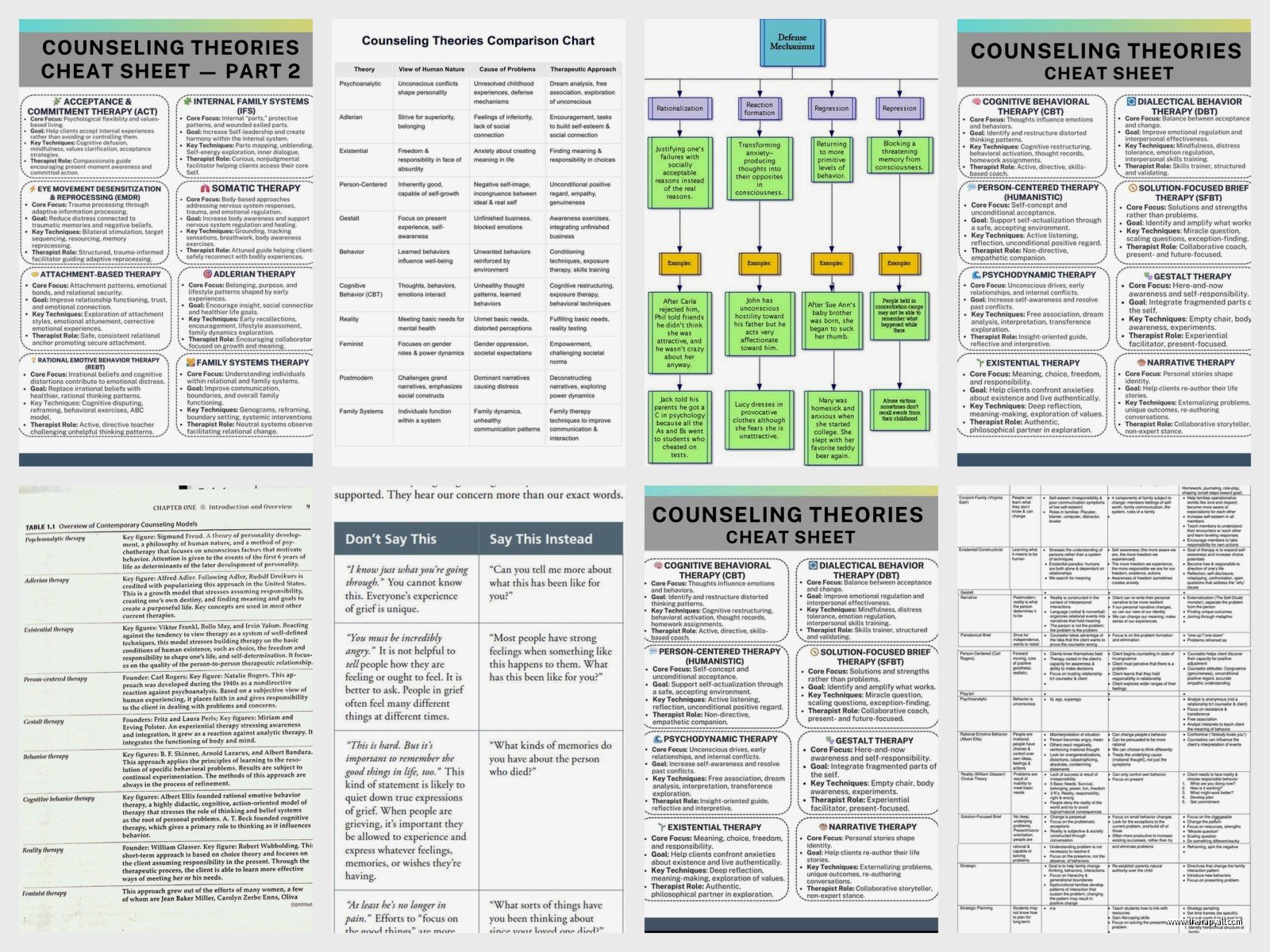
Counseling Theories Cheat Sheet: Quick Reference for Therapists

Jun
# Quick Reference Guide to Major Counseling Theories
Psychodynamic Theory
Psychodynamic therapy focuses on unconscious processes and how past experiences shape current behavior. You’re basically looking at patterns that formed early in life, usually in childhood, and examining how they play out in the present. The therapist-client relationship becomes a mirror for other relationships—what we call transference and countertransference.
I remember sitting in supervision back in 2019 and my supervisor kept pointing out how I was responding to a particular client’s lateness. She was always exactly 12 minutes late, every single session, and I’d gotten kinda irritated about it. Turns out I was having a countertransference reaction because my mother was chronologically late to everything growing up and it drove me insane. That’s psychodynamic work right there—recognizing those patterns.
Key concepts you need to know:
- Defense mechanisms: Repression, denial, projection, displacement, sublimation. These are unconscious strategies the ego uses to manage anxiety.
- Free association: Client says whatever comes to mind without censoring. Reveals unconscious material.
- Dream analysis: Dreams as the “royal road to the unconscious” according to Freud.
- Transference: Client projects feelings about past relationships onto the therapist.
- Countertransference: Therapist’s emotional reactions to the client based on the therapist’s own unconscious processes.
The thing that genuinely annoys me about psychodynamic theory is when people dismiss it entirely as “just talking about your childhood.” Like, no. It’s a sophisticated framework for understanding how the mind protects itself and how relational patterns repeat across time. Sure, classical psychoanalysis with the couch and four sessions a week isn’t practical for most settings, but psychodynamic principles inform so much of what we do.
Cognitive Behavioral Therapy (CBT)
CBT operates on the principle that thoughts, feelings, and behaviors are interconnected. Change your thoughts, and you can change how you feel and what you do. It’s structured, time-limited, and focused on the present rather than diving deep into childhood.
The cognitive model looks like this: situation triggers automatic thoughts, which create emotions, which drive behaviors. You’re teaching clients to identify cognitive distortions—those thinking errors we all make—and challenge them with evidence.

Common cognitive distortions include:
- All-or-nothing thinking: Everything is black or white, no middle ground
- Catastrophizing: Assuming the worst possible outcome
- Mind reading: Believing you know what others are thinking
- Should statements: Rigid rules about how things “should” be
- Overgeneralization: One negative event means everything is always terrible
- Mental filtering: Only noticing negative details
- Personalization: Taking responsibility for things outside your control
CBT uses homework assignments—thought records, behavioral experiments, exposure hierarchies. You assign specific tasks between sessions. My cat knocked over my coffee this morning right onto a stack of blank thought records I’d printed for a client, which was honestly pretty fitting given how often clients “forget” to complete them anyway.
The core techniques you’ll use constantly:
- Socratic questioning to help clients examine their thoughts
- Behavioral activation for depression
- Exposure therapy for anxiety disorders
- Cognitive restructuring to challenge distorted thoughts
- Relaxation training and grounding techniques
Dialectical Behavior Therapy (DBT)
DBT started as a treatment for borderline personality disorder but it’s expanded way beyond that. Marsha Linehan developed it by combining CBT with mindfulness and acceptance strategies. The “dialectical” part means holding two opposing truths at once—like accepting yourself as you are while also working to change.
There are four skill modules and honestly if you work with anyone who has emotion regulation issues or, you know, lives in the modern world, these skills are gonna be useful:
Mindfulness: Observing, describing, and participating in the present moment without judgment. The “what” skills (observe, describe, participate) and “how” skills (non-judgmentally, one-mindfully, effectively).
Distress Tolerance: Getting through crisis situations without making them worse. TIPP skills (Temperature, Intense exercise, Paced breathing, Paired muscle relaxation), ACCEPTS, self-soothing, IMPROVE the moment, pros and cons.
Emotion Regulation: Understanding and managing emotions. Identifying and labeling emotions, reducing vulnerability to negative emotions (PLEASE skills), opposite action, problem-solving.
Interpersonal Effectiveness: Asking for what you need and maintaining relationships. DEAR MAN for requests, GIVE for maintaining relationships, FAST for self-respect.
I had a client once who kept confusing CBT and DBT and finally I just drew the difference on the back of a napkin in the break room—CBT focuses on changing thoughts to change feelings, DBT adds acceptance and says sometimes you need to sit with difficult emotions rather than change them immediately. That napkin drawing ended up being more helpful than three weeks of explanation.
Person-Centered Therapy
Carl Rogers developed this approach based on the belief that people have an innate tendency toward growth and self-actualization. The therapist’s job isn’t to direct or interpret but to provide a relationship characterized by three core conditions:
- Unconditional positive regard: Accepting the client completely without judgment
- Empathic understanding: Deeply understanding the client’s subjective experience
- Congruence (genuineness): Being authentic and real in the therapeutic relationship
You’re reflecting feelings, staying with the client’s experience, trusting their capacity to find their own answers. There’s no agenda, no homework, no “fixing.” The relationship itself is the healing mechanism.
Techniques are actually pretty minimal because it’s more about a way of being than doing:
- Reflection of feelings and content
- Active listening
- Staying in the client’s frame of reference
- Trusting the client’s process
This approach gets criticized for being too passive or not directive enough, especially for clients in crisis or with severe symptoms. But the research on therapeutic alliance—which is one of the strongest predictors of outcomes regardless of modality—comes directly from person-centered principles.
Solution-Focused Brief Therapy (SFBT)
Solution-focused therapy flips the script. Instead of analyzing problems, you’re looking at solutions, exceptions, and what’s already working. It’s future-oriented and assumes clients have the resources they need to solve their problems.
Key questions you’ll use over and over:
The Miracle Question: “Suppose tonight while you’re sleeping, a miracle happens and the problem is solved. When you wake up tomorrow, what will be different? How will you know the miracle happened?”
Exception Questions: “When doesn’t the problem happen?” or “Tell me about a time recently when you expected the problem to occur but it didn’t.”
Scaling Questions: “On a scale of 1 to 10, where are you now? What would it take to move up one point?”
Coping Questions: “How have you managed to cope with this so far? What keeps you going?”
The whole approach is built on finding what works and doing more of it. You’re looking for client strengths and resources, not pathology. Sessions are typically brief—sometimes just 3-5 sessions total—or at least that’s the goal, though in reality it often takes longer depending on complexity.
Acceptance and Commitment Therapy (ACT)
ACT is part of the “third wave” of cognitive behavioral therapies. Instead of challenging or changing thoughts like traditional CBT, ACT teaches psychological flexibility—the ability to be present, accept your thoughts and feelings, and take action based on your values even when it’s uncomfortable.
Six core processes make up the ACT hexaflex:
- Acceptance: Making room for difficult feelings instead of fighting them
- Cognitive defusion: Changing your relationship with thoughts rather than changing the thoughts themselves. A thought is just a thought, not a fact
- Being present: Mindfulness and contact with the current moment
- Self-as-context: The observing self that remains constant even as experiences change
- Values: Identifying what matters most to you
- Committed action: Taking steps toward your values even in the presence of discomfort
ACT uses metaphors extensively. The passengers on the bus metaphor, quicksand, tug-of-war with a monster—these illustrate the futility of struggling against internal experiences. Summer 2021 I was writing so many ACT worksheets for a platform that I started actually using the techniques myself, particularly defusion strategies when I’d get stuck in my own anxious thoughts about deadlines.
Common techniques include:
- Leaves on a stream (watching thoughts float by)
- Naming the story (“I’m having the thought that…”)
- Values clarification exercises
- Willingness work
- Creative hopelessness (exploring how avoidance strategies haven’t worked)
Narrative Therapy
Narrative therapy views problems as separate from people. You’re not a depressed person; you’re a person experiencing depression. This externalization helps clients see that they’re not defined by their problems and creates space for resistance and change.
Michael White and David Epston developed this approach based on the idea that we construct meaning through the stories we tell about our lives. Dominant narratives—often influenced by culture, family, and society—can be oppressive or limiting. Therapy involves deconstructing these narratives and authoring new ones.
Key practices include:
- Externalization: Naming the problem as separate from the person. “When does Anxiety show up?” instead of “When are you anxious?”
- Mapping the influence: Exploring how the problem affects the person and how the person affects the problem
- Unique outcomes: Finding exceptions when the problem wasn’t in control
- Re-authoring: Developing alternative stories that align with preferred identities
- Remembering conversations: Connecting with the influence of important people, living or deceased
- Definitional ceremony: Witnessing and re-telling stories with an audience
The therapist takes a curious, not-knowing stance. You’re asking questions to help clients become authors of their own lives rather than positioning yourself as the expert with answers—which, I’ll be honest, can feel weird when you’re trained in more directive approaches and a client is looking at you like “aren’t you supposed to tell me what to do?”
Gestalt Therapy
Gestalt therapy emphasizes present-moment awareness and personal responsibility. Fritz Perls developed it with the idea that people are whole beings who can’t be understood by breaking them into parts. The focus is on the “here and now”—what’s happening right in this moment between therapist and client.
Core concepts:
- Contact and contact boundary disturbances: How we meet the world and where we interrupt genuine contact (through introjection, projection, retroflection, deflection, confluence)
- Awareness: Noticing sensations, feelings, thoughts, and needs in the present
- Personal responsibility: Owning your experiences rather than blaming external circumstances
- Unfinished business: Unexpressed feelings from the past that intrude on present functioning
Techniques get experiential and sometimes dramatic:
- Empty chair: Dialoguing with different parts of yourself or with someone not present
- Experiments: Trying new behaviors in session to increase awareness
- Focusing on body sensations: “What are you noticing in your body right now?”
- Exaggeration: Amplifying a gesture or expression to bring awareness to it
- Dream work: Acting out all parts of a dream as aspects of yourself
Gestalt can feel confrontational compared to other approaches. Therapists might point out incongruencies—like when someone says they’re fine while their fists are clenched. The goal is increased awareness, not comfort, which doesn’t work for every client or every situation.
Motivational Interviewing (MI)
Motivational Interviewing isn’t exactly a full theory of therapy but it’s a crucial approach for working with ambivalence about change, especially in addiction treatment but really anywhere people are stuck. William Miller and Stephen Rollnick developed MI based on the principle that you can’t argue someone into change—you have to help them find their own motivation.
The spirit of MI includes:
- Partnership: Collaborative relationship, not expert-driven
- Acceptance: Absolute worth, autonomy, accurate empathy, affirmation
- Compassion: Actively promoting the client’s welfare
- Evocation: Drawing out the client’s own motivations rather than installing new ones
Four core processes: engaging, focusing, evoking, and planning. You’re listening for “change talk”—any statement the client makes that moves toward change—and reflecting it back, amplifying it, asking about it.
The thing is, MI requires you to genuinely let go of the righting reflex—that urge to fix things and convince people to change. You gotta sit with their ambivalence without pushing, which is harder than it sounds when someone’s making choices that are clearly harmful.
Key skills:
- Open-ended questions
- Affirmations
- Reflective listening (simple and complex reflections)
- Summaries
- Eliciting and responding to change talk
- Rolling with resistance rather than confronting it
Attachment-Based Therapy
Attachment theory comes from John Bowlby’s work on how early relationships with caregivers shape our relational patterns throughout life. Mary Ainsworth identified attachment styles through her Strange Situation research: secure, anxious-ambivalent, avoidant, and disorganized.
In therapy, you’re looking at how someone’s attachment style shows up in their current relationships and in the therapeutic relationship itself. Secure attachment develops when caregivers are consistently responsive. Insecure attachment patterns develop when caregiving is inconsistent, absent, or frightening.
Adult attachment styles:
- Secure: Comfortable with intimacy and independence, can regulate emotions effectively
- Anxious-preoccupied: Craves closeness, fears abandonment, hyperactivating strategies
- Dismissive-avoidant: Values independence, uncomfortable with emotional closeness, deactivating strategies
- Fearful-avoidant: Wants closeness but fears it, mixed strategies
The therapeutic relationship becomes a space to develop earned secure attachment. You’re providing consistent, attuned responses, helping clients mentalize (understand their own and others’ mental states), and working through ruptures and repairs in the relationship.
This framework has become super popular in the last decade, which is great, but also sometimes people reduce complex relational dynamics to just “oh they’re avoidant” without understanding the underlying mechanisms or—and this bugs me—using attachment style as an excuse for poor behavior rather than a pattern to understand and potentially change.
ADHD & Neurodiversity
Life Planner Bundle – Life Organizer
Self-Care & Personal Growth
Acceptance And Commitment
Anxiety & Stress
Stress Processing Journal & Reflection Worksheets For Daily Self – Care
Self-Care & Personal Growth
Self – Reflection Guided Journal With Guided Prompts 30
Emotional Wellness
Decision Processing – Thought Processing Journal For Daily Self – Care
Therapist Resources
Physiotherapist Journal PDF Planner Tracker Or Log Book
Self-Care & Personal Growth
Customizable Self – Confidence & Self – Esteem Guided Journal
ADHD & Neurodiversity
ADHD Behavior Tracker PDF Planner Tracker Or Log Book