
Mental Health, Therapy resources
Couples Counseling Handouts: Practical Tools for Every Session

Jun
What Makes a Counseling Handout Actually Useful
Couples counseling handouts need to do three things: get to the point fast, give people something they can actually use between sessions, and not sound like a corporate training manual. I’ve seen too many therapists hand out PDFs that look like they were designed in 2003 with clip art of holding hands and sunset imagery, and honestly it drives me nuts because couples already feel vulnerable enough without being given materials that look like a church retreat brochure.
The best handouts I’ve used in my own practice—wait, I should clarify, I’m not a practicing therapist, I write about this stuff and consult with practices on their client education materials—but the best ones I’ve seen therapists use are the ones that clients actually bring back to the next session with notes scribbled in the margins. That’s your metric right there.
Communication Pattern Trackers
You need a simple grid. Left column lists common conflict triggers: money, sex, in-laws, household responsibilities, parenting differences, time together versus apart. Top row has days of the week. Couples put a mark when that topic comes up and whether it escalated or got resolved. That’s it.
What this does is show patterns without requiring people to journal or do anything elaborate. I remember working with a content team for a therapy group in summer 2019, and we were testing different handout formats with actual couples. The fancy ones with reflection questions and “rate your feelings 1-10” scales? Nobody filled them out. The simple tracking grids? Those came back completed like 70% of the time.
The trick is making it small enough that it doesn’t feel like homework. One page, can fit on the fridge or tucked into a planner. You don’t want couples to need a three-ring binder system to manage their therapy materials.
The Gottman-Style Repair Checklist
This handout lists specific phrases couples can use when an argument is getting heated. Not the generic “use I-statements” advice—actual sentences they can grab when their brain is flooded and they can’t think straight.
Examples include: “I need a break, can we come back to this in 20 minutes?” or “You’re right about that part” or “I’m feeling defensive, can you say that differently?” The list usually has about 15-20 options.
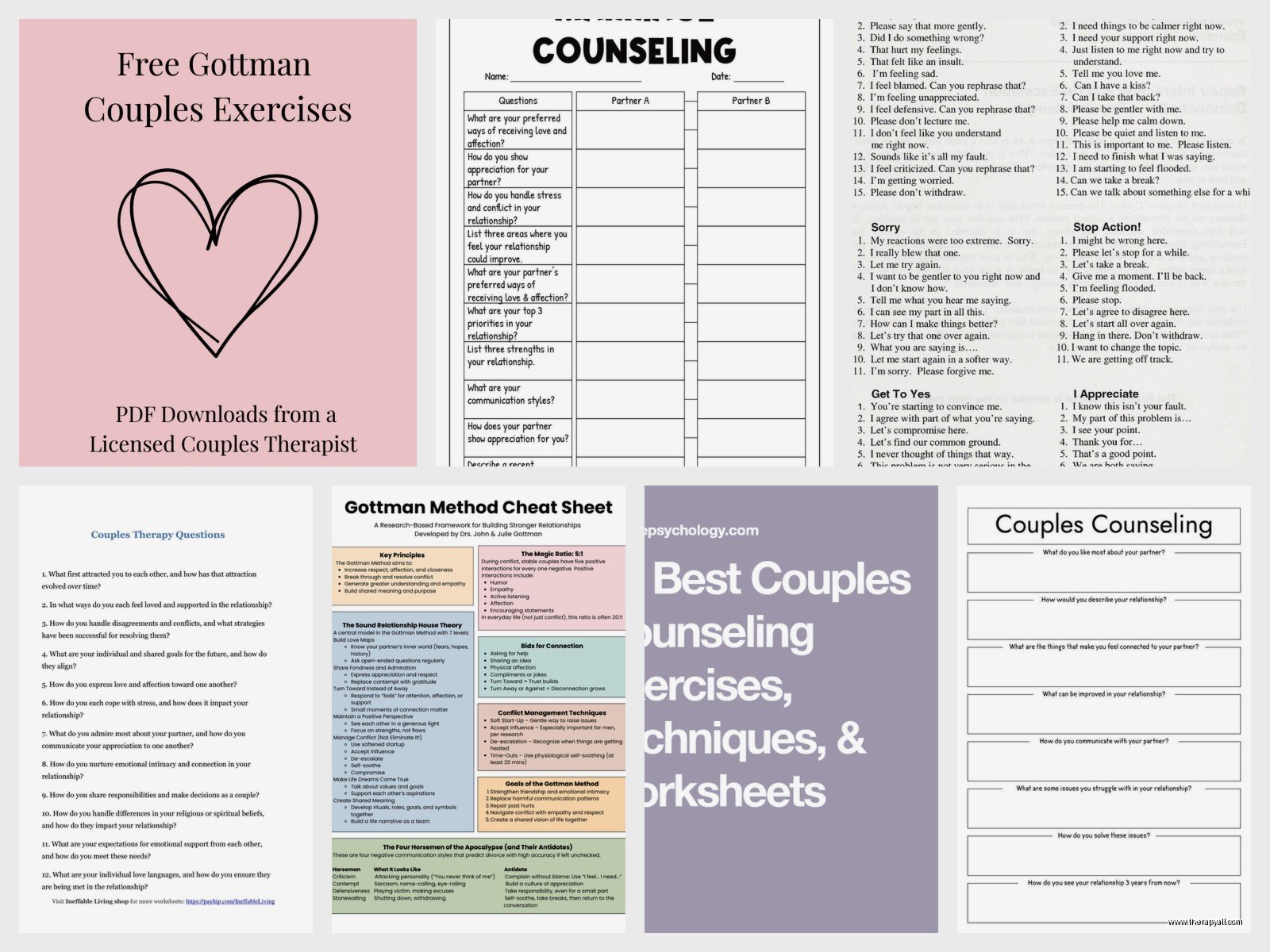
What annoys me about most versions of this handout is they include phrases nobody would actually say in real life. “I hear that you’re experiencing discomfort around this topic and I want to honor your perspective”—nah, nobody talks like that when they’re pissed off about whose turn it is to deal with the broken dishwasher. Keep it conversational.
I’ve seen therapists add a checkbox system where couples mark which phrases they tried during the week. Some add a notes section for what happened after they used it. The goal isn’t perfection, it’s just interrupting the usual script couples fall into when they fight.
Needs Versus Strategies Worksheet
This one comes from Nonviolent Communication principles but adapted for couples work. It helps people distinguish between the underlying need and the specific strategy they’re demanding.
Example: Partner A says “You need to text me more during the day.” The need underneath might be reassurance, connection, or feeling prioritized. The strategy is texting specifically. But maybe Partner B could meet that need through a quick morning check-in call instead, or leaving notes, or whatever actually works for both people.
The handout typically has two columns. Left side: “What I’m asking for.” Right side: “The need underneath that.” Couples fill this out individually first, then compare. It sounds kinda simple but it cuts through so much of the surface-level bickering about logistics.
You want to include examples on the handout itself because otherwise people stare at it confused. Show them what a completed version looks like for a fictional couple dealing with a common issue.
Weekly Check-In Structure
This handout gives couples a framework for a 15-minute weekly meeting. Not a big emotional processing session—just administrative and emotional maintenance stuff.
The structure usually includes: appreciations (each person shares one thing they appreciated about the other this week), schedule coordination for the week ahead, one thing that felt off or needs attention, and one request for the coming week. Sometimes there’s a section for tracking a specific goal they’re working on in therapy.
I worked with a practice that was gonna create an app for this, and then they realized couples don’t need an app, they just need a printed sheet they can fill out together with coffee on Sunday morning or whenever. Technology isn’t always the answer, which—my cat just knocked over my water bottle, hang on—which seems obvious but a lot of therapy practices get obsessed with gamifying everything.
The key instruction on this handout: pick a consistent time and place. Doesn’t matter when, just make it predictable. Some couples do Friday nights, some do Sunday mornings, some do Wednesday during lunch. Consistency matters more than the perfect time slot.
Conflict Escalation Ladder
This visual handout shows the stages of conflict escalation as a ladder or staircase. Bottom step is minor irritation, top step is full blowout or stonewalling. Each step in between has specific physical and emotional signs.
Step 2 might be: tension in shoulders, shorter responses, avoiding eye contact. Step 4 might be: raised voice, bringing up past issues, accusatory language. Step 6 might be: yelling, name-calling, or complete shutdown.
The point is helping couples recognize where they are on the ladder before they’re at the top. Each step has suggested interventions. At step 2, maybe just name it: “I’m feeling tense about this.” At step 4, maybe take a break. At step 6, you definitely need to stop and come back later.
Some versions include a section where couples identify their personal early warning signs. One person might get quiet, another might talk faster, another might start cleaning aggressively. You know yourself, might as well use that information.
Intimacy Menu
This handout lists different types of intimacy beyond just sexual: emotional, intellectual, recreational, spiritual, physical non-sexual. Under each category are specific activities or interactions.

Under emotional intimacy: sharing something you’re worried about, talking about childhood memories, discussing hopes for the future. Under recreational: trying a new restaurant, hiking, watching a show together, working on a project. Under physical non-sexual: hand-holding, massage, cuddling, dancing.
Each partner goes through and marks items that appeal to them, then they compare lists to find overlap and also see where they differ. It opens up conversations about what connection actually means to each person.
The version I like best has a blank section at the bottom of each category where couples can add their own ideas. Pre-made lists are helpful but they can’t capture everything, and sometimes the most meaningful intimacy activities are specific to that couple’s relationship.
Fighting Fair Guidelines
Every couples therapist has their version of this. It’s usually a one-page list of ground rules for arguments: no name-calling, no bringing up past resolved issues, no threats of leaving, take breaks when needed, focus on one topic at a time, that kind of thing.
What makes a good version is specificity. Instead of “be respectful,” give examples of what respectful looks like and what it doesn’t. Instead of “stay on topic,” explain why bringing up seventeen different grievances in one argument makes resolution impossible.
Some therapists have couples sign this handout like a contract, which feels a bit much to me but apparently some people respond well to that level of formality. Others just have couples post it somewhere visible as a reminder.
I’d add a section about repair after breaking the guidelines because everyone’s gonna mess up. What do you do when you call your partner a name in the heat of the moment? How do you get back on track? The handout should address that.
Time-Out Protocol
This deserves its own section on the handout or as a separate sheet. When someone calls a time-out during an argument, both people need to know what that means.
Standard protocol: person calling the time-out says “I need a break” and suggests when to resume (usually 20-30 minutes minimum). During the break, both people do something to calm down—walk, listen to music, whatever works. They don’t text about the argument or ruminate. They come back at the agreed time and either continue the conversation or decide to table it.
The handout should emphasize that time-outs aren’t about avoiding—they’re about preventing damage. When people are physiologically flooded, they can’t think clearly or communicate effectively. Better to pause than to say something you’ll regret.
Love Language Quick Reference
Yeah, I know the five love languages thing is everywhere and kinda oversimplified, but couples actually use this framework. A simple handout listing the five languages with specific examples for each makes it practical.
Words of affirmation: compliments, thank yous, verbal appreciation, encouraging texts. Quality time: undivided attention, shared activities, meaningful conversations. Physical touch: hugs, holding hands, sitting close, initiacy. Acts of service: doing chores, running errands, cooking, helping with tasks. Gifts: thoughtful presents, bringing home favorites, remembering important items.
Have each partner identify their primary and secondary languages, then brainstorm specific ways they can speak each other’s language. The handout works best when it moves beyond theory into concrete action items.
Gottman Four Horsemen Identifier
This handout explains criticism, contempt, defensiveness, and stonewalling—the four communication patterns Gottman research links to relationship breakdown. Each section defines the pattern, gives examples, and offers the antidote.
Criticism versus complaint: “You never help with dinner” (criticism) versus “I felt stressed cooking alone tonight, can we figure out a better system?” (complaint). The antidote is gentle startup—stating needs without blame.
Contempt examples: eye-rolling, mockery, sarcasm, name-calling. Antidote is building a culture of appreciation and respect. Defensiveness examples: making excuses, cross-complaining, whining. Antidote is taking responsibility for even part of the issue. Stonewalling is shutting down, and the antidote is self-soothing then re-engaging.
The handout should help couples spot these patterns in their own interactions. Some versions include a tracking element where couples note when they catch themselves using a horseman and whether they were able to apply the antidote.
Emotion Wheel for Couples
A lot of people struggle to articulate emotions beyond mad, sad, happy. An emotion wheel handout shows the range: frustrated, disappointed, anxious, overwhelmed, excited, content, grateful, proud—all the variations.
For couples work, the instruction is usually: when you’re upset, use the wheel to identify the specific emotion before discussing it with your partner. “I’m angry” gives your partner less to work with than “I’m feeling unappreciated and resentful.”
Some therapists create couple-specific versions that include relationship emotions like feeling taken for granted, disconnected, cherished, seen, supported. The more precise the vocabulary, the more productive the conversation.
Appreciation Journal Prompts
This handout gives couples daily or weekly prompts to notice and share appreciations. Not vague “I appreciate you” stuff—specific observations.
Prompts might include: something your partner did this week that made your life easier, a quality you admire in your partner, a time recently when your partner showed up for you, something you’re looking forward to doing together, a way your partner has grown or changed positively.
The format matters. Some couples prefer a shared journal they pass back and forth. Others prefer individual tracking that they share during check-ins. The handout should offer options and let couples experiment with what feels sustainable for them.
ADHD & Neurodiversity
Life Planner Bundle – Life Organizer
Self-Care & Personal Growth
Acceptance And Commitment
Anxiety & Stress
Stress Processing Journal & Reflection Worksheets For Daily Self – Care
Self-Care & Personal Growth
Self – Reflection Guided Journal With Guided Prompts 30
Emotional Wellness
Decision Processing – Thought Processing Journal For Daily Self – Care
Therapist Resources
Physiotherapist Journal PDF Planner Tracker Or Log Book
Self-Care & Personal Growth
Customizable Self – Confidence & Self – Esteem Guided Journal
ADHD & Neurodiversity
ADHD Behavior Tracker PDF Planner Tracker Or Log Book