
Mental Health, Therapy resources
Counseling Tools – Helpful Guide and Resources

Jul
Assessment and Intake Tools
When you’re starting with a new client, the intake process can feel overwhelming if you don’t have a system. I remember back in 2019, I was shadowing a clinician who literally used a different intake form for every single client depending on what “vibe” they gave off in the waiting room, and it was chaos. You need standardized tools that actually capture what matters.
The PHQ-9 is probably the most widely used depression screening tool, and for good reason. It’s nine questions based on DSM criteria, takes about five minutes, and gives you a numeric score that tracks over time. I use it in examples constantly when I’m writing because it’s just that ubiquitous. The GAD-7 does the same thing for anxiety. Both are free, public domain, and you can find them everywhere.
The thing that annoys me about intake paperwork in general is when therapists make it so long and complicated that clients are exhausted before the first session even starts. I’ve seen 40-page intake packets. Nobody is reading all that carefully when they’re already anxious about starting therapy.
For trauma history, the Life Events Checklist is solid. It’s tied to the PCL-5, which measures PTSD symptoms. You’re basically getting a yes/no on whether someone experienced or witnessed different types of traumatic events. It’s not diagnostic on its own, but it opens the conversation in a structured way.
The Adverse Childhood Experiences questionnaire, the ACE, gets used a lot in research and clinical settings. Ten questions about childhood trauma, abuse, neglect, and household dysfunction. Each “yes” is one point. Higher scores correlate with worse health outcomes across the board. It’s useful but also—and I’m gonna be honest here—it can feel reductive when you’re sitting with someone’s actual lived experience.
Cognitive Behavioral Therapy (CBT) Worksheets
Thought records are the backbone of CBT work. The classic version has columns for situation, automatic thought, emotion, evidence for and against the thought, alternative thought, and outcome. You walk through it with clients until they can do it themselves, which sometimes happens quickly and sometimes… doesn’t. I spent probably six months in 2021 just writing variations of thought record explanations for different websites, and I started filling them out for my own stuff, which was weirdly helpful when I was stressed about deadlines.
The cognitive distortions list is everywhere, and clients usually recognize themselves in at least a few. All-or-nothing thinking, overgeneralization, catastrophizing, mind reading, emotional reasoning—there are different versions with anywhere from 10 to 15 distortions listed. I like the ones that include examples because otherwise “mental filtering” doesn’t mean much to someone who’s never heard the term.
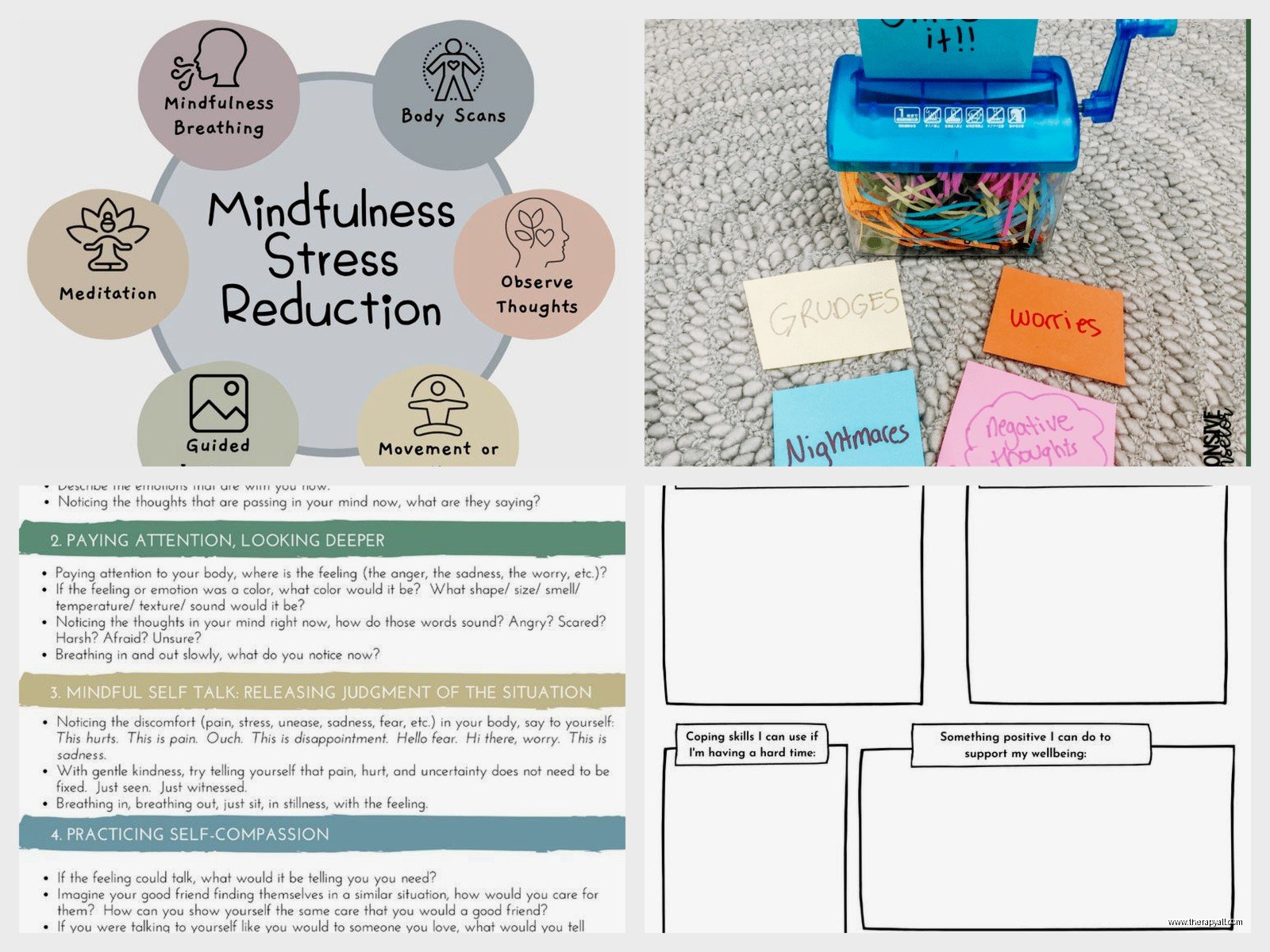
Behavioral activation worksheets help with depression by tracking activities and mood. You’re essentially testing the hypothesis that doing things improves mood, even when motivation is gone. The activity scheduling version has you plan stuff in advance. The activity monitoring version tracks what you actually did and how you felt. Both matter because the gap between what people plan and what they do is usually pretty telling.
Exposure hierarchies for anxiety are basically ranked lists of feared situations, usually 0-100 for subjective distress. You start with the least scary thing and work up. Building these with clients is kinda like— well, it’s collaborative but also you’re sometimes helping them see that their hierarchy doesn’t make logical sense, like they’ll rate “making a phone call” as 95 but “going to a party” as 60, and then you explore why.
Dialectical Behavior Therapy (DBT) Resources
DBT has four main skill modules and the worksheets for each are pretty specific. Mindfulness skills include things like the “what” skills (observe, describe, participate) and the “how” skills (nonjudgmentally, one-mindfully, effectively). The worksheets usually have you practice and then reflect on what happened.
Distress tolerance is about getting through crisis without making things worse. The TIPP skill—Temperature, Intense exercise, Paced breathing, Paired muscle relaxation—is for immediate crisis. The ACCEPTS acronym gives you activities, contributing, comparisons, emotions, pushing away, thoughts, and sensations. I’ve seen these printed on little cards that clients carry in their wallets.
Emotion regulation skills include identifying and labeling emotions, which sounds simple until you’re working with someone who just says “bad” for every feeling. The chain analysis worksheet is for analyzing what led to a specific behavior or crisis. It’s detailed, sometimes takes a full session to complete one, and it maps out vulnerability factors, prompting event, links in the chain, and consequences.
Interpersonal effectiveness has the DEAR MAN skill for asking for what you want or saying no. There are worksheets that break down each letter. My cat just knocked over my water bottle while I’m writing this, which is perfect timing because I was about to say that GIVE and FAST are the other interpersonal skills for maintaining relationships and self-respect, and they also have corresponding worksheets that are pretty straightforward.
Mindfulness and Grounding Exercises
The 5-4-3-2-1 grounding technique is everywhere for a reason. Five things you see, four you can touch, three you hear, two you smell, one you taste. It pulls you into the present moment using your senses. You can find printable versions, but honestly once someone learns it they don’t usually need the written version anymore.
Body scan scripts guide attention through different parts of the body, usually starting with feet and moving up. They’re used for relaxation, mindfulness, and sometimes pain management. Audio recordings work better than written scripts for most people because reading while trying to relax is counterproductive.
Breathing exercise handouts cover everything from box breathing (four counts in, hold four, out four, hold four) to 4-7-8 breathing to diaphragmatic breathing. The instructions need to be clear because people will sometimes hyperventilate if they’re trying too hard or breathing into their chest instead of their belly.
Progressive muscle relaxation involves tensing and releasing muscle groups systematically. There are short versions and long versions. The worksheets usually include which muscle groups in which order, how long to tense and release, and what to notice.
Journaling Prompts and Structured Writing
Gratitude journals get recommended constantly, sometimes too constantly. Three things you’re grateful for each day, that’s the usual format. Research supports it for mood improvement, but it can feel forced or invalidating when someone is in acute crisis. Timing matters with this one.

Worry time journals give you a designated 15-20 minutes to write all your worries, then you’re done for the day. When worries pop up outside that time, you note them quickly and save them for worry time. It’s a containment strategy that actually works for some people with generalized anxiety.
The unsent letter technique has you write a letter to someone you can’t or won’t actually send. It’s for processing feelings, getting closure, or saying things you need to say without the actual confrontation. You can keep it, burn it, whatever feels right.
Stream of consciousness writing, sometimes called morning pages, is three pages of whatever comes to mind. No editing, no judgment. It’s less structured than other journaling but can surface stuff that more directed prompts miss.
Mood Tracking Apps and Charts
Paper mood charts are still useful even though there are approximately ten million apps now. A simple chart with dates and a 1-10 rating scale, maybe columns for sleep, medication, exercise, and notes. You’re looking for patterns over weeks and months.
Daylio is a popular mood tracking app that uses icons instead of words. You select your mood and activities for the day. It generates charts and statistics automatically. Some clients love it, some find it too simplistic.
Moodpath asks daily questions about depression symptoms and generates reports you can share with your therapist. It’s more structured than just mood tracking. eMoods is specifically designed for bipolar disorder tracking with fields for mood, sleep, medications, and triggers.
The thing about tracking apps is that they only work if people actually use them consistently, which is harder than it sounds when you’re depressed or manic or just busy living your life.
Relationship and Communication Tools
The Gottman Institute has so many worksheets for couples. The Love Maps questionnaire helps partners learn details about each other’s inner world. The Four Horsemen—criticism, contempt, defensiveness, stonewalling—are relationship killers, and there are worksheets for identifying them and finding antidotes.
I-statements worksheets teach people to say “I feel X when Y happens” instead of “You always Z.” It sounds basic but changing communication patterns takes practice. The worksheets usually have fill-in-the-blank formats until it becomes more natural.
Boundaries worksheets help people identify what boundaries they need, how to communicate them, and what consequences they’ll enforce. This comes up in individual therapy and relationship therapy. Some worksheets separate physical, emotional, time, and material boundaries into different categories.
Genograms map family relationships, patterns, and history across generations. They’re more complex than family trees because they include relationship quality, conflicts, cutoffs, and sometimes mental health or addiction patterns. There are specific symbols for different types of relationships.
Relaxation and Self-Care Planning
Self-care isn’t just bubble baths, though the internet would make you think otherwise. Practical self-care worksheets cover physical, emotional, social, spiritual, and professional areas. You’re identifying what you currently do, what you want to do, and actual barriers.
The self-care wheel divides self-care into different sections like a pie chart. You rate your current status in each area and identify specific actions. It’s visual, which helps some people more than lists do.
Pleasant activities schedules are lists of potentially enjoyable activities across different categories. Clients check off what they used to enjoy, what they currently enjoy, and what they’re willing to try. Then you’re scheduling them, because “I should do nice things for myself” doesn’t translate to action without specifics.
Crisis planning worksheets identify warning signs, coping strategies that have worked before, people to contact, and professional resources. Everyone should have one, especially people with recurring mental health crises, but it needs to be created when you’re stable, not during the actual crisis.
Values Clarification Exercises
ACT therapy uses values work extensively. Values card sorts give you cards with different values written on them—family, creativity, health, justice, adventure, whatever—and you sort them into piles of importance. Some versions have 50+ cards, some have fewer.
The values clarification worksheet asks questions about what matters most to you, what you want your life to stand for, what you want people to say about you. It’s deeper than goals because values are directions, not destinations.
The bull’s eye worksheet has concentric circles in four life domains: work/education, relationships, personal growth, and leisure. You mark where you are currently versus where you want to be in terms of living consistently with your values. The gap between the two is where therapy goals often come from.
Specialized Assessment Tools
The AUDIT questionnaire screens for alcohol use problems. Ten questions about consumption, dependence, and problems caused by drinking. Scores of 8 or higher indicate hazardous drinking. The DAST does the same thing for drug use.
Eating disorder screenings like the EAT-26 or SCOFF questionnaire identify potential issues with eating behaviors and attitudes. They’re not diagnostic but they flag when someone needs a more thorough assessment.
The Edinburgh Postnatal Depression Scale is specifically for depression during pregnancy and after childbirth. It’s ten questions that avoid physical symptoms that might just be normal pregnancy or postpartum stuff. Question 10 asks about self-harm thoughts and is weighted heavily.
Autism screening tools for adults include the AQ-10 and the RAADS-R. They’re lengthy and cover social skills, communication, imagination, attention to detail, and sensory sensitivities. There’s been more recognition lately that autism in adults, especially women, often went undiagnosed.
Psychoeducation Handouts
You need handouts that explain diagnoses, symptoms, and treatment options in plain language. I spent summer 2022 writing what felt like three different versions of “what is anxiety” per week for different platforms, and the challenge is always making it informative without being condescending or overly clinical.
Medication information sheets should cover what the medication does, common side effects, how long it takes to work, and what to do if you miss a dose. Psychiatrists and prescribers should provide these, but sometimes they don’t, so therapists end up filling the gap.
Sleep hygiene handouts list all the standard recommendations: consistent schedule, dark room, no screens, no caffeine late in the day. Everyone’s seen them, fewer people actually follow them. The research supports all of it but changing sleep habits is genuinely difficult.
Handouts about the therapy process itself—what to expect, confidentiality limits, how to get the most out of therapy—help with informed consent and realistic expectations. First sessions involve so much information that having something in writing helps.
ADHD & Neurodiversity
Life Planner Bundle – Life Organizer
Self-Care & Personal Growth
Acceptance And Commitment
Anxiety & Stress
Stress Processing Journal & Reflection Worksheets For Daily Self – Care
Self-Care & Personal Growth
Self – Reflection Guided Journal With Guided Prompts 30
Emotional Wellness
Decision Processing – Thought Processing Journal For Daily Self – Care
Therapist Resources
Physiotherapist Journal PDF Planner Tracker Or Log Book
Self-Care & Personal Growth
Customizable Self – Confidence & Self – Esteem Guided Journal
ADHD & Neurodiversity
ADHD Behavior Tracker PDF Planner Tracker Or Log Book