
Mental Health, Therapy resources
Goal Setting Therapy Worksheet: Define and Achieve Your Objectives

Jun
What Goal Setting Therapy Worksheets Actually Do
Goal setting worksheets in therapy help you move from vague wishes to concrete action steps. They create structure around what you want to change, why it matters, and how you’ll track progress. Most therapeutic approaches use some form of goal-setting framework because outcomes improve when clients can articulate what they’re working toward and measure movement.
I remember sitting with a client in 2019 who kept saying she wanted to “be happier” and when I asked what that looked like specifically, she just stared at me like I’d asked her to explain quantum physics. We spent three sessions just defining what happiness meant for her before we could even touch a worksheet. That’s when I realized most people have never actually been taught how to set goals that aren’t just performance metrics from work.
The worksheet format forces specificity. Instead of “I want better relationships,” you write “I will initiate one meaningful conversation with my partner each week about something other than logistics.” The difference is massive.
Components of Effective Goal Setting Worksheets
Most therapeutic goal worksheets include several standard sections that build on each other. You start with identifying the broad area of concern, then narrow to specific objectives, then break those into actionable steps.
Problem or Area Identification
This section asks you to name what’s not working. It might be anxiety, relationship conflict, career dissatisfaction, self-esteem issues, or behavioral patterns you want to change. The key is being honest without being catastrophic. “I avoid social situations” works better than “I’m completely broken and can’t function.”
What drives me nuts is when worksheets frame this section as “What brings you joy?” or some other positive psychology spin. Sometimes you’re in therapy because things suck and pretending otherwise just wastes time. You gotta name the actual problem.
Values Clarification
This connects your goals to what actually matters to you. If you’re setting a goal around career changes, the worksheet might ask what you value about work—creativity, stability, helping others, autonomy, whatever. Goals disconnected from values rarely stick because there’s no deeper motivation.
I use values exercises constantly in my own life now. Back in summer 2021 I was writing probably four articles a day for different platforms and I realized I was miserable because none of it connected to my actual value of depth over breadth. The worksheet I was literally writing about goal-setting made me rethink my entire work structure, which felt kinda ironic at the time.
SMART Goal Framework
You’ve probably seen this acronym everywhere: Specific, Measurable, Achievable, Relevant, Time-bound. It’s overused in corporate settings but it’s actually useful in therapy when applied correctly.
Specific means you can picture the goal clearly. “Exercise more” becomes “attend two yoga classes per week.” Measurable means you can track it—you either went to yoga or you didn’t. Achievable means it’s within your current capacity, not some fantasy version of yourself. Relevant ties back to values. Time-bound gives you a deadline or timeframe.
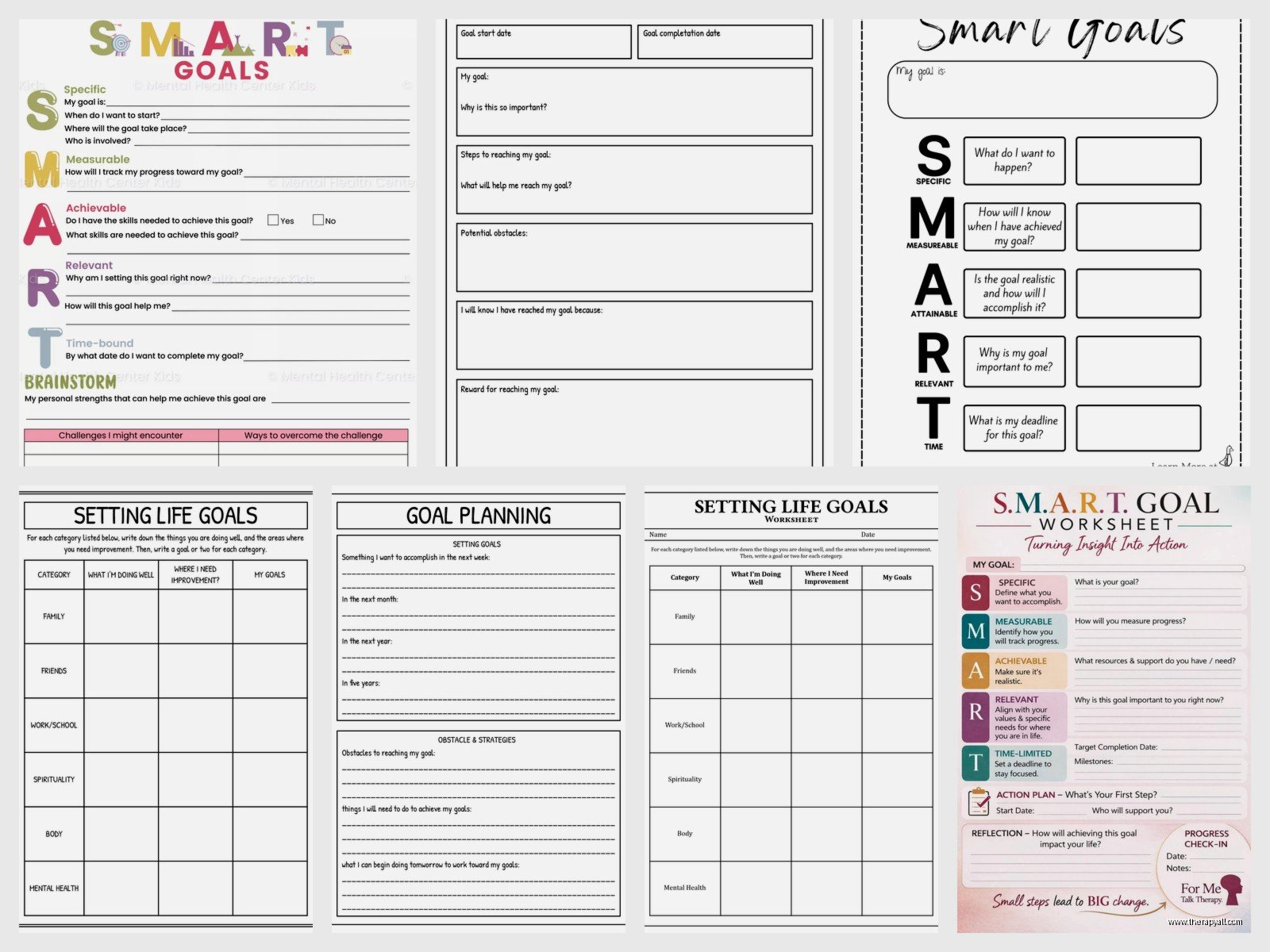
The issue with SMART goals in therapy is they work great for behavioral changes but get weird with emotional or relational goals. “Feel less anxious” doesn’t fit neatly into measurable categories, so you have to translate it into observable behaviors like “use grounding techniques three times daily when anxiety spikes.”
Obstacle Identification
Good worksheets include space to anticipate what will get in your way. This isn’t being pessimistic—it’s being realistic. If your goal is to establish boundaries with family and you don’t acknowledge that your mother guilt-trips you every single time, you’re gonna hit that wall unprepared.
I ask clients to list both external obstacles (time, money, other people’s reactions) and internal ones (fear, shame, old patterns, that voice that says you don’t deserve good things). The internal obstacles are usually the bigger problem but people tend to focus on external ones because they’re easier to talk about.
Action Steps
This breaks the goal into small, concrete tasks. If your goal is “improve communication with my partner,” action steps might include: research communication techniques, schedule weekly check-in time, practice “I feel” statements, ask for what I need at least once per day.
The worksheet should have space for multiple action steps because most goals require several different behaviors. You also need to sequence them—some steps have to happen before others make sense.
Progress Tracking
This section lets you record what you actually did versus what you planned. It’s not about judgment, it’s about data. If you planned to meditate daily and only did it twice in two weeks, that’s useful information. Maybe daily is too ambitious, maybe mornings don’t work, maybe meditation isn’t the right tool for you.
My cat knocked over my coffee this morning right when I was trying to track my own goals for the week and I just thought, well, that’s also data about my environment and distractions, so.
How to Use the Worksheet in Actual Practice
You don’t just fill this out once and forget it. The worksheet is a living document you return to regularly, usually weekly in active therapy.
Start by completing the entire worksheet with as much detail as you can. Be specific in the goal section—if you write “be more confident,” you haven’t actually set a goal yet. What does confidence look like in behavior? Speaking up in meetings? Making eye contact? Trying new things even when you might fail?
Then you pick one or two action steps to focus on for the coming week. Not all of them. People get ambitious and list seventeen action steps and then do none of them and feel like failures. Pick two maximum.
At the end of the week, you review what happened. Did you do the action steps? If yes, what changed? If no, what got in the way? This is where you learn about your patterns. Maybe you realize you only skip action steps when they involve other people, which tells you something about social anxiety or fear of rejection.
You adjust based on what you learned. Maybe the goal needs to be smaller, or the action steps need to be more specific, or you need to address an obstacle first before the goal is even realistic.

Common Goal Categories in Therapy Worksheets
Different therapeutic issues require different types of goals. The worksheet structure stays similar but the content shifts.
Behavioral Goals
These are the most straightforward. Reduce drinking to two days per week. Exercise three times per week. Maintain a sleep schedule. Practice exposure hierarchy for phobia. These goals track easily and you can see progress clearly.
Emotional Regulation Goals
These are trickier because emotions aren’t directly controllable. You can’t just decide to feel less anxious. So the goals become about regulation strategies: use deep breathing when panic starts, identify emotion before reacting, practice distress tolerance skills, challenge negative thoughts.
The worksheet has to translate emotional outcomes into behavioral practices. I’ve seen so many badly designed worksheets that just ask “How do you want to feel?” and leave it there, which is completely useless without the behavior bridge.
Relational Goals
These involve other people which makes them complicated. You can’t control what someone else does, so the goals have to focus on your part. “Make my partner listen to me” isn’t achievable. “Express my needs clearly using I-statements twice per week” is.
Relational goals often need to include boundaries, communication skills, and realistic expectations about what you can actually change—which is only yourself and sometimes not even that if we’re being honest.
Cognitive Goals
These target thought patterns. Challenge three negative automatic thoughts daily. Practice cognitive restructuring when catastrophizing. Notice self-critical thoughts without engaging them. These require a lot of self-awareness and often work better after you’ve built some foundational skills.
Why Goal Setting Worksheets Sometimes Fail
The worksheet is just paper. It doesn’t do anything by itself. I’ve worked with clients who filled out gorgeous detailed worksheets and then never looked at them again. The worksheet has to be part of an active process.
Goals fail when they’re not actually your goals. If you’re setting a goal because your therapist thinks you should, or your partner wants you to, or society says you’re supposed to, the motivation isn’t there. You have to want the outcome for your own reasons.
They also fail when they’re too big. “Overcome depression” isn’t a goal you can work on next Tuesday. “Get out of bed before 10am three days this week” is. The worksheet should help you scale down to manageable pieces.
Sometimes goals fail because the underlying issue hasn’t been addressed. If you’re trying to be more social but you have untreated social anxiety, the worksheet can’t fix that gap. You might need skills-building or exposure work or medication or…well, the point is the worksheet isn’t therapy, it’s a tool within therapy.
Adapting Worksheets for Different Needs
Not everyone relates to written worksheets the same way. Some people are visual and need to draw or diagram their goals. Some need digital versions they can update on their phone. Some need simplified versions with less writing.
I’ve created voice-memo versions for clients who hate writing, where they just talk through the sections and record it. The structure matters more than the format.
You can also adjust timeframes. Traditional worksheets assume weekly check-ins but some goals need daily tracking and others only make sense monthly. If you’re working on reducing panic attacks, daily tracking shows patterns. If you’re working on career direction, monthly might be more realistic.
Integrating with Different Therapy Approaches
Goal worksheets adapt to whatever therapeutic framework you’re using. In CBT, the goals often target thought patterns and behavioral experiments. In DBT, they might focus on distress tolerance or interpersonal effectiveness skills. In ACT, goals connect to values and committed action.
The worksheet is theory-neutral in structure but the content reflects your approach. A psychodynamic therapist might use goals around insight or pattern recognition, while a solution-focused therapist keeps goals very concrete and present-focused.
What matters is that the goal connects to the therapeutic work you’re doing. If you’re processing trauma, your goals might be about building safety and stabilization before you ever touch the trauma material. If you’re working on relationships, goals involve communication and boundary skills.
When to Revise or Abandon Goals
Goals aren’t permanent. Sometimes you realize a goal doesn’t actually matter to you anymore. Sometimes circumstances change and the goal becomes irrelevant or impossible. Sometimes you achieve a goal and need a new one.
The worksheet should be reviewed regularly with your therapist to assess if the goals still make sense. I had a client who spent six weeks working toward assertiveness goals and then realized what she actually needed was to leave the relationship entirely, not communicate better within it. The worksheet helped her figure that out by showing what wasn’t working.
You’re allowed to change your mind. You’re allowed to realize a goal was based on someone else’s expectations. You’re allowed to decide something isn’t worth the effort. The worksheet documents your thinking, it doesn’t lock you into anything.
Tracking Multiple Goals Simultaneously
Most people in therapy are working on several things at once. You might have goals around anxiety, relationships, and career all happening together. The worksheet needs to accommodate this without becoming overwhelming.
I usually recommend focusing intensely on one primary goal while keeping others in maintenance mode. You might actively work on social anxiety while just maintaining your sleep schedule and checking in on relationship stuff. Trying to make major progress on five goals at once is a recipe for burnout.
The worksheet can list all your goals but you mark which ones are active this week or this month. The others stay visible so you don’t forget them but they’re not demanding daily attention.
Some worksheets use separate pages for each goal area, which keeps things organized but can feel like a lot of paperwork. Digital versions sometimes work better for multiple goals because you can collapse sections you’re not actively using. Or you just…I don’t know, find whatever system doesn’t make you want to throw the whole thing away because it’s too complicated.
ADHD & Neurodiversity
Life Planner Bundle – Life Organizer
Self-Care & Personal Growth
Acceptance And Commitment
Anxiety & Stress
Stress Processing Journal & Reflection Worksheets For Daily Self – Care
Self-Care & Personal Growth
Self – Reflection Guided Journal With Guided Prompts 30
Emotional Wellness
Decision Processing – Thought Processing Journal For Daily Self – Care
Therapist Resources
Physiotherapist Journal PDF Planner Tracker Or Log Book
Self-Care & Personal Growth
Customizable Self – Confidence & Self – Esteem Guided Journal
ADHD & Neurodiversity
ADHD Behavior Tracker PDF Planner Tracker Or Log Book