
Mental Health, Therapy resources
Hot Cross Bun CBT Worksheet: Visualize Thoughts, Feelings & Behaviors
Jun
# Understanding the Hot Cross Bun Model in CBT
The Hot Cross Bun is a cognitive behavioral therapy framework that maps out how thoughts, feelings, physical sensations, and behaviors all interact with each other in any given situation. Picture an actual hot cross bun—the kind with the cross on top dividing it into four sections. Each quadrant represents one component of your experience, and the lines connecting them show how everything influences everything else.
I remember working with a client in late 2019 who kept saying “I just feel anxious for no reason” and no matter how many times I asked her to identify thoughts, she’d circle back to “I don’t know, I just feel it.” So I literally drew the hot cross bun model on the back of a intake form because I didn’t have my usual worksheets with me, and watching her face when she realized her “random” anxiety always happened after thinking “I’m going to mess this up” was… yeah, that’s why this model works.
## The Four Quadrants Explained
**Thoughts** sit in one section. These are the words, images, beliefs, or interpretations running through your mind. Not feelings—actual cognitive content. “I’m going to fail this presentation” is a thought. “Everyone thinks I’m boring” is a thought. These can be automatic (just pop up without you deciding to think them) or more deliberate.
**Feelings** occupy another quadrant. This is your emotional state: anxious, sad, angry, excited, ashamed, guilty. You’d think this would be obvious to separate from thoughts, but you would be shocked how many people say “I feel like nobody likes me” when that’s actually a thought, not a feeling. The feeling might be loneliness or sadness. This drives me absolutely nuts when I see worksheets that don’t clarify this distinction—like, are we even doing CBT at that point or just journaling?
**Physical sensations** get their own space. Your body’s response to whatever’s happening: racing heart, tight chest, sweaty palms, tension in your shoulders, nausea, fatigue, restlessness. A lot of people skip this section entirely because they’re not used to paying attention to their body, but it’s actually super important because sometimes physical sensations kick off the whole cycle.
**Behaviors** complete the model. What you actually do in response to everything else: avoid the situation, snap at someone, scroll your phone for three hours, drink, call a friend, go for a run, cancel plans. Actions and reactions, basically.
## How the Connections Work
Here’s where it gets interesting and also kinda messy. Each quadrant influences all the others, which is why it’s drawn with connecting lines. Your thought “I can’t handle this meeting” triggers the feeling of anxiety, which creates physical sensations like a racing heart, which leads to the behavior of calling in sick, which then reinforces the original thought that you can’t handle it.
But it can start anywhere. Maybe you wake up with a headache (physical sensation), which makes you irritable (feeling), so you think “this day is going to suck” (thought), and then you’re short with your partner (behavior). Or you cancel plans (behavior), which makes you feel guilty, which triggers thoughts about being a bad friend, which creates that heavy feeling in your chest.
The model doesn’t say one thing causes another in a straight line—it’s circular, it’s interconnected, and honestly sometimes it’s hard to figure out what started what. My cat knocked over a plant this morning and I had this whole hot cross bun moment about it before I’d even had coffee, which is ridiculous but also proves how automatic these cycles are.
## Using the Worksheet Format
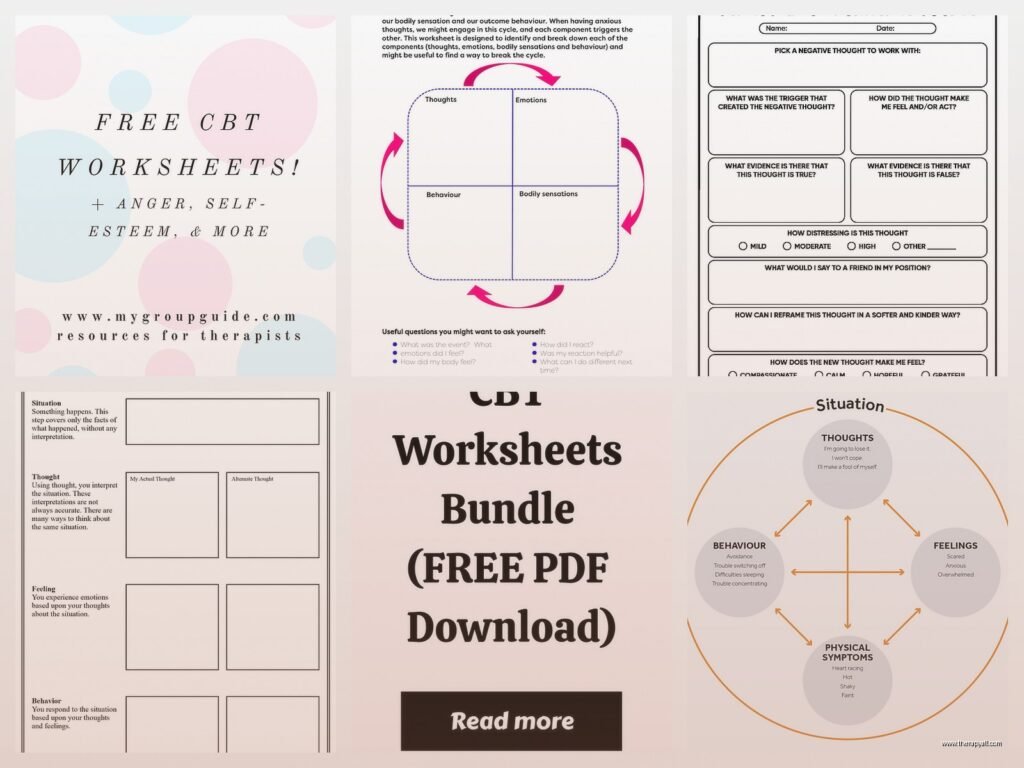
A Hot Cross Bun worksheet typically puts the situation or trigger event in the center, then has four sections radiating out from it. You fill in each quadrant based on a specific moment or scenario you’re analyzing.
**Start with the situation.** Be specific. Not “work stress” but “presentation to the board on Thursday at 2pm” or “text from my sister about Thanksgiving plans.” Vague situations produce vague insights, and you’re gonna waste your time.
The more concrete you are about the trigger moment, the easier it becomes to identify the four components. “Social anxiety” as your situation doesn’t help—but “walking into the coffee shop and seeing it’s crowded with nowhere to sit” gives you something to work with.
## Filling Out Each Section Effectively
When you tackle the thoughts section, write down the actual words or images in your head during that situation. First-person statements work best. Stream of consciousness is fine. You might have multiple thoughts—write them all down. “I look stupid,” “People are staring,” “I should leave,” “Why did I come here,” “I’m so awkward.” Don’t censor yourself or try to make them rational yet.
For feelings, stick to actual emotion words. Anxious, embarrassed, angry, sad, scared, frustrated, ashamed, lonely, hopeless. If you write a sentence, you’ve probably written a thought instead. Check yourself.
Physical sensations should be body-focused and descriptive. Where in your body do you notice something? Heart pounding, stomach churning, face flushing, hands shaking, throat tight, shoulders tense, breathing shallow. I spent summer 2021 writing worksheet guides and I started actually filling them out myself during stressful moments, and I was genuinely surprised how much tension I carry in my jaw that I never noticed before.
Behaviors include both what you did and what you avoided or wanted to do. “Left the coffee shop immediately,” “Checked my phone to look busy,” “Avoided eye contact,” “Ordered quickly without thinking,” “Texted a friend for reassurance.” Even subtle behaviors count—like that thing where you suddenly become very interested in your shoelaces.
## Why This Visual Model Works
The Hot Cross Bun format helps you see patterns you might miss if you’re just thinking about your problems. When it’s all laid out visually, you start noticing things like “oh, every time I think X, I feel Y and do Z.” That awareness is actually the first step in changing anything.
It also shows you where you might intervene. Can’t always control the situation or immediately change your thoughts, but maybe you can notice the physical sensations early and do some breathing exercises before the whole cycle spirals. Or maybe you can identify the behavior that’s reinforcing everything and try something different there.
The model makes it clear that you don’t have to fix all four quadrants at once—changing one element affects the others. If you change the behavior (force yourself to stay in the coffee shop for five minutes instead of leaving), that might shift the thoughts (“I stayed and nothing terrible happened”), which influences the feelings and even the physical sensations.
## Common Mistakes People Make
Putting thoughts in the feelings section is probably the number one issue. “I feel like I’m going to fail” is not a feeling—you think you’re going to fail, and you feel anxious or scared about it. This matters because CBT techniques for challenging thoughts are different from techniques for managing emotions, and if you can’t tell them apart, you’re gonna struggle with the interventions.
Another mistake is being too general. “I feel bad” doesn’t tell you much. Bad how? Sad? Angry? Guilty? Ashamed? Disappointed? Each of those emotions might connect to different thoughts and require different approaches. Same with physical sensations—”I feel tense” is a start, but where? Your shoulders, your stomach, your whole body?
Some people also fill it out retrospectively and try to remember what they thought or felt hours or days ago, and then they end up with what they think they probably thought, which isn’t the same as what actually went through their mind in the moment. The worksheet works best when you use it close to the actual situation or at least while the memory is fresh.
## Variations and Related Models
You might see this called the “four factors model” or “four systems model” or just “CBT formulation” in some resources. The hot cross bun name is just the UK version because, well, hot cross buns are more of a thing there. Some versions add a fifth element for environment or context, which honestly makes sense but also makes the bun metaphor fall apart, so… there’s that.
The five-part model used in some CBT protocols is basically the same thing with the situation/environment separated out from the four main components. Either version works—pick whichever makes more sense to you.
## Practical Applications Beyond Anxiety
While the Hot Cross Bun worksheet gets used a lot for anxiety (because anxiety cycles are super obvious once you map them out), it works for depression, anger issues, relationship problems, basically any pattern you’re trying to understand or change.
For depression, you might notice how the thought “nothing matters” leads to feelings of hopelessness, physical fatigue, and behaviors like staying in bed, which then reinforces the thought that nothing matters because you’re not doing anything. Seeing it laid out like that makes it obvious why behavioral activation (forcing yourself to do things even when you don’t feel like it) can actually interrupt the cycle.
With anger, you might see how the physical sensation of tension comes first, then the thought “they’re disrespecting me,” then the feeling of rage, then the behavior of yelling, which creates more tension. Maybe if you catch the physical tension early, you can step away before the whole sequence unfolds—or maybe not, I don’t know your life, but at least you’d understand what’s happening.
## How to Actually Use This in Real Life
Keep blank Hot Cross Bun worksheets accessible—on your phone, in a notebook, wherever you’ll actually use them. When you notice yourself getting activated or stuck in a pattern, take five minutes to fill one out. You don’t need perfect handwriting or complete sentences. Bullet points work fine.
Do it multiple times for the same type of situation. If social situations trigger you, fill out a worksheet after several different social events. You’ll start seeing the consistent thoughts (“people think I’m boring”), the recurring feelings (anxiety and shame), the typical physical responses (face flushing, voice shaking), and the habitual behaviors (leaving early, drinking too much, avoiding eye contact). Those patterns are what you work on in therapy or with CBT self-help techniques.
Once you’ve identified patterns, you can start testing interventions. What happens if you change the behavior? What if you challenge the thought? What if you address the physical sensation first? The worksheet becomes a way to track what works and what doesn’t.
## Integration with Other CBT Tools
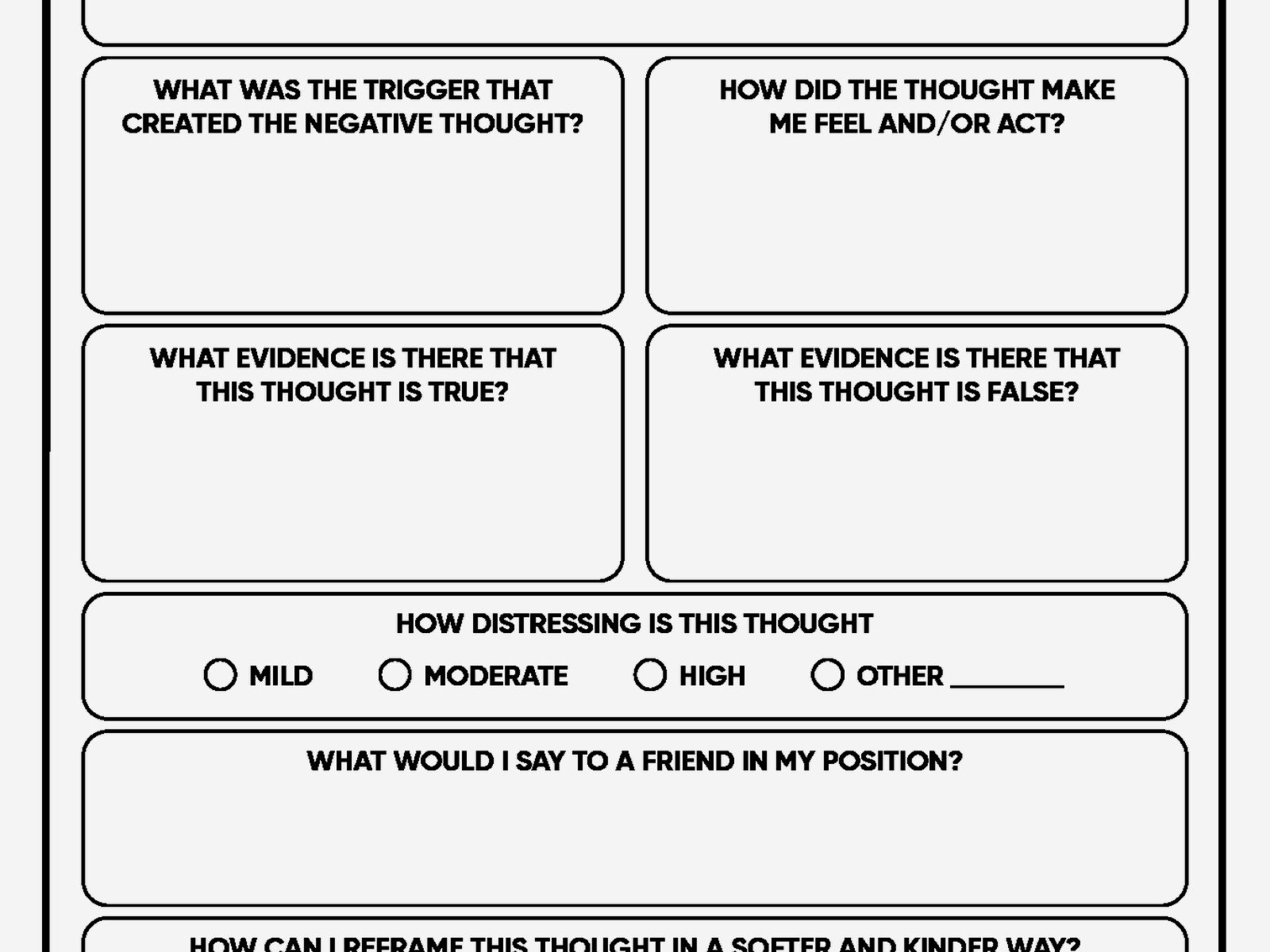
The Hot Cross Bun model pairs well with thought records, behavioral experiments, and exposure hierarchies. You might use the hot cross bun to identify the thought “I’ll have a panic attack if I go to the grocery store,” then use a thought record to examine the evidence for and against that thought, then design a behavioral experiment to test it.
It also works alongside mindfulness practices because filling out the worksheet requires you to pause and observe what’s actually happening rather than just reacting automatically. You’re developing that meta-awareness of your own internal processes, which sounds fancy but really just means noticing what you’re thinking and feeling instead of being completely swept up in it.
## When the Model Feels Limiting
Sometimes the hot cross bun framework feels too rigid or doesn’t capture the complexity of what you’re experiencing. That’s fine—it’s a tool, not a rule. If it’s not helpful for a particular situation, skip it. Some moments are too nuanced or too overwhelming to fit neatly into four boxes.
Other times you might have competing thoughts or contradictory feelings happening simultaneously, and trying to organize them into the model just creates more confusion. The worksheet is supposed to clarify, not complicate. If it’s making things worse, you probably need a different approach or maybe just need to talk it through with someone rather than writing it down.
The model also doesn’t account for trauma responses particularly well because trauma reactions often bypass the thought component entirely—you go straight from trigger to physical response to behavior without conscious thoughts mediating the process, or at least not in a way that’s easy to identify and write down in a quadrant.

ADHD & Neurodiversity
Life Planner Bundle – Life Organizer
Self-Care & Personal Growth
Acceptance And Commitment
Anxiety & Stress
Stress Processing Journal & Reflection Worksheets For Daily Self – Care
Self-Care & Personal Growth
Self – Reflection Guided Journal With Guided Prompts 30
Emotional Wellness
Decision Processing – Thought Processing Journal For Daily Self – Care
Therapist Resources
Physiotherapist Journal PDF Planner Tracker Or Log Book
Self-Care & Personal Growth
Customizable Self – Confidence & Self – Esteem Guided Journal
ADHD & Neurodiversity
ADHD Behavior Tracker PDF Planner Tracker Or Log Book