
Mental Health, Therapy resources
Therapy Values Worksheet: Clarify What Matters Most to You
Jun
# Understanding the Therapy Values Worksheet
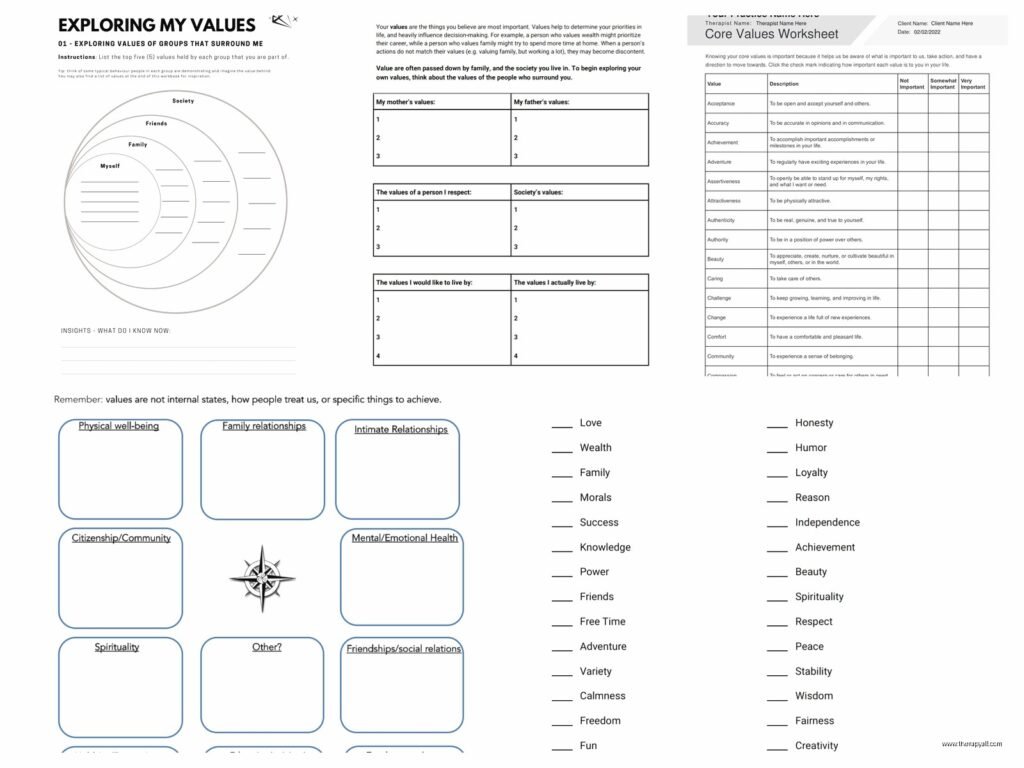
Values worksheets show up everywhere in therapy—ACT practitioners love them, CBT therapists use them for goal-setting, even psychodynamic folks will sneak one in when someone’s completely stuck. The basic premise is straightforward: you identify what actually matters to you, not what you think should matter or what your parents wanted or what looks good on paper.
I remember sitting with a client in 2019 who kept saying she valued “success” and when I asked what that meant, she just stared at me. We spent three sessions circling around it before I finally pulled out a values worksheet, and she realized she’d been chasing her ex-husband’s definition of success for like fifteen years after the divorce. That’s the thing about values work—it sounds simple until you’re actually doing it.
## What Makes a Values Worksheet Different from Goal-Setting
Here’s where people get confused, and honestly, a lot of therapy content doesn’t help. Goals are specific, measurable things you want to achieve. Values are directions you want to move in. You can complete a goal. You can’t complete a value because it’s ongoing.
If your value is connection, you don’t check it off once you make a friend. Connection becomes something you orient toward in decisions—do I take this job that pays more but requires 70-hour weeks, or do I prioritize time with people I care about? The worksheet helps you name these directions so you’re not just reacting to whatever crisis showed up that day.
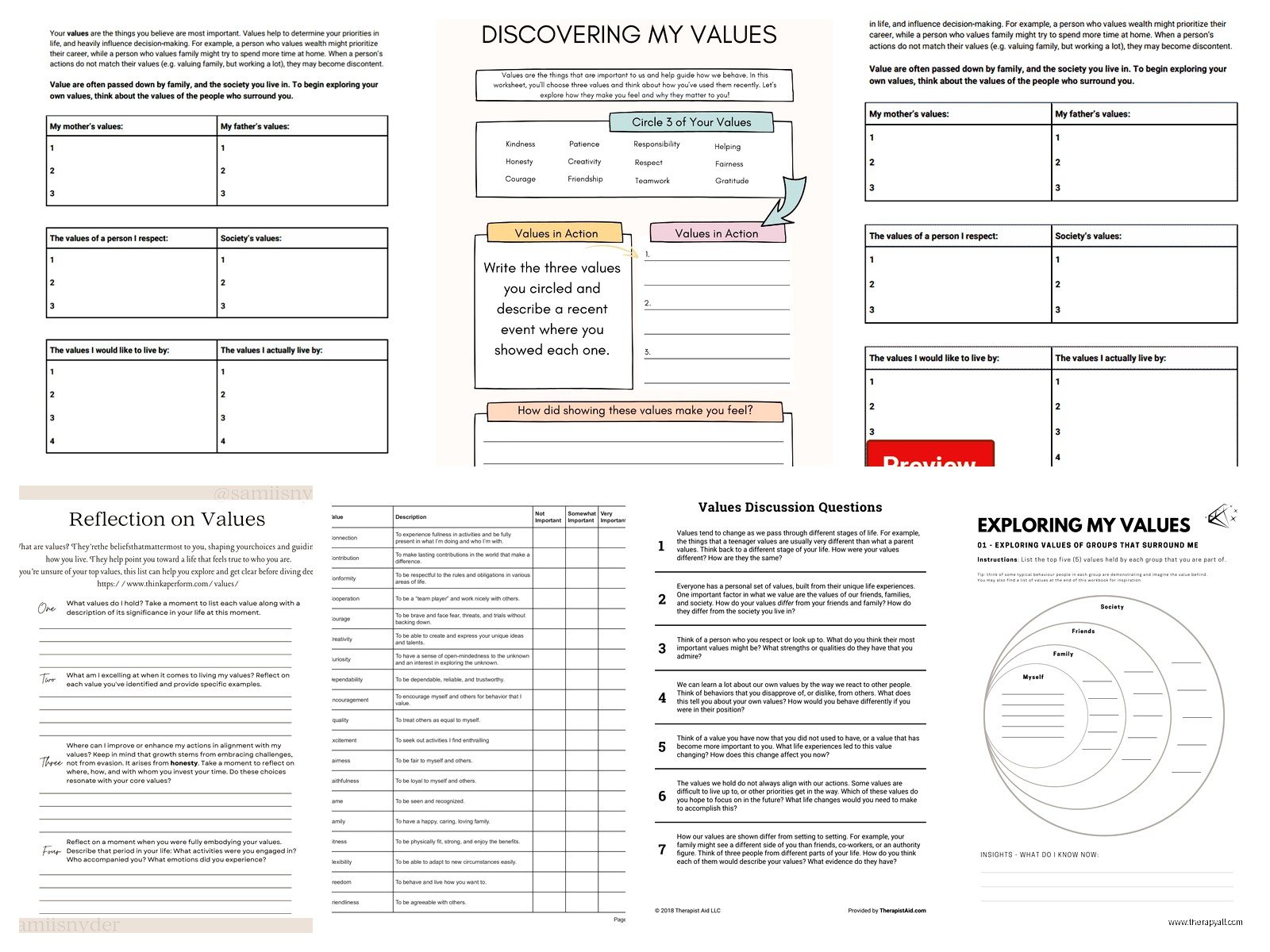
Most values worksheets will give you a list of common values—things like authenticity, creativity, family, health, learning, spirituality, adventure. You usually rank them or choose your top five or ten. Some worksheets ask you to define what each value means to you specifically because “family” means something totally different to someone who had great parents versus someone who’s setting boundaries with toxic relatives.
## The Structure Most Worksheets Follow
You’re gonna see some variation, but most therapy values worksheets have these components:
**Value identification**: Usually a list of 50-100 possible values. You read through and mark the ones that resonate. Some worksheets ask you to do this quickly without overthinking, which is actually harder than it sounds. I’ve watched people spend 20 minutes debating whether they value “stability” or just think they should value it.
**Ranking or prioritization**: Once you’ve identified maybe 15-20 values that matter, you narrow down. Top ten, top five, sometimes top three. This is where it gets uncomfortable because you’re essentially saying some things matter more than others, and that feels wrong to a lot of people.
**Definition section**: Good worksheets include space to write what each value means to you. “Creativity” might mean painting for one person and problem-solving at work for another. Without this step, you end up with a list of abstract words that don’t actually guide behavior.
**Current alignment assessment**: This is the part that actually annoys me when it’s done badly—worksheets that just ask “are you living according to your values?” like it’s a yes/no question. The better versions ask you to rate on a scale how aligned your current life is with each value, or they ask for specific examples of when you did or didn’t honor that value recently.
**Action planning**: Some worksheets stop at identification, which is kinda useless honestly. The ones worth using include a section where you brainstorm small, concrete actions that align with each value. If you value health, what’s one thing you could do this week? Not “get healthy” but like, “take a 10-minute walk on Tuesday.”
## How to Actually Use One Without Making It Another Self-Improvement Project
I wrote a roundup of values worksheets in summer 2020—I think I reviewed like twelve different versions—and I started actually using them myself because I was curious what the experience was like. What I noticed is there’s this temptation to turn it into another thing you’re failing at.
You identify that you value creativity and then immediately start beating yourself up for not painting enough or writing enough or whatever. That’s not the point. The worksheet is supposed to give you information about what matters so you can make decisions, not so you can add more items to your mental list of ways you’re inadequate.
When you’re filling it out, you wanna pay attention to the difference between values you actually hold and values you think you should hold. If everyone around you values ambition and career advancement but you genuinely just want a stable job that pays the bills so you can focus on hobbies, that’s real information. The worksheet only works if you’re honest, which sounds obvious but you’d be surprised how many people fill these out with their “best self” in mind instead of their actual self.
## Common Values That Show Up and What They Actually Mean in Practice
**Authenticity**: This one’s everywhere. People love saying they value authenticity. In practice, it usually means something like “I want to stop pretending to be interested in things I’m not” or “I want to date people I’m actually attracted to instead of people who look good on paper.” Sometimes it means “I’m gonna start telling people what I really think” which can go sideways fast if you don’t also value tact.
**Family**: Could mean spending every Sunday with your parents or could mean creating chosen family with friends. Could mean having kids or could mean being the aunt who shows up. The word itself doesn’t tell you much.
**Health**: Physical health, mental health, both? Does this mean working out five days a week or does it mean not hating your body? Does it include rest or just productive health activities? You gotta define this one carefully because it’s easy to turn into diet culture nonsense.
**Learning/Growth**: Usually means people like acquiring new skills or knowledge, but sometimes it’s code for “I get bored easily and need novelty.” Both are fine, but they lead to different action steps.
**Independence**: This value trips people up constantly because—wait, my cat just knocked over my water bottle, hold on—okay, because Western culture pushes independence so hard that people think they value it when they actually value interdependence or community. Real independence might mean financial self-sufficiency or it might mean making decisions without seeking approval. Figure out which.
## The ACT Approach to Values Work
Acceptance and Commitment Therapy basically built its whole model around values. ACT sees values as chosen life directions that guide ongoing action. The therapy uses values work to help people move toward what matters even when it’s uncomfortable or scary.
ACT worksheets often include questions about different life domains: relationships, work/education, personal growth, recreation, health, spirituality. You identify values in each domain and then look at whether your actions match. The gap between values and actions is where suffering often lives.
One thing I really appreciate about the ACT approach is it doesn’t treat values as static. You’re allowed to have different values at different life stages. What mattered at 25 might not matter at 40. What mattered before you had kids might shift after. The worksheet becomes something you revisit, not a one-time exercise.
## What Therapists Actually Do with These Worksheets
In session, a therapist might use a values worksheet when you’re stuck in rumination or avoidance. If you’re spending three months debating whether to leave your job, identifying your core values gives you a framework for the decision that’s not just pros/cons lists.
They’re also useful when someone’s motivation is low. Depression tends to flatten everything—nothing seems to matter. Working through a values worksheet can sometimes reconnect you to what used to matter or help identify what might matter if the depression lifted. It’s not a cure, obviously, but it’s a tool.
Some therapists assign values worksheets as homework between sessions. You fill it out, bring it back, and then you talk through what came up. Did anything surprise you? Were there conflicts between values? Did you notice yourself avoiding certain values?
The conversation around the worksheet is often more valuable than the worksheet itself, honestly. I’ve seen people have complete realizations just from having to articulate why they chose “adventure” over “security” or vice versa.
## When Values Conflict and What to Do About It
Here’s what nobody tells you: your values will contradict each other. You might value both freedom and commitment. You might value both career success and work-life balance. You might value both honesty and kindness, and sometimes those pull in different directions.
Good values worksheets acknowledge this. They include questions about how you navigate conflicts between values or how you prioritize when two values are competing for your time and energy. If you value both family connection and creative work, how do you decide whether to go to your nephew’s recital or finish your project?
There’s no right answer, which is sorta the point. The worksheet helps you make conscious choices instead of just reacting or letting guilt decide. You might choose family this time and creative work next time, and that’s fine as long as you’re aware you’re making a choice based on what matters to you.
## The Badly Designed Worksheets That Drive Me Up the Wall
I’ve seen so many values worksheets that are just… bad. The ones that list values in a way that’s leading—putting “God” and “spirituality” and “faith” all separately like they’re trying to stack the deck. The ones that include “values” that are actually personality traits or emotions. “Happiness” is not a value. It’s a feeling that might result from living according to your values, but it’s not a direction you move toward.
The worksheets that don’t leave space for nuance are also frustrating. Real life is complicated. You might value environmental sustainability but also need to drive a car to get to work because public transit doesn’t exist where you live. The worksheet should help you think through those tensions, not make you feel like a hypocrite.
And the ones with that inspirational quote at the top or the sunset photo background—nah. This is practical work, not a motivational poster. Just give me the questions and space to write.
## How Values Work Changes Your Therapy Approach
Once you’ve identified your values, they become a reference point for basically everything else in therapy. Cognitive distortions, behavior patterns, relationship dynamics—you can evaluate all of it through the lens of whether it moves you toward or away from your values.
If you value connection but your anxiety keeps you from reaching out to friends, that’s actionable information. You’re not working on the anxiety because anxiety is “bad,” you’re working on it because it’s blocking something that matters to you. That distinction actually helps with motivation.
Same with boundaries. If you value both kindness and authenticity, you can set boundaries that honor both—saying no in a way that’s honest but not cruel. Without knowing your values, boundaries can feel arbitrary or mean. With values clarity, they make sense.
## The Difference Between Values and Morals
This trips people up and honestly some worksheets don’t make the distinction clear. Morals are usually about right and wrong—lying is wrong, stealing is wrong, helping others is right. They’re often shaped by culture, religion, family background.
Values are more personal and about what you want your life to be about. You might have a moral belief that honesty is right, and you might also have a personal value of authenticity. They overlap but they’re not identical.
Some people’s values align perfectly with their moral framework. Other people have values that conflict with the morals they were raised with, and that creates a whole thing to work through in therapy. The worksheet helps you separate what you actually value from what you were told to value.
## Revisiting Your Values Over Time
I mentioned this earlier but it’s worth expanding—values aren’t supposed to be set in stone. A good practice is to revisit your values worksheet every year or so, or whenever you’re going through a major life transition. New job, relationship change, health diagnosis, moving cities, whatever.
What mattered when you were building your career might shift when you’re established. What mattered before you had kids definitely shifts after. What mattered when you were healthy might change after chronic illness. This isn’t failure or inconsistency, it’s just being human.
Some values stay consistent across your whole life. Others are phase-specific. Both are fine. The worksheet gives you permission to acknowledge that and adjust accordingly instead of trying to force yourself to care about things that don’t matter to you anymore.

ADHD & Neurodiversity
Life Planner Bundle – Life Organizer
Self-Care & Personal Growth
Acceptance And Commitment
Anxiety & Stress
Stress Processing Journal & Reflection Worksheets For Daily Self – Care
Self-Care & Personal Growth
Self – Reflection Guided Journal With Guided Prompts 30
Emotional Wellness
Decision Processing – Thought Processing Journal For Daily Self – Care
Therapist Resources
Physiotherapist Journal PDF Planner Tracker Or Log Book
Self-Care & Personal Growth
Customizable Self – Confidence & Self – Esteem Guided Journal
ADHD & Neurodiversity
ADHD Behavior Tracker PDF Planner Tracker Or Log Book