
Mental Health, Therapy resources
Art Therapy Handouts: Ready-to-Use Creative Healing Activities

Jun
What Art Therapy Handouts Actually Are
Art therapy handouts are structured creative prompts designed to help people process emotions, reduce stress, or explore mental health themes through visual expression. They’re not just random coloring pages. They include guided drawing exercises, collage templates, paint-based emotion maps, clay prompts, photography assignments, and mixed-media projects with specific therapeutic intentions behind them.
I remember sitting in a supervision meeting back in 2019 when a colleague showed me her art therapy handout collection, and honestly, half of them looked like they’d been photocopied so many times the instructions were barely readable. She was using them with teens in a residential program, and I could see how much they helped, but the presentation was just… rough. That’s when I started realizing that the gap between clinical effectiveness and actual usability was kinda huge in this space.
The handouts work because they remove the “blank canvas” intimidation factor. You get a framework. You don’t have to be artistic or know what you’re doing. The structure guides the process while still leaving room for personal expression and interpretation.
Who Uses These and Why
Therapists, counselors, art therapists, social workers, school psychologists, group facilitators, and psychiatric nurses use art therapy handouts regularly. They’re also used in hospitals, rehab centers, correctional facilities, community mental health centers, and private practices. Some people use them independently for self-care, though that’s not really the primary design intention.
You use them when traditional talk therapy isn’t landing, when someone’s too activated to sit still and just talk, when working with kids who can’t articulate complex feelings yet, when you need a non-threatening entry point into trauma work, or when group members need a shared activity that doesn’t require them to perform vulnerability immediately.
What genuinely annoys me is when people conflate art therapy handouts with adult coloring books. They’re not the same thing. Adult coloring books are fine for stress relief, but they’re passive. You’re filling in someone else’s design. Art therapy handouts ask you to create something that reflects your internal experience. There’s a therapeutic intention and usually a follow-up reflection component. The coloring book industry has kind of muddied the waters here, and now everyone thinks mandalas equal therapy, which, nah, that’s not how this works.

Types of Ready-to-Use Activities
Emotion Identification and Expression
These handouts help people recognize and name what they’re feeling. Common formats include feeling wheels you color-code based on intensity, body maps where you draw or mark where emotions show up physically, emotion color charts, feeling faces templates, and weather metaphor drawings where you illustrate your emotional climate.
The body map one is particularly effective with trauma survivors who’ve disconnected from physical sensations. You give them an outline of a human figure and ask them to use colors, symbols, or words to show where they hold tension, pain, numbness, or safety. I’ve seen people have major breakthroughs just from noticing they always draw darkness in their chest or heat in their shoulders.
Coping Skills and Safety Planning
These include illustrated coping toolbox templates, safe place visualization drawings, grounding technique visual guides, self-soothing activity menus, and crisis plan posters. They’re practical and action-oriented.
The toolbox handout is one I used constantly when I was writing content for a crisis intervention platform in 2021. You draw or collage items that represent your coping strategies, like a phone for calling a friend, headphones for music, running shoes for exercise, or a journal for writing. It makes abstract coping skills concrete and easier to remember when you’re actually in distress.
Identity and Self-Concept Work
These explore who you are beyond your symptoms or struggles. Formats include “I am” poems with visual elements, self-portrait variations, personal timeline illustrations, values clarification collages, strengths shields or coats of arms, and identity mandala templates divided into life domains.
The timeline ones can get heavy quickly, so you gotta be careful about when you introduce them. You’re asking someone to visually map significant life events, which means trauma will probably come up. But for people who struggle with narrative coherence, seeing their story laid out spatially can be incredibly organizing.
Relationship and Communication Exercises
These include family sculpture drawings, social support network maps, boundary visualization activities, communication pattern illustrations, and conflict processing templates. They’re useful in family therapy, couples work, or group settings.
The social support map is basically concentric circles with “me” in the center, and you place people in your life at different distances based on closeness and support level. Then you can use different colors or symbols to show the quality of each relationship. It’s simple but it makes isolation really visible, which can be the push someone needs to start rebuilding connections.
Trauma Processing and Narrative Work
These are more advanced and require clinical judgment about timing and client readiness. They include before-and-after drawings, trauma timeline activities, safe container visualizations where you draw a place to “store” difficult material, witness figure drawings, and sequential art panels for storytelling.
The safe container one is something I always recommend having in your back pocket. When someone starts to go into trauma material but you’re near the end of a session or they’re getting too dysregulated, you can pull out this handout and have them draw a box, safe, treasure chest, or whatever container feels right, then symbolically place the difficult content inside until next session. It sounds simplistic but it works for containment.
How to Actually Use Them in Practice
You don’t just hand someone a worksheet and walk away. There’s a process. You introduce the activity with clear instructions, explain the therapeutic purpose without over-explaining, provide the necessary materials, give them adequate time to complete it, and then process the experience together afterward.
The processing part is where the actual therapy happens. You ask open-ended questions about their choices, notice what they avoided or emphasized, explore any surprises or difficulties that came up, and help them connect the creative product to their presenting concerns. The art itself isn’t the endpoint, it’s the conversation starter.
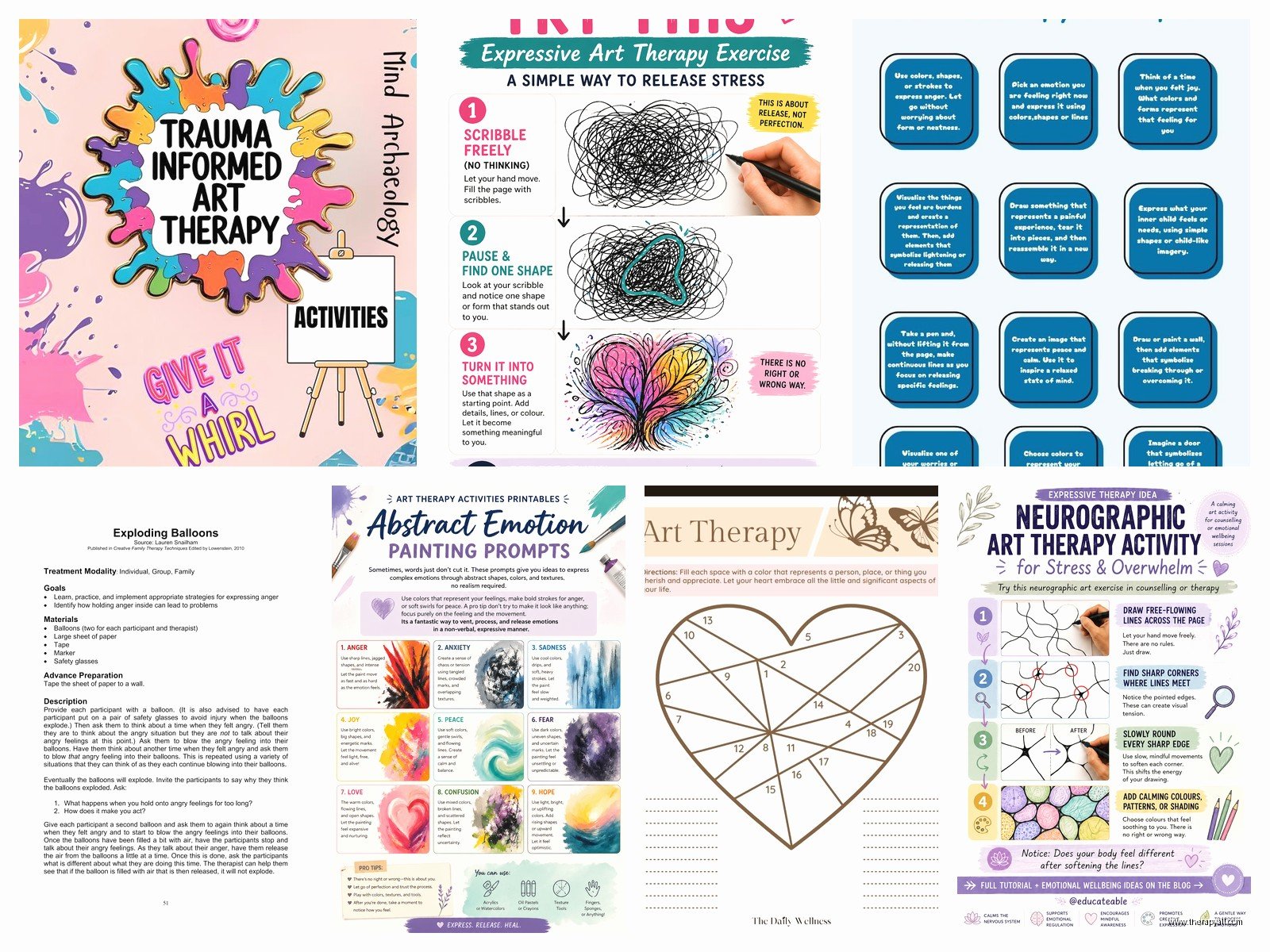
I learned this the hard way during a group I facilitated in summer 2020 where I gave everyone a feelings mandala handout and then just… didn’t leave enough time to process. We ran out of time and people left holding these emotionally loaded drawings with nowhere to put the feelings that had come up. Not my finest moment. Now I always work backward from the end time and make sure there’s at least 15 minutes for discussion.
Material Considerations
You need actual art supplies, not just printer paper and a pencil. Keep markers, colored pencils, crayons, oil pastels, watercolors, magazines for collage, glue sticks, scissors, and different paper types available. The tactile quality of materials matters. Sometimes someone will refuse to engage with markers but will spend an hour working with clay or torn paper.
My cat once knocked over an entire container of oil pastels during a telehealth session and the client and I just watched them roll across my floor for a solid ten seconds before I could even react, which was honestly a better icebreaker than anything I’d planned.
Adapting for Different Populations
Kids need more concrete prompts and shorter activities. Teens respond to things that don’t feel childish, they want edgy or abstract options. Adults often need permission to be “bad” at art and reassurance that this isn’t about skill. Older adults might have vision or dexterity limitations that require larger formats or different materials.
Cultural considerations matter too. Some visual symbols or metaphors don’t translate across cultures. The weather metaphor for emotions works great in some contexts and falls completely flat in others. You can’t assume everyone relates to your reference points.
Creating Your Own vs. Using Templates
Ready-to-use handouts save time and provide structure, but they’re not always gonna fit your specific client or situation. Sometimes you need to modify them or create something new. The advantage of templates is consistency and the fact that they’ve usually been tested, but they can also feel generic.
When you create your own, you can tailor it exactly to what you’re addressing, incorporate cultural elements that matter to your client population, and adjust complexity levels. The downside is time. If you’re seeing 30 clients a week you probably don’t have hours to design custom handouts for everyone.
A middle path is taking existing templates and adapting them. Change the prompts, add or remove sections, modify the visual layout, or combine elements from multiple handouts. I do this constantly and it feels more authentic than using something totally off-the-shelf while still being efficient.
Common Formats and Delivery Methods
Most art therapy handouts come as PDFs you can print and photocopy. Some are designed as digital files clients can complete on tablets or computers, though I find that loses some of the therapeutic benefit because the tactile element disappears. There are also workbook-style collections with multiple activities organized by theme or clinical issue.
During the telehealth explosion in 2020 and 2021, a bunch of digital art therapy platforms emerged, but honestly most of them were clunky and my clients hated them. There’s something about the physical act of making marks on paper that you just can’t replicate with a stylus and screen for a lot of people, or maybe I’m just old-fashioned about this, I don’t know.
Single-Session vs. Series Activities
Some handouts are designed as one-time activities. You complete them in a session, process them, and move on. Others are meant to be repeated or built upon over time. A mood tracking mandala might be something you return to weekly. A trauma timeline might span multiple sessions as you add detail gradually.
Series activities create continuity and let you track progress visually. You can literally see how someone’s self-concept or coping strategies have expanded by comparing handouts from different points in treatment.
What Makes a Handout Actually Good
Clear instructions that don’t require a graduate degree to understand. Enough structure to provide direction but enough openness for personal expression. Culturally neutral imagery and language unless it’s specifically designed for a particular population. Appropriate complexity for the intended age or functioning level. And please, readable fonts and clean layouts.
Bad handouts are cluttered, use tiny text, include clipart that’s either childish or weirdly corporate, have confusing instructions, or try to do too many things at once. I’ve seen handouts that combined gratitude journaling with trauma processing with goal-setting all on one page and it’s like, pick a lane, you know?
The reflection questions matter as much as the activity itself. Generic questions like “how did this make you feel” are weak. Better questions are specific: “What surprised you about the colors you chose?” or “If this drawing could talk, what would it say?” or “What part was hardest to create and what does that tell you?”
Ethical and Clinical Considerations
You need informed consent before using art therapy techniques, especially with trauma-focused activities. Clients should understand the purpose and have the right to decline. You also need to be trained in whatever you’re implementing because art therapy can bring up unexpected material and you need to know how to handle that.
Documentation gets tricky. Do you keep the physical artwork? Photograph it? Let the client take it home? There are different approaches and you need a clear policy. Some clients want to destroy what they create, which can itself be therapeutic, but then you don’t have a record.
There’s also the question of interpretation. You’re not analyzing someone’s art like it’s a projective test unless you’re specifically trained in that. You’re using it as a springboard for discussion and exploration. The client is the expert on what their art means, not you.
Where to Find Quality Resources
Professional organizations like the American Art Therapy Association have resource libraries. Therapeutic publishing companies like PESI, Therapist Aid, and Creative Counseling Resources sell handout collections. Some individual therapists and art therapists sell their materials on Teachers Pay Teachers or Etsy, though quality varies wildly there.
Free resources exist but you get what you pay for. Some are excellent, many are mediocre, and a few are actively bad. Pinterest is full of things labeled “art therapy” that are really just craft projects with no therapeutic framework.
When you’re evaluating a resource, look at who created it and what their credentials are. Was it made by an actual art therapist or counselor, or just someone who likes making printables? Is there any citation of therapeutic theory or research? Are the activities linked to specific clinical goals?
ADHD & Neurodiversity
Life Planner Bundle – Life Organizer
Self-Care & Personal Growth
Acceptance And Commitment
Anxiety & Stress
Stress Processing Journal & Reflection Worksheets For Daily Self – Care
Self-Care & Personal Growth
Self – Reflection Guided Journal With Guided Prompts 30
Emotional Wellness
Decision Processing – Thought Processing Journal For Daily Self – Care
Therapist Resources
Physiotherapist Journal PDF Planner Tracker Or Log Book
Self-Care & Personal Growth
Customizable Self – Confidence & Self – Esteem Guided Journal
ADHD & Neurodiversity
ADHD Behavior Tracker PDF Planner Tracker Or Log Book