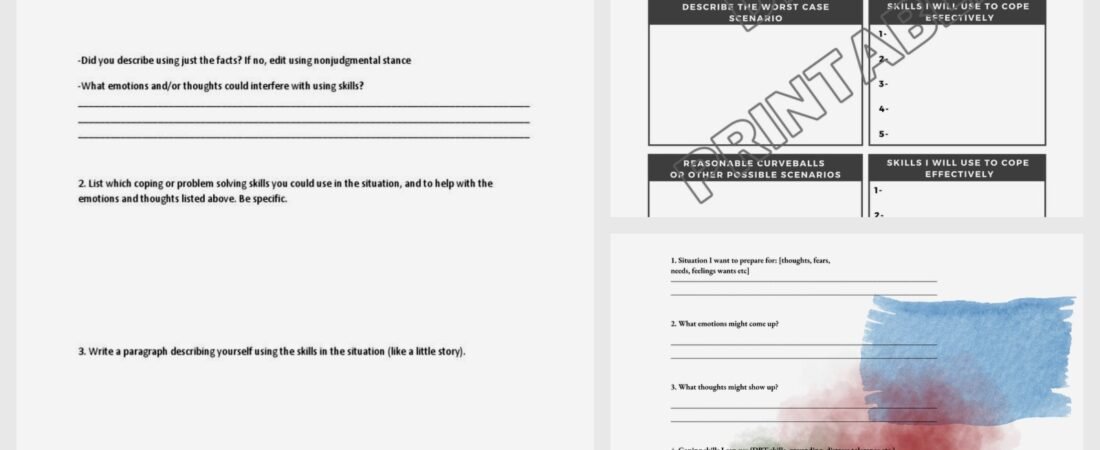
What the COPE AHEAD Skill Actually Does
COPE AHEAD is a DBT distress tolerance skill that helps you mentally rehearse difficult situations before they happen. The acronym stands for: Cope ahead of time by thinking about what might happen, Overcoming obstacles by planning how to handle them, Practicing in your mind what you’ll do and say, Ending with imagining yourself coping effectively, Accepting that you can’t control everything, Having a plan for when things don’t go perfectly, Evaluating afterward what worked and what didn’t.
Actually, I just gave you the wrong breakdown. Let me fix that because this genuinely annoys me—people online keep making up their own versions of what COPE AHEAD stands for and it creates so much confusion. The real DBT acronym from Marsha Linehan’s manual is simpler: you Cope ahead, Practice, and Have a plan. The worksheet guides you through imagining a stressful situation, identifying what emotions might come up, deciding what skills you’ll use, and mentally rehearsing the whole thing like you’re running a dress rehearsal in your head.
I remember back in 2019 when I was working on a mental health resource site and we were building out a whole DBT section. One of the graphic designers kept asking me why we needed so many worksheets for “the same thing” and I had to explain that DBT skills are kinda like tools in a toolbox—you don’t use a hammer for every job. COPE AHEAD is specifically for preparation, not for in-the-moment crisis management.
When You’d Actually Use This Worksheet
You use COPE AHEAD when you know something difficult is coming. A job interview. A conversation with your ex about custody schedules. Thanksgiving dinner with your family where your uncle always brings up politics. A medical appointment that makes you anxious. The dentist. Court dates. First day at a new job.
The worksheet walks you through the situation step by step. You describe what’s going to happen, when it’s happening, where you’ll be. You identify what emotions you expect to feel—maybe anxiety, anger, sadness, or that weird combination of dread and numbness. Then you figure out which DBT skills you’re gonna use when those emotions show up.
Let’s say you have to attend a meeting with someone who criticized your work last month and it really got under your skin. You know you’ll feel defensive and maybe embarrassed. The worksheet prompts you to choose skills like STOP (Stop, Take a step back, Observe, Proceed mindfully) or TIPP (Temperature, Intense exercise, Paced breathing, Paired muscle relaxation). You write down specifically what you’ll do: “I’ll take three deep breaths before responding” or “I’ll excuse myself to the bathroom if I feel tears coming.”
How to Fill Out the Worksheet Properly
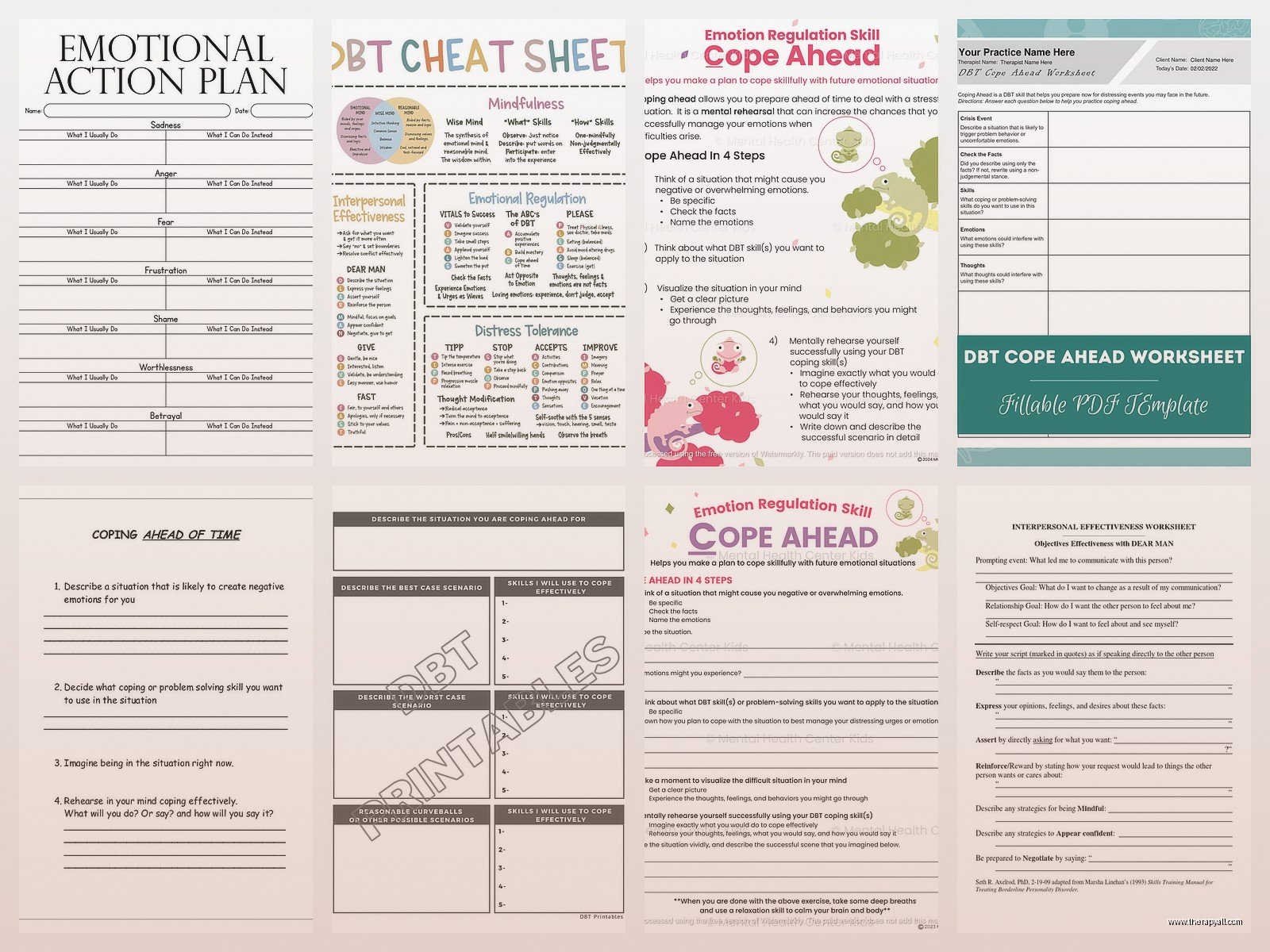
Most COPE AHEAD worksheets follow a similar structure. Here’s what you’re actually filling in:
Describe the situation: Be specific. Not “family gathering” but “Sunday dinner at Mom’s house, 5pm, my sister will probably be there with her new boyfriend, we’ll eat in the dining room, dinner usually lasts 90 minutes.”
Identify potential problems: What could go wrong? What usually goes wrong in situations like this? My sister might make passive-aggressive comments about my job. Mom might ask when I’m getting married. I might drink too much wine to cope and say something I regret.
Decide which skills to use: This is where you get practical. Not “I’ll stay calm”—that’s not a skill, that’s a wish. Instead: “I’ll use DEAR MAN if my sister criticizes me. I’ll use the STOP skill before responding to Mom’s questions. I’ll limit myself to one glass of wine and bring my own sparkling water.”
Imagine the situation from start to finish: This is the mental rehearsal part. You close your eyes and walk through the whole thing in your mind. You imagine parking the car, walking up to the door, greeting everyone, sitting down at the table. You imagine your sister making that comment, and you imagine yourself taking a breath, using your skill, responding effectively or not responding at all.
Rehearse your coping: You practice in your mind what you’ll actually say and do. Some people find it helpful to rehearse out loud or even role-play with a friend or therapist. I’ve had clients who literally stand in front of a mirror and practice their facial expressions so they don’t automatically make that eye-roll face when their dad says something irritating.
The Part Nobody Talks About
The worksheet also asks you to imagine things not going according to plan, which—okay, this part is actually brilliant but also kinda anxiety-inducing if you’re already anxious. You’re supposed to imagine yourself coping even when your planned skills don’t work perfectly. What if you do use DEAR MAN and your sister still won’t drop it? What if you take three deep breaths and you still feel furious?
That’s when you build in backup skills. Plan A is DEAR MAN. Plan B is excusing yourself to the bathroom. Plan C is leaving early. You’re not trying to create a foolproof system—you’re trying to prevent that total blank-out moment where you freeze or default to old patterns because you didn’t think ahead.
Where to Find Free PDF Worksheets
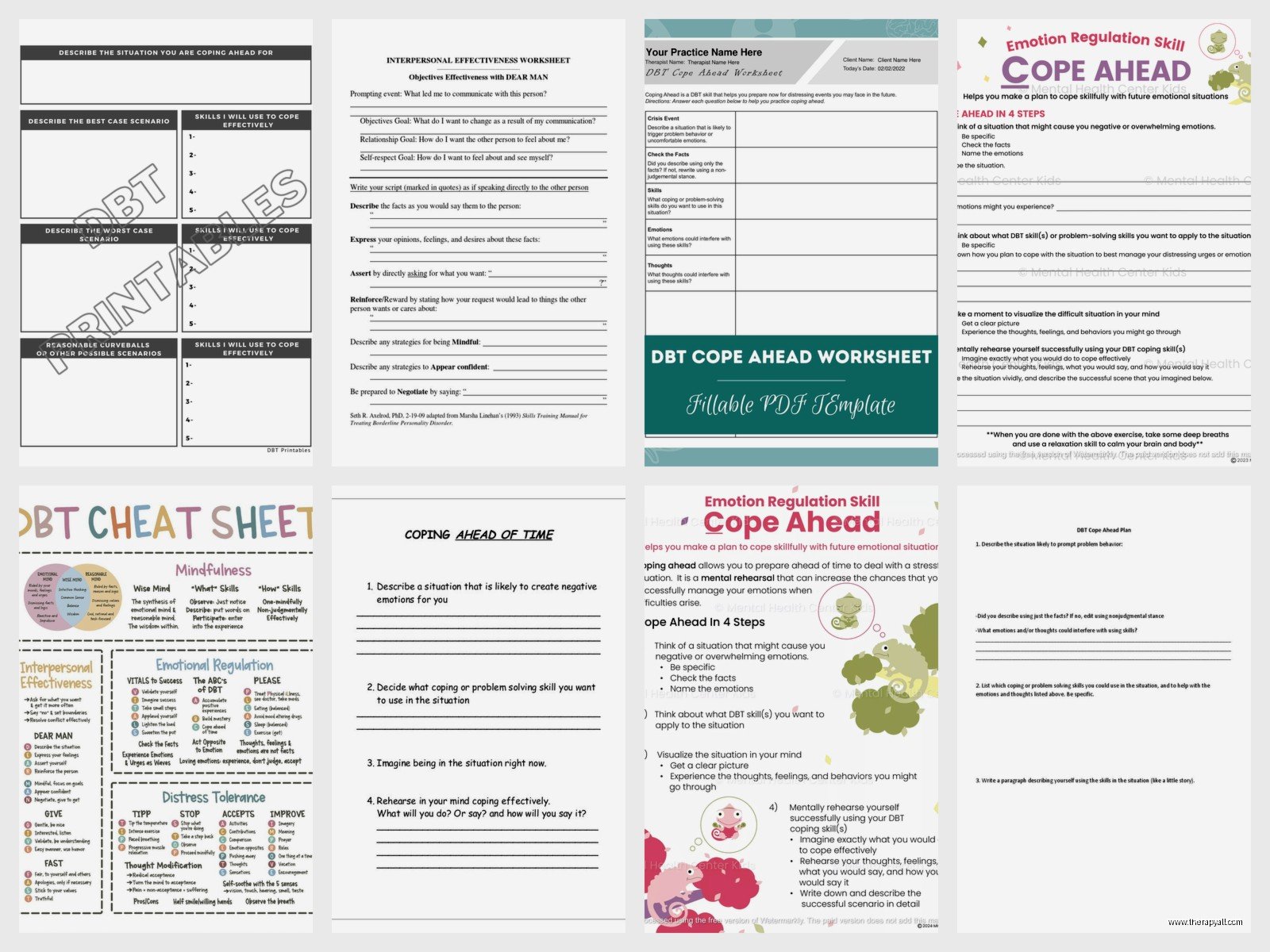
Most DBT workbooks include a COPE AHEAD worksheet. The official “DBT Skills Training Handouts and Worksheets” by Marsha Linehan has the original version, but you need to buy the book or have access through a therapist or program.
Free PDFs are available from several reputable sources. Many DBT therapists and clinics post their own versions on their websites. Psychology Tools has a good one. Therapist Aid used to have one but I think they moved it behind their membership wall, which is annoying because their worksheets are really well-designed and now you gotta pay for most of them.
Some mental health organizations offer free downloadable DBT resources. The problem is quality control—I’ve seen COPE AHEAD worksheets that are so cluttered with boxes and sections that they’re more stressful to look at than the actual situation you’re preparing for. You want something clean and straightforward.
My cat just knocked over my water bottle on my desk and I’m trying to keep typing while I mop it up with the sleeve of my sweater, which is definitely not the mindful approach to problem-solving but here we are.
Common Mistakes People Make
The biggest mistake is being too vague. “I’ll cope with the situation” tells you nothing. “I’ll use my skills” doesn’t help when you’re actually in the moment and your brain is flooding with cortisol. You need specifics. Which skill? What will you literally say out loud? What will you do with your hands?
Another mistake: only imagining the best-case scenario. If you only rehearse the version where you use your skill perfectly and everyone responds well and the whole thing goes smoothly, you’re not actually preparing. You’re daydreaming. COPE AHEAD requires you to imagine realistic difficulties and plan for those too.
People also skip the actual mental rehearsal part. They fill out the worksheet like it’s homework—check, check, check—but they don’t close their eyes and run through it like a movie in their head. The rehearsal is what makes the skill stick. Your brain needs that practice firing those neural pathways so when the real situation happens, it’s not completely foreign territory.
The Overthinking Trap
Some people get so into COPE AHEAD that they start using it for every minor situation. Do you need to COPE AHEAD for buying groceries? Probably not, unless grocery stores are genuinely triggering for you. Do you need to COPE AHEAD for a phone call with your boss about a serious performance issue? Yes, probably.
I’ve also seen people use COPE AHEAD as a way to avoid situations entirely. They rehearse so much that they convince themselves they can’t handle it and they cancel. That’s not the point. The point is to go into difficult situations more prepared, not to catastrophize until you’re paralyzed.
How This Fits Into the Bigger DBT Picture
COPE AHEAD lives in the Distress Tolerance module of DBT, but it actually uses skills from all four modules. You’re using Mindfulness when you observe what emotions might come up. You’re using Interpersonal Effectiveness when you plan what to say. You’re using Emotion Regulation when you identify your vulnerabilities and plan to take care of yourself. It’s sort of a meta-skill that pulls everything together.
In DBT groups, COPE AHEAD usually gets taught after people have already learned a bunch of other skills. You can’t really cope ahead if you don’t know what skills you have available to use. It’s like being told to pack a bag for a trip before anyone’s shown you what items exist in the world—wait, that metaphor got away from me.
What I mean is: COPE AHEAD assumes you’ve already got a toolkit. If you’re brand new to DBT, you might want to familiarize yourself with skills like STOP, TIPP, DEAR MAN, GIVE, and FAST before you try to use COPE AHEAD. Otherwise you’ll get to the “decide which skills to use” section of the worksheet and just stare at it blankly.
Printable vs Digital Versions
Some people prefer printing the worksheet and writing by hand. There’s something about the physical act of writing that helps with memory and processing. You can keep it in a binder with other DBT materials or fold it up and bring it with you to the actual event.
Digital versions work well if you’re always on your phone anyway. You can fill out a PDF on your phone or tablet, save it, and review it right before the situation. I’ve known people who keep voice memos instead—they record themselves talking through the COPE AHEAD steps while driving or walking. Whatever works for your brain.
The key is actually doing it ahead of time. Not five minutes before. Ideally a day or two before, so you have time to rehearse multiple times. The mental rehearsal is what builds confidence. You’re essentially pre-living the experience in a controlled way so your nervous system isn’t completely shocked when it happens for real.
Adapting the Worksheet for Different Situations
You can modify COPE AHEAD for different contexts. Some therapists have created versions specifically for social anxiety, others for chronic pain management, others for parenting challenges. The core structure stays the same but the prompts get more targeted.
For example, a COPE AHEAD worksheet for someone with social anxiety might include specific questions about escape routes, safe people to stand near, and scripts for declining invitations to extend the social event. A worksheet for chronic pain might include sections on pacing activities, having backup plans if pain flares, and communicating needs to others.
You don’t need a special version though. The standard worksheet is flexible enough for most situations. I worked on a whole series of “specialized” DBT worksheets back in summer 2021 and honestly, most of them were just the regular worksheets with slightly different wording. People used them because they felt more personalized, but functionally they were the same tool.
What Actually Happens After You Fill It Out
You review it. Multiple times. The night before, the morning of, maybe even in the parking lot right before you walk into the situation. You’re refreshing your memory about what you planned to do.
Then you go into the situation and you try to use your skills. Sometimes it works exactly as planned. Sometimes it works partially. Sometimes it doesn’t work at all and you end up using completely different skills or just white-knuckling through it.
Afterward, you’re supposed to evaluate. What worked? What didn’t? What would you do differently next time? This isn’t about judging yourself—it’s about learning. Maybe you realized that DEAR MAN wasn’t the right skill for that particular family dynamic, and next time you’ll try GIVE instead. Maybe you discovered that you need to eat something before stressful events because low blood sugar makes everything worse.
The evaluation step is what people skip most often, which is too bad because that’s where the actual learning happens. Without evaluation, you’re just repeating the same patterns. With evaluation, you’re building a database of what actually works for your specific brain and body and life circumstances.