
Mental Health, Therapy resources
DBT Worksheets: Skills for Emotional Regulation and Mindfulness

Jun
# DBT Worksheets: Skills for Emotional Regulation and Mindfulness
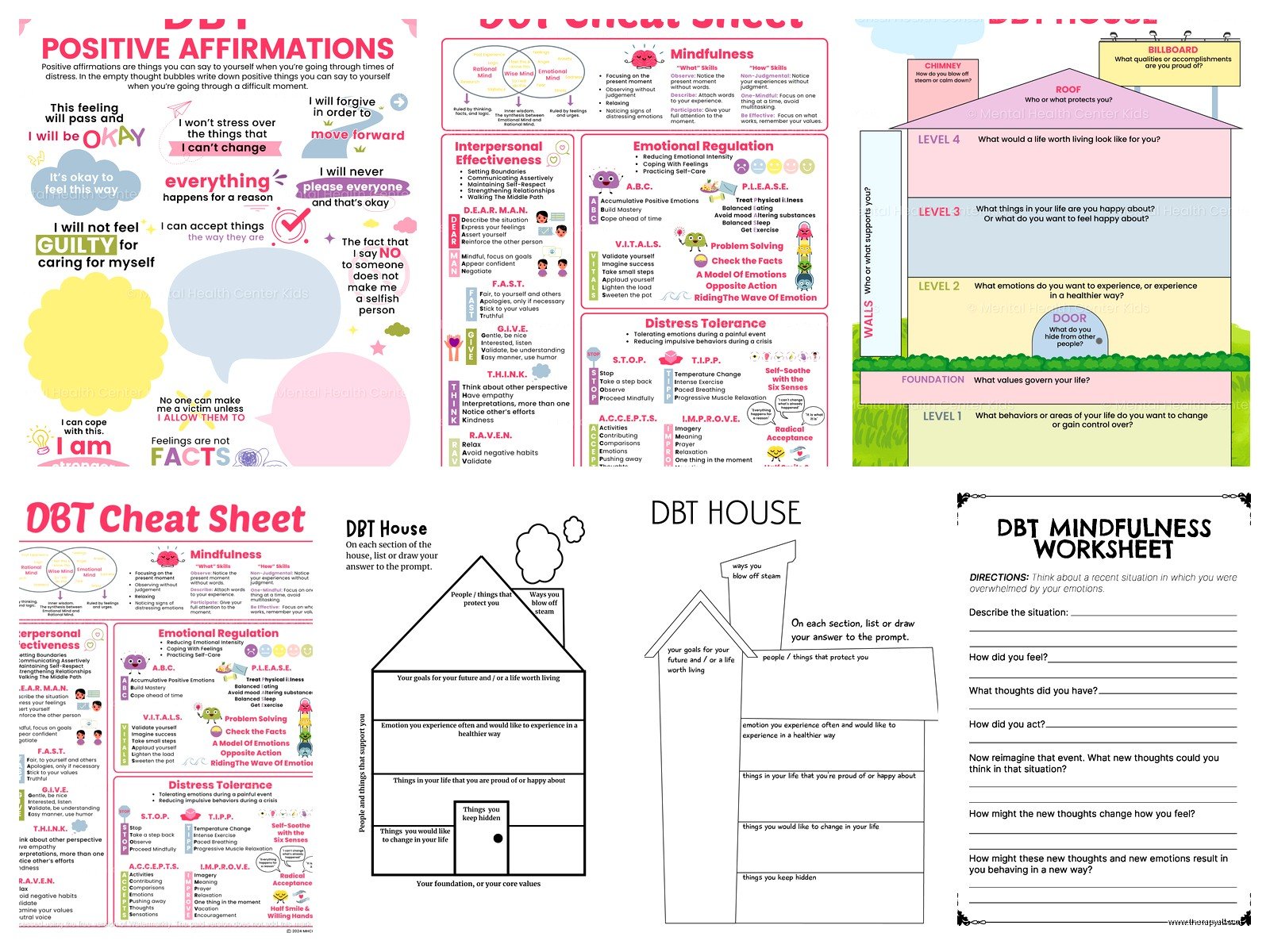
DBT worksheets are structured tools designed to help you practice the four core skill modules developed by Marsha Linehan: mindfulness, distress tolerance, emotion regulation, and interpersonal effectiveness. They’re not journal prompts or reflection exercises—they’re actual skill-building instruments with specific instructions, tracking sections, and guided practice components.
I remember in 2019 working with a therapist who kept handing clients these photocopied DBT worksheets that were so faded you could barely read the instructions, and half the clients would come back saying they didn’t understand what they were supposed to write in which box. That’s when I realized the design of these things actually matters way more than people think.
## The Core Structure of DBT Worksheets
Most DBT worksheets follow a pretty consistent format regardless of which skill module they’re targeting. You’ll typically see a section that identifies the situation or trigger, a space to note your emotional and physical responses, prompts to apply a specific skill, and some kind of rating scale to measure intensity or effectiveness.
The worksheets aren’t meant to be completed once and filed away. You’re supposed to use them repeatedly, often daily, until the skill becomes more automatic. That’s the whole point—repetition builds neural pathways, and you need that muscle memory when you’re actually in crisis mode and can’t think clearly enough to remember what “TIPP” stands for.
What genuinely annoys me is when mental health content creators present DBT worksheets like they’re some kind of magical cure-all that’ll fix your emotional dysregulation if you just fill them out prettily enough with color-coded pens. Nah. They’re practice tools. They’re boring. They’re repetitive. And that’s exactly why they work.
## Mindfulness Worksheets
Mindfulness worksheets in DBT focus on the “what” skills (observe, describe, participate) and the “how” skills (non-judgmentally, one-mindfully, effectively). These aren’t the same as general meditation worksheets you’ll find on wellness blogs.
The “Observing Emotions” worksheet typically asks you to notice an emotion without trying to change it, push it away, or judge yourself for having it. You might track: What emotion am I feeling? Where do I notice it in my body? What thoughts come with it? What urges do I have? The whole exercise is about creating distance between you and the emotion so you’re not completely consumed by it.
“Wise Mind” worksheets help you identify when you’re operating from emotion mind (all feelings, no logic), reasonable mind (all logic, no feelings), or wise mind (the sweet spot that integrates both). I’ve seen worksheets that use Venn diagrams, decision trees, or simple checklists. You’re basically training yourself to recognize which mode you’re in before making decisions.
The “Mindful Breathing” tracking sheets—and honestly these feel kinda redundant to me but some people love them—ask you to log how many minutes you practiced, what you noticed, and whether you stayed focused or got distracted. It’s accountability more than anything else.
One worksheet I actually use myself is the “Observing Sounds” exercise where you just… sit there and write down every sound you hear for five minutes without labeling them as good or bad. My cat knocked over a plant while I was doing this last week and I had to decide if that counted as a sound or a disruption, which sort of defeats the purpose but whatever.
## Distress Tolerance Worksheets
Distress tolerance skills are for crisis situations when you can’t immediately solve the problem and you just need to get through the next hour without making things worse. The worksheets here are different because they’re designed to be used in the moment, not as retrospective analysis tools.
The “TIPP” worksheet covers Temperature (changing your body temperature to calm down), Intense exercise, Paced breathing, and Paired muscle relaxation. You’d fill this out after using the skill to track what you tried and how effective it was. Most versions include a 0-10 rating scale for distress before and after.
“Pros and Cons” worksheets are incredibly straightforward but people still mess them up—you list the pros and cons of tolerating the distress versus the pros and cons of not tolerating it (usually acting on a crisis urge). It’s a 2×2 grid. That’s it. But it interrupts impulsive action by forcing you to think for a few minutes.
The “ACCEPTS” worksheets walk through Activities, Contributing, Comparisons, Emotions (opposite), Pushing away, Thoughts (other), and Sensations. You’re supposed to pick one and describe exactly how you’ll use it. Not “I’ll distract myself”—that’s too vague. More like “I’ll spend 15 minutes reorganizing my bookshelf by color.”
Self-soothing worksheets break down the five senses and ask you to identify specific soothing experiences for each. The problem I see constantly is people writing down things that aren’t actually accessible to them in a crisis. “Take a bath with lavender oil” doesn’t help if you’re having a panic attack in your car or at work—you need portable options.
## Emotion Regulation Worksheets
This is where DBT worksheets get more complex because you’re not just managing crisis—you’re trying to change your overall emotional patterns. Summer 2022 I was writing like three worksheet roundups a week for different platforms and I started actually using them myself, which was weird because I’d been writing about therapy tools for years without really implementing them.
The “Emotion Regulation Worksheet” (yeah, they’re not creative with names) asks you to identify what prompted the emotion, interpret what the emotion is telling you, describe your experience of it, and note your aftereffects. Then you evaluate whether the emotion fits the facts of the situation. This is huge—emotions are valid, but they’re not always proportional or based on accurate interpretations.
“Opposite Action” worksheets guide you through acting opposite to your emotional urge when the emotion doesn’t fit the facts. If you’re anxious about something that’s not actually dangerous, approach it instead of avoiding it. If you’re angry but the situation doesn’t warrant aggression, gently avoid instead of attacking. The worksheet prompts you to identify the emotion, the urge, whether it fits the facts, and what the opposite action would be.
“Check the Facts” worksheets are basically cognitive restructuring with DBT language. You describe the prompting event, your interpretation, and then systematically question whether your interpretation is accurate or complete. Are you assuming? Mind-reading? Catastrophizing? Then you write a more factual description.
The “ABC PLEASE” worksheet covers Accumulating positive emotions, Building mastery, Coping ahead, and then the PLEASE skills (treating PhysicaL illness, Eating balanced, Avoiding mood-altering substances, Sleep, Exercise). It’s a weekly tracking sheet where you check off what you actually did. Most people hate this one because it makes obvious how inconsistent they are with basic self-care, but that’s sort of the point.
I’ve seen people get really caught up in filling out these worksheets perfectly, like they’re gonna be graded on them or something. You’re not trying to impress anyone. Half-assed completion is better than no completion.
## Interpersonal Effectiveness Worksheets
These worksheets focus on getting what you need from interactions while maintaining relationships and self-respect. The acronyms here are DEAR MAN, GIVE, and FAST.
“DEAR MAN” worksheets help you prepare for difficult conversations: Describe the situation, Express your feelings, Assert what you want, Reinforce the positive outcome, stay Mindful, Appear confident, Negotiate. You fill out each section before the conversation so you’re not winging it emotionally.
The structure typically includes: What’s the situation? What do I want to achieve? What might get in the way? How will I handle obstacles? Then you script out your actual DEAR MAN statement. It feels artificial at first, but when you’re trying to set a boundary with someone who usually bulldozes you, having a script helps.
“GIVE” worksheets are for maintaining relationships: be Gentle, act Interested, Validate, use an Easy manner. These usually ask you to reflect on a recent interaction and identify where you did or didn’t use these skills. Sometimes you fill them out prospectively to plan how you’ll handle an upcoming situation.
“FAST” worksheets help you maintain self-respect during interactions: be Fair, no Apologies (for existing or having needs), Stick to values, be Truthful. The worksheet format often includes identifying situations where you compromised your self-respect, what you did instead of FAST, and what you could do differently.
What drives me nuts about interpersonal effectiveness worksheets is the assumption that the other person will respond reasonably if you just use your skills correctly. Sometimes people are jerks. Sometimes the relationship is abusive. Sometimes DEAR MAN doesn’t work because the other person doesn’t care about your needs. The worksheets don’t always acknowledge that.
## Using Worksheets in Actual Practice
You need to fill these out when you’re relatively calm, not in the middle of a meltdown. That’s a common misconception—people think they’ll grab a worksheet during a crisis and it’ll save them, but your brain doesn’t work that way when you’re flooded. You practice with worksheets when you’re stable so the skills are available when you’re not.
Most DBT therapists assign specific worksheets as homework between sessions. You bring them to therapy and review what you noticed, what worked, what didn’t. The worksheet itself isn’t the intervention—the practice is the intervention, and the worksheet just structures it.
Digital versions exist now, apps and fillable PDFs, but I honestly think paper works better for most people because the physical act of writing slows you down and there’s no notification popping up to distract you halfway through. Though I know that’s my age showing and plenty of people prefer digital.
You don’t need to use every worksheet. Some people connect with mindfulness skills, others need distress tolerance more urgently. A good therapist helps you figure out which modules to prioritize based on your specific patterns. If you’re trying to DIY this without a therapist, start with whatever problem is most urgent—if you’re in constant crisis, distress tolerance first; if you’re avoiding emotions, emotion regulation; if relationships are your main issue, interpersonal effectiveness.
The tracking components in most worksheets—those 0-10 scales, the before-and-after ratings—actually matter because they show you whether skills are working. Your brain will lie to you about whether something helped, but if you rated your anxiety as 8 before TIPP skills and 4 after, that’s data.
Some worksheets include space for barriers or obstacles, which is useful because you’ll encounter the same blocks repeatedly. “I forgot to use the skill” is different from “I remembered but didn’t think it would work” which is different from “I tried it and it didn’t help.” Each requires a different solution.
## Finding and Selecting Worksheets
There are approximately nine million DBT worksheets floating around online, and quality varies wildly. Some are directly from Linehan’s manuals, some are adapted by other DBT therapists, and some are… loosely DBT-inspired at best.
The most reliable sources are the official DBT workbooks—Linehan’s skills training manual has worksheets, and there are several published workbooks by DBT-trained therapists. These cost money but they’re comprehensive and actually aligned with the model.
Free worksheets online can be fine but check who created them. Was it a licensed therapist trained in DBT, or someone who read about DBT once and made a pretty PDF? The latter might still be useful but it might also teach skills incorrectly or mix in concepts from other therapeutic approaches without making that clear.
Your therapist might create custom worksheets tailored to your specific situations, which can be more relevant than generic ones. I’ve seen therapists modify standard worksheets to use examples from a client’s actual life, which makes them way more accessible.
Some worksheets are too simple—just a list of skills with checkboxes. Others are so detailed and complex that you’d need 45 minutes to complete one, which isn’t realistic. You want something in the middle: enough structure to guide practice, not so much that it becomes another source of stress.
## Common Problems with Worksheet Use
People abandon worksheets because they feel stupid or childish filling them out. That’s fair—they do kind of feel like homework. But the alternative is continuing to use skills inconsistently or not at all, so it’s a trade-off.
Another issue is perfectionism. You don’t need to fill out every section completely. You don’t need neat handwriting. You can cross stuff out. The worksheet is a tool for you, not a performance.
Some people use worksheets as avoidance—spending so much time documenting and analyzing that they never actually practice the skills in real situations. The worksheet isn’t the point, the behavioral change is the point.
Inconsistency is probably the biggest barrier. You fill out worksheets for a week, feel better, stop doing them, fall apart again, restart the cycle. Building any new habit is hard, and these require consistent practice over months, not days… which is annoying but true.
If you’re using worksheets without a therapist, you might misunderstand instructions or apply skills incorrectly. DBT is evidence-based partly because it’s taught in a specific way—self-directed learning can work but it’s less reliable.

ADHD & Neurodiversity
Life Planner Bundle – Life Organizer
Self-Care & Personal Growth
Acceptance And Commitment
Anxiety & Stress
Stress Processing Journal & Reflection Worksheets For Daily Self – Care
Self-Care & Personal Growth
Self – Reflection Guided Journal With Guided Prompts 30
Emotional Wellness
Decision Processing – Thought Processing Journal For Daily Self – Care
Therapist Resources
Physiotherapist Journal PDF Planner Tracker Or Log Book
Self-Care & Personal Growth
Customizable Self – Confidence & Self – Esteem Guided Journal
ADHD & Neurodiversity
ADHD Behavior Tracker PDF Planner Tracker Or Log Book