What Parts Work Therapy Worksheets Actually Do
Parts work therapy worksheets help you map out the different internal voices, impulses, and emotional states that show up in your psyche. They’re based on Internal Family Systems (IFS), a therapeutic model developed by Richard Schwartz in the 1980s that treats your mind like it contains multiple sub-personalities or “parts” rather than one unified self. The worksheets give you a structured way to identify these parts, understand what they’re trying to do for you, and eventually help them trust your core Self to lead.
I remember in 2019 sitting with a client who kept saying “part of me wants to leave my job but part of me is terrified” and I pulled out this extremely basic parts mapping worksheet I’d found online. It had these little circles where you were supposed to write the part’s name and its fear. She looked at it, looked at me, and said “this feels like a kindergarten activity.” She wasn’t wrong. A lot of early IFS worksheets looked like they were designed for children or had this overly cutesy aesthetic that didn’t match the actual complexity of what people were experiencing internally.
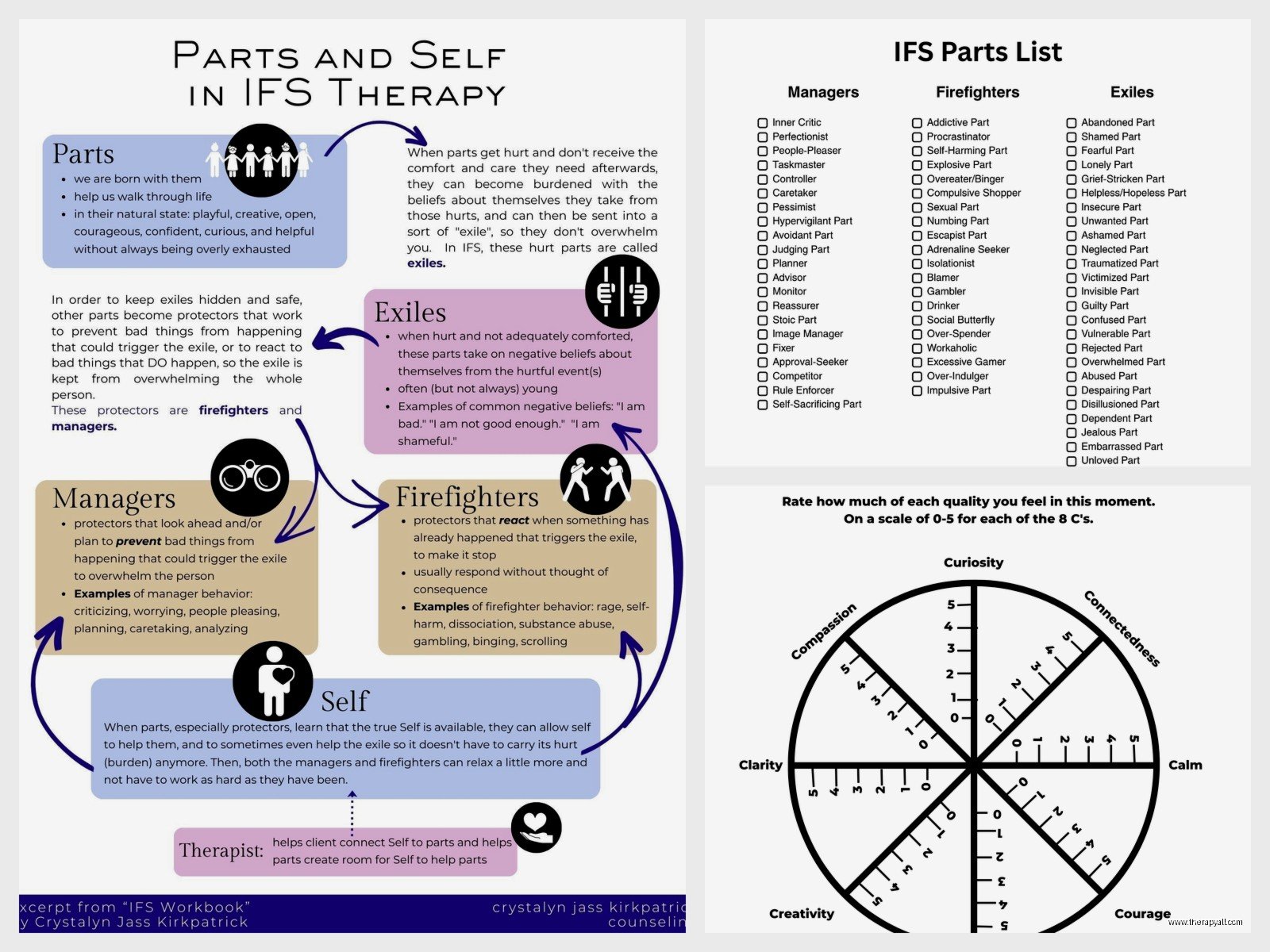
The core premise is that you don’t have one anxiety or one inner critic. You have multiple parts that developed at different times, for different reasons, often to protect you from something that felt unbearable. Some parts are managers—they try to keep you in control, organized, acceptable to others. Some are firefighters—they jump in when you’re overwhelmed and try to numb or distract you. And some are exiles—younger, vulnerable parts carrying old wounds that the other parts are desperately trying to keep buried.
How IFS Worksheets Are Structured
Most IFS worksheets follow a similar format. They ask you to identify a part, describe what it does, explore what it’s afraid would happen if it stopped doing that thing, and eventually ask what it needs from you or your Self. The Self in IFS isn’t another part—it’s supposed to be your core essence, the calm, curious, compassionate center that can relate to all the parts without being hijacked by any of them.
You start with noticing. This sounds simple but it’s genuinely hard for a lot of people because we’re so identified with our parts that we don’t realize we’re in one. A worksheet might ask: “What part of you is most active right now?” or “Notice the voice that says you shouldn’t be doing this exercise—what does that voice sound like?”
Then you describe the part. What does it look like if you visualize it? How old does it feel? Where do you sense it in your body? Some worksheets get very specific here—they’ll have sections for the part’s appearance, its tone of voice, the physical sensations associated with it. I’ve seen ones that ask you to draw the part, which honestly can be kinda powerful even if you think you can’t draw.
The next section usually asks about the part’s role or job. What is it trying to do for you? This is where people often have small breakthroughs because they realize their inner critic isn’t just mean for no reason—it’s trying to keep them from being rejected or humiliated. Their procrastination isn’t laziness, it’s a part that’s afraid of failure or success or visibility.
The Questions That Actually Matter
The most useful IFS worksheets dig into what the part is afraid of. “What does this part think would happen if it stopped criticizing you?” “What is this part protecting you from feeling or remembering?” These questions help you understand the part’s positive intention, which is a foundational IFS concept—every part, even the ones that seem destructive, developed to help you survive something.
You also need questions that help you access Self. “How do you feel toward this part right now?” is the classic IFS question. If you feel curious, compassionate, calm, connected—those are signs you’re in Self. If you feel annoyed, scared, judgmental, frustrated—that’s another part reacting to the first part, and you need to work with that one first or ask it to step back.
Some worksheets include a section for the part’s history. When did it first show up? What was happening in your life? What did it help you get through? This is where the work can get heavy because you’re often tracing parts back to childhood experiences, family dynamics, trauma. My cat just knocked over my water bottle and I’m gonna ignore it for now because I’m on a roll here.
Common IFS Exercises You’ll Find in Worksheets
The U-Turn is a foundational exercise where instead of focusing on external problems, you turn your attention inward to notice which parts are activated by those problems. A worksheet might walk you through a recent conflict and ask you to identify all the parts that showed up—the part that got defensive, the part that wanted to flee, the part that immediately started planning how to fix everything.
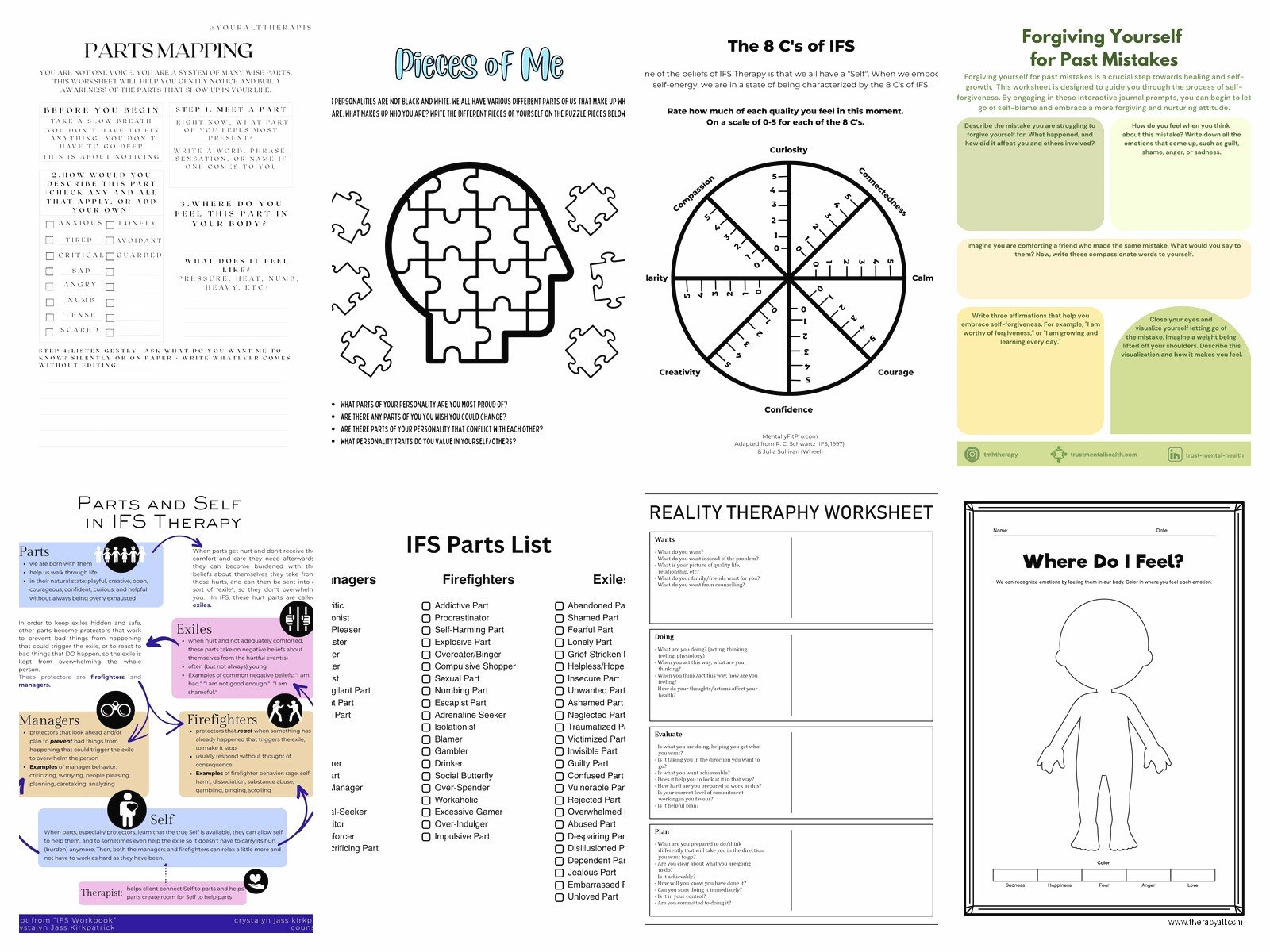
Parts mapping or creating a parts diagram is exactly what it sounds like. You draw or list out your parts and show how they relate to each other. Some parts are polarized—they’re in direct conflict, like the part that wants to be spontaneous versus the part that needs everything planned. Some parts work together, like the achievement-oriented part and the perfectionist part teaming up to drive you into the ground.
Direct access exercises guide you through actually talking to a part. The worksheet provides prompts: “Ask the part what it wants you to know. Wait for a response. Ask what it’s afraid of. Ask what it needs.” This can feel weird at first, like you’re making it up, but most people are surprised by what comes through when they actually pause and listen.
Unburdening Protocols
More advanced worksheets include unburdening exercises, which is the IFS term for helping an exiled part release the painful beliefs or emotions it’s been carrying. These typically involve visualization—imagining the part releasing its burden into light or water or fire or earth, whatever element feels right. The worksheet might ask: “What is this part carrying that doesn’t belong to it? What belief or feeling is it ready to release? How does it want to release it? What would it like to take on instead?”
I’ve gotta say, the unburdening worksheets are where I see the most variance in quality. Some are thoughtful and well-paced, giving you space to really be with the part and not rush the process. Others feel like they’re trying to speed-run deep trauma work in two pages, which is not only ineffective but potentially destabilizing.
There are also worksheets focused specifically on working with protector parts—helping them trust that you can handle what they’ve been protecting you from. These usually involve a lot of appreciation and negotiation. “Thank this part for its hard work. Ask if it would be willing to step back just a little so you can get to know what it’s protecting. Ask what it needs from you to feel safe doing that.”
What Makes an IFS Worksheet Actually Useful
The best worksheets give you enough structure to stay on track but enough space to follow what emerges. You don’t want something so rigid that you’re just filling in blanks without actually connecting to your internal experience. You also don’t want something so open-ended that you have no idea where to start or what you’re supposed to be paying attention to.
Good IFS worksheets remind you to check in with yourself throughout the process. They’ll have periodic prompts like “Pause here. Notice how you’re feeling. If you’re overwhelmed, it’s okay to stop” or “If you notice judgment or frustration toward a part, that’s another part—see if it will step back.”
They should also be clear about what to do if you get stuck or activated. Not every worksheet needs to be something you complete in one sitting. Some parts work takes weeks or months, and a worksheet that acknowledges that is more realistic than one that implies you’ll have some major breakthrough in 20 minutes.
I really appreciate worksheets that include psychoeducation alongside the exercises. A paragraph explaining what managers versus firefighters versus exiles are, or a note about how polarized parts work, helps you understand what you’re doing and why. You’re not just following instructions, you’re learning the model.
The Formats That Work Best
Some people like fill-in-the-blank worksheets where you write directly on the page. Others prefer more open journaling prompts. I’ve seen effective worksheets that are basically decision trees—”if the part feels young, go to section A; if it feels like a protector, go to section B.” These can be helpful when you’re first learning to differentiate parts.
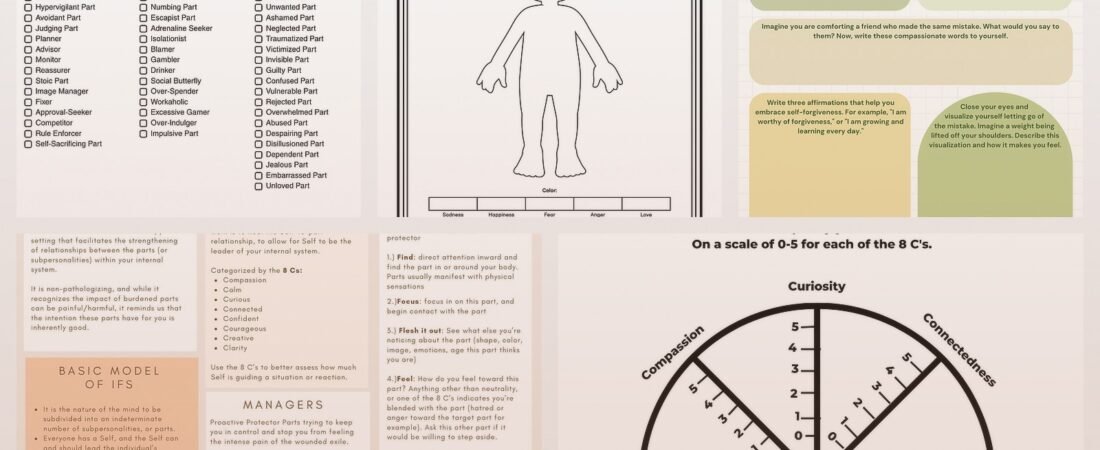
Visual worksheets with diagrams, circles, or body maps work well for people who are less verbal or who process better through images. You might have an outline of a body where you mark where different parts live—anxiety in the chest, shame in the stomach, the critic in the head.
What drives me absolutely up the wall is when worksheets use IFS language without explaining it, or worse, use it incorrectly. I’ve seen worksheets that conflate parts with emotions, treating “angry part” and “anger” as the same thing when they’re not. Or worksheets that skip the whole Self-leadership piece and just have you analyzing parts from a detached, intellectual place, which misses the entire point of the model.
Using IFS Worksheets Outside of Therapy
You can absolutely use these worksheets on your own, though there’s always a caveat about doing trauma work without support. If you’re working with exiled parts carrying significant trauma, you probably want a therapist involved. For everyday parts work—getting to know your inner critic, understanding your people-pleasing part, noticing which part takes over when you’re stressed—worksheets are a solid self-help tool.
The rhythm I’ve seen work well is to pick one part and spend a week or two just noticing it. Use a worksheet to map out what you’re learning. Then maybe do a deeper dive with a direct access exercise. Then see if anything shifts in your regular life. Parts work isn’t usually a one-and-done thing—it’s more like you’re building relationships with these parts over time, and the worksheets are a way to document and deepen that process.
Some people create ongoing parts journals where they check in with different parts regularly. They might have a worksheet template they use weekly, just asking “which parts were most active this week, what were they responding to, what do they need from me right now.”
What to Watch Out For
The main risk with IFS worksheets is flooding—accessing more pain or intensity than you can handle in the moment. Good worksheets build in containment, reminding you that you can pause, that you don’t have to go into the exile’s full story today, that it’s okay to ask a part to wait until you have more support. If a worksheet doesn’t mention pacing or safety at all, I’d be cautious.
Another thing is getting lost in parts proliferation where you’re identifying 47 different parts and losing track of the forest for the trees. Most people have some core patterns—maybe five to ten parts that show up regularly in various combinations. You don’t need to catalog every micro-variation. Worksheets that help you cluster or organize parts are more useful than ones that encourage endless subdivision.
There’s also the tendency to use parts language as another way to intellectualize or avoid actually feeling anything, which… I’ve definitely done this, sitting there filling out a worksheet about my anxious part while completely detached from any actual anxiety, just going through the motions. The worksheet should bring you closer to your internal experience, not further from it.
Where to Find IFS Worksheets
The IFS Institute has some official resources though they’re often more oriented toward therapists. You’ll find a ton of worksheets on therapy resource sites, some free and some paid. The quality varies wildly. Summer 2021 I was reviewing worksheets for a roundup post and I swear half of them were just reworded versions of the same basic template, nothing original or particularly helpful.
Some IFS therapists share their worksheets on their websites or in workbooks they’ve published. These tend to be more nuanced because they’re created by people actually doing this work with clients day in and day out. You can also find parts work exercises in books like “Self-Therapy” by Jay Earley or “No Bad Parts” by Richard Schwartz—not exactly worksheets but structured exercises you could adapt into worksheet format.
Pinterest has a surprising number of IFS worksheets though you have to wade through a lot of generic self-help stuff to find the actual parts work content. Same with Teachers Pay Teachers, which isn’t just for classroom stuff—there are therapy worksheets there too.
The worksheets I keep coming back to are the ones that feel like they were made by someone who actually gets how messy and nonlinear this work is, who isn’t trying to make it neat or inspirational but just gives you tools to explore what’s actually happening inside you without judgment or a predetermined outcome.