What DBT Actually Is and Why Worksheets Matter
Dialectical Behavior Therapy is a structured therapy model Marsha Linehan developed in the late 1980s, originally for people with borderline personality disorder who were chronically suicidal. It’s expanded way beyond that now. DBT combines cognitive-behavioral techniques with mindfulness practices borrowed from Zen Buddhism, and the whole framework rests on this idea of dialectics—holding two seemingly opposite things as true at the same time. Like “I’m doing the best I can AND I need to do better” or “I accept myself as I am AND I’m working to change.”
The therapy itself is usually delivered in a specific format: individual therapy sessions, skills training groups, phone coaching between sessions, and a consultation team for the therapists. But you don’t need to be in a full DBT program to benefit from the skills. I remember back in 2019, I was working on a content project for a therapy app and we kept getting requests for DBT worksheets—not from people in formal DBT programs, but from folks who’d heard about the skills online or from a friend and wanted to try them out. That’s when I realized how much these tools had spread beyond clinical settings.
Worksheets serve as the practical application tools for DBT skills. You learn the concept in session or from reading, then you use a worksheet to actually practice it in your daily life. They’re structured enough to guide you but flexible enough to adapt to whatever situation you’re dealing with.
The Four DBT Modules
DBT breaks down into four main skill modules, and most worksheets you’ll find organize around these categories.
Mindfulness
This is the foundation of everything else in DBT. Mindfulness in this context means being present in the current moment without judgment. It’s not about clearing your mind or achieving some blissed-out state—it’s about noticing what’s happening right now, internally and externally, and describing it without adding a layer of “this is good” or “this is bad.”
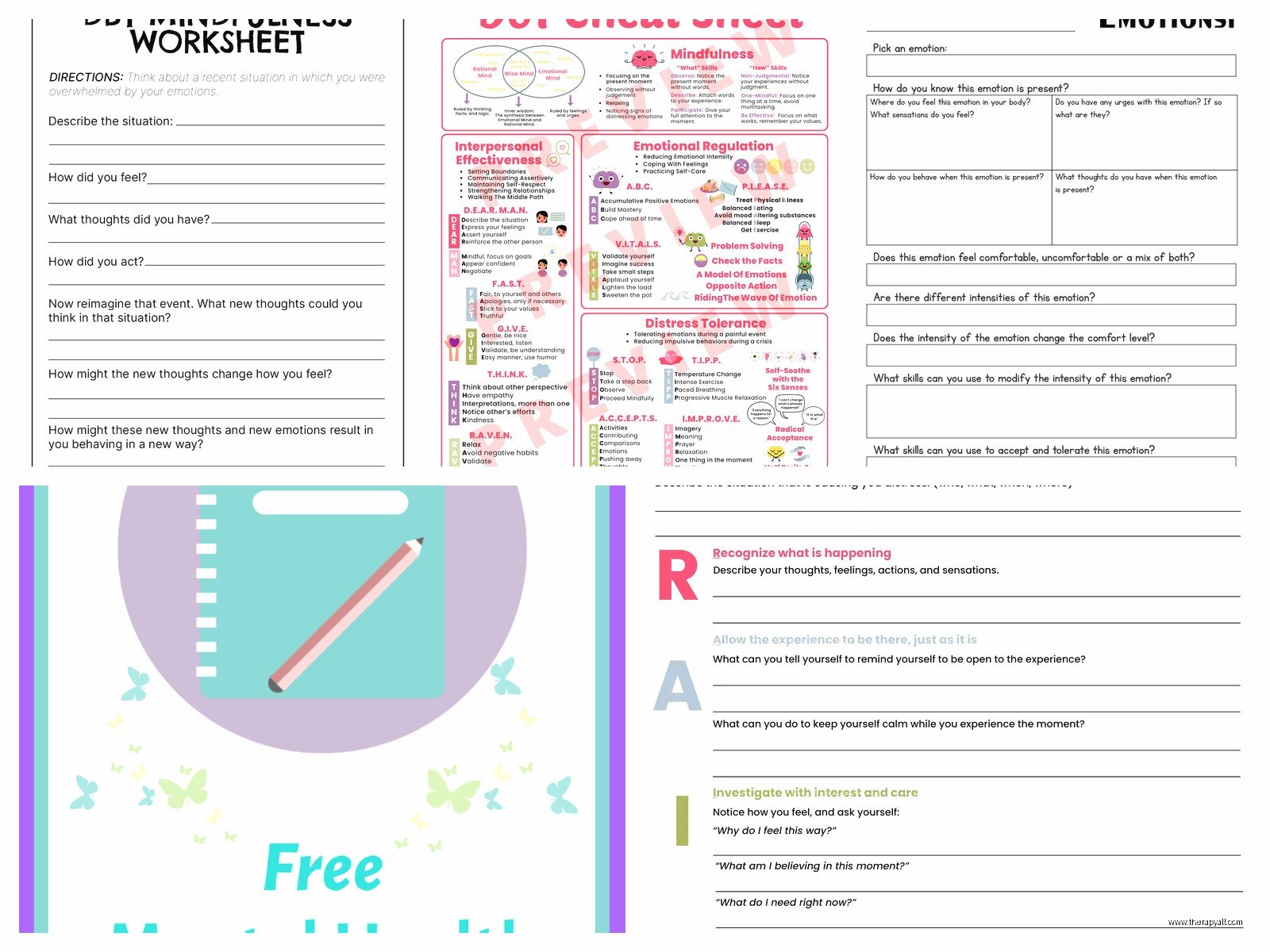
The core mindfulness skills are the “what” skills and the “how” skills. The “what” skills are observe, describe, and participate. You observe by noticing with your senses, describe by putting words to what you notice, and participate by throwing yourself fully into an activity. The “how” skills are non-judgmentally, one-mindfully, and effectively. These tell you the manner in which to practice the “what” skills.
Mindfulness worksheets usually ask you to practice observing something specific—your breath, sounds around you, physical sensations—and then describe what you noticed. Some have you track how often you were able to stay present versus getting pulled into thoughts about past or future.
Distress Tolerance
These are crisis survival skills. When you’re in intense emotional pain and you need to get through the next hour or the next day without making things worse, distress tolerance skills are what you reach for. They’re not about fixing the problem or feeling better permanently—they’re about surviving a crisis moment without engaging in destructive behaviors.
The main distress tolerance skills include TIPP (Temperature, Intense exercise, Paced breathing, Paired muscle relaxation), the STOP skill, distraction techniques, self-soothing with the five senses, and radical acceptance. There’s also the pros and cons worksheet where you map out the pros and cons of both tolerating the distress AND acting on your urges.
I’ve gotta say, the distraction worksheets are some of the most practical ones out there. They usually have you brainstorm ahead of time—before you’re in crisis—what specific activities you can do in different categories. Like activities that engage your mind, activities that create different emotions, activities that help others, activities that create physical sensations. Then when you’re actually in distress, you’ve got a pre-made menu instead of trying to think creatively while your brain is on fire.
Finding Actually Useful Free Worksheets
There are tons of free DBT worksheets online, but the quality varies wildly. Some are clearly made by people who’ve actually used DBT clinically, and others feel like someone skimmed a Wikipedia article and made a PDF.
The most reliable free sources are university counseling centers and established mental health nonprofits. A lot of university psychology departments that run DBT clinics will have worksheets available on their websites. Same with DBT training organizations—they often provide sample materials. Some individual therapists who specialize in DBT also share worksheets on their professional websites or blogs.
What annoys me is when worksheet collections present themselves as “comprehensive DBT resources” but they’re just reworded versions of the same three basic skills with different fonts and stock photos of sunsets. You don’t need 47 variations of a feelings wheel. You need clear, structured worksheets for the specific skills you’re trying to practice.
Emotion Regulation
This module teaches you to understand and manage emotions more effectively. Not suppress them, not avoid them, but work with them. The skills here include identifying and labeling emotions, understanding what emotions do for you (they’re not random—they have functions), reducing vulnerability to negative emotions, and increasing positive emotional experiences.
One of the most-used worksheets from this module is the emotion log or diary card. You track your emotions throughout the day, rate their intensity, identify what triggered them, and note what you did in response. Over time, you start seeing patterns. Maybe you notice your anxiety spikes every Sunday evening, or your anger is usually preceded by feeling dismissed, or—wait, I’m getting ahead of myself because there’s also the ABC PLEASE skill which is about taking care of your physical health to make yourself less emotionally vulnerable.
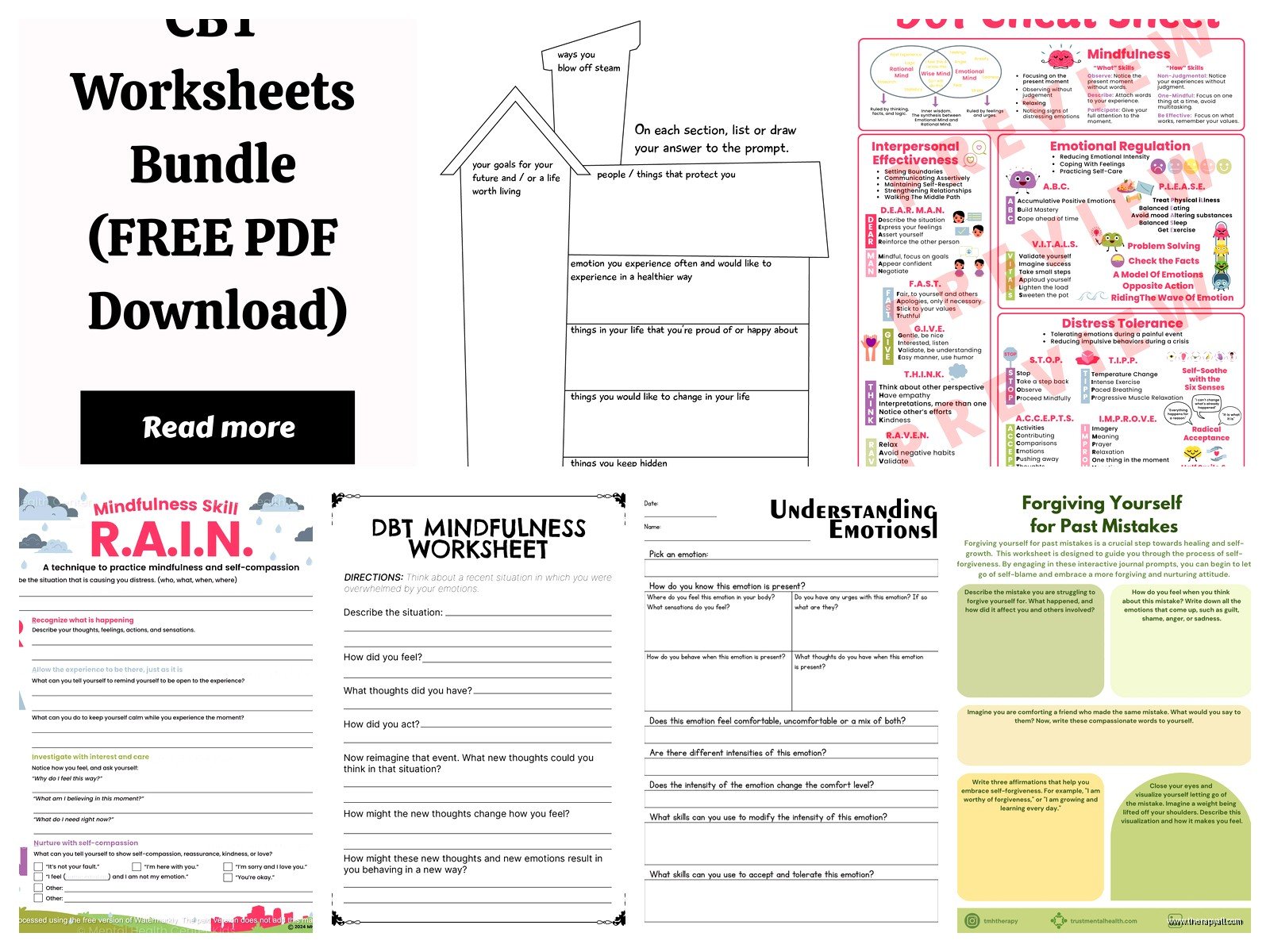
ABC stands for Accumulate positive experiences, Build mastery, and Cope ahead. PLEASE is treat PhysicaL illness, balance Eating, avoid mood-Altering substances, balance Sleep, and get Exercise. There are worksheets for each of these components where you plan specific actions and track whether you followed through.
The opposite action worksheet is another big one from emotion regulation. The idea is that every emotion comes with an action urge—fear makes you want to avoid, anger makes you want to attack, sadness makes you want to withdraw. Sometimes those urges are justified and you should follow them, but sometimes they’re not, and acting opposite to the urge can actually change the emotion. The worksheet walks you through identifying the emotion, checking whether it fits the facts of the situation, and if it doesn’t, planning an opposite action.
Interpersonal Effectiveness
This is basically assertiveness training plus relationship skills. How do you ask for what you need, say no to things you don’t want, and maintain your self-respect in interactions with others—all while keeping the relationship intact when that matters to you?
The DEAR MAN skill is probably the most well-known interpersonal effectiveness technique. It’s an acronym for how to ask for something or say no effectively: Describe the situation, Express your feelings, Assert what you want, Reinforce the positive, stay Mindful, Appear confident, and Negotiate. Worksheets for DEAR MAN have you script out what you’ll say for each component before a difficult conversation.
There’s also GIVE (be Gentle, act Interested, Validate, use an Easy manner) for maintaining relationships and FAST (be Fair, no Apologies, Stick to values, be Truthful) for maintaining self-respect. You can find worksheets that help you prepare for specific interactions using these frameworks.
My cat just knocked over my water bottle and I had to stop typing to clean it up, which is actually a good example of how you practice mindfulness in regular moments—noticing the irritation, describing it, then choosing to effectively deal with the situation instead of staying stuck in annoyance.
How to Actually Use These Worksheets
You’re not gonna get much out of DBT worksheets if you just download them, fill them out once, and forget about them. They’re meant to be practiced repeatedly. The skills become automatic through repetition, not through intellectual understanding.
Start with one skill module that feels most relevant to what you’re struggling with right now. If you’re in frequent crisis states, start with distress tolerance. If you have emotional reactions that feel disproportionate or confusing, try emotion regulation. If relationships are your main struggle, go with interpersonal effectiveness. Mindfulness supports everything else, so you can practice that alongside any other module.
Pick one or two specific skills from that module and find worksheets for those skills. Practice them for at least two weeks before deciding whether they’re helpful. Some skills feel awkward at first—that’s normal. You’re building new neural pathways, basically.
Fill out worksheets in the moment when possible, not hours later when you’re trying to remember what happened. Keep them accessible. Some people use printouts in a binder, others keep photos of blank worksheets on their phone and fill them out digitally or on paper as needed.
Diary Cards and Tracking
The DBT diary card is the daily tracking sheet that ties everything together. Standard diary cards have you rate your emotions each day, track target behaviors (both ones you’re trying to reduce and skills you’re trying to increase), note any urges you had, and indicate which skills you practiced.
In formal DBT programs, you bring your diary card to every therapy session and it guides what you work on. If you’re using DBT skills on your own, the diary card still helps you see patterns and progress over time. You can find free templates online that range from very simple (just emotions and a few key behaviors) to comprehensive (tracking 15+ different metrics daily).
I spent summer 2021 trying out different diary card formats for an article I was writing, and I ended up kinda getting into the habit myself even though I wasn’t in DBT therapy. It’s weirdly satisfying to fill out, like a very clinical bullet journal.
Chain Analysis Worksheets
This is the problem-solving worksheet in DBT. When you engage in a target behavior you’re trying to stop—self-harm, binge eating, substance use, whatever it is—you do a chain analysis to understand exactly how you got from the prompting event to the behavior.
The worksheet has you identify the prompting event (what started the chain), your vulnerability factors (were you hungry, tired, already stressed), links in the chain (each thought, feeling, and action that led to the next one), the problem behavior itself, and the consequences. Then you figure out where you could have intervened with a skillful behavior to break the chain.
These worksheets are detailed. They take 30-45 minutes to complete properly. But they’re incredibly useful for understanding your own patterns. You start recognizing the early links in your chains so you can intervene before you’re in full crisis mode.
Skills Application Worksheets
Beyond the worksheets for specific skills, there are application worksheets that help you figure out which skill to use when. These usually present a situation or have you describe one you’re dealing with, then walk you through questions to determine what category of problem you’re facing and which skills might help.
Some of these are formatted as decision trees—if you’re in crisis, go to distress tolerance; if you’re not in crisis but emotions are intense, go to emotion regulation; if the problem involves another person, consider interpersonal effectiveness. They’re helpful when you’ve learned a bunch of skills but feel overwhelmed trying to figure out which one to use in the moment.
Adapting Worksheets for Your Needs
Most free worksheets are designed to be somewhat generic so they work for different people and situations. You should absolutely modify them to fit your specific circumstances. If a worksheet has space for rating emotions 1-10 but you find a 1-5 scale more useful, change it. If the categories don’t match your life, cross them out and write your own.
Some people make their worksheets more visual—adding color coding, symbols, or drawings. Others strip them down to just the essential questions. The structure matters more than the exact format. As long as you’re actually doing the cognitive work the worksheet is designed to prompt, you’re using it correctly.