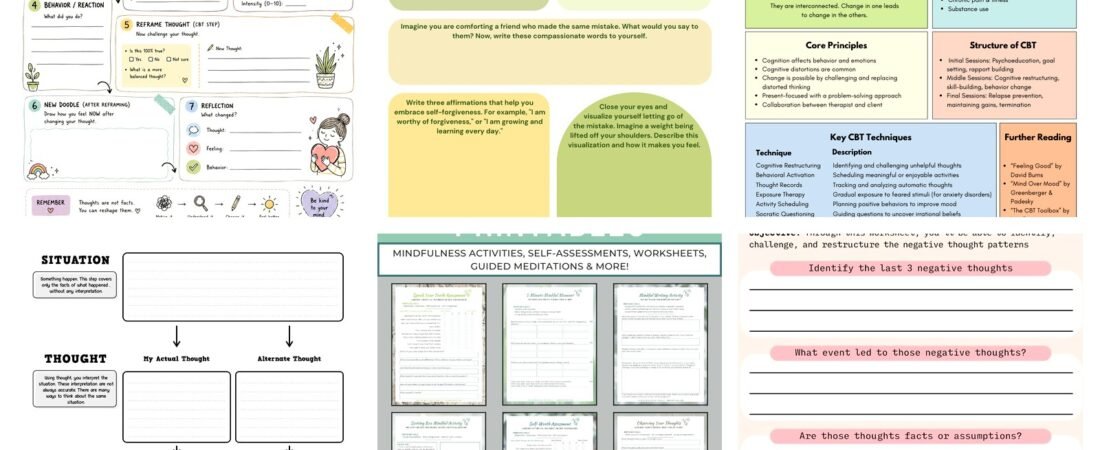
What CBT Worksheets Actually Are
Cognitive Behavioral Therapy worksheets are structured paper tools designed to help you identify, challenge, and change thought patterns that contribute to emotional distress or unhelpful behaviors. They’re based on the core CBT principle that thoughts, feelings, and behaviors are interconnected, and changing one element can influence the others.
I remember sitting in a coffee shop in 2019 watching a therapist friend absolutely lose it because someone had designed a “CBT worksheet” that was just a gratitude journal with the letters CBT slapped on top. That’s not CBT. That’s just… a list. A real CBT worksheet has a specific structure that guides you through cognitive restructuring, behavioral activation, or exposure planning.
The most common types include thought records, behavioral activation logs, exposure hierarchies, activity scheduling sheets, and cognitive distortion identification tools. Each serves a different function within the CBT framework, and honestly, using the wrong one for your specific issue is kinda like trying to hammer a screw.
Thought Records and Cognitive Restructuring
Thought records are the backbone of CBT work. You document a situation that triggered distress, identify the automatic thoughts that popped up, notice what emotions followed, and then challenge those thoughts with evidence. The standard format includes columns for: situation, automatic thought, emotion and intensity, evidence for the thought, evidence against the thought, and alternative balanced thought.
Here’s what genuinely bugs me about most free thought record templates online: they skip the emotion intensity rating or they make it way too complicated. You need that 0-100 scale or 1-10 rating because tracking how your emotional intensity changes after cognitive restructuring is literally the whole point. Without it, you’re just writing in a diary.
When you first start using thought records, you’re gonna feel like you’re doing it wrong. That’s normal. I’ve written about these worksheets probably a hundred times and I still sometimes catch myself writing “I feel like he hates me” in the thought column when that’s clearly an emotion mixed with a thought, not a clean automatic thought. The distinction matters because you can’t challenge a feeling, but you can challenge the thought generating that feeling.
How to Use a Thought Record Effectively
Fill it out as close to the triggering event as possible. Waiting until the end of the day means you‘re working with reconstructed memories, not actual automatic thoughts. Your brain is gonna edit the story to make more sense, which defeats the purpose.
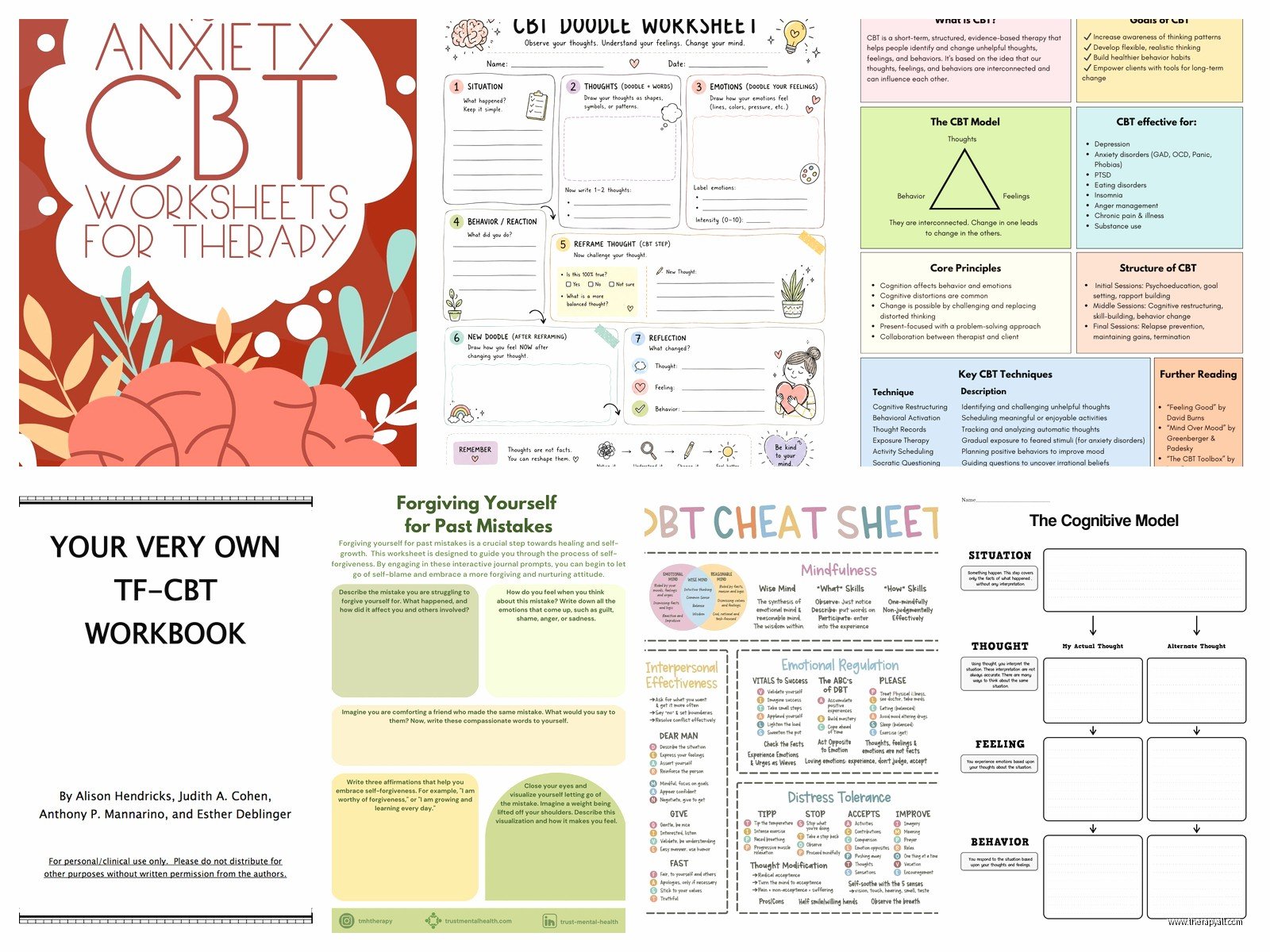
Be specific in the situation column. “Bad day at work” tells you nothing useful. “My manager didn’t respond to my email for 3 hours and I convinced myself I was getting fired” gives you something concrete to work with.
The evidence columns are where people get stuck. You’re looking for factual evidence, not more thoughts. “He always ignores me” isn’t evidence against “My manager hates me”—that’s another thought. “He responded to my email and asked me to lead the next project” is actual evidence.
Behavioral Activation Worksheets
These track your activities and mood throughout the day to identify patterns between what you do and how you feel. Depression especially loves to convince you that nothing will help, so you stop doing things, which makes depression worse, which makes you do even less. Behavioral activation breaks that cycle.
A good behavioral activation worksheet divides your day into time blocks, usually hourly or by morning/afternoon/evening. You record what you did, rate your mood during that activity, and often include columns for mastery (sense of accomplishment) and pleasure.
I started using these myself during summer 2022 when I was writing like three worksheet roundups a week and realized I felt worse on days I didn’t leave my apartment. Sounds obvious, but seeing it on paper—every single day I went outside had a mood rating at least 2 points higher—made it impossible to ignore. My cat was probably tired of being my only social contact anyway.
Activity Scheduling
This is the next step after tracking. You plan activities in advance, especially ones that historically improved your mood or gave you a sense of achievement. The worksheet typically includes the planned activity, anticipated mood rating, actual mood rating, and notes about what got in the way if you didn’t complete it.
The key is balancing pleasure activities with mastery activities. All fun and no accomplishment doesn’t build momentum. All productivity and no pleasure makes you… well, it makes you more likely to give up on the whole thing.
Cognitive Distortion Identification Worksheets
These help you recognize patterns in distorted thinking. Common categories include all-or-nothing thinking, overgeneralization, mental filtering, discounting the positive, jumping to conclusions, magnification or minimization, emotional reasoning, should statements, labeling, and personalization.
You write down a thought and then identify which distortion or distortions it contains. Some worksheets include definitions and examples, which is helpful when you’re starting out because honestly, the line between “jumping to conclusions” and “overgeneralization” can get blurry.
What annoys me is when these worksheets list like fifteen different cognitive distortions with overlapping definitions. Aaron Beck and David Burns identified the core ones. You don’t need a worksheet with “fortune telling” AND “jumping to conclusions” as separate categories—they’re the same thing. Stick with the classic list or you’re gonna spend more time debating which category your thought fits into than actually challenging it.
Exposure Hierarchy Worksheets
For anxiety disorders, phobias, OCD, and PTSD, exposure hierarchies help you gradually face feared situations. You list situations related to your fear, rate how much anxiety each would cause (usually 0-100), and then work through them from least to most anxiety-provoking.
A good exposure hierarchy worksheet includes columns for the situation, anxiety rating, whether it’s imaginal or in-vivo exposure, and space to track your anxiety levels during exposure (beginning, middle, end). That last part is crucial because you need to see that anxiety decreases with sustained exposure.
I remember a client in 2018 who was terrified of dogs and we built an exposure hierarchy starting with looking at cartoon dogs and working up to petting a friend’s calm golden retriever, and— actually, the worksheet structure matters more than the specific example. The point is you need enough steps that no single jump feels impossible, but not so many steps that you’re creating unnecessary delays.
Tracking Exposure Practice
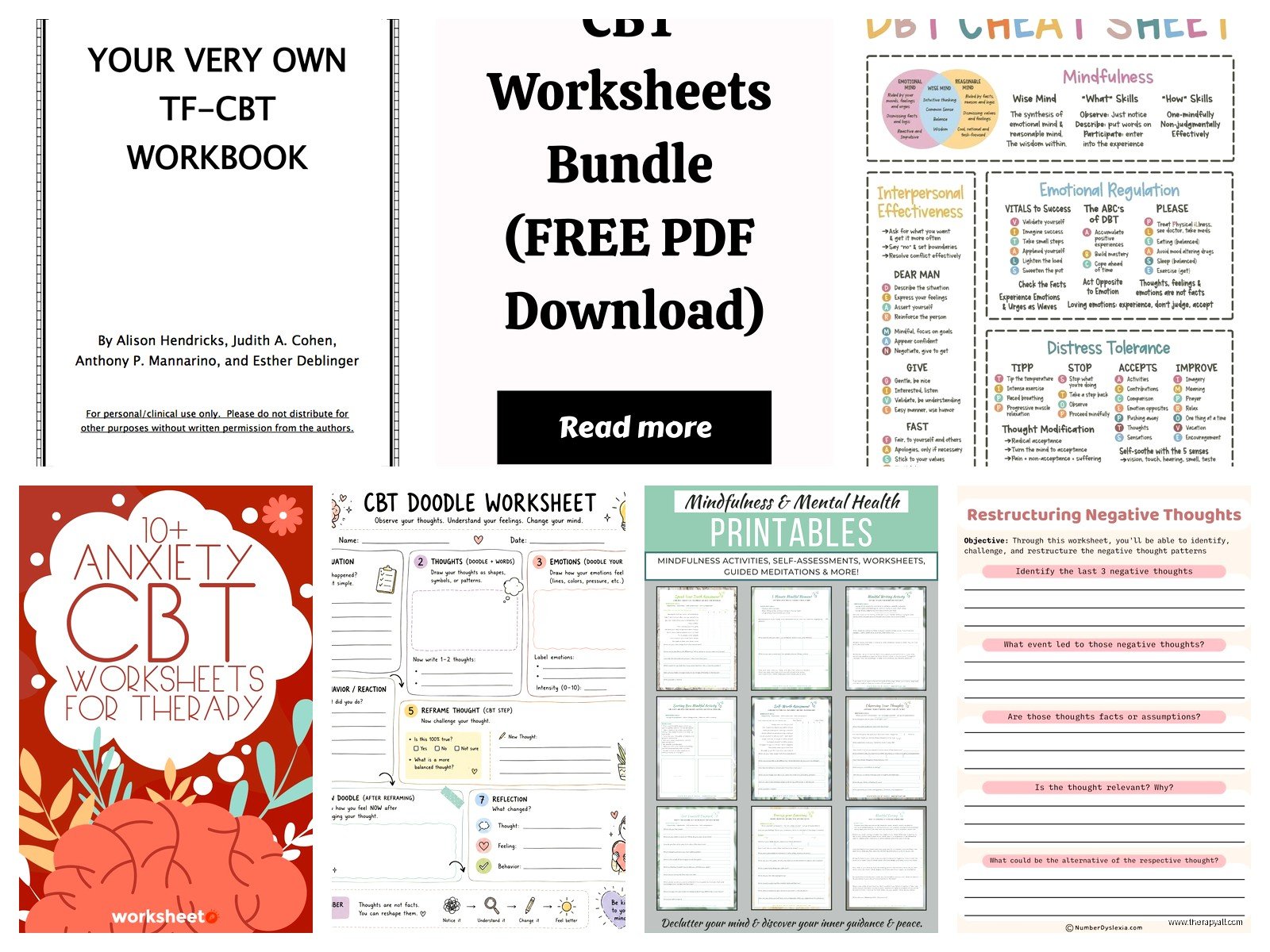
Separate worksheets track individual exposure sessions. You record what you did, how long you stayed in the situation, peak anxiety level, ending anxiety level, and what you learned. The learning component is essential because exposure isn’t just about habituation—it’s about gathering evidence that contradicts your feared prediction.
Core Belief Worksheets
These dig deeper than automatic thoughts to identify underlying beliefs about yourself, others, and the world. Core beliefs are usually formed early and operate like background programs running all the time. Common ones include “I’m unlovable,” “I’m incompetent,” “People can’t be trusted,” or “The world is dangerous.”
A core belief worksheet typically uses a downward arrow technique. You start with an automatic thought and keep asking “What does that mean about me?” until you hit bedrock. Or it might use a historical test where you track evidence for and against the belief across your entire life, not just recent events.
You might notice that core belief work is more complex than thought records, which is why most free worksheets focus on automatic thoughts. Core beliefs require more context and often more therapeutic support to challenge effectively without just… spiraling.
Where to Find Quality Free Worksheets
Several organizations and websites offer genuinely useful CBT worksheets at no cost. Psychology Tools has a free section with professionally designed worksheets, though their best stuff is behind a paywall. Therapist Aid offers a solid collection sorted by topic and includes instructions for both therapists and clients. The Centre for Clinical Interventions in Australia provides comprehensive workbooks, not just individual worksheets, which is actually better if you’re working on a specific issue.
Academic institutions sometimes publish free resources. The Beck Institute has some materials available. The Association for Behavioral and Cognitive Therapies has a fact sheet section that includes downloadable tools.
You can also find worksheets through mental health apps, though quality varies wildly. Some are just poorly formatted PDFs of techniques that don’t actually follow CBT protocols.
What Makes a Worksheet Actually Useful
Clear instructions that don’t assume you already know CBT theory. Enough space to actually write—those worksheets with tiny boxes are useless. A logical flow that guides you through the process step by step. Examples that illustrate what goes in each section.
The worksheet should target one specific skill. A “mega CBT worksheet” that tries to cover thought records AND behavioral activation AND exposure planning is gonna be overwhelming and probably ineffective for all three purposes.
Professional design matters less than you’d think, but readability matters a lot. If the font is difficult to read or the layout is confusing, you won’t use it consistently.
How to Actually Use These Worksheets
Consistency beats perfection. Using a worksheet imperfectly three times a week is more valuable than waiting for the perfect moment or the perfect insight to fill one out completely. I see people—okay, I’ve done this myself—spend twenty minutes staring at a blank thought record waiting for the “right” automatic thought to analyze. Just pick one. Any distressing thought. Start there.
Keep them accessible. I know someone who downloaded like forty worksheets, organized them into a beautiful folder system, and then never actually printed any because the folder system was too precious to disrupt. Print a stack. Keep them messy. Write in the margins.
Review what you’ve completed. Going back through old thought records shows patterns you can’t see in a single entry. You might notice you use the same cognitive distortions repeatedly, or that certain situations consistently trigger specific automatic thoughts.
Common Mistakes
Treating worksheets like homework you’re being graded on. There’s no wrong answer in the evidence columns—you’re gathering data about your thinking patterns, not trying to impress anyone. Being too vague helps nobody. “I felt bad” and “I thought negative things” gives you nothing to work with.
Skipping the emotion rating because it feels artificial. I get it, reducing complex feelings to a number seems reductive, but that number is how you measure change. Without it, you’re just hoping you feel better without any way to track whether the intervention actually worked.
Only filling them out when you’re already feeling better. The whole point is to use them during distress, when automatic thoughts are active and accessible. Reconstructing a thought pattern hours later when you’re calm is less effective.
Limitations of Worksheet-Only Approaches
Worksheets are tools, not treatment. They’re most effective within the context of therapy or at minimum with some education about CBT principles. Using them without understanding the underlying theory is like— actually, some people do benefit from worksheets alone, but it’s not the ideal approach for everyone.
Complex trauma, severe depression, active suicidal ideation, psychosis, and certain personality disorders typically require professional support beyond self-help worksheets. If you’re filling out thought records and your mood keeps getting worse, that’s information. It means you need more support, not different worksheets.
Some people find the structured format helpful. Others find it constraining or invalidating, like their experience is being forced into boxes that don’t quite fit. That’s legitimate. CBT isn’t the only evidence-based approach, and worksheets aren’t the only way to practice CBT skills.
Digital Versus Printed Worksheets
Both have advantages. Printed worksheets are tactile, don’t require a charged device, and some people process better when writing by hand. Digital versions are searchable, easier to store long-term, and you can’t lose them in a pile of papers on your desk.
Some apps let you fill out worksheets on your phone, which means you can complete a thought record immediately when something happens rather than waiting until you get home. The trade-off is screen fatigue and the temptation to switch to checking email or scrolling social media mid-worksheet.
I’m gonna be honest, I’ve tried both extensively and I keep coming back to printed worksheets in a dedicated notebook. Something about the physical act of writing slows my thinking down enough to actually examine it. Your mileage may vary.