
Mental Health, Therapy resources
ERP Therapy Worksheets: Exposure and Response Prevention Tools

Jun
# ERP Therapy Worksheets: Exposure and Response Prevention Tools
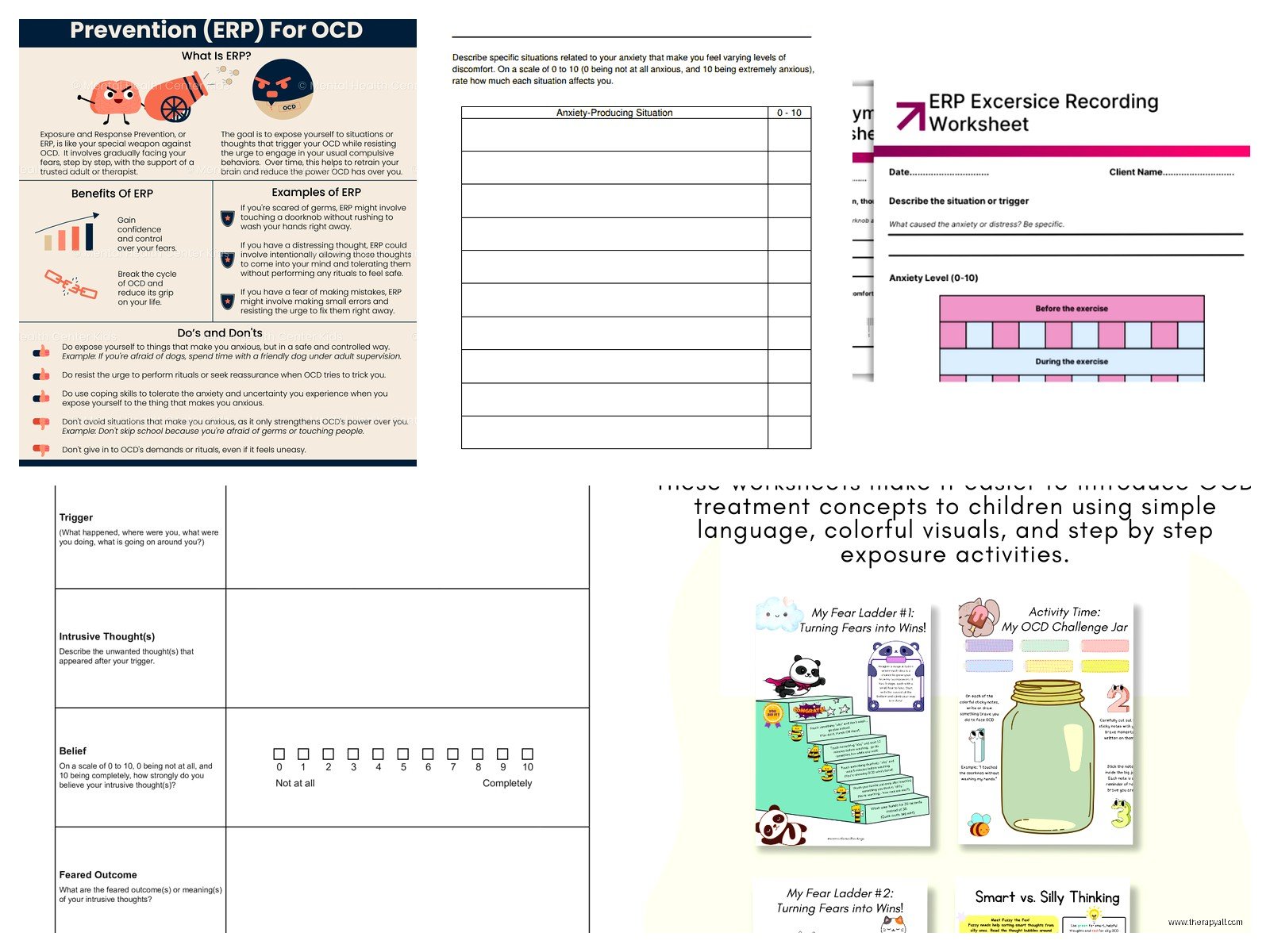
ERP worksheets are structured documents that guide people through the process of exposure and response prevention therapy, which is the gold-standard treatment for OCD and several anxiety disorders. These aren’t just random fill-in-the-blank exercises. They’re systematic tools that help track exposures, monitor anxiety levels, identify compulsions, and measure progress over time.
The core function of an ERP worksheet is documentation. You need to record what exposure you did, how anxious it made you, whether you completed a compulsion or resisted it, and how long the anxiety lasted. This creates a written record that becomes incredibly useful when you’re three weeks into treatment and can’t remember if touching a doorknob without washing your hands used to spike your anxiety to an 8 or a 9.
I remember back in 2021 when I was compiling resources for an OCD treatment center’s website and the clinical director handed me a stack of photocopied worksheets that looked like they’d been designed in 1987. Literally dot matrix printer quality. And she was like, “Can you make these look better?” which turned into this whole project where I actually had to understand what each section was doing and why it mattered, not just make it pretty.
## Fear Hierarchy Worksheets
The fear hierarchy worksheet is usually where ERP starts. You list out situations that trigger anxiety or obsessions, then rate them from least scary to most terrifying. The scale is typically 0-10 or 0-100, depending on how granular you wanna get.
A good fear hierarchy worksheet includes several columns: the triggering situation, your SUDs rating (Subjective Units of Distress), the obsession or fear it triggers, and the compulsion you usually do in response. Some versions also have a column for “avoidance behaviors” because sometimes people don’t realize they’re avoiding something until they see it written down.
For someone with contamination OCD, a hierarchy might look like: touching a clean countertop (SUDs: 20), touching a doorknob at home (SUDs: 40), touching a public doorknob (SUDs: 65), touching a bathroom door handle (SUDs: 85), touching a toilet seat (SUDs: 95). You get the idea.
The worksheet format forces you to break down this massive overwhelming fear into specific, manageable pieces. That’s the whole point. You can’t do exposure therapy against “germs” as a concept. You need concrete situations.
What genuinely annoys me is when these worksheets don’t leave enough space for people to write actual descriptions. I’ve seen templates with tiny boxes where you’re supposed to cram in complex obsessive thoughts, and it’s like—how is anyone supposed to differentiate between “fear of contamination leading to illness” and “fear of contaminating others” in a 2-inch box?
## Exposure Tracking Logs
Once you’ve built your hierarchy, you need exposure logs. These track each exposure exercise: what you did, when you did it, your anxiety level before/during/after, whether you did any compulsions, and how long the exposure lasted.
The “before/during/after” anxiety ratings are critical because they demonstrate habituation, which is when your anxiety naturally decreases even though you’re still in the triggering situation. That’s what you’re trying to prove to your brain—that the anxiety goes down on its own without compulsions.
A typical exposure log has columns for: date, time, exposure description, starting SUDs, peak SUDs, ending SUDs, duration, compulsions (yes/no), and notes. The notes section is where the real information lives. That’s where you write “felt like I was gonna die for the first 10 minutes but then my cat knocked over a plant and I got distracted and realized I’d stopped thinking about it.”
You’re supposed to do multiple repetitions of the same exposure because one time doesn’t rewire anything. The log helps you see patterns like “okay, the third time I touched the doorknob my starting anxiety was only a 4 instead of a 7.”
I’ve worked with therapists who have clients do 3-5 exposures per day and track every single one. That’s a lot of data. Some people love it because they’re data-driven and seeing the numbers drop is motivating. Other people find it tedious and—honestly, I get it. When you’re already anxious about the exposure itself, having to immediately sit down and fill out a form can feel like homework you didn’t sign up for.
## Response Prevention Tracking
This is the part people skip and then wonder why ERP isn’t working. The “RP” in ERP is just as important as the “E.” Response prevention worksheets help you identify and resist compulsions.
These worksheets usually ask: What compulsion did you want to do? Did you do it? If yes, how many times? If no, what did you do instead? How did it feel to resist?
Common compulsions include washing, checking, seeking reassurance, mental review, researching, confessing, and ordering/arranging. A good worksheet lists examples because people don’t always recognize their compulsions as compulsions. They think “I’m just being thorough” or “I’m just making sure.”
The resistance strategies section is important. You need alternative behaviors that aren’t compulsions. If your compulsion is washing your hands for five minutes, and you resist but then spend five minutes thinking through whether you touched anything contaminated, you’ve just replaced a behavioral compulsion with a mental one. The worksheet should prompt you to identify truly neutral activities: listen to music, text a friend, do jumping jacks, whatever gets your brain onto something else.
What makes these worksheets actually useful versus just busy work is the reflection component. After you resist a compulsion, you write down what happened. Did the feared outcome occur? (Spoiler: it didn’t.) How long did the discomfort last? What did you learn?
## Anxiety Curve Recording
Some ERP worksheets include anxiety curve graphs where you plot your SUDs ratings over time during a single exposure. The x-axis is time (usually in 5 or 10-minute intervals) and the y-axis is anxiety level.
This visual representation shows the curve going up, peaking, and then coming back down. That downward slope is what you’re trying to demonstrate. Your anxiety doesn’t stay at a 9 forever. It peaks and then it drops, usually within 30-60 minutes, sometimes faster.
I spent like two months in summer 2022 writing worksheet guides and honestly started using some of these tracking tools myself for non-OCD anxiety stuff and realized, oh, this actually does help to see it on paper instead of just feeling like you’re drowning in it indefinitely.
The curve worksheet works best when you stay in the exposure long enough to see the decrease. If you bail at 10 minutes when you’re at peak anxiety, you don’t get the learning. That’s why the worksheet often has a “planned duration” field versus “actual duration” field. It holds you accountable.
## Thought Records for OCD
Traditional CBT thought records get adapted for OCD, but they need modifications. Standard thought records ask you to identify cognitive distortions and replace negative thoughts with balanced ones. For OCD, that doesn’t really work because the thoughts aren’t just “negative”—they’re intrusive and often bizarre.
OCD-specific thought records focus on: identifying the obsession, recognizing it as an OCD thought (not a real threat), noting the compulsion urge, and practicing uncertainty tolerance. There’s usually a column for “response to the thought” where instead of challenging it, you practice saying “maybe, maybe not” or “I’m not gonna figure this out right now.”
The goal isn’t to convince yourself the thought is irrational. People with OCD already know their thoughts are irrational most of the time. The goal is to practice sitting with uncertainty and not engaging with the thought through compulsions or mental rituals.
Some worksheets include a “thought fusion” section because OCD brains often confuse thinking something with it being true or important. Just because you had the thought “what if I hit someone with my car” doesn’t mean you did or that you’re a dangerous person. The worksheet helps externalize that process.
## Progress Tracking Sheets
Long-term progress worksheets compare your hierarchy ratings over weeks or months. You revisit situations from your fear hierarchy and re-rate them. What was a 75 in week one might be a 30 in week six.
These sheets often include a section for “situations I can now do that I couldn’t before” which sounds kinda cheesy but actually serves a purpose. OCD makes you forget your wins. You’ll be focused on the fact that public bathrooms still make you anxious and completely forget that three months ago you couldn’t touch your own kitchen counter without washing your hands immediately.
Progress tracking also identifies stuck points. If something isn’t decreasing after multiple exposures, that usually means either the exposure isn’t hitting the actual fear, you’re doing subtle compulsions, or you need to increase the difficulty.
## Ritual Prevention Contracts
Some therapists use written contracts or commitment forms where you specify which compulsions you’re working to eliminate and what you’ll do instead. It’s not legally binding obviously, it’s just a commitment device.
The contract might say: “I agree to resist checking the stove more than once before leaving the house. If I feel the urge to check again, I will leave the house immediately and text my therapist or support person instead.”
There’s usually a consequence section, though not in a punitive way. More like, “If I do the compulsion, I will do an additional exposure within 24 hours.” It builds in accountability.
I’ve seen these work really well for some people and completely backfire for others who turn the contract itself into a compulsion and start obsessing about whether they’re following it perfectly, which—yeah, OCD is gonna OCD.
## Family/Support Person Involvement Worksheets
ERP often involves other people, especially if reassurance-seeking is a compulsion. There are worksheets designed for family members or support people that outline how to respond (or not respond) to reassurance requests.
These typically include: common reassurance questions the person asks, scripted responses that don’t provide reassurance (“I’m not gonna answer that because it’s your OCD talking”), and what to do if the person gets upset when you don’t provide reassurance.
It’s kinda awkward, honestly. You’re basically asking your partner or parent to read a script that feels unnatural. But reassurance is one of the most common compulsions and one of the hardest to break without environmental support.
The worksheet might also track “reassurance-free days” or count how many times the support person successfully redirected instead of answering the OCD question. Some families get competitive about it in a good way.
## Imaginal Exposure Scripts
For fears that can’t be directly exposed to in real life (like “what if I secretly molested someone and don’t remember” or “what if this means I’ll go to hell”), imaginal exposure uses written scripts.
The worksheet format for this is basically: write out your worst-case scenario in detail, present tense, first person. Then you read it repeatedly until it loses its power. The worksheet tracks how many times you’ve read the script and your SUDs rating each time.
What’s important is the script stays consistent. You’re not elaborating or adding new details each time—that would be rumination. You write it once and then expose yourself to the same story over and over.
There’s usually a notes section for recording what you notice: “The fifth time reading this, I noticed I was kinda bored” or “My anxiety didn’t spike as high when I read it before bed versus in the morning.”
## Maintenance Planning Worksheets
After active ERP treatment, maintenance worksheets help prevent relapse. These outline: triggering situations to continue exposing yourself to, warning signs that OCD is creeping back, and what to do if you notice yourself avoiding or doing compulsions again.
It’s basically a personalized action plan. If you notice you’ve started checking the locks three times again instead of once, the worksheet prompts you to immediately do an exposure or contact your therapist.
Some include a “values” section borrowed from ACT (Acceptance and Commitment Therapy) that asks what you’re doing with the time and energy you’re not spending on compulsions anymore, which I guess is supposed to be motivating but sometimes just feels like—I don’t know, can I just exist without a constant self-improvement project?
These worksheets are meant to be living documents you return to periodically, not something you fill out once and forget. The format should be simple enough that you’ll actually use it when OCD tries to sneak back in six months later.

ADHD & Neurodiversity
Life Planner Bundle – Life Organizer
Self-Care & Personal Growth
Acceptance And Commitment
Anxiety & Stress
Stress Processing Journal & Reflection Worksheets For Daily Self – Care
Self-Care & Personal Growth
Self – Reflection Guided Journal With Guided Prompts 30
Emotional Wellness
Decision Processing – Thought Processing Journal For Daily Self – Care
Therapist Resources
Physiotherapist Journal PDF Planner Tracker Or Log Book
Self-Care & Personal Growth
Customizable Self – Confidence & Self – Esteem Guided Journal
ADHD & Neurodiversity
ADHD Behavior Tracker PDF Planner Tracker Or Log Book