
Mental Health, Therapy resources
Imago Therapy Worksheets: Exercises for Relationship Healing
Jun
# Imago Therapy Worksheets: Exercises for Relationship Healing
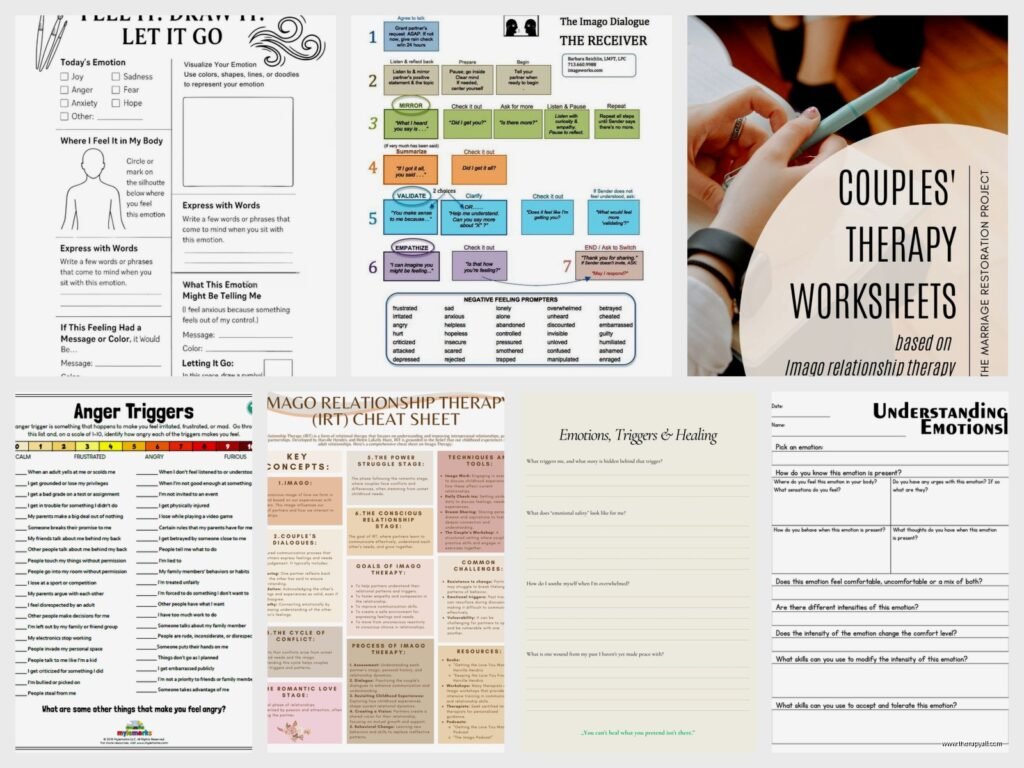
Imago Relationship Therapy worksheets are structured exercises designed to help couples communicate more effectively and understand the unconscious patterns driving their conflicts. The core concept behind Imago therapy is that we’re attracted to partners who mirror both the positive and negative traits of our primary caregivers, and we unconsciously try to heal childhood wounds through these adult relationships. The worksheets provide a framework for making these unconscious dynamics conscious and workable.
I remember sitting in a coffee shop in 2019 watching a couple across from me clearly doing some kind of Imago exercise—they had this worksheet between them and were taking turns talking while the other just listened without interrupting. It was kinda awkward to witness but also fascinating because you could see how hard it was for them to just shut up and listen. That’s essentially what these worksheets force you to do.
## The Couples Dialogue Worksheet
This is the foundational Imago exercise and honestly the one that trips people up the most. The Couples Dialogue has three specific steps: mirroring, validation, and empathy. You can’t just have a conversation—you have to follow the structure exactly, which feels robotic at first.
**Mirroring** means the receiving partner repeats back what they heard, word for word if possible, and asks “Did I get that right?” The sending partner either confirms or clarifies. This sounds simple but people hate it because it feels unnatural. You’re supposed to say things like “What I heard you say is…” or “Let me see if I got this…” and then literally parrot back their words.
**Validation** comes next where the receiving partner says something like “You make sense, and what makes sense is…” even if they disagree with the content. This is where couples really struggle because validation doesn’t mean agreement—it just means acknowledging their partner’s perspective has internal logic. The worksheet usually has prompts like “Given your experience, it makes sense that you would feel…”
**Empathy** is the final step where you imagine what your partner might be feeling. “I imagine you might be feeling…” followed by emotions. The worksheet typically lists common emotions to help because most people are terrible at naming feelings beyond mad, sad, and glad.
What genuinely annoys me about how these worksheets get presented online is that half the PDFs you download are missing the critical instruction that you HAVE TO take turns. I’ve seen so many badly designed Imago worksheets where it’s just the dialogue structure with no clear indication of who goes first, when to switch, or how many rounds to do. My cat knocked over my coffee on one of these poorly formatted worksheets last month and honestly it wasn’t a huge loss.
## The Childhood Wounds Inventory
This worksheet asks you to identify patterns from your childhood that show up in your current relationship. You list your primary caregivers and their traits—both positive and negative. Then you compare those traits to your partner’s characteristics.
The exercise includes questions like:
– What did you long for but not receive as a child?
– What behaviors from your caregivers felt frustrating or hurtful?
– How does your partner trigger similar feelings?
– What are you trying to get from your partner that you didn’t get as a child?
You’re supposed to see that your partner isn’t actually the problem—they’re just activating old wounds. The worksheet usually has you rate the intensity of certain childhood experiences on a scale, then identify which current conflicts connect to those experiences.
I spent probably six months in 2021 analyzing these connection patterns for a series I was writing and started seeing my own relationship dynamics differently, which was… uncomfortable. You realize you’ve been basically casting your partner in a role they never auditioned for.
## The Behavior Change Request Worksheet
This is the practical one where you actually ask for specific behavioral changes instead of just complaining about what’s wrong. The worksheet has a very specific format that prevents vague complaints.
The structure is usually:
– **Frustration**: “I feel frustrated when you…”
– **Childhood connection**: “This reminds me of when…”
– **Hidden desire**: “What I really need is…”
– **Specific request**: “Would you be willing to…” (has to be specific, doable, and positive)
The request can’t be “stop doing X”—it has to be “do Y instead.” So instead of “stop ignoring me when you come home,” it’s gotta be something like “Would you be willing to greet me with a hug and ask about my day when you get home, before checking your phone?”
You’re supposed to make three specific requests and your partner picks one to work on. The worksheet often includes a section for the partner to say yes, no, or counteroffer. Most templates have space to track whether the behavior actually happened and how both people felt about it.
## The Reimaging Exercise Worksheet
This one focuses on recreating positive experiences from the relationship’s early days or childhood. The worksheet asks you to identify moments when you felt truly seen, safe, or valued—either in childhood or in your relationship. Then you design experiences that recreate those feelings.
It’s structured around these questions:
– Describe a time you felt completely accepted
– What specifically did the other person do or say?
– What emotions did you experience?
– How can we recreate this feeling now?
The worksheet usually includes a “gifting” section where you list things your partner could do that would make you feel loved, based on those positive memories. These have to be specific actions, not general concepts like “be more present” or… wait, I think I already mentioned the specificity thing.
## The Zero Negativity Commitment Worksheet
This worksheet helps couples track and eliminate critical, blaming, or shaming communication. You log every instance of negativity for a week, categorize it (criticism, contempt, defensiveness, stonewalling), and identify what need wasn’t being met.
The worksheet typically has columns for:
– Date and time
– What was said
– Type of negativity
– Underlying need
– Alternative phrasing
The idea is that negativity is just a clumsy attempt to get a need met. Once you identify the need, you can make a clean request instead. The worksheet sometimes includes a “repair” section where you go back and restate what you said without the negativity.
Couples are supposed to share their logs and discuss patterns. Most worksheets have a section for identifying triggers—specific topics, times of day, or situations where negativity spikes.
## The Appreciations and Surprises Log
This is the positivity-building worksheet where you track appreciations (things your partner did that you valued) and surprises (unexpected positive gestures). You’re supposed to do this daily, which sounds exhausting but the worksheet usually just has a few lines per day.
The format is simple:
– One thing I appreciated today: [specific behavior]
– How it made me feel: [emotion]
– One surprise I could give my partner: [specific action]
The “surprise” component is key because Imago therapy emphasizes that relationships die from predictability. The worksheet prompts you to plan small, unexpected positive actions. Not big romantic gestures—just breaking routine in caring ways.
Some worksheets include a weekly review section where you share your appreciations list with your partner. You’re supposed to read them aloud, which feels kinda corny but apparently helps rewire the brain’s negativity bias.
## The Stretching Exercise Worksheet
This addresses the concept that growth happens when you do things that feel uncomfortable but are important to your partner. The worksheet identifies behaviors your partner wants that feel unnatural to you, and you practice them anyway.
It typically includes:
– What my partner wants that feels difficult for me: [behavior]
– Why this feels uncomfortable: [childhood/personality reason]
– How I can stretch into this behavior: [specific steps]
– How often I’ll practice: [frequency]
The worksheet often has a tracking component where you log each time you “stretched” and how it felt. Your discomfort level is supposed to decrease over time as new neural pathways form.
There’s usually a section for the receiving partner to acknowledge the stretch and express appreciation, because apparently people need recognition for doing things that don’t come naturally. Which, fair.
## The Safe Conversations Worksheet
This creates structure for discussing highly charged topics without escalating into fights. The worksheet designates a specific time, location, and duration for difficult conversations. You can’t just ambush your partner with heavy topics—you have to schedule them.
The worksheet includes:
– Topic to discuss: [one issue only]
– Scheduled time: [specific]
– Time limit: [usually 20-30 minutes]
– Ground rules agreement: [both sign]
– Dialogue format: [mirroring structure]
There’s typically a section for pre-conversation preparation where each person writes out their main points. This prevents the rambling, kitchen-sink arguments where everything you’ve been mad about for six months comes tumbling out.
The worksheet usually has a post-conversation section for rating how safe you felt and what could improve next time. You’re building a template for handling conflict that you can repeat.

ADHD & Neurodiversity
Life Planner Bundle – Life Organizer
Self-Care & Personal Growth
Acceptance And Commitment
Anxiety & Stress
Stress Processing Journal & Reflection Worksheets For Daily Self – Care
Self-Care & Personal Growth
Self – Reflection Guided Journal With Guided Prompts 30
Emotional Wellness
Decision Processing – Thought Processing Journal For Daily Self – Care
Therapist Resources
Physiotherapist Journal PDF Planner Tracker Or Log Book
Self-Care & Personal Growth
Customizable Self – Confidence & Self – Esteem Guided Journal
ADHD & Neurodiversity
ADHD Behavior Tracker PDF Planner Tracker Or Log Book