What Internal Family Systems Actually Means for Worksheets
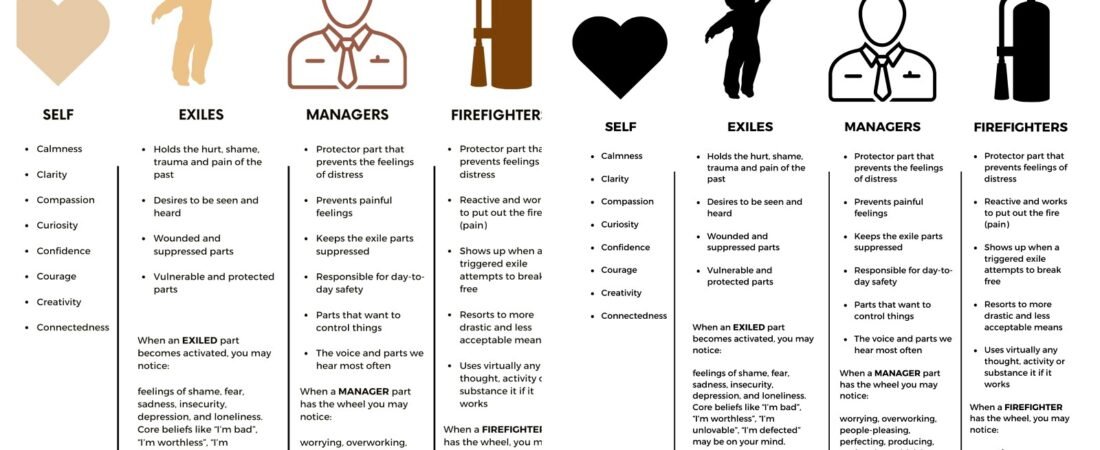
Internal Family Systems operates on the premise that your psyche isn’t one unified self but a collection of parts, each with its own perspective, emotion, and role. When I first started writing about IFS back in 2019, I kinda thought the whole “parts” language was metaphorical nonsense until I sat in on a training session and realized how literally people experienced these distinct voices in their heads. The model was developed by Richard Schwartz in the 1980s, and it categorizes parts into three main groups: managers (the planners and controllers), firefighters (the crisis responders who numb or distract), and exiles (the wounded parts carrying old pain).
The core concept revolves around Self—capital S—which isn’t a part but the calm, curious, compassionate center that can mediate between all these parts. IFS worksheets are designed to help you map these parts, understand their roles, and eventually unburden the exiles so the whole system can function without constant internal conflict.
Why PDF Worksheets for Parts Work
You need something concrete when you’re trying to identify which part is running the show at any given moment. I remember this one afternoon in 2021 when I was editing a massive worksheet collection and my cat knocked over my coffee directly onto my laptop—completely unrelated but I lost like four hours of work—and I realized that my own “firefighter” part wanted to just binge Netflix instead of redoing everything. That’s the thing about parts work: once you start seeing the framework, you can’t unsee it.
PDFs work well because you can print them, write on them, cross things out, circle stuff. There’s something about physically mapping your internal system that makes it more real than typing into a notes app. Plus you can save them, return to them weeks later, and see how your understanding of your parts has shifted.
Mapping Your Parts: The Foundation Worksheet
The most basic IFS worksheet asks you to identify and name your parts. This sounds simple but it’s genuinely difficult at first. You’re looking for distinct voices or patterns—like the part that says you’re lazy versus the part that pushes you to work 12-hour days. They’re both trying to protect you, just in opposite ways.
A good mapping worksheet includes:
- Space to name each part (and people get creative here—”The Perfectionist,” “Inner Critic,” “The Procrastinator,” “Anxious Annie,” whatever feels right)
- Description of what this part does or says
- When this part shows up (specific triggers or situations)
- What this part is trying to protect you from
- How old this part feels (many parts formed during childhood)
What genuinely annoys me is when worksheet creators just slap “Part 1, Part 2, Part 3” as labels with zero guidance on how to actually differentiate between parts. Like, if someone’s new to IFS, they need examples, prompts, maybe even a diagram showing how managers differ from firefighters. The worst worksheets I’ve reviewed are just blank boxes with “describe your part here” and nothing else.
The Self-to-Part Relationship Tracker
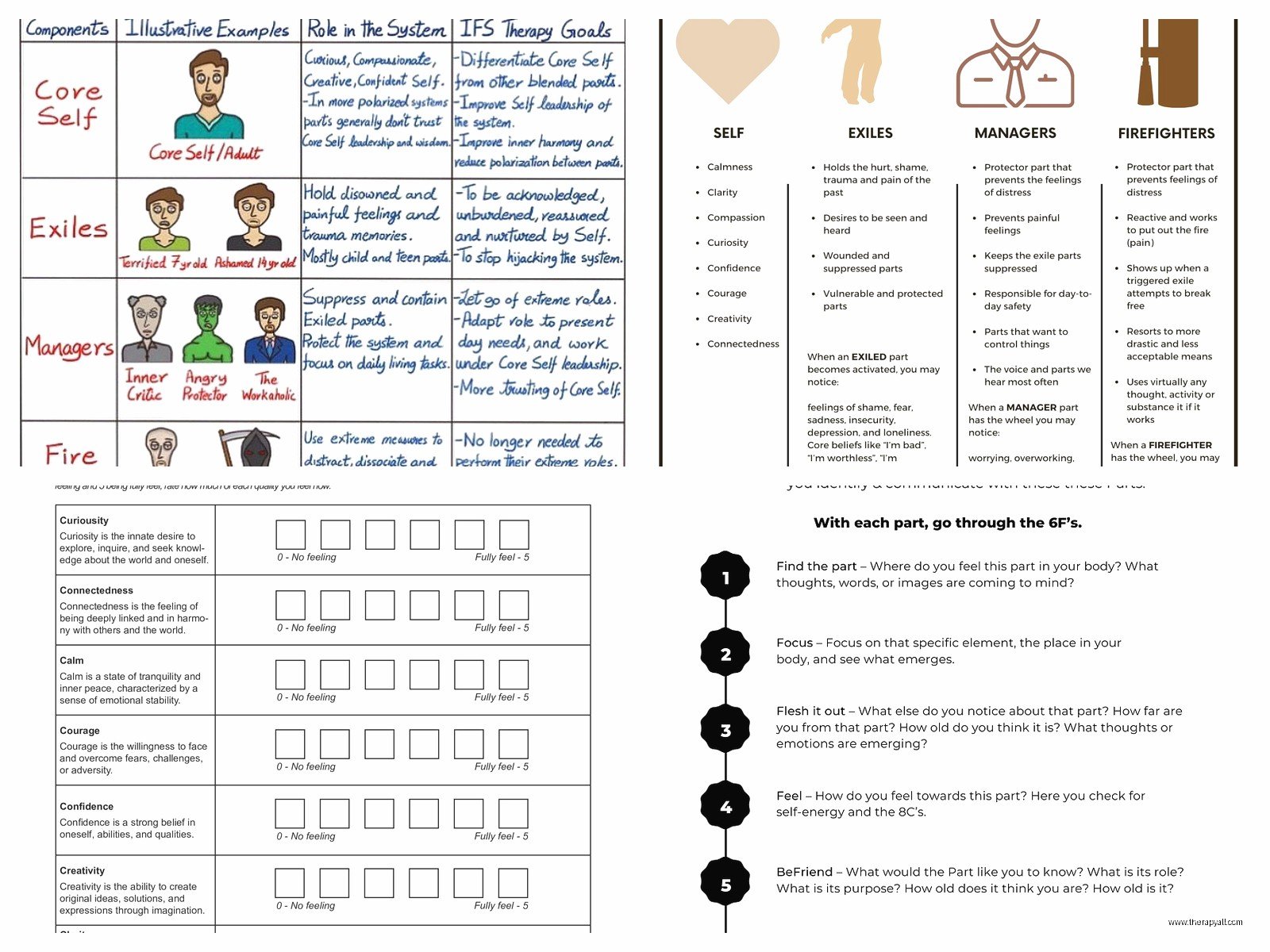
Once you’ve identified your parts, you need to track how Self relates to each one. Are you curious about this part or do you hate it? Do you try to suppress it or listen to what it needs? IFS emphasizes that you can’t heal parts by fighting them—you have to approach them with what Schwartz calls the “8 C’s”: curiosity, calm, clarity, compassion, confidence, courage, creativity, and connectedness.
A relationship tracker worksheet typically includes:
- The part’s name
- Your current feeling toward this part (judgment, fear, appreciation, anger)
- Whether you’re in Self when you think about this part
- What changes when you approach this part with curiosity instead of criticism
I use a version of this myself sometimes because—okay this sounds like I’m making it up but I swear it’s true—I have a part that gets irrationally angry when people misuse “affect” and “effect” in mental health articles, and I had to actually work with that part to understand it’s not really about grammar, it’s about this deeper fear that sloppy writing means sloppy thinking which means someone might get hurt by bad mental health advice. See how that works? The grammar thing is just the manager part’s strategy.
Exile Unburdening Protocol Sheets
This is where IFS gets into deeper therapeutic territory. Exiles are the parts carrying old wounds—usually formed in childhood—that other parts (managers and firefighters) work overtime to keep hidden. The unburdening process involves going back to those wounded parts, witnessing their pain, and helping them release the burdens they’ve been carrying.
Unburdening worksheets walk you through:
- Identifying which exile needs attention (usually the one your protector parts are most afraid of)
- Getting permission from protector parts to approach the exile
- Asking the exile what it wants you to know
- Witnessing the exile’s story without trying to fix or change it
- Asking what burden it’s ready to release
- Imagining how the exile wants to release the burden (some people visualize light, fire, water, whatever feels right)
- Inviting in new qualities or beliefs to replace the burden
This is heavy work and honestly shouldn’t be done without a therapist if you’re dealing with significant trauma. The free worksheets are useful for understanding the process, but they’re not a replacement for actual therapeutic support. That’s something I gotta emphasize because I’ve seen people online treat IFS worksheets like they’re some kind of DIY trauma cure and that’s… not how this works.
Protector Part Interviews
Before you can unburden exiles, you need to work with the protectors. These are your manager and firefighter parts, and they’re not gonna just let you waltz in and mess with the system they’ve spent years building. A protector interview worksheet helps you have a conversation with these parts.
The interview format usually includes questions like:
- What is your role in my system?
- What are you protecting me from?
- What are you afraid would happen if you stopped doing your job?
- How old do you think I am?
- What do you need from me?
- Would you be willing to step back slightly so I can check on the part you’re protecting?
That second-to-last question is crucial because many protector parts are stuck in the past. They formed when you were seven or twelve or sixteen, and they’re still operating as if you’re that age and that vulnerable. When you can show them that you’re an adult now with more resources—or when I guess, Self can show them that—they often relax their extreme strategies.
Daily Parts Check-In Logs
Some people benefit from tracking which parts are active throughout the day. This is less about deep therapeutic work and more about building awareness. I spent like three months in 2020 doing these daily logs and honestly it got tedious but I learned that my “productive manager” part takes over every morning around 6 AM and doesn’t let up until I’ve cleared my email, which explained why I was always exhausted by 10 AM.
A daily log worksheet might include:
- Time of day
- Situation or trigger
- Which part showed up
- What the part did or said
- Whether Self was present
- What happened next
You don’t need to do this forever, but a week or two of tracking can reveal patterns you’d never notice otherwise.
Polarization Maps
Sometimes parts are in direct conflict with each other—IFS calls this polarization. You might have one part that wants to quit your job and another part that’s terrified of financial instability. Or a part that wants intimacy and a part that sabotages every relationship. These parts end up in an exhausting tug-of-war, and neither can win because they’re both you.
A polarization worksheet helps you:
- Identify the two (or more) parts in conflict
- Describe each part’s position and fear
- Understand what each part is ultimately trying to protect
- Find the common ground (usually they both want your wellbeing, just have different strategies)
- Negotiate a truce from Self
The key insight is that polarized parts are so busy fighting each other that they can’t do their actual jobs effectively. When Self can mediate and both parts feel heard, they usually discover they’re not really enemies.
Where to Find Free IFS Worksheets
The IFS Institute website has some resources, though not as many free downloadable worksheets as you’d expect. I’ve found better collections on therapy blogs and individual therapist websites—people who are trained in IFS and create worksheets for their own clients, then share them publicly.
Some reliable sources include:
- Therapist Aid (they have a small but solid IFS section)
- Individual IFS practitioner websites (just search “IFS worksheets PDF” and you’ll find therapists who’ve made their materials available)
- Psychology Today’s resource section occasionally features parts work exercises
- The Self-Led podcast website has downloadable guides
What you won’t find easily are worksheets for the really advanced IFS protocols—legacy burdens, unburdening collective trauma, working with spiritual or cultural parts. That material usually requires training and isn’t appropriate for self-guided work anyway.
How to Actually Use These Worksheets
Don’t just fill them out once and file them away. The value comes from returning to them, noticing what’s changed, seeing how parts evolve. I keep a folder—both physical and digital, because I’m inconsistent like that—and I’ll sometimes pull out a parts map from six months ago and realize that the part I labeled “The Saboteur” was actually protecting me from burnout by forcing breaks, just in a really aggressive way.
You can use worksheets in therapy sessions if your therapist is trained in IFS or at least open to parts language. You can also use them on your own, though I’d recommend starting with the simpler identification and mapping tools before diving into unburdening protocols.
Some people like to set aside specific time for parts work—like 20 minutes every Sunday morning. Others just grab a worksheet when they notice a part activated and want to understand what’s happening. There’s no right way, which is both freeing and sometimes frustrating because you do need some consistency to see patterns.
Common Pitfalls with DIY Parts Work
The biggest mistake is trying to get rid of parts. That’s not how IFS works. Every part has a positive intention, even the ones that seem destructive or self-sabotaging. The goal isn’t elimination—it’s integration and healing so parts can update their roles and stop using extreme strategies.
Another issue is blending, which is when a part takes over so completely that you lose access to Self. When you’re blended, you can’t do effective parts work because you’re not in that curious, compassionate observer state. If you’re filling out a worksheet and you realize you hate the part you’re writing about, that’s probably blending with another part that judges it. You gotta step back, take a breath, see if you can find some curiosity.
And honestly, some people just don’t resonate with parts language at all. It feels artificial or forced to them. That’s fine—IFS isn’t the only path to healing, and if the framework doesn’t click for you, there are plenty of other therapeutic approaches that might work better.
Also watch out for worksheets that promise quick fixes or act like you can resolve deep trauma in three easy steps. Complex trauma requires professional support, period. Worksheets are tools for exploration and understanding, not magic bullets.
Adapting Worksheets for Your Needs
Most free PDF worksheets are pretty generic, which means you’ll probably want to modify them. Add questions that matter to you, cross out sections that don’t apply, create your own categories. I’ve seen people turn the basic parts map into elaborate color-coded diagrams, while others just keep a running list in a notebook.
If you’re working with specific issues—addiction recovery, eating disorders, relationship patterns, work stress—you can tailor the questions to focus on how parts show up in those contexts. Like, an addiction-focused worksheet might ask “What does this part use substances to cope with?” or “What would this part need in order to feel safe without the addictive behavior?”
The structure matters less than the inquiry itself. You’re trying to get curious about your internal world and understand the logic of your parts, even when that logic seems contradictory or doesn’t make rational sense from the outside.