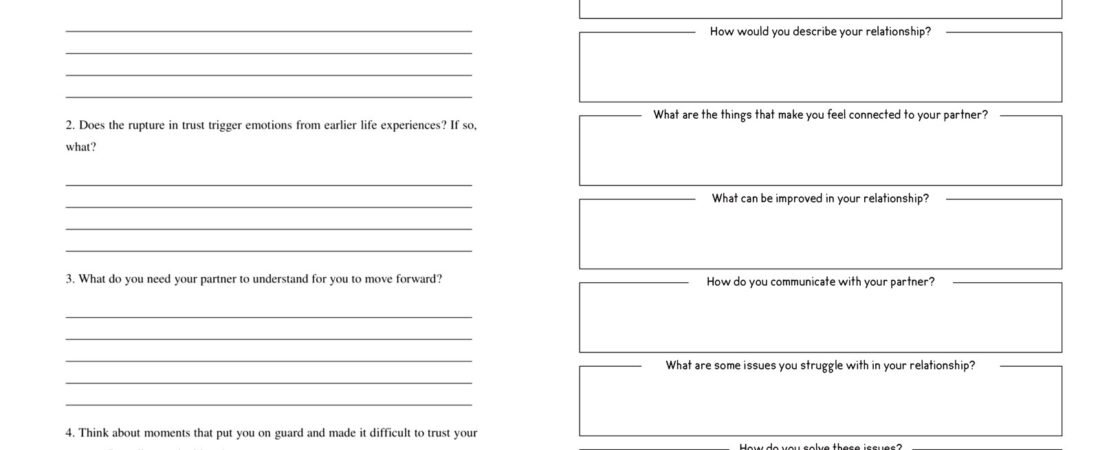
What Relationship Counseling Worksheets Actually Do
Relationship counseling worksheets are structured documents designed to help couples identify communication patterns, emotional triggers, and recurring conflicts outside the therapy room. They’re not magic. They’re tools that externalize what usually stays stuck in someone’s head during an argument—thoughts like “why does he always interrupt me” or “she never listens when I talk about work.”
I remember back in 2019 when a couple I was working with kept circling the same fight about household responsibilities. We spent three sessions on it and got nowhere until I handed them a simple communication worksheet that mapped out “I feel X when you do Y because Z.” The husband filled it out in the waiting room before our next session and brought it in looking kinda sheepish because he realized he’d been conflating her request for help with criticism of his character. That’s what these worksheets do—they slow down the emotional freight train long enough for people to see what’s actually happening.
Most worksheets fall into a few categories: communication skills builders, conflict resolution frameworks, intimacy assessments, and attachment style explorations. The best ones don’t try to be everything at once.
Communication Pattern Worksheets
These focus on how couples talk to each other, or more accurately, how they fail to talk to each other. The classic example is the “I Statement” worksheet, which has been around forever and honestly I got so tired of seeing badly designed versions of this floating around Pinterest in 2022. Half of them had instructions that made no sense or mixed up the formula.
The actual structure is: “I feel [emotion] when [specific behavior] because [impact on me].” Not “I feel like you’re a jerk” which isn’t a feeling, it’s a judgment. You teach people to identify the actual emotion first—frustrated, dismissed, anxious, whatever—then tie it to a concrete action, not a character assessment.
A good worksheet in this category will include:
- Space to identify the triggering situation without blame language
- A feelings wheel or emotion list because most people have like five emotions in their working vocabulary
- Prompts to distinguish between the event and the story you’re telling yourself about the event
- Room for the partner to reflect back what they heard
The reflection piece is critical. I’ve seen couples complete these worksheets independently and then never share them, which defeats the entire purpose. The worksheet is a scaffolding for a conversation, not a replacement for one.
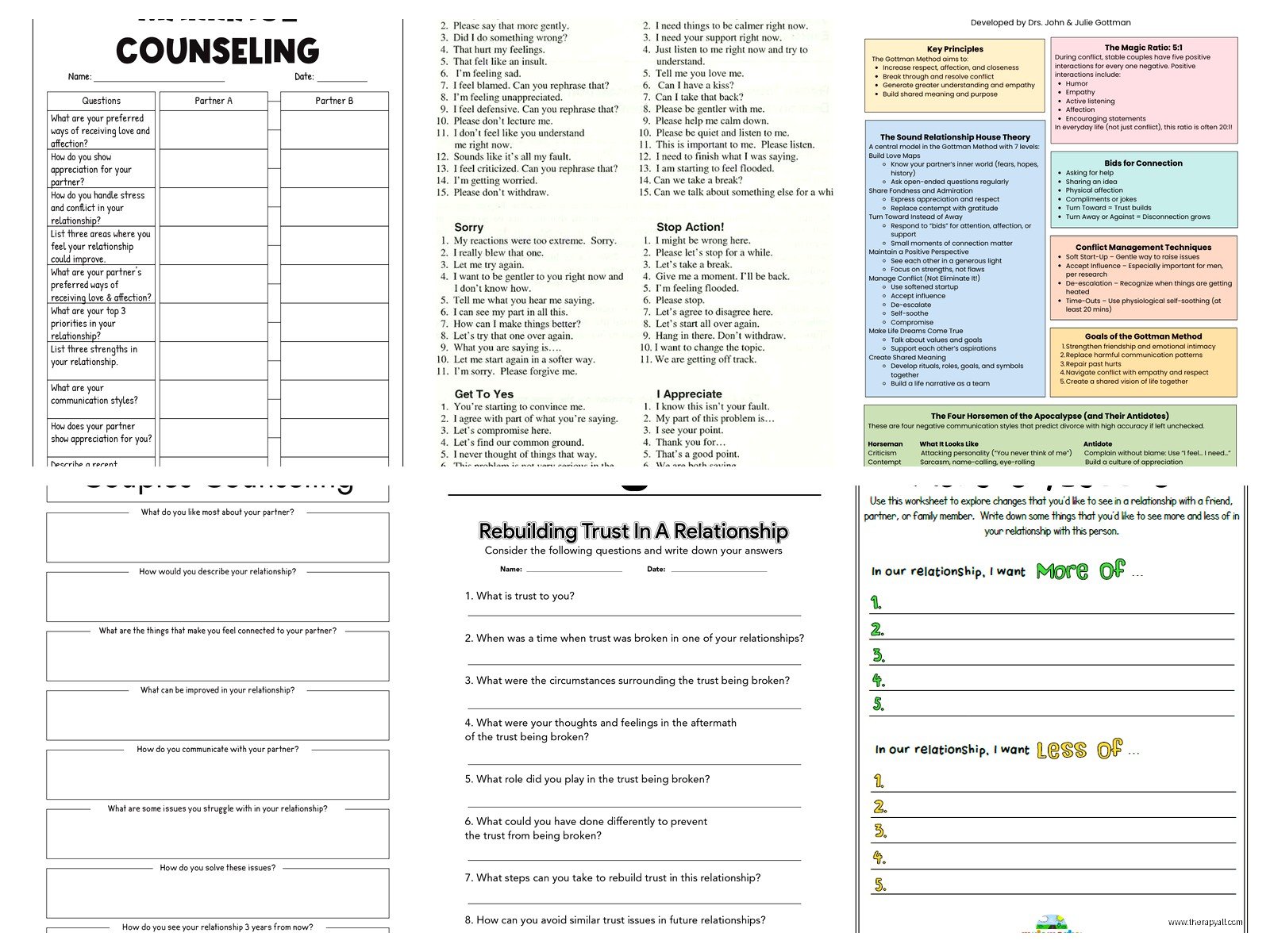
Active Listening Exercises
Active listening worksheets typically structure a timed exercise where one partner speaks for 5-10 minutes while the other only listens—no interrupting, no formulating responses, no “yeah but” interjections. Then they switch.
What genuinely annoys me about most of these is they don’t address what to do with all the anxiety that builds up when you’re forced to just listen. People aren’t wired to sit silently while their partner talks about something emotionally charged. Your brain is gonna start drafting your defense, and a worksheet that just says “listen without interrupting” doesn’t give you anywhere to put that energy.
Better versions include a section for the listener to jot down their reactions in real-time—not to share immediately, but to externalize so they can actually focus on listening instead of rehearsing. After both partners have spoken, there’s usually a structured response section: “What I heard you say was…” followed by “Is that accurate?”
My cat knocked over my coffee right onto a stack of these worksheets last month and honestly the couple probably got more out of my frantic dabbing with paper towels than they would have from the actual exercise, but anyway.
The Speaker-Listener Technique Framework
This is a specific protocol that shows up in a lot of relationship worksheets, developed from PREP (Prevention and Relationship Enhancement Program). One person holds an object—literally a physical object, some therapists use a small ball or even a TV remote—and that person is the speaker. The other person cannot speak until they’re holding the object.
The worksheet version breaks this into steps:
- Speaker shares one complete thought (not a 20-minute monologue)
- Listener paraphrases what they heard
- Speaker confirms or clarifies
- Only after confirmation does the object switch hands
It feels incredibly artificial at first. Couples hate it. But it works for high-conflict pairs who constantly talk over each other because it forces turn-taking at a mechanical level.
Conflict Resolution Worksheets
These map out disagreements in a structured way. The goal isn’t always agreement—sometimes it’s just understanding why you disagree and whether the disagreement is actually about what you think it’s about.
A standard conflict resolution worksheet will ask both partners to separately identify:
- What the conflict is about (their version)
- What they want to happen
- What they’re afraid will happen
- What underlying need isn’t being met
- What they’re willing to compromise on
That fear question is usually where things get interesting. Someone says the conflict is about whether to spend Christmas with his parents or hers, but the fear underneath is “if we always do what you want, I’ll disappear in this relationship” or “if we don’t see my family, they’ll think you don’t care about them and I’ll have to manage their disappointment.”
I spent summer 2022 writing what felt like three worksheet roundups a week for different mental health platforms and started actually using some of these myself in my own relationship. Turns out when you write about communication tools all day, you notice your own patterns more—or maybe you just get tired of being a hypocrite, I don’t know.
The Gottman Aftermath of a Fight Worksheet
This one’s specific to John Gottman’s research on couple dynamics. It’s designed to be completed after a fight has happened, not during. Each partner fills it out separately, then shares.
Questions include things like: What were your feelings during the conflict? What did your partner do that felt hurtful? What was your role in escalating things? What do you wish you’d done differently?
The part that makes this different from just rehashing the fight is the section on subjective reality—it explicitly asks each person to describe their experience without claiming it as objective truth. You’re not trying to agree on what happened. You’re trying to understand that you both experienced different things in the same moment.
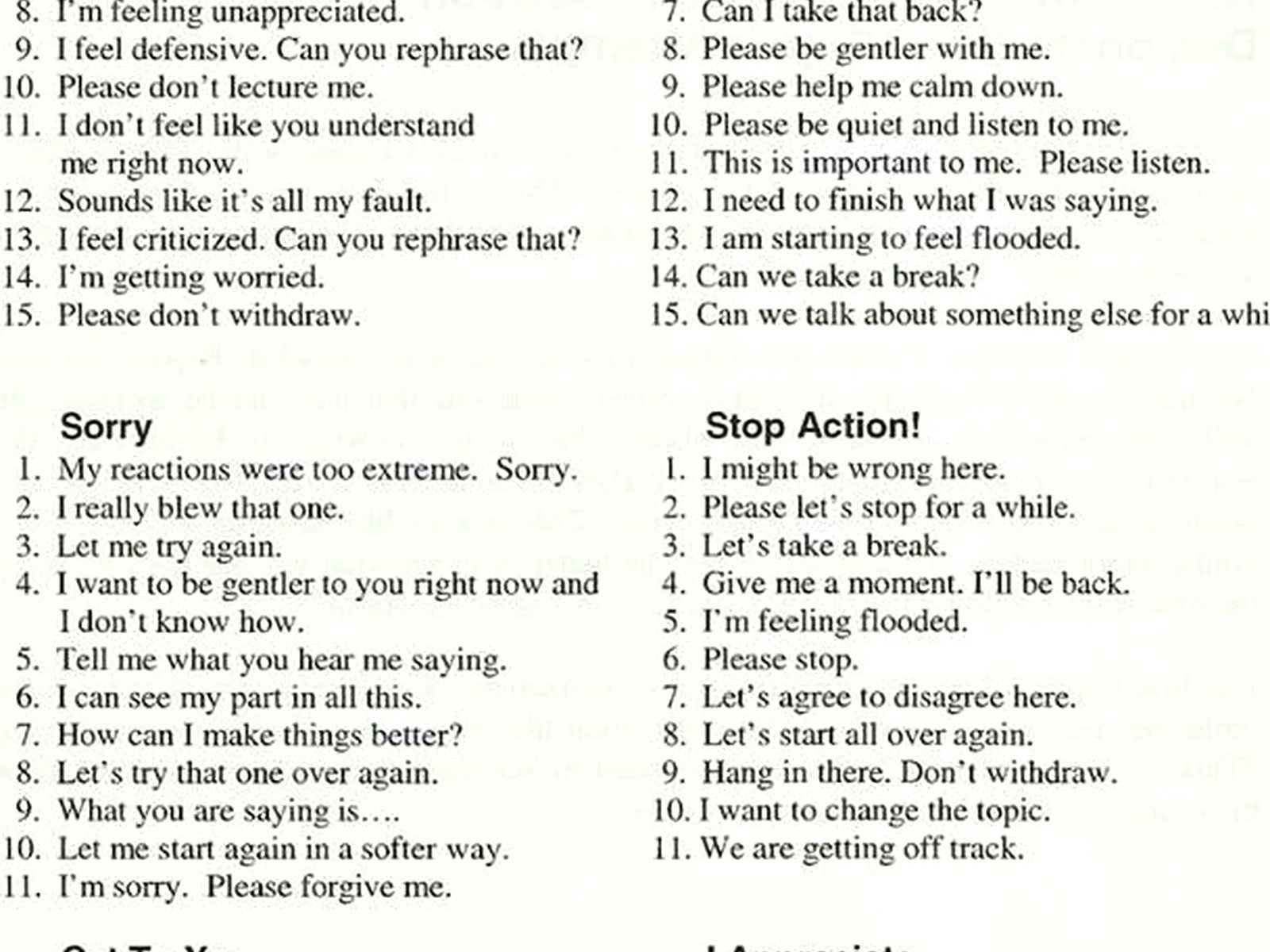
Emotional Needs Assessment
These worksheets help couples identify what they actually need from each other, which sounds obvious until you realize most people have never articulated this clearly. They know what annoys them, but the underlying need? That’s harder.
A typical emotional needs worksheet lists common relationship needs—affection, validation, autonomy, security, fun, intellectual connection, etc.—and asks each partner to rank them or rate their current satisfaction level for each need.
Then there’s usually a section for: “How do you know when this need is being met?” Because “I need more affection” doesn’t mean anything actionable. But “I feel cared for when you text me during the day just to check in” or “I feel connected when we cook dinner together without phones” gives your partner something concrete.
What trips people up is they’ll identify a need but then describe how they want it met in a way that’s actually about controlling their partner’s behavior. “I need security, which means you need to stop talking to your ex entirely” is not a need, it’s a demand rooted in anxiety—or, I mean, it might be a reasonable boundary depending on the situation, but it’s not the same as identifying an emotional need.
Attachment Style Worksheets
These help couples understand their attachment patterns and how those patterns create friction. Anxious attachment, avoidant attachment, secure attachment—this framework is everywhere now, sometimes to the point where people use it as an excuse rather than insight, but that’s a different rant.
A good attachment worksheet will:
- Help each person identify their dominant attachment style through specific behavioral examples
- Map out how their style shows up under stress
- Identify their partner’s attachment cues and what they mean
- Suggest specific communication adjustments based on the pairing
For example, if you’re anxiously attached and your partner is avoidant, the worksheet might highlight that your need for reassurance can trigger their need for space, which then triggers more anxiety in you, and you’re off to the races in a pursue-withdraw cycle. Just naming that pattern can interrupt it.
The worksheets that include a section on “earned security”—how to move toward more secure attachment through intentional behavior—are more useful than the ones that just categorize you and stop there.
Intimacy and Connection Builders
These aren’t about sex specifically, though some include sexual intimacy. They’re about emotional closeness, shared experiences, and maintaining friendship within the relationship.
The “Love Map” worksheet from Gottman’s work is probably the most well-known. It’s essentially a quiz about how well you know your partner—their current stresses, dreams, friends, preferences. Couples who’ve been together for years sometimes bomb this because they’re operating on outdated information. Your partner’s biggest worry five years ago might not be their biggest worry now.
Other worksheets in this category include:
- Shared goals and values alignment exercises
- Gratitude or appreciation prompts (write three specific things your partner did this week that you appreciated)
- Ritual creation worksheets that help couples design small regular connection points
- Adventure or novelty planning—because the research is pretty clear that novel experiences together strengthen bonds
I’m always skeptical of the ones that feel too much like forced fun, you know? Like “plan a surprise date night using these prompts!” when the couple can barely get through dinner without fighting. You gotta address the communication breakdown first.
How to Actually Use These Worksheets
Most couples fail with worksheets because they treat them like homework they can skip or do half-heartedly. Or they fill them out and never discuss them. Or one partner does them earnestly while the other scribbles nonsense just to get it over with.
The worksheet is not the intervention. The conversation that happens because of the worksheet is the intervention.
Some practical guidelines that actually help:
Set a specific time to complete worksheets together or separately depending on the exercise. Not “whenever we get around to it” because you won’t get around to it. Pick a time when you’re not already in conflict—doing a communication worksheet in the middle of a fight is like trying to learn to swim while drowning.
If you’re working with a therapist, bring completed worksheets to sessions. They’re designed to generate material for therapy, not replace it. Your therapist can help you process what came up, identify patterns you might have missed, and troubleshoot where you got stuck.
If you’re using these without a therapist, build in time to share and discuss after you’ve both completed them. This is not optional. Filling out a worksheet about your feelings and then shoving it in a drawer is just expensive journaling.
Common Pitfalls
Using worksheets as evidence in an argument. “See, you wrote right here that you’d work on this and you haven’t!” is not the point. The worksheet is a snapshot of awareness in a moment, not a binding contract.
Treating the worksheet categories as the problem. If a worksheet asks about trust issues and you don’t think you have trust issues, don’t force it. Not every framework applies to every relationship. Though sometimes resistance to a particular question is worth examining—why does that one make you defensive?
Expecting immediate change. You can identify a communication pattern on a worksheet and still fall right back into it the next day because you’ve been practicing that pattern for years. Awareness is step one, not the finish line.
Filling them out to please your therapist or partner rather than engaging honestly. If you’re just writing what you think you’re supposed to write, you’re wasting everyone’s time including your own.
Where to Find Quality Worksheets
The Gottman Institute has a bunch of free and paid resources based on decades of research. Therapist Aid has a large free collection organized by topic. Psychology Today has worksheets though the quality varies wildly. Your actual therapist might create custom worksheets tailored to your specific issues, which is often more useful than generic ones.
Watch out for worksheets that are basically just trauma dumping prompts with no structure for what to do with the information afterward, or ones that assume a level of emotional regulation that people in distressed relationships don’t have yet. If a worksheet asks you to “explore your deepest fears about abandonment” with no guidance on how to manage what comes up, that’s not helpful, that’s potentially destabilizing.
The best worksheets include psychoeducation—they teach you something about relationships or communication while you’re filling them out, not just extract information from you. They explain why you’re being asked a particular question and what the research says about that dynamic.