
Mental Health, Therapy resources
Free Depression Therapy – Everything You Need to Know

Jul
What Free Depression Therapy Actually Means
Free depression therapy isn’t one thing. It’s a bunch of different options that don’t require payment upfront, though the “free” part comes with asterisks depending on where you live and what resources you qualify for. Some programs are genuinely no-cost, others operate on sliding scales that might bottom out at zero for certain income brackets, and some are free trials that’ll hit you with a paywall after a few sessions.
I remember back in 2019, I was helping a friend navigate their options after they lost their job and insurance simultaneously, and we spent like three hours on the phone going through every community mental health center website in their area. Half of them had “free services” listed but when you called, it turned out they meant “free initial consultation” or “free if you qualify for Medicaid.” The terminology is kinda all over the place.
The main categories you’re looking at: community mental health centers, nonprofit organizations, training clinics at universities, support groups, crisis lines, some telehealth platforms with limited free tiers, and occasionally private practices that reserve a few pro bono slots.
Community Mental Health Centers
These are funded through a mix of federal, state, and local money, and they’re required to see anyone regardless of ability to pay. You‘ll find them in most cities and many rural areas, though coverage is definitely patchy in some states. They use a sliding fee scale based on your income, and if you’re below a certain threshold, your cost drops to zero.
The catch is wait times. I’ve seen people wait two months for an intake appointment, then another month before they actually start therapy. If you’re in crisis, that’s obviously not gonna work, but for ongoing depression treatment, it’s a viable path. The therapists are usually licensed professionals, often LCSWs or LPCs, sometimes psychologists.
You typically need to bring proof of income, residency, and sometimes a government ID. The intake process involves paperwork—so much paperwork—and an assessment to determine what level of care you need. Some centers offer individual therapy, group therapy, medication management, and case management all under one roof.

What the Experience Actually Looks Like
You’re not gonna get the boutique therapy experience with the fiddle leaf fig in the corner and the white noise machine. These are often busy, institutional settings. Your therapist might have a caseload of 40+ clients. Sessions are usually 45-50 minutes, sometimes every other week instead of weekly depending on demand and your assessed need level.
But here’s the thing that genuinely annoys me: people write off community mental health centers like they’re automatically lower quality, and that’s just not accurate. I’ve met therapists in these settings who are more skilled and dedicated than some folks charging $250 per session in private practice. The system is strained, yes, but the care itself can be excellent.
University Training Clinics
If you live near a university with a psychology or counseling program, their training clinic might offer free or very low-cost therapy. Graduate students provide the therapy under supervision from licensed faculty members. Every session is reviewed, students are being actively taught and corrected, and there’s usually more attention to treatment planning than you’d get in some other settings.
The students are further along in their training than you might think—usually in their second or third year of a master’s or doctoral program. They’ve completed coursework, they’re studying evidence-based treatments, and they’re being supervised by people who actually know what they’re doing. My cat knocked over my coffee while I was researching this section and I lost like two paragraphs, but anyway—
The downside is continuity. Students graduate, they complete their required hours, they move to different placements. You might see someone for six months and then need to transition to a new therapist. For some people with depression, especially if attachment and abandonment are part of your stuff, this can be rough.
Wait lists here can also be long, and many training clinics prioritize clients who present good “learning opportunities,” which is a weird way of saying they want cases that will teach their students something. Straightforward depression usually qualifies, but if you have a very complex presentation or need highly specialized treatment, you might not be the best fit.
Online Options and Apps
There are platforms like 7 Cups that offer free emotional support from trained listeners—not therapists, but people who’ve completed training in active listening. It’s text-based, it’s available 24/7, and it’s completely free. You can also pay for actual licensed therapy through their platform, but the listener support doesn’t cost anything.
Then there’s stuff like TalkSpace or BetterHelp that occasionally run promotions or offer limited free trials, but I’m gonna be honest, these aren’t really “free depression therapy” in any meaningful sense. You might get one free week, and then you’re looking at subscription costs that aren’t that different from copays with insurance.
Some apps offer CBT-based tools and exercises at no cost. MoodGYM, for example, is a completely free online program based on cognitive behavioral therapy principles. It’s self-guided, which means you’re doing the work without a therapist, but the modules are based on actual evidence-based treatment for depression.
The Self-Guided Problem
Self-guided programs work for some people, particularly if your depression is mild to moderate and you’re pretty good at self-motivation. But depression literally saps your motivation, so telling someone with depression to work through a self-guided program is like… I don’t know, it’s sort of asking someone with a broken leg to walk to the orthopedist. Some can do it, many can’t.
I spent summer of 2021 reviewing like fifteen different mental health apps for a platform I was writing for, and honestly most of them were either too simplistic to be helpful or so complicated that you needed a manual to figure out the interface. The free versions were usually stripped down to the point of being nearly useless, just teasers to get you to upgrade.
Support Groups
Depression and Bipolar Support Alliance (DBSA) runs free peer support groups all over the country. These aren’t therapy groups led by professionals—they’re peer-led, meaning people with lived experience of depression facilitate discussions and provide mutual support.
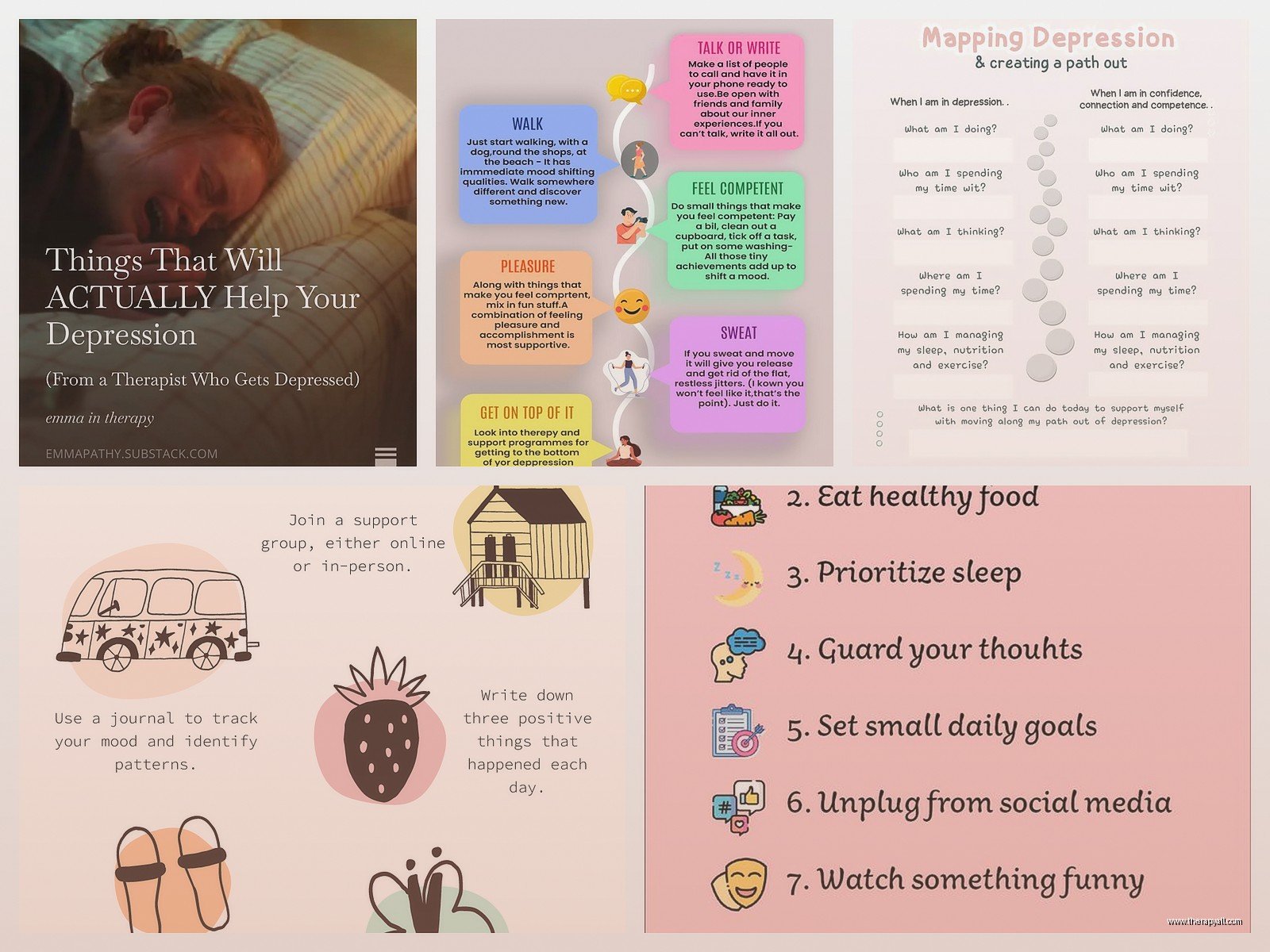
NAMI also offers free support groups, both for people experiencing mental health conditions and for family members. The Depression and Anxiety Support Group (DASG) model is another option in some areas.
Support groups aren’t therapy. I need to be clear about that because there’s this misconception that shows up in like every badly researched article about mental health resources, where people conflate peer support with professional treatment. They serve different functions. A support group can reduce isolation, provide coping strategies from people who get it, and create accountability. It cannot diagnose, it cannot provide clinical treatment for severe depression, and it shouldn’t replace professional care when professional care is needed.
That said, for ongoing maintenance, for connection, for that feeling of not being alone in this, support groups are valuable. And they’re actually free, not “free with conditions” or “free for now.”
Crisis Services
Crisis lines like 988 (the Suicide and Crisis Lifeline) are free, 24/7, and available to anyone. You don’t need to be actively suicidal to call—despite the name, they help with any mental health crisis, including severe depression episodes.
Crisis Text Line (text HOME to 741741) connects you with a trained crisis counselor via text. Again, completely free, no insurance needed, no income verification, nothing.
These are short-term interventions. You’re not gonna get ongoing therapy through a crisis line, but you can get immediate support, safety planning, and referrals to longer-term resources in your area.
Nonprofit and Faith-Based Organizations
Some nonprofits offer free counseling services, though availability varies wildly by location. Organizations like Open Path Collective aren’t technically free—they charge $30-$80 per session—but they maintain a network of therapists who’ve committed to seeing clients at significantly reduced rates.
Faith-based counseling through churches, mosques, synagogues, or other religious organizations is sometimes free for members or community residents. The counselors might be pastoral counselors, which is different from licensed mental health professionals. Some have dual training, some don’t. If the religious framework aligns with your beliefs, this can be helpful. If it doesn’t, or if you’re looking for secular treatment, it’s probably not the right fit.
Pro Bono Therapy
Some therapists in private practice reserve a few slots for pro bono clients. There’s no centralized database of who’s doing this—you kinda have to ask around. Call practices, explain your situation, ask if they have any pro bono availability or if they know colleagues who do.
Professional organizations sometimes maintain referral lists. The American Psychological Association, NASW (National Association of Social Workers), and state-level licensing boards occasionally have resources for finding reduced-fee or pro bono services, though these lists are often outdated or incomplete because therapists’ availability changes constantly.
Insurance-Based Options That Might Feel Free
If you have Medicaid, therapy is typically covered with no copay in most states. If you don’t have insurance but qualify based on income, applying for Medicaid might be your best route to accessing free therapy. The Affordable Care Act expanded Medicaid eligibility in many states, though not all states accepted the expansion, so this is geography-dependent.
Some employers offer Employee Assistance Programs (EAPs) that include a limited number of free therapy sessions—usually 3-8 sessions per issue per year. It’s not long-term treatment, but it’s something, and it’s actually free if you have access through your job.
What You Should Know Before Starting
Free or low-cost therapy often comes with less flexibility in terms of scheduling and therapist selection. You might not get to choose your therapist, you might not get evening or weekend appointments, and you might need to see whoever has availability rather than someone who specializes in your specific concerns.
Intake processes can be lengthy and invasive. You’ll answer questions about income, living situation, mental health history, sometimes trauma history before you’ve even met your therapist. It’s necessary for determining eligibility and appropriate level of care, but it can feel like a lot when you’re already struggling.
Confidentiality protections apply the same way they do in private practice, with the same exceptions: harm to self, harm to others, abuse of children or vulnerable adults. Free doesn’t mean less private.
The quality of care you receive isn’t determined by what you pay. I’ve seen this from both sides—as someone who’s worked in training clinics and community settings, and as someone who’s helped dozens of people navigate these systems. Some of the best therapeutic work happens in free or low-cost settings because therapists who choose those environments often do so out of commitment to access and equity, not because they couldn’t get hired elsewhere.
Practical Steps to Access Free Depression Therapy
Start by calling 211 if you’re in the US. It’s a hotline that connects you with local social services, including mental health resources. Tell them you’re looking for free or low-cost depression therapy and they’ll provide referrals specific to your area.
Search for “community mental health center” plus your county or city name. Call them directly, ask about their sliding scale, ask about wait times for intake.
If there’s a university nearby with a psychology or counseling program, search for their training clinic or “psychology clinic” on the university website. Call and ask about eligibility and availability.
Check SAMHSA’s treatment locator online—it’s a searchable database of mental health and substance use treatment facilities, many of which offer sliding scale or free services.
Ask your primary care doctor if you have one. They often know about local resources and can provide referrals. Some primary care offices even have behavioral health consultants on staff who can see you for brief therapy at no additional cost beyond your regular office visit.
Document everything. When you call places, write down who you spoke with, what they told you, what the next steps are. These systems are complicated and you’ll forget details, especially when depression is already affecting your memory and concentration.
ADHD & Neurodiversity
Life Planner Bundle – Life Organizer
Self-Care & Personal Growth
Acceptance And Commitment
Anxiety & Stress
Stress Processing Journal & Reflection Worksheets For Daily Self – Care
Self-Care & Personal Growth
Self – Reflection Guided Journal With Guided Prompts 30
Emotional Wellness
Decision Processing – Thought Processing Journal For Daily Self – Care
Therapist Resources
Physiotherapist Journal PDF Planner Tracker Or Log Book
Self-Care & Personal Growth
Customizable Self – Confidence & Self – Esteem Guided Journal
ADHD & Neurodiversity
ADHD Behavior Tracker PDF Planner Tracker Or Log Book